Jump to Content
Artificial Insemination Market Size & Industry Share - Growth Trends & Forecasts (2026 - 2034)
Artificial Insemination Market Size:
The Artificial Insemination market size was valued at 2.89 (US$B) in 2025 and is projected to grow from 3.13 (US$B) in 2026 to 6.06 (US$B) by 2034, at a CAGR of 8.6% from 2026 to 2034, according to a recent report from Consegic Business Intelligence.
Artificial Insemination Market Scope & Overview:
The artificial insemination (AI) is a reproductive technology which involves the process of directly inserting sperm into a woman's reproductive tract to assist in conception, bypassing natural mating. Also, the process is majorly adopted in livestock for rapid genetic improvement as well as in human fertility treatments for infertility issues such as low sperm count is driving the artificial insemination market demand. Moreover, the treatment methods include intrauterine insemination (IUI), intracervical insemination (ICI), and intratubal insemination (ITI), which caters to specific fertility challenges. Further, the key features such as enhanced control, minimized handling of gametes and improved success rates are boosting the artificial insemination market growth. Furthermore, the application spans across livestock breeding, fertility clinics and others.
How is AI Impacting the Artificial Insemination Market?
AI is transforming the artificial insemination treatment for both humans and livestock by optimizing processes, improving success rates, along with personalized treatments. Also, AI algorithms have the ability to analyze vast datasets to select superior sperm, which safeguards faster genetic progress for characteristics such as high milk yield and disease resistance. Additionally, AI helps in predictive modelling for embryo selection and workflow automation which in turn leads to better outcomes, reduced errors, and increased efficiency. Further, AI has the ability to monitor herd health, predict reproductive issues, as well as optimize breeding cycles, which in turn helps in reducing calving intervals and costs.

Artificial Insemination Market Dynamics - (DRO) :
Key Drivers:
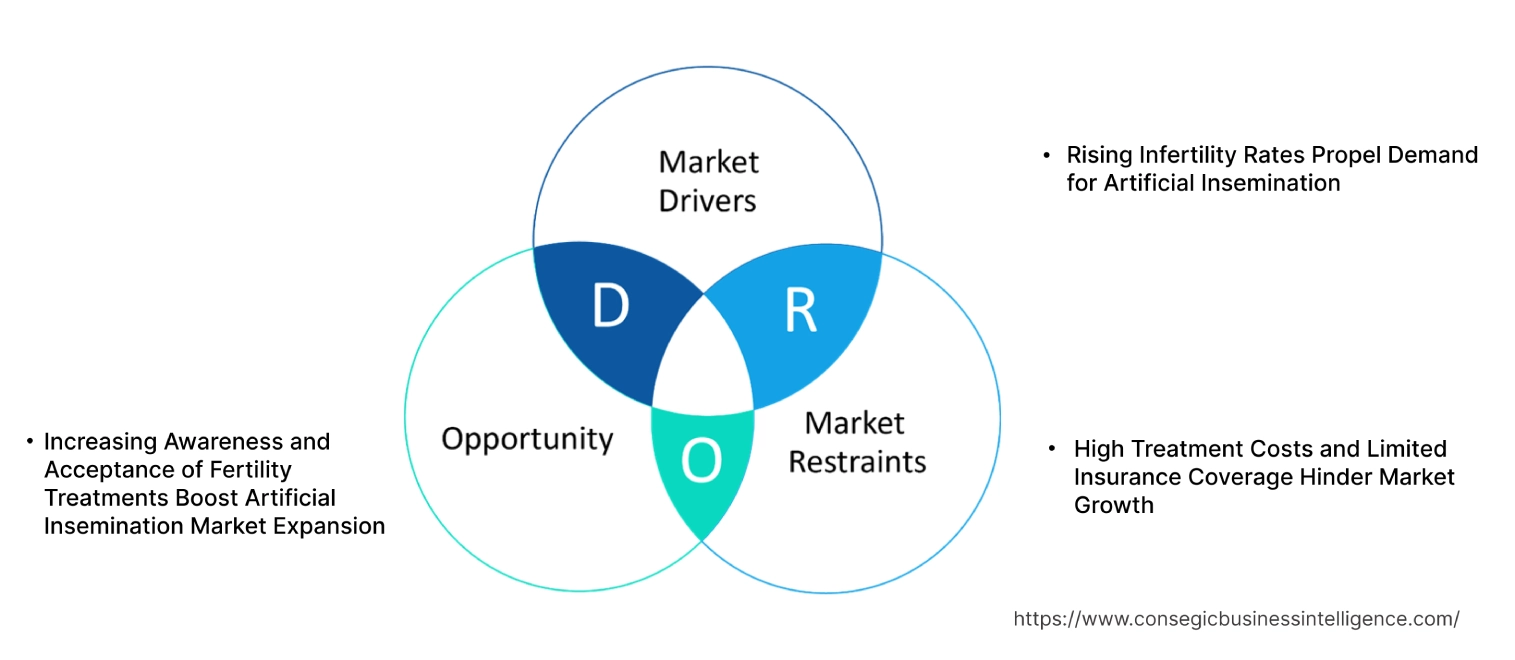
Surging global infertility rates is boosting market growth for artificial insemination
The significant portion of the adult population worldwide faces infertility which in turn is boosting the need for assisted reproductive technologies. Also, the rising number of medical conditions such as polycystic ovary syndrome (PCOS) and endometriosis is driving the artificial insemination market demand. Moreover, key factors such as delaying childbirth, stress, obesity, and exposure to pollutants are negatively impacting fertility. Further, the growing societal awareness of the benefits of assisted reproductive technologies is driving the artificial insemination market growth.
- For instance, in April 2023, according to the World Health Organization, approximately 17.5% of the adult populationexperiences infertility, which in turn fuels the need for affordable, high-quality fertility care.
Therefore, the rising rate of infertility is driving the adoption of assisted reproductive technologies, in turn, proliferating the growth of the market.
Key Restraints :
Low success rate and risk of prematurity are restraining the market growth
The success rate of assisted reproductive technologies is majorly dependent on factors such as age, multiple pregnancies and others which lead to multiple cycles and increasing costs, which in turn hinders the artificial insemination market expansion. Also, the potential discouragement due to continuing treatment, makes them hesitant to use these technologies. Moreover, the treatment increases the chance of having twins, triplets, or more, which leads to a major risk factor for preterm birth. Further, the combination of low success rates along with potential risks can lead to patient dissatisfaction and may discourage people from pursuing AI treatments.
Therefore, the low success rate and risk of prematurity are restraining the artificial insemination market expansion.
Future Opportunities :
Increasing focus on precision breeding in animals is expected to promote potential opportunities for market growth
The assisted reproductive technologies allow the widespread use of semen from elite males for rapidly spreading traits such as higher milk yield, disease resistance and others across herds, which in is paving the way for artificial insemination market opportunities. Also, it enables more targeted mating, better resource use, and faster genetic progress, crucial for intensive livestock farming. Further, the proliferation of government initiatives is propelling the market progress.
- For instance, in August 2025, according to PIB India, the Government of India is promoting Rashtriya Gokul Mission (RGM) since 2014, in which the government is promoting the utilization of AI services for the development and conservation of indigenous breeds, genetic upgradation of the bovine population and enhancement of milk production.
Hence, the rising adoption of precision breeding in animals is anticipated to increase the utilization of assisted reproductive technologies in turn promoting prospects for artificial insemination market opportunities during the forecast period.
Artificial Insemination Market Segmental Analysis :
By Type:
Based on the type, the market is segmented into intrauterine insemination (IUI), intracervical insemination (ICI), intravaginal insemination (IVI), and intratubal insemination.
Trends in the Type:
- The increasing number of delayed parenthoods is driving the need for intracervical insemination which in turn is boosting the artificial insemination market trends.
- The rising adoption of LGBTQ+ family planning is driving the need for intravaginal insemination which in turn is fueling the artificial insemination market trends.
The intrauterine insemination (IUI) accounted for the largest revenue share in the year 2024.
- Intrauterine Insemination (IUI) is a common fertility treatment where perfect sperm is placed directly into the uterus around ovulation to increase pregnancy chances, making it easier for sperm to reach the egg.
- Also, the intrauterine insemination treatment is widely adopted due to the higher success rates and less invasive nature which in turn is boosting the artificial insemination market share.
- Moreover, the treatment is mainly for couples dealing with mild male infertility, unexplained infertility, or cervical issues.
- Further, the process is cost-effective as compared to various techniques such as intracervical insemination (ICI), intravaginal insemination (IVI), and intratubal insemination which in turn is boosting the artificial insemination market size.
- Furthermore, the key factors such as reduced discomfort and relatively higher pregnancy rates contribute significantly to the artificial insemination industry.
- For instance, in January 2023, Posterity Health partnered with Path Fertility for the launch of IUI Assessment, which evaluates multiple semen parameters and predicts the success rate of IUI.
- Thus, as per the market analysis, the aforementioned factors are driving the adoption of intracervical insemination.
The intracervical insemination (ICI) is anticipated to register the fastest CAGR during the forecast period.
- The intracervical insemination is a simple fertility treatment where sperm is placed directly into the cervix with the help of a syringe or catheter
- Also, the key advantages include less invasive, cost-effective, improved sperm delivery, enhanced sperm quality and minimal discomfort among others are fueling the artificial insemination market share.
- Further, the key factors driving the adoption of intracervical insemination include rising infertility, technological advancement, and greater social acceptance are boosting the artificial insemination market size.
- Therefore, as per the market analysis, the aforementioned factors are anticipated to boost the market during the forecast period.
By Source:
Based on the source, the market is segmented into Artificial Insemination by Husband (AIH) and Artificial Insemination by Donor (AID).
Trends in the Source:
- The trend towards the proliferation of at-home kits and supportive government policies is driving the adoption of artificial insemination by donors.
- The trend towards delayed pregnancies and greater acceptance of fertility treatments industry globally is boosting the adoption of artificial insemination by husbands.
The artificial insemination by husband (AIH) accounted for the largest revenue share in the year 2024.
- The artificial insemination by husband (AIH) is a fertility treatment in which the husband's processed sperm is placed directly into the wife's uterus around ovulation to boost pregnancy chances.
- Also, the insemination by husband is preferred when the male partner has mild fertility issues, such as low sperm count and others, but the sperm quality is superior.
- Additionally, in the process, the sperm undertakes washing to improve its appearance before insemination which in turn is fueling the market progress.
- Further, the proliferation of moderate male infertility along with increasing familiarity of fertility treatment solutions, is driving the development of the industry.
- Thus, as per the market analysis, the rising awareness of fertility treatment and increasing prevalence of moderate male infertility are driving the adoption of artificial insemination by husband.
The artificial insemination by donor (AID) is anticipated to register the fastest CAGR during the forecast period.
- The artificial insemination by donor is a process where sperm from a donor which is anonymous is used to fertilize a woman's egg, bypassing the need for sperm from a partner.
- Also, the key advantages such as reduced genetic risks, trait selection option, less invasive, cost-effective, bypasses cervical issues and others are driving the adoption of artificial insemination by donor.
- Further, the rising adoption of artificial insemination by donor by LGBTQ+ couples and individuals opting for single parenthood is driving the market development.
- Furthermore, the increasing availability of advancements in cryopreservation technology and sperm banks along with rising social acceptance of donor insemination, is paving the way for market adoption.
- Therefore, as per the artificial insemination market analysis, the aforementioned factors are anticipated to boost the market during the forecast period.
By End-User:
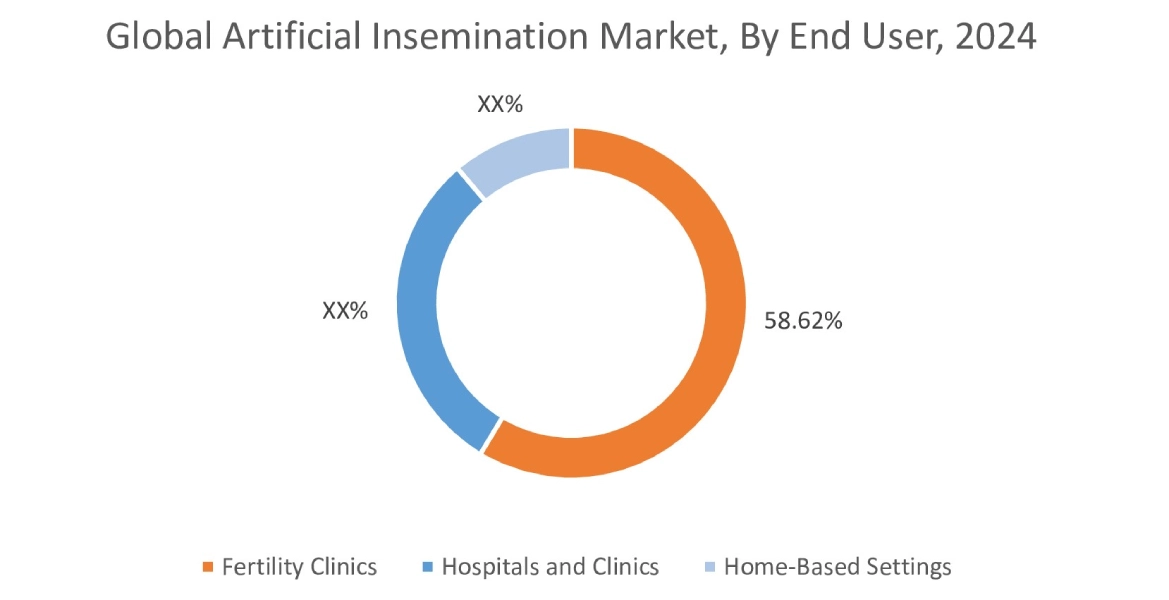
Based on the end user, the market is segmented into fertility clinics, hospitals and clinics, and home-based settings.
Trends in the End User:
- The trend towards increased investment in fertility infrastructure by hospitals and clinics is boosting the market progress.
- The trend towards rising need for privacy, lower costs, and convenience is driving the adoption of home-based settings, which in turn is fueling the market progress.
The fertility clinics accounted for the largest revenue share of 58.62% in the year 2024.
- The fertility clinics are the most significant end-users of assisted reproductive technologies, offering specialized reproductive services and tailored treatment plans.
- Also, the clinics offer advanced technologies such as intrauterine insemination (IUI) and intracervical insemination (ICI), catering to diverse patient requirements.
- Further, the clinics are expanding their services, adopting newer techniques, and investing in state-of-the-art equipment to improve the success rate is driving the market progress.
- Furthermore, the rising availability of diverse fertility clinics offering personalized care for couples and individuals seeking reproductive assistance is driving the market progress.
- Thus, as per the market analysis, the aforementioned factors are driving the market progress of fertility clinics.
The hospitals and clinics is anticipated to register the fastest CAGR during the forecast period.
- The hospitals and clinics are increasingly integrating insemination procedures into their broader reproductive health services.
- Also, hospitals and clinics have the ability to cater to a wide range of patients, including those with complex medical histories that may impact fertility.
- Moreover, they have specialized departments for reproductive health with trained staff capable of handling various insemination procedures such as IUI and ICI, which in turn is driving the market adoption.
- Further, the hospitals are well-equipped for managing rising infertility treatments by implementing specialized programs, and collaborating with fertility experts for enhancing patient care is driving the market growth.
- Therefore, as per the artificial insemination market analysis, the aforementioned factors are anticipated to boost the market during the forecast period.
Regional Analysis:
The regions covered are North America, Europe, Asia Pacific, Middle East and Africa, and Latin America.
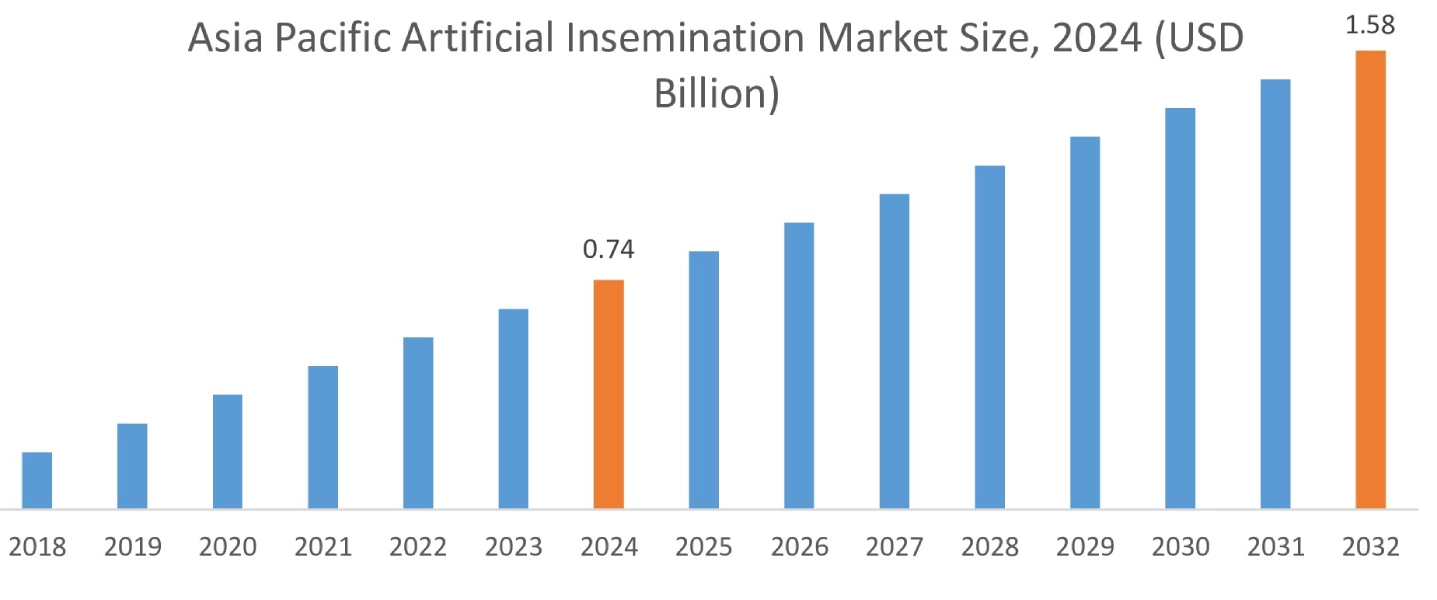
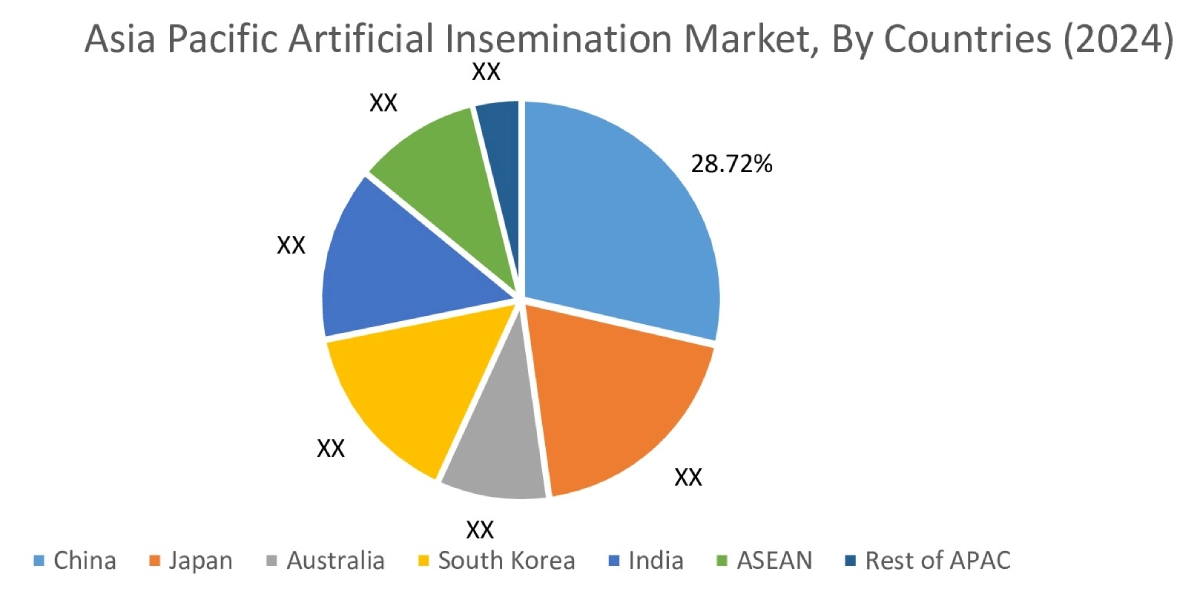
Asia Pacific region was valued at USD 0.74 Billion in 2024. Moreover, it is projected to grow by USD 0.80 Billion in 2025 and reach over USD 1.58 Billion by 2032. Out of this, China accounted for the maximum revenue share of 28.72%. The market progress is mainly driven by rising societal acceptance of fertility treatments. Furthermore, factors including the shifting consumer acceptance and supportive government policies are projected to drive the market progress in Asia Pacific region during the forecast period.
- For instance, in March 2025, according to PIB India, Government of India is promoting Rashtriya Gokul Mission with a budget of USD 34 billion which in turn is proliferating the promotion of free AI at farmers' doorsteps. The scheme has helped to increase milk production along with farmers' income.
North America is estimated to reach over USD 1.78 Billion by 2032 from a value of USD 0.85 Billion in 2024 and is projected to grow by USD 0.92 Billion in 2025. The North American region's growing trend towards delayed parenthood for careers offer lucrative growth prospects for the market. Additionally, the advancement in reproductive technology, better healthcare infrastructure, and growing demand for high-quality livestock are driving the market progress.
- For instance, in March 2024, Alife Health partnered with Boston IVF for the launch of AI tool for IVF medication optimization across the U.S. Also, the partnership aims to advance the field of reproductive medicine and reduce overall medication costs.
The regional analysis depicts that the growing awareness among consumers about assisted reproduction is driving the market in Europe. Additionally, the key factor driving the market is the rising demand for dairy/protein demand as well as strong government support for agriculture and food security is propelling the market adoption in the Middle East and African region. Further, the increasing health consciousness and a rising need for improving milk yield, meat quality, and disease resistance in livestock is paving the way for the progress of the market in Latin America region.
Top Key Players & Market Share Insights:
The global artificial insemination market is highly competitive with major players providing solution to the national and international markets. Key players are adopting several strategies in research and development (R&D), product innovation, and end user launches to hold a strong position in the artificial insemination industry. Key players in the artificial insemination market include-
- Vitrolife(Sweden)
- Nexpring Health(Denmark)
- Genea Ltd.(Australia)
- Pride Angel Ltd. (United Kingdom)
- Rocket Medical plc (United Kingdom)
- Conceivex, Inc. (United States)
- Hamilton Thorne, Inc. (United States)
- Kitazato Corporation (Japan)
- Biogenics Inc. (United States)
- Surelife Pte Ltd. (Singapore)
Artificial Insemination Market Report Insights :
| Report Attributes | Report Details |
| Study Timeline | 2021-2034 |
| Market Size in 2034 | USD 6.06 Billion |
| CAGR (2026-2034) | 8.60% |
| Base Year | 2025 |
| By Type |
|
| By Source |
|
| By End User |
|
| By Region |
|
| Key Players |
|
| North America | U.S. Canada Mexico |
| Europe | U.K. Germany France Spain Italy Russia Benelux Rest of Europe |
| APAC | China South Korea Japan India Australia ASEAN Rest of Asia-Pacific |
| Middle East and Africa | GCC Turkey South Africa Rest of MEA |
| LATAM | Brazil Argentina Chile Rest of LATAM |
| Report Coverage |
|
Key Questions Answered in the Report
How big is the artificial insemination market? −
The artificial insemination market size is estimated to reach over USD 5.14 Billion by 2032 from a value of USD 2.45 Billion in 2024 and is projected to grow by USD 2.66 Billion in 2025, growing at a CAGR of 8.6% from 2025 to 2032.
Which segmentation details are covered in the artificial insemination report? +
The artificial insemination report includes specific segmentation details for type, source, end user, and regions.
Which is the fastest segment anticipated to impact the market growth? +
In the artificial insemination market, the artificial insemination by doner is the fastest-growing segment during the forecast period due to increasing availability of advancements in cryopreservation technology and sperm banks along with rising social acceptance of donor insemination.
Who are the major players in the artificial insemination market? +
The key participants in the artificial insemination market are Vitrolife (Sweden), Nexpring Health (Denmark), Genea Ltd. (Australia), Pride Angel Ltd. (United Kingdom), Rocket Medical plc (United Kingdom), Conceivex, Inc. (United States), Hamilton Thorne, Inc. (United States), Kitazato Corporation (Japan), Biogenics Inc. (United States), Surelife Pte Ltd. (Singapore), and others.
What are the key trends in the artificial insemination market? +
The artificial insemination market is being shaped by several key trends including delayed pregnancies and greater acceptance of fertility treatments globally and proliferation of at-home kits, and supportive government policies are the key trends driving the market.
Overview
Reputation & Certifications


Our Services
- Market Intelligence & Forecasting
- Custom Research Solutions
- Market Entry Strategy
- Competitive Intelligence
- Customer Insights
- Industry Innovation Analysis
- Investment Advisory