Jump to Content
Bamboo Charcoal Market - Size, Share, Industry Trends, and Forecasts (2025-2032)
Bamboo Charcoal Market Size:
The Bamboo Charcoal Market size is growing with a CAGR of 7.5% during the forecast period (2025-2032), and the market is projected to be valued at USD 237.22 Million by 2032 from USD 133.45 Million in 2024. Additionally, the market value for 2025 is attributed to USD 142.99 Million.
Bamboo Charcoal Market Scope & Overview:
Bamboo charcoal is derived from bamboo plants through a process known as pyrolysis. This involves heating bamboo with limited oxygen, preventing complete combustion and resulting in charcoal. The product that is obtained has a high porous structure. This structure leads to a vast surface area. This high porosity acts as a key factor to its ability to absorb and adsorb various substances. This makes them a very effective product to be utilized across a range of applications. These applications include water and air purification, skincare, amongst others. Furthermore, it also acts as a sustainable option due to the renewability of bamboo. This makes it an environmentally friendly alternative to traditional charcoal. Its combination of unique properties and sustainable sourcing contributes to its growing popularity in various industries and consumer products.
How is AI Transforming the Bamboo Charcoal Market?
The integration of AI is considerably transforming the bamboo charcoal market, mainly in areas such as optimizing production, enhancing product quality, and improving supply chain management. AI-powered systems can analyze data from various stages of production, such as bamboo harvesting, charring temperatures, and activation methods, to identify optimum parameters for higher quality and yield.
Additionally, AI-powered image recognition and sensor technologies can be used to sort bamboo based on quality and monitor charcoal kilns for optimal carbonization. Further, by optimizing production processes, AI helps in reducing waste, lowering energy consumption, and improving the overall efficiency of bamboo charcoal production. Consequently, the above factors are anticipated to drive the market growth in upcoming years.

Bamboo Charcoal Market Dynamics - (DRO) :
Key Drivers:
Abundant Bamboo Supply is Leading to a Growing Demand for Bamboo Charcoal is Driving Market Growth
Bamboo is a fast-growing and renewable resource. It provides a sustainable and consistent feedstock for charcoal production. This abundance ensures a reliable supply chain and also promotes investment within the bamboo charcoal market expansion.
For instance,
- In 2024, according to Global Forest Resource Assessment report, around 35 million ha resources of bamboo are available across the world with roughly more than 705 of these found in Asia.
As there is easy access to raw materials, it leads to lower production costs. This makes charcoal derived from bamboo a more economically viable option. Therefore, the high bamboo supply is driving market adoption across various sectors.
Increasing Demand for Water Treatment Applications is Contributing to Bamboo Charcoal Market Expansion.
Charcoal derived from bamboo has unique porous structure which helps it to efficiently adsorb a wide range of impurities, and pollutants, amongst others. This makes it a highly valuable component in various water filtration systems. This expands from small-scale household filters to larger-scale industrial water treatment facilities.
- For instance, according to FAO, a plant of an improved biological bamboo charcoal wastewater treatment system with a daily treatment capacity of 10,000 tons attributes to a cost of USD 50, 000, contributing to roughly 75% less price compared to traditional water treatment facility.
Moreover, there is a focus of key players on continuous research and development efforts, leading to advancements in bamboo charcoal-based water filtration technologies. These aforementioned factors are contributing to market growth.

Key Restraints:
Competition from Alternative Products Hinder Bamboo Charcoal Market Growth.
Several materials offer similar functionalities, creating a competitive landscape that hinders the adoption of charcoal derived from bamboo. Activated carbon, derived from various sources like coal and coconut shells, apart from bamboo, are acting as an alternative to the market. Similarly, other filtration materials, such as ceramic filters, reverse osmosis membranes, and others offer performance in specific applications. These alternatives often benefit from established supply chains, economies of scale make them readily available and sometimes more cost-effective.
This competitive pressure has led to a negative impact on the potential of the market. Hence, the aforementioned factors are restraining bamboo charcoal market growth.
Future Opportunities :
Increasing adoption of Charcoal Derived from Bamboo in Composite Films to Create Bamboo Charcoal Market Opportunities.
The increasing incorporation of charcoal derived from bamboo into composite films presents a significant prospect for the market. The inclusion of charcoal made from bamboo improves key characteristics of PLA films. A few of these characteristics include their strength and flexibility, amongst others.
- For instance, in 2024, according to Science Direct, charcoal made from bamboo was introduced in composite film to regulate the microstructure as well as flame-retardant properties creating potential for this charcoal in composite films
Additionally, as the market for bioplastics and sustainable packaging continues to grow, the need for bamboo charcoal-infused PLA films is expected to grow as well.
Bamboo Charcoal Market Segmental Analysis :
By Product Type:
Based on Product Type, the market is categorized into powder, bags, tablets, activated charcoal bamboo, and others.
Trends in Product Type:
- The inclusion of activated form in skincare, and pharmaceuticals is expected to drive the market.
The activated charcoal bamboo segment accounted for the largest bamboo charcoal market share in 2024 and is expected to be the fastest growing segment over the forecast period.
- The activated form is dominant due to the significant enhancement of charcoal's properties through the activation process.
- Activation process increases the material's porosity and surface area. This results in superior performance in key applications.
- For instance, according to Agico Cement, roughly 33% of the of bamboo charcoal is utilized for the production of bamboo-activated charcoal.
- Its enhanced absorption makes it a popular ingredient in skincare products, where it effectively draws out toxins and excess oils.
- Furthermore, a few individuals use activated form for its potential to aid in detoxification.
- As per the analysis, based on the above-mentioned factors, the activated charcoal bamboo-segment dominates the bamboo charcoal market demand as well as expected to grow as the fastest CAGR over the forecast period.
By Application:
The application segment is categorized into food and beverage processing, personal care and cosmetics formulations, home appliances, agricultural applications, water treatment, and others.
Trends in the Application:
- Charcoal derived from bamboo has the ability to absorb impurities and its benefits for skin health are driving the segment in market.
- Increasing usage of this charcoal to improve water retention as a soil amendment is expected to create lucrative opportunities.
The water treatment segments accounted for the largest share in bamboo charcoal market in 2024.
- The water treatment segment holds a dominant position due to the need for accessible and sustainable solutions to water purification challenges.
- Access to safe drinking water remains a stringent factor for a lot of economies worldwide. Charcoal derived from bamboo has emerged as a product to address these needs. It offers a natural and effective way to remove impurities and pollutants from water sources.
- Moreover, key players focus on environmental consciousness has led to the increase in adoption rate of this charcoal presents a sustainable alternative to many conventional water treatment methods.
- Thus, as per the bamboo charcoal market analysis, due to the above-mentioned factors, the water treatment segment is dominating the Bamboo Charcoal market trends.
The personal care and cosmetics formulation segment is expected to be the fastest growing segment over the forecast period.
- One of the key factors is the increasing consumer need for natural and sustainable ingredients in personal care and cosmetic products.
- Bamboo charcoal, derived from a renewable resource with purifying qualities, aligns with this trend.
- Furthermore, it has the ability to absorb impurities, toxins, and excess oil from the skin makes it a highly popular ingredient in a wide array of skincare products.
- For instance, according to a study conducted by Brydie in 2022, activated charcoal peel derived from bamboo showed high performance in cleansing the skin by eliminating the dead skin.
- Therefore, as per analysis and trends, the personal care and cosmetics formulation segment is expected to be lucrative over the forecast period.
By End Use:
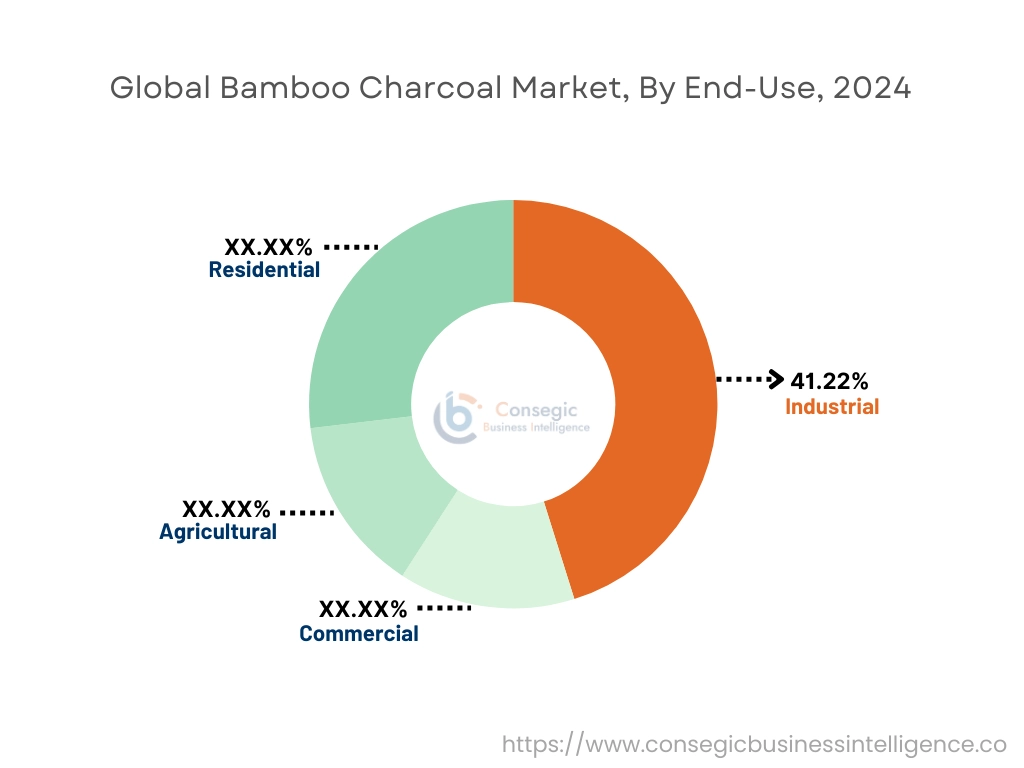
The End Use segment is categorized into Residential, Commercial, Industrial, And Agricultural.
Trends in the End Use:
- Strong demand for charcoal made from bamboo in home air purifiers, especially as concerns about indoor air quality rise.
- The hospitality industry is utilizing charcoal made from bamboo in amenities such as toiletries and room deodorizers to promote eco-friendly practices.
The Industrial segment accounted for the largest market share of 41.22% in 2024.
- Bamboo charcoal's versatility extends across a range of industrial processes. One key application is in wastewater treatment, where industries facing stringent environmental regulations leverage charcoal made from bamboo has adsorptive properties to remove pollutants and contaminants from their wastewater discharge.
- They are also utilized in air purification and filtration within industrial facilities. Clean air is essential for specific manufacturing processes as well as to safeguard the health of workers amongst others. They offer an effective way to remove harmful particles and gases from the air.
- Additionally, the increasing stringency of environmental regulations is driving the adoption of charcoal derived from bamboo within the industrial sector.
- Thus, as per the bamboo charcoal market analysis, due to the above-mentioned factors and trends, the industrial segment is dominating the Bamboo Charcoal market trends.
The agriculture segment is expected to be the fastest growing segment over the forecast period.
- Bamboo charcoal offers significant benefits for soil fertility. Its porous structure enhances soil aeration, water retention, and nutrient availability creating optimal conditions for plant development. This makes it a valuable soil amendment for improving overall soil health and boosting crop yields.
- It is derived from a renewable resource and reduces reliance on chemical fertilizers and pesticides leading to an increase in demand for organic and sustainable food production.
- Additionally, increasing awareness among farmers about the advantages of using charcoal made from bamboo as a soil amendment plays a vital role.
- For instance, according to a study conducted by ScienceDirect, the application of bamboo charcoal have showcased and improvement in the effective nutrient content of organic carbon and humus of soil.
- Therefore, as per analysis and trends, the agriculture segment is expected to be lucrative over the forecast period.
Regional Analysis:
The regional segment includes North America, Europe, Asia Pacific, the Middle East and Africa, and Latin America.
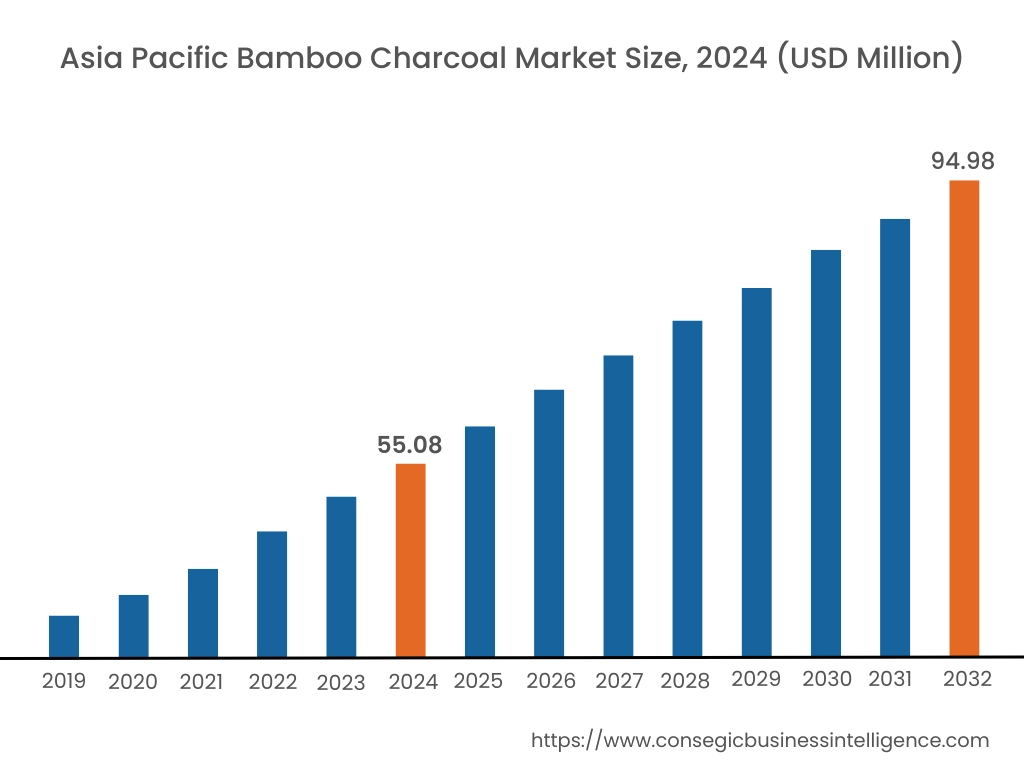
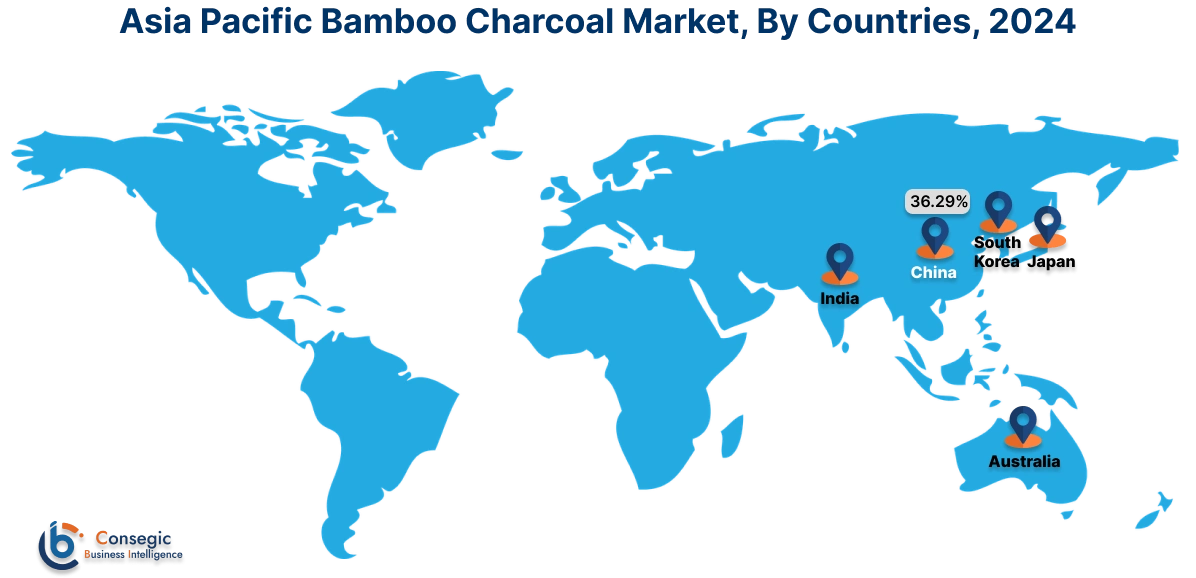
In 2024, Asia Pacific accounted for the highest bamboo charcoal market share at 41.28% and was valued at USD 55.08 Million and is expected to reach USD 94.98 Million in 2032. In Asia Pacific, China accounted for the market share of 36.29% during the base year of 2024. The Asia Pacific region boasts a rich and abundant supply of bamboo, making it a significant resource for charcoal production. This ready availability of raw material is essential for production, providing a cost-effective and readily accessible resource for manufacturers. The widespread growth of various bamboo species across the region, coupled with established cultivation and harvesting practices, ensures a consistent supply chain. Countries like China, India, Japan, Indonesia, and the Philippines are particularly known for their bamboo forests and production.
For instance,
- The article published by Invest India, 2021, states that India's annual bamboo production potential is estimated at 3.23 million tons.
Thus, this abundance not only lowers input costs for producers but also fosters a thriving local industry, supporting the development of charcoal.
In Europe, the Bamboo Charcoal industry is experiencing the fastest growth with a CAGR of 10.2% over the forecast period. The shift towards the development of sustainable packaging solutions serves a prominent role in European market growth. European consumers are increasingly environmentally conscious and actively seek products with sustainable packaging. This includes a preference for packaging made from renewable resources. Charcoal made from bamboo is a renewable resource aligns with this demand. In addition to this, as per the market analysis, the European Union has implemented various regulations and policies aimed at promoting sustainable packaging practices. These regulations incentivize the use of renewable and biodegradable materials like bamboo, creating a favorable environment for this charcoal-based packaging, further supporting bamboo charcoal market opportunities in Europe.
The growing adoption of bamboo charcoal in water treatment is the key factor that is leading to the upward market trajectory in North America. Clean water is a growing concern, and bamboo charcoal's high adsorption properties make it a material of choice for water purification. This is driving its adoption into both household water filters and larger-scale water treatment facilities across the region. Additionally, American countries including US and Canada, has a robust regulatory framework for water quality. These regulations at both federal and state levels set strict standards for drinking water and wastewater discharge. This influences municipalities and industries to invest in water treatment facilities including advanced treatment technologies such as the use of bamboo charcoal. Thus, the growing adoption of bamboo charcoal across the water treatment facilities is supporting the market growth across North America.
Bamboo charcoal is gaining recognition in Latin America for its potential to improve air quality, particularly in regions with pollution from both urban and rural sources. Its highly porous structure gives it exceptional adsorption capabilities, allowing it to trap pollutants like volatile organic compounds (VOCs), particulate matter, and odors from the air. This is particularly relevant in densely populated cities where traffic emissions and industrial activity contribute to poor air quality. Beyond urban settings, bamboo charcoal is also used in mitigating indoor air pollution caused by cooking with biomass fuels, a common practice in some rural areas. Thus, these factors are influencing the development of the market in this region.
Bamboo charcoal is a type of charcoal made from bamboo. It has a number of properties that make it beneficial for use in agriculture, particularly in the Middle East and Africa. One of the main benefits of this type of charcoal is its ability to improve soil health. It also improves soil structure, water retention, and nutrient availability. This leads to increased crop yields and healthier plants. Additionally, this type of charcoal helps to protect plants from pests and diseases. It creates a barrier against soil-borne pathogens and also helps to repel insects. This reduces the need for pesticides and other harmful chemicals, thus driving the bamboo charcoal market demand in this region.
Top Key Players & Market Share Insights:
The Global Bamboo Charcoal Market is highly competitive with major players providing products to the national and international markets. Key players are adopting several strategies in research and development (R&D) and product innovation to hold a strong position in the global Bamboo Charcoal market. Key players in the Bamboo Charcoal industry include
- ZHEJIANG WANGLIN BIO-TECH CO.,LTD (China)
- Moso Bamboo (Netherlands)
- Hangzhou Nature Technology Co.,Ltd (China)
- Vedic Orgo LLP (India)
- BWG Bamboo (Vietnam)
- Shandong Baiyi New Material Technology Co., Ltd. (China)
- Bioway Organic Ingredients CO., LTD. (China)
Bamboo Charcoal Market Report Insights :
| Report Attributes | Report Details |
| Study Timeline | 2019-2032 |
| Market Size in 2032 | USD 237.22 Million |
| CAGR (2025-2032) | 7.5% |
| By Product Type |
|
| By Application |
|
| By End Use |
|
| By Region |
|
| Key Players |
|
| North America | U.S. Canada Mexico |
| Europe | U.K. Germany France Spain Italy Russia Benelux Rest of Europe |
| APAC | China South Korea Japan India Australia ASEAN Rest of Asia-Pacific |
| Middle East and Africa | GCC Turkey South Africa Rest of MEA |
| LATAM | Brazil Argentina Chile Rest of LATAM |
| Report Coverage |
|
Key Questions Answered in the Report
How big is the Bamboo Charcoal market? −
In 2024, the Bamboo Charcoal market is USD 133.45 Million.
Which is the fastest-growing region in the Bamboo Charcoal market? +
Europe is the fastest-growing region in the Bamboo Charcoal market.
What specific segmentation details are covered in the Bamboo Charcoal market? +
By Product Type, Application, and End Use segmentation details are covered in the Bamboo Charcoal market.
Who are the major players in the Bamboo Charcoal market? +
ZHEJIANG WANGLIN BIO-TECH CO.,LTD (China), Moso Bamboo (Netherlands), BWG Bamboo (Vietnam) are some of the major players in the market.
Overview
Reputation & Certifications


Our Services
- Market Intelligence & Forecasting
- Custom Research Solutions
- Market Entry Strategy
- Competitive Intelligence
- Customer Insights
- Industry Innovation Analysis
- Investment Advisory