Jump to Content
Battlefield Management System Market - Size, Share, Industry Trends, and Forecasts (2025-2032)
Battlefield Management System Market Size:
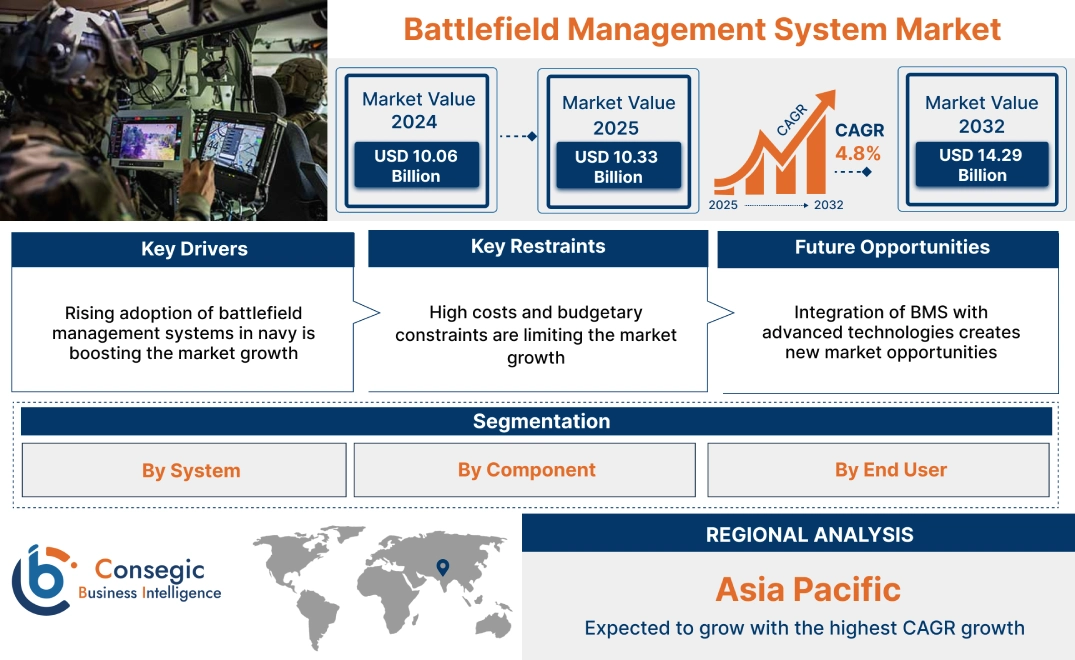
Battlefield Management System Market size is estimated to reach over USD 14.29 Billion by 2032 from a value of USD 10.06 Billion in 2024 and is projected to grow by USD 10.33 Billion in 2025, growing at a CAGR of 4.8% from 2025 to 2032.
Battlefield Management System Market Scope & Overview:
A battlefield management system (BMS) integrates information acquisition and processing to enhance command and control that provides commanders with better situational awareness. This leads to faster, more effective decision-making and execution of combat operations. BMS gathers and displays real-time data from various sources to provide detailed information of the battlefield. The system creates a shared understanding of the battlefield environment, allowing commanders and units to see the same information.
Battlefield Management System Market Dynamics - (DRO) :
Key Drivers:
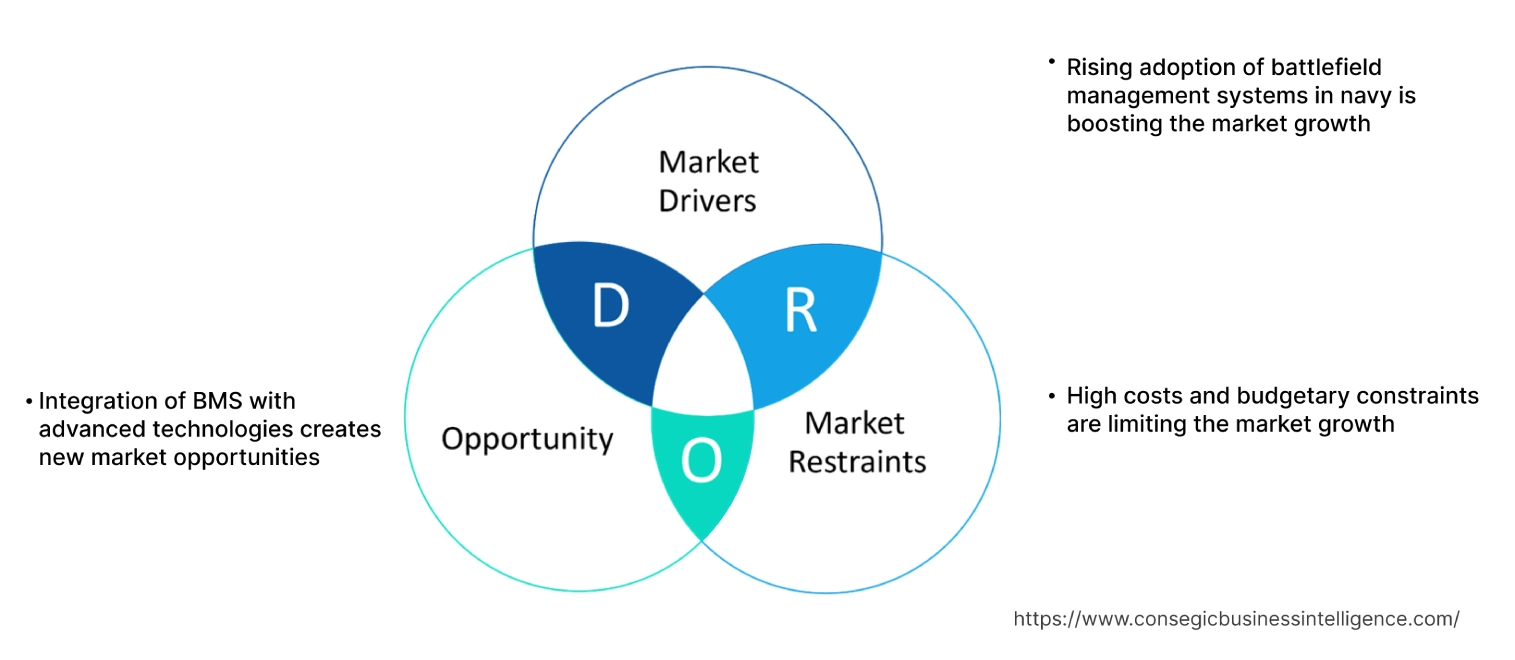
Rising adoption of battlefield management systems in navy is boosting the market growth
A BMS is a central hub, integrating data from various sensors, communication systems, and weapon systems on a naval vessel. The system collects data from various sensors including radar, sonar, and others and processes and analyzes the data to provide a clear and accurate picture of the situation. The system identifies and assesses potential threats to the vessel or fleet. Additionally, the system facilitates communication and coordination between different units and platforms. Moreover, the system integrates with weapon systems to facilitate target designation and engagement.
- For instance, in March 2025, Chilean Navy used Turkish BMS Advent. The ADVENT is designed to meet modern warfare requirements, as a network-based operation technique that allows naval platforms to work together using a multi-task force architecture.
Thus, the aforementioned factors are boosting the adoption of BMS in navy in turn driving the battlefield management system market growth.
Key Restraints:
High costs and budgetary constraints are limiting the market growth
Battlefield management system involves integrating various defense systems, intelligence, surveillance, and reconnaissance (ISR) systems, and command and control systems into a single, multi-domain platform. The development of BMS prototypes and the necessary infrastructure is extremely expensive. Maintaining and upgrading these complex systems requires ongoing resources and expertise, adding to the overall cost.
Additionally, integrating new battlefield management system with existing military infrastructure and legacy systems can be complex and challenging, potentially leading to compatibility issues and increased costs. Thus, the market analysis shows that the aforementioned factors are restraining the battlefield management system market demand.
Future Opportunities :
Integration of BMS with advanced technologies creates new market opportunities
Battlefield management system is often built upon and integrated with C4ISR capabilities, providing a holistic view of the battlefield. Advanced sensors, data processing, and communication technologies enable real-time situational awareness, allowing commanders to track enemy movements, identify threats, and assess the situation accurately. BMS often include decision support tools that analyze data and provide recommendations to commanders, aiding in faster and more effective decision-making. Moreover, AI is being used to enhance military forces' cybersecurity, situational awareness, decision-making, automation, and adaptability capabilities.
- For instance, in February 2025, Vegvisir launched Vegvisir Visor, an augmented reality headset that allows commanders to access and interact with real-time battlefield data from battlefield management systems.
Thus, the ongoing technological advancements and their integration with BMS are projected to drive battlefield management system market opportunities during the forecast period.
Battlefield Management System Market Segmental Analysis :
By System:
Based on the system, the market is segmented into navigation and mapping, communication, command and control, computing, and others.
Trends in the System:
- Rising trend in adoption of computing systems for enhancing command and control, integrating information, and improving situational awareness.
- Increasing demand for navigation and mapping systems for tactical operations, situational awareness, and troop movement is propelling the battlefield management system market size.
The command and control segment accounted for the largest revenue in the battlefield management system market share in 2024.
- A command and control (C2) system is a network of individual, equipment, and procedures that enable commanders to plan, direct, and control forces and operations to achieve a mission's goals.
- These systems leverage technology to enhance situational awareness, facilitate communication, and streamline decision-making on the battlefield.
- For instance, in September 2023, Northrop Grumman Corp., in collaboration with US Army, started the production of hardware and software for the integrated battle command system (IBCS). It is an air command-and-control system helping air and missile defenders to make faster decisions.
- Therefore, the wide applications of command and control systems are boosting the battlefield management system market growth.
The communication segment is expected to register the significant CAGR growth during the forecast period.
- Communication systems, including tactical radios, satellite communication, and secure data links, are crucial for real-time coordination and decision-making, which ensures seamless information flow and operational success.
- For instance, in March 2025, L3Harris Technologies signed a long-term agreement with the Dutch Ministry of Defense. The agreement is valued at USD 1.1 billion and is aimed for the delivery of advanced Falcon IV radios associated with the FOXTROT program.
- Thus, the market analysis shows that the rising adoption of communication systems is expected to boost the battlefield management system market trends during the forecast period.
By Component:
Based on the component, the market is segmented into hardware and software.
Trends in the Component:
- Rising demand for hardware systems to gather and transmit real-time data is boosting the battlefield management system market size.
- Increasing trend in adoption of software systems for real-time situational awareness and facilitating faster, more informed decision-making.
The hardware segment accounted for the largest revenue share in the battlefield management system market share in 2024.
- BMS is a system designed to enhance command and control by integrating information acquisition and processing, utilizing hardware like tactical computers, communication systems, and displays.
- For instance, in August 2024, US Air Force’s integrating program executive office for command, control, communications and battle management (C3BM) started to use service’s aircraft into its distributed network of systems and capabilities.
- Therefore, the market analysis shows that the aforementioned factors are driving the battlefield management system market demand.
The software segment is expected to register the fastest CAGR during the forecast period.
- BMS is a software-based tool used in the defense industry to enhance command and control by integrating information acquisition and processing, ultimately improving situational awareness and decision-making during combat operations.
- For instance, in November 2024, Austrian Army invested USD 76.92 million for more than 1,000 software licenses in battle management systems and more than 500 software licenses for a tactical command information system.
- Thus, the market analysis depicts that the software segment is expected to boost the battlefield management system market trends during the forecast period.
By End User:
Based on the end user, the market is segmented into army, navy, and air force.
Trends in the End User:
- Rising demand for battle management systems in army for improved coordination and cooperation with enhanced decision making.
- Increasing trend in adoption of BMS in navy for efficient communication, coordination of assets, and enhanced maneuverability.
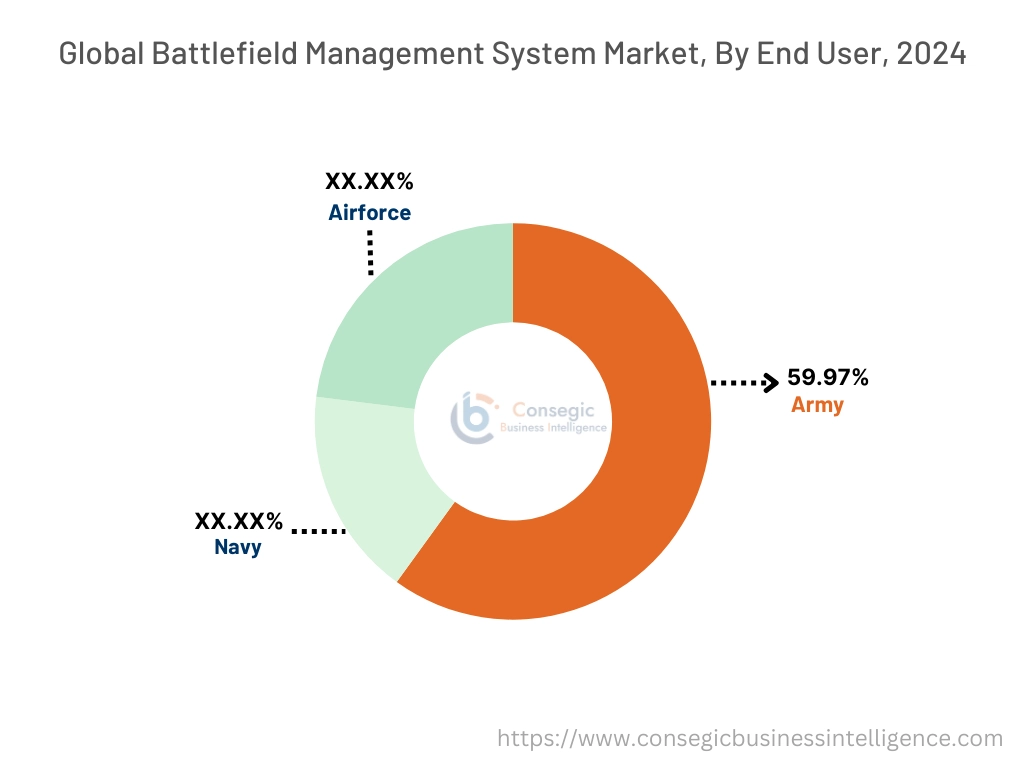
The army segment accounted for the largest revenue share of 59.97% in the market in 2024.
- BMS provides commanders and troops with real-time view of the battlefield, including the location and status of enemy forces.
- It integrates information from various sources, including sensors, intelligence reports, and communication networks, to create a common operating picture (COP).
- For instance, in September 2024, Indra and Thales collaborated to strengthen the BMS of Spain’s Army. The advancements in the systems include improved performance to operate in tactical environments and a higher processing capacity.
- Therefore, the rising adoption of BMS in army worldwide is boosting the battlefield management system market expansion.
The air force segment is expected to register the fastest CAGR during the forecast period.
- BMS enable the air force to conduct offensive and air defense operations synergistically through an integrated air command and control system.
- Moreover, BMS facilitates rapid communication and coordination among different units and platforms, allowing for faster reaction times and more agile operations.
- BMS promotes interoperability between different systems and platforms, enabling joint operations and enhancing the ability of different units to work together effectively.
- Thus, the aforementioned factors are expected to boost the battlefield management system market opportunities during the forecast period.
Regional Analysis:
The regions covered are North America, Europe, Asia Pacific, the Middle East and Africa, and Latin America.
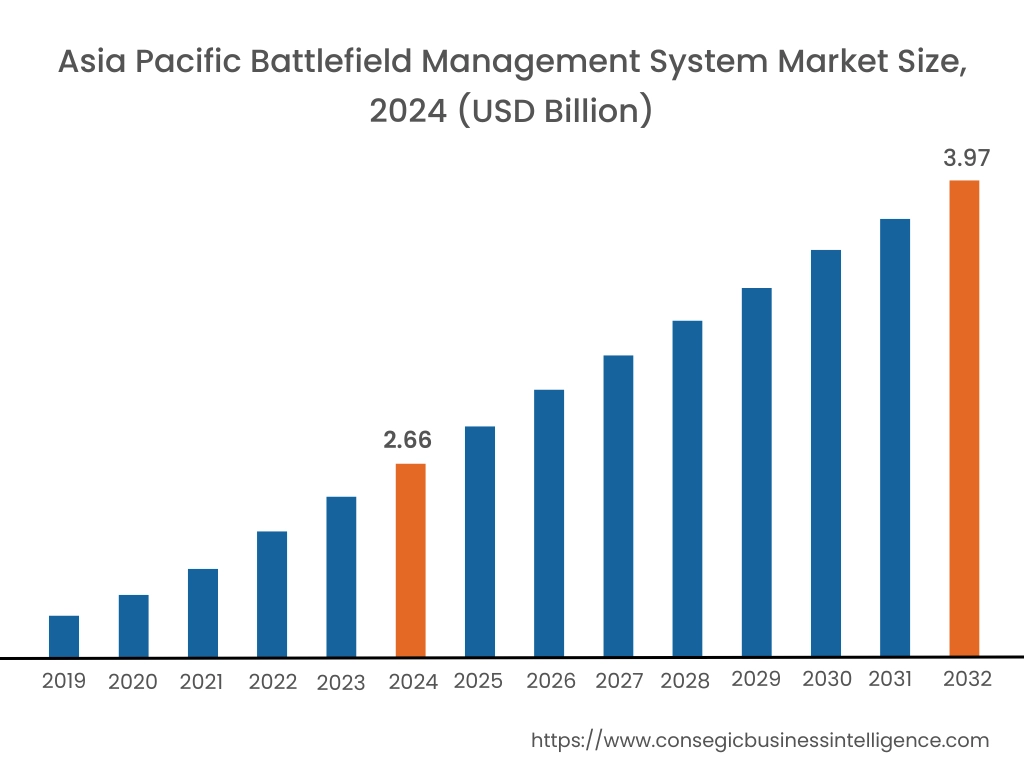
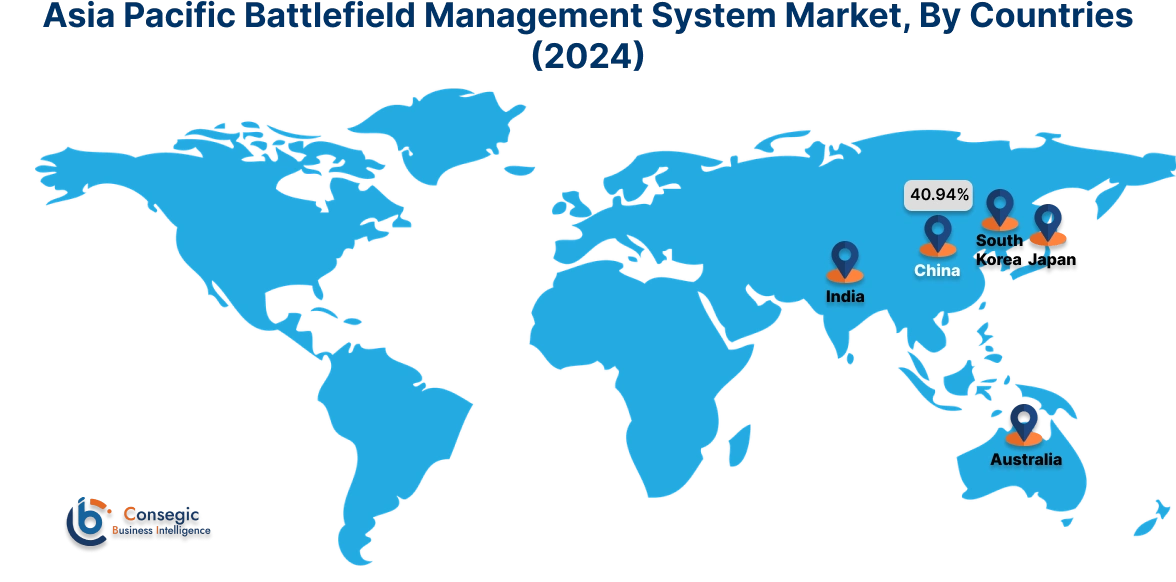
Asia Pacific region was valued at USD 2.66 Billion in 2024. Moreover, it is projected to grow by USD 2.74 Billion in 2025 and reach over USD 3.97 Billion by 2032. Out of this, China accounted for the maximum revenue share of 40.94%. The battlefield management system market analysis in the region shows that the market is growing due to rising investments by the government, leading to adoption of advanced technologies including BMS for enhanced mission control and management.
- For instance, in April 2024, Lockheed signed a contract with Australia to build joint air battle management system. The company aims to supply command-and-control architecture for USD 320 million. Thus, the aforementioned factors are leading to battlefield management system market expansion in the Asia-Pacific region.
North America is estimated to reach over USD 4.76 Billion by 2032 from a value of USD 3.39 Billion in 2024 and is projected to grow by USD 3.47 Billion in 2025. The market in the region is primarily driven due to high budget allocations for the military and defense industry. This allows military to adopt advanced systems for communication, command, control, navigation, and mapping. Moreover, technological advancements in cloud, AI, virtual reality, and other technologies leads to development of advanced BMS, further leading to the adoption of these systems.
- For instance, in February 2025, S. Army granted a contract to Leonardo DRS to supply BMS to the Royal Thailand Army’s combat vehicles. The contract is worth USD 7 million. Thus, the analysis shows that the aforementioned factors are boosting the market growth in North America.
Additionally, the battlefield management system market analysis depicts that the market in Europe is primarily driven by rising adoption of BMS for enhancing military capabilities and ensuring national security. In Latin America, Middle East and Africa, the market is propelled by the growing need for enhanced military capabilities due to rising border disputes and geopolitical tensions, and increasing adoption of real-time data, communication, and coordination tools that improves the situational awareness. Thus, the aforementioned factors are boosting the market growth in the region.
Top Key Players and Market Share Insights:
The battlefield management system industry is highly competitive with major players providing solutions to the national and international markets. Key players are adopting several strategies in research and development (R&D), product innovation, and end-user launches to hold a strong position in the global battlefield management system market. Key players in the battlefield management system industry include -
- Aselsan A.S. (Turkey)
- BAE Systems plc (UK)
- RTX Corporation (US)
- Elbit Systems Ltd. (Israel)
- General Dynamics Corporation (US)
- L3Harris Technologies, Inc. (US)
- Leonardo S.p.A. (Italy)
- Saab AB (Sweden)
- Thales Group (France)
- Rheinmetall AG (Germany)
- Kongsberg Gruppen (Norway)
- Northrop Grumman (US)
- Lockheed Martin Corporation (US)
Battlefield Management System Market Report Insights :
| Report Attributes | Report Details |
| Study Timeline | 2019-2032 |
| Market Size in 2032 | USD 14.29 Billion |
| CAGR (2025-2032) | 4.8% |
| By System |
|
| By Component |
|
| By End User |
|
| By Region |
|
| Key Players |
|
| North America | U.S. Canada Mexico |
| Europe | U.K. Germany France Spain Italy Russia Benelux Rest of Europe |
| APAC | China South Korea Japan India Australia ASEAN Rest of Asia-Pacific |
| Middle East and Africa | GCC Turkey South Africa Rest of MEA |
| LATAM | Brazil Argentina Chile Rest of LATAM |
| Report Coverage |
|
Key Questions Answered in the Report
How big is the battlefield management system market? −
Battlefield Management System Market size is estimated to reach over USD 14.29 Billion by 2032 from a value of USD 10.06 Billion in 2024 and is projected to grow by USD 10.33 Billion in 2025, growing at a CAGR of 4.8% from 2025 to 2032.
What are the major segments covered in the battlefield management system market report? +
The segments covered in the report are system, component, end user, and region.
Which region holds the largest revenue share in 2024 in the battlefield management system market? +
North America holds the largest revenue share in the battlefield management system market in 2024.
Who are the major key players in the battlefield management system market? +
The major key players in the market are Aselsan A.S. (Turkey), BAE Systems plc (UK), RTX Corporation (US), Elbit Systems Ltd. (Israel), General Dynamics Corporation (US), L3Harris Technologies, Inc. (US), Leonardo S.p.A. (Italy), Saab AB (Sweden), Thales Group (France), Rheinmetall AG (Germany), Kongsberg Gruppen (Norway), Northrop Grumman (US), and Lockheed Martin Corporation (US).
Overview
Reputation & Certifications


Our Services
- Market Intelligence & Forecasting
- Custom Research Solutions
- Market Entry Strategy
- Competitive Intelligence
- Customer Insights
- Industry Innovation Analysis
- Investment Advisory