Air purifying systems are being implemented by businesses in order to enhance the air quality in their workplaces, which is an issue that affects both the health and comfort of their employees, and increases the efficiency of their operations. Indoor air pollution due to dust, particulates, chemical substances, allergens, among other pollutants, may occur in various settings such as offices, retail shops, hospitals, schools, manufacturing companies, hotels, and other workplaces. Bad indoor air quality may cause discomfort, lack of focus, breathing problems, and even employee absenteeism.
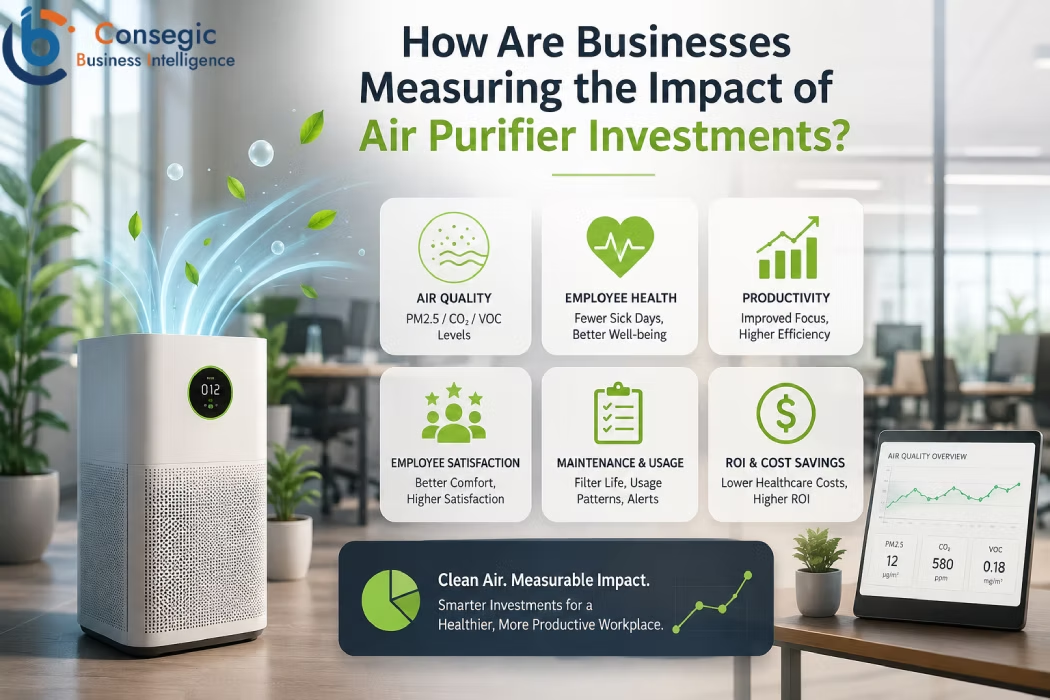
Businesses are now trying to go beyond the price tag of air purifiers and see if their investment is worthwhile or not. This process usually involves combining information about air quality, employee perceptions, health factors, energy consumption, maintenance, and productivity. The company can measure air pollution through the use of sensors before and after the installation of air purifiers. The company can also carry out employee satisfaction surveys on issues related to air quality and comfort in the work environment.
By connecting the dots between all these factors, companies will be able to know if their investment in air purifiers is worthwhile or not.
Measuring Indoor Air Quality Improvements and Workplace Health
One of the most direct methods businesses use to evaluate the benefits of their investment into air purification systems is the measurement of improvement in air quality. The installation of air-quality monitors allows companies to continually collect data on certain indicators such as particulate matter, namely PM2.5, and carbon dioxide, volatile organic compounds, temperature, and humidity. This information allows for the estimation of the effectiveness of the purchased air purifiers.
Average concentration of pollutants, pollution peaks, as well as the amount of time during which the air in the premises falls into the acceptable category according to the company can all be evaluated. Moreover, this information can be gathered about various parts of the building to see what areas require extra purification.
There is also an option to consider workplace health indicators when evaluating the air purification system. Companies can survey employees to see how irritated, headachy, allergic or otherwise respiratoryly challenged they feel, and compare absenteeism or sick leave rates, though these indicators can be influenced by many other factors.
All of these indicators are useful for evaluating the effect of air purification on indoor air quality and employee health.
Tracking Employee Productivity, Attendance, and Well-Being
Firms now evaluate air purifiers by assessing the effect that it may have on employee productivity, attendance, and employee satisfaction levels. Clean indoor air will help create a more comfortable workspace and thus affect the perception of the office space and efficiency of workers. In any case, firms should take into account several variables when interpreting these results because one cannot assume that air purification is the only cause of this change.
Surveys from employees may prove to be useful from a qualitative point of view. Firms may ask employees to rate air cleanliness, comfort, concentration, and overall satisfaction before and after the installation of air purifiers. These results can be compared to some of the operating measures like absenteeism, sick leaves, turnover, and complaints at work.
In addition, businesses can analyze productivity measures that are already used in the firm's operation. Manufacturing business will be able to use production volume and quality data, customer service business will use response times, office-based firms can use project completion and employee engagement measures.
However, the aim of this is not only to establish the effectiveness of air purifiers on productivity; it is to determine whether there is any change in the employees' performance and business productivity due to better indoor environment. It is through this kind of measurement that the efficacy of air purification can be measured.
Calculating Energy Costs, Maintenance Expenses, and ROI
The need for financial analysis in evaluating the suitability of investing in air purifiers is critical. Apart from the cost of buying the machine, expenses like electricity usage, replacement of filters, maintenance, repair, installation, and up-grading of the equipment are part of the total cost of ownership of the device. Companies make comparison between the cost of owning the equipment and the benefits gained during its lifetime.
Usage of electricity is important in case where the company operates several air purifiers continuously. The company may track the amount of electricity used and calculate the cost of operation. Also, the company may track the maintenance of the machines to determine the cost incurred annually.
In order to find out the return on investment, the company may calculate the costs incurred above and compare them against the financial gains. Such gains could include reduction in absenteeism, reduction in complaints, improvement in staff retention rate, reduction in disruption caused by unhealthy indoor environment, or reduced use of other solutions to indoor air quality.
It will then be possible for the organization to calculate the payback period of the technology and even compare between technologies.
Long-Term Business Benefits of Cleaner Indoor Air
In addition to the quick gains of improving air quality, more companies are beginning to realize the long-term strategic advantages of creating a cleaner indoor environment. Indoor air purification might be integrated into workplace wellness programs, employee experience initiatives, sustainability programs, and facility management plans. Instead of assessing the cost-effectiveness based on short-term returns on investment, companies can think about how the improved indoor air quality contributes to building operational resilience.
Thus, for instance, any company having office spaces, retail stores, hotels, medical facilities, or educational establishments can use air-quality sensors to analyze regular air pollution patterns and plan proper ventilation and air purification. Furthermore, monitoring of air quality allows facility managers to know when filters should be changed or when some places require special care.
Perception of employees is another aspect that companies might take into account when thinking about long-term strategies regarding indoor air quality. A company taking measures to ensure good indoor air quality is likely to build employee satisfaction and commitment to their workplace.
In the long term, organizations may establish their own historical databases from which to evaluate the air quality performance, maintenance costs, human response, and other performance metrics. In this way, they can make better decisions regarding purchases and management. All told, companies are measuring their air purifier purchases using a combination of metrics, not just one.
Conclusion
Business organizations have started considering the value of air purifiers by using multiple parameters, which include the quality of air, health status, efficiency, finance, and operations. It is possible to measure the presence of air pollution like PM2.5, conduct a survey among employees, measure absenteeism, and assess the performance of the work environment. At the same time, it is possible to evaluate the consumption of energy, the cost of maintenance, and savings in order to estimate the ROI of the system. Over time, better air quality can contribute to the well-being of employees and efficiency of the organization.