Jump to Content
Butachlor Market - Size, Share, Industry Trends, and Forecasts (2025-2032)
Butachlor Market Size:
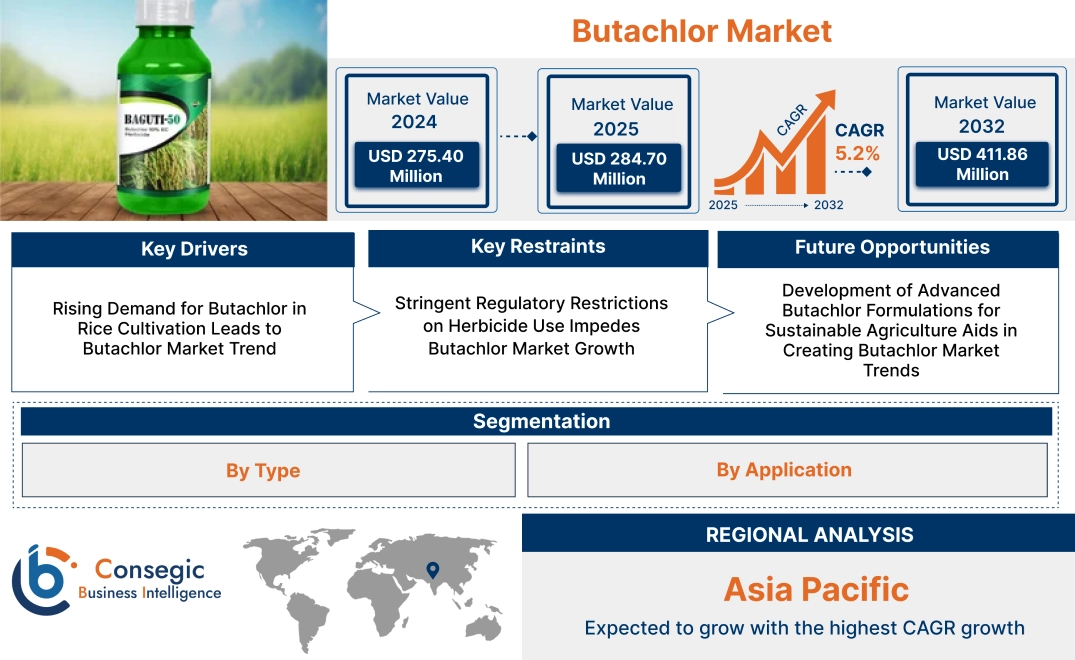
Butachlor Market size is estimated to reach over USD 411.86 Million by 2032 from a value of USD 275.40 Million in 2024 and is projected to grow by USD 284.70 Million in 2025, growing at a CAGR of 5.2% from 2025 to 2032.
Butachlor Market Scope & Overview:
Butachlor is a selective, pre-emergent herbicide used to control annual grasses and broadleaf weeds in agricultural fields. It inhibits weed growth by restricting protein synthesis and cell division. The herbicide is available in emulsifiable concentrate and granule formulations for efficient application.
Key properties include high solubility, stability, and effectiveness in moist soil conditions. It provides long-lasting weed suppression and reduces the need for repeated herbicide applications. Butachlor is compatible with various soil types and crop management practices.
This herbicide is widely used in rice, maize, and wheat cultivation. It helps improve crop yield by minimizing weed competition for nutrients, water, and sunlight. End users include commercial farmers, agricultural cooperatives, and agrochemical companies.
Butachlor Market Dynamics - (DRO):
Key Drivers:
Rising Demand for Butachlor in Rice Cultivation Leads to Butachlor Market Trend
Rice is a staple crop consumed worldwide, and its production requires effective weed management to maintain high yields. Butachlor is widely used as a selective pre-emergent herbicide in rice farming, preventing the growth of weeds that compete with rice plants for nutrients, sunlight, and water. It is specifically effective in controlling grassy weeds such as barnyard grass and broadleaf weeds, which significantly reduce rice crop productivity if left unchecked.
As global rice consumption continues to increase, especially in Asian countries such as China, India, and Indonesia, farmers are seeking effective herbicide solutions to enhance yields and ensure food security. Butachlor’s ability to improve crop protection and facilitate large-scale rice production is increasing its adoption in agriculture.
Therefore, the growing reliance on Butachlor as a preferred herbicide in rice cultivation is a significant factor contributing to the butachlor market expansion.

Key Restraints:
Stringent Regulatory Restrictions on Herbicide Use Impedes Butachlor Market Growth
The use of chemical herbicides, including Butachlor, is regulated due to concerns over environmental pollution and human health risks. Several regulatory bodies, such as the Environmental Protection Agency (EPA) in the U.S. and the European Food Safety Authority (EFSA), have implemented strict guidelines regarding the use, residue limits, and permissible concentrations of Butachlor in agricultural fields.
Excessive application of Butachlor has been linked to groundwater contamination and adverse effects on aquatic ecosystems, leading some countries to impose restrictions or bans on its usage. Additionally, consumer awareness regarding pesticide-free and organic farming is increasing, reducing the trend for chemical herbicides in certain regions.
These stringent regulations and shifting agricultural preferences pose challenges to the butachlor market expansion, potentially limiting its adoption and sales in highly regulated regions.
Future Opportunities:
Development of Advanced Butachlor Formulations for Sustainable Agriculture Aids in Creating Butachlor Market Trends
The future of the Butachlor market is expected to benefit from research and development initiatives aimed at creating environmentally friendly and efficient formulations. Manufacturers are investing in the development of controlled-release Butachlor products that minimize environmental impact while maintaining high efficacy in weed control.
For instance, nano-formulation technology is being explored to improve the efficiency of Butachlor by ensuring targeted weed control with minimal chemical runoff into soil and water bodies. Additionally, bio-based surfactants are being integrated into formulations to enhance herbicide absorption while reducing toxicity concerns.
As sustainable agricultural practices gain momentum, these innovations are likely to enhance the adoption of Butachlor while complying with evolving regulatory standards. This will create new butachlor market growth prospects for the players, driving the future butachlor market opportunities.
Butachlor Market Segmental Analysis :
By Type:
Based on type, the Butachlor market is segmented into Butachlor generated by DEA (Diethanolamine) and Paraformaldehyde, and Butachlor generated by Ketene.
The Butachlor generated by DEA (Diethanolamine) and Paraformaldehyde sector accounted for the largest revenue inbutachlor market share in 2024.
- DEA and paraformaldehyde synthesis method ensures high efficiency and cost-effectiveness, making it widely preferred among manufacturers.
- This type of Butachlor provides effective pre-emergent herbicidal action against a wide range of weeds, particularly in cereal and vegetable crops.
- The increasing growth for selective herbicides in agricultural applications contributes to its high revenue share.
- Regulatory approvals and widespread adoption in key agricultural economies further boost its market presence.
- The established supply chain and production capabilities also enhance its dominance in the market.
- Therefore, according to butachlor market analysis, DEA and paraformaldehyde-based Butachlor dominate the market due to cost-effectiveness and wide application.
The Butachlor generated by Ketene sector is anticipated to register the fastest CAGR during the forecast period.
- The Ketene-based synthesis process offers improved purity and formulation stability, leading to enhanced herbicidal performance.
- Growing interest in advanced chemical synthesis techniques and increased investment in R&D promote the adoption of this segment.
- The rising concerns over chemical residues and environmental impact are driving the shift towards more refined and controlled synthesis methods.
- Manufacturers focusing on sustainable herbicide formulations are increasing their investment in Ketene-based Butachlor production.
- Thus, according to butachlor market analysis, Ketene-based Butachlor is gaining momentum due to improved formulation stability and environmental considerations.
By Application:
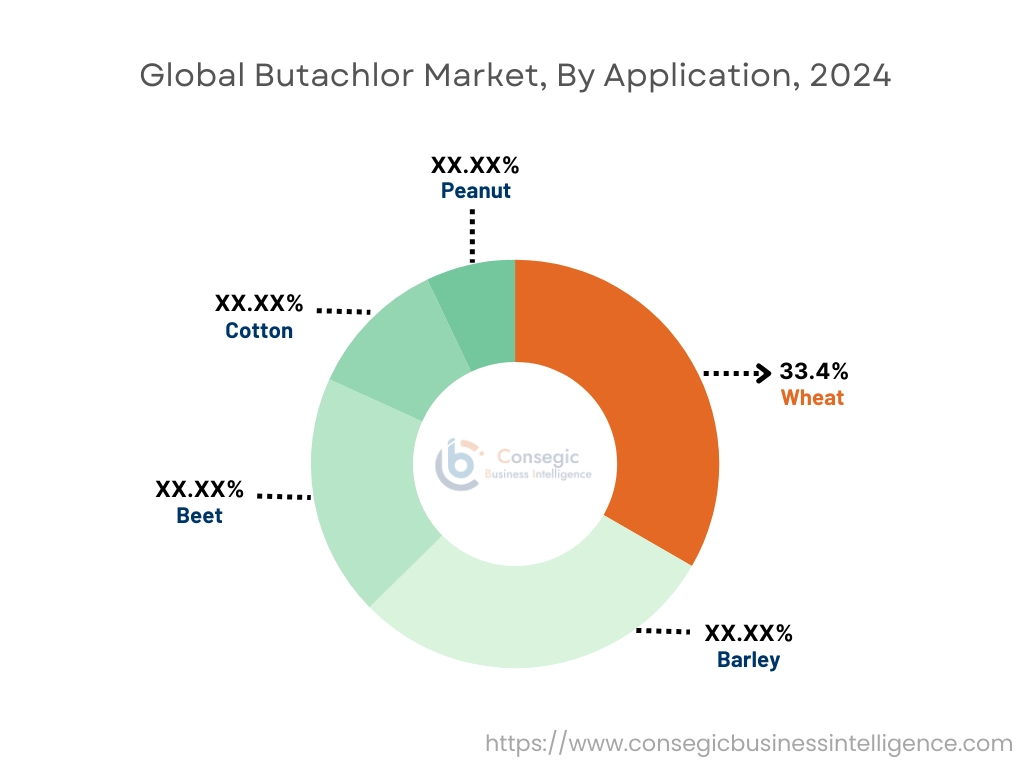
Based on application, the Butachlor market is segmented into wheat, barley, beet, cotton, and peanut.
The wheat sector accounted for the largest revenue inbutachlor market share of 33.4% in 2024.
- Butachlor is widely used in wheat cultivation due to its strong pre-emergence weed control properties.
- The high global demand for wheat as a staple crop increases the adoption of selective herbicides like Butachlor.
- Farmers rely on Butachlor to protect wheat crops from broadleaf and grassy weeds, ensuring higher yield and productivity.
- Favorable government policies and subsidies supporting herbicide use in cereal crops contribute to the widespread usage of Butachlor in wheat farming.
- Therefore, according to the market analysis, the wheat segment leads in revenue share due to its widespread cultivation and high herbicide adoption.
The cotton sector is anticipated to register the fastest CAGR during the forecast period.
- The expansion of cotton cultivation, especially in developing agricultural economies, is fueling the growth for effective herbicides.
- Butachlor is increasingly used in cotton farming due to its efficiency in controlling weeds that compete for nutrients and reduce crop yield.
- The adoption of herbicide-resistant cotton varieties has driven the need for complementary chemical weed control solutions, boosting butachlor need.
- Increasing global trend for textile and cotton-based products is supporting the growth of cotton farming, thereby strengthening the herbicide market.
- Thus, according to the market analysis, the cotton segment is expanding rapidly due to rising global textile trend and the need for enhanced weed management solutions.
Regional Analysis:
The regional segment includes North America, Europe, Asia Pacific, Middle East and Africa, and Latin America.
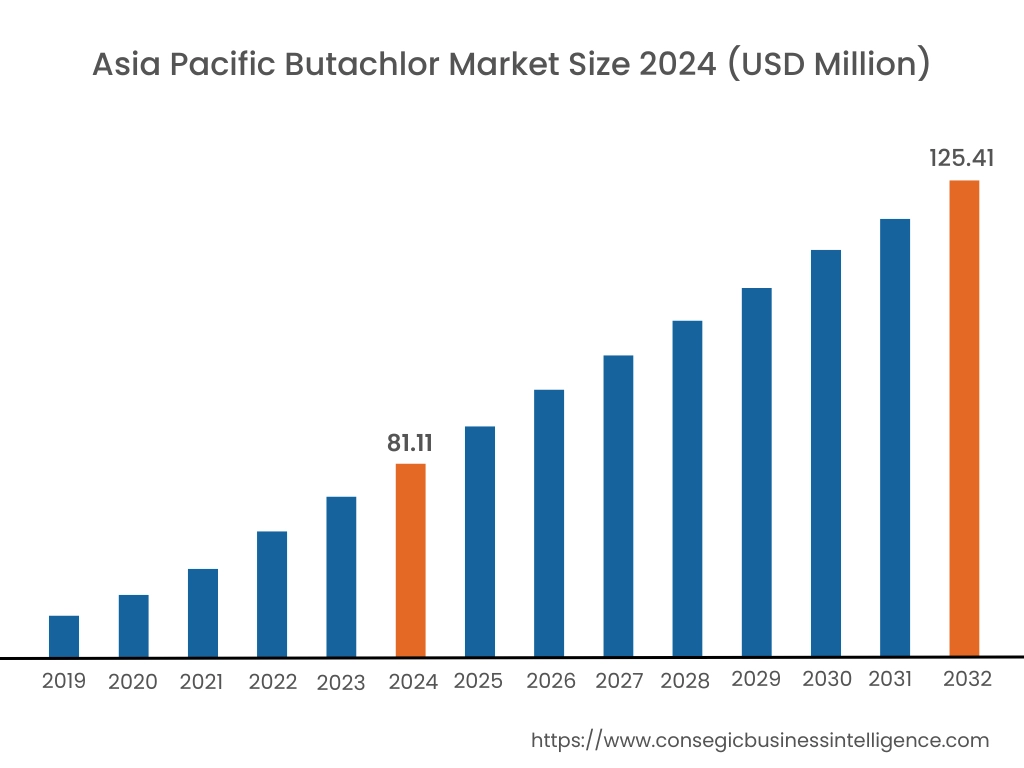
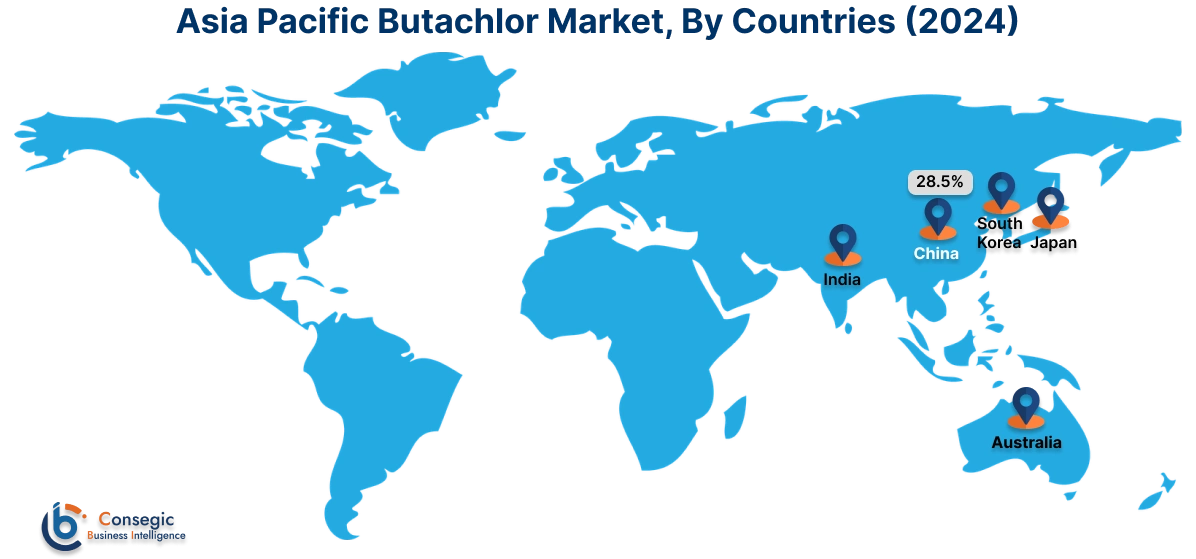
In 2024, Asia-Pacific was valued at USD 81.11 Million and is expected to reach USD 125.41 Million in 2032. In Asia-Pacific, China accounted for the highest share of 28.5% during the base year of 2024. Asia-Pacific holds a significant share of the Butachlor market due to extensive rice cultivation in China, India, Thailand, and Vietnam. The high dependency on herbicides for weed management in paddy fields supports butachlor market demand. Government initiatives promoting agricultural productivity influence the use of herbicides. The availability of generic Butachlor formulations affects pricing and competition. Regulatory changes in countries like China impact the production and export of Butachlor-based products. The increasing focus on sustainable farming practices affects future butachlor market trends.
North America is estimated to reach over USD 133.48 Million by 2032 from a value of USD 91.35 Million in 2024 and is projected to grow by USD 94.26 Million in 2025. The Butachlor market in North America is influenced by regulatory restrictions on herbicide usage. The presence of stringent environmental policies limits the application of Butachlor in major agricultural activities. The preference for alternative herbicides impacts market performance. The need for weed control solutions in rice and maize cultivation affects product adoption. The presence of key agricultural chemical companies influences product availability. Ongoing research on sustainable herbicides affects the long-term viability of Butachlor in this region.
The Butachlor market in Europe is restricted due to strict regulations on herbicide usage. The European Union’s policies on environmental safety limit the commercial use of Butachlor. The trend for organic and eco-friendly alternatives reduces butachlor market opportunities. The presence of advanced weed management technologies influences product adoption. Agricultural policies promoting reduced chemical dependency impact market performance. The shift toward integrated weed control methods affects the ask for traditional herbicides.
The Butachlor market in the Middle East and Africa is shaped by agricultural expansion in countries like Egypt, Nigeria, and South Africa. The demand for herbicides in rice and maize production affects product sales. Government initiatives to enhance agricultural yields support the use of chemical weed control solutions. Limited access to advanced farming technologies impacts product adoption. Price-sensitive markets influence the demand for cost-effective herbicides. Regulatory frameworks on pesticide use affect the market landscape.
Latin America exhibits demand for Butachlor due to its application in rice, corn, and soybean farming. Brazil and Argentina contribute to product consumption due to large-scale agricultural activities. The presence of local and international agrochemical companies affects market competition. Changing regulatory policies on herbicide application influence product adoption. The shift toward sustainable agriculture and integrated pest management affects future butachlor market trends. The availability of alternative herbicides impacts the demand for Butachlor in the region.
Top Key Players & Market Share Insights:
The global butachlor market is highly competitive with major players providing products and services to the national and international markets. Key players are adopting several strategies in research and development (r&d), product innovation, and end-user launches to hold a strong position in the global butachlor market. Key players in the butachlor industry include-
- BASF SE (Germany)
- Bayer CropScience AG (Germany)
- Binnong Technology Co., Ltd. (China)
- SinoHarvest Corporation (China)
- Shanghai Tenglong Agrochemical Co., Ltd. (China)
- FMC Corporation (United States)
- Syngenta AG (Switzerland)
- Adama Agricultural Solutions Ltd. (Israel)
- Dow AgroSciences LLC (United States)
- Qingfeng Agro-chemical Co., Ltd. (China)
Butachlor Market Report Insights:
| Report Attributes | Report Details |
| Study Timeline | 2019-2032 |
| Market Size in 2032 | USD 411.86 Million |
| CAGR (2025-2032) | 5.2% |
| By Type |
|
| By Application |
|
| By Region |
|
| Key Players |
|
| North America | U.S. Canada Mexico |
| Europe | U.K. Germany France Spain Italy Russia Benelux Rest of Europe |
| APAC | China South Korea Japan India Australia ASEAN Rest of Asia-Pacific |
| Middle East and Africa | GCC Turkey South Africa Rest of MEA |
| LATAM | Brazil Argentina Chile Rest of LATAM |
| Report Coverage |
|
Key Questions Answered in the Report
How big is the Butachlor Market? −
In 2024, the Butachlor Market was USD 275.40 million.
What will be the potential market valuation for the Butachlor Market by 2032? +
In 2032, the market size of Butachlor Market is expected to reach USD 411.86 million.
What are the segments covered in the Butachlor Market report? +
The type and application are the segments covered in this report.
Who are the major players in the Butachlor Market? +
BASF SE (Germany), Bayer CropScience AG (Germany), FMC Corporation (United States), Syngenta AG (Switzerland), Adama Agricultural Solutions Ltd. (Israel), Dow AgroSciences LLC (United States), Qingfeng Agro-chemical Co., Ltd. (China), Binnong Technology Co., Ltd. (China), SinoHarvest Corporation (China), Shanghai Tenglong Agrochemical Co., Ltd. (China) are the major players in the Butachlor market.
Overview
Reputation & Certifications


Our Services
- Market Intelligence & Forecasting
- Custom Research Solutions
- Market Entry Strategy
- Competitive Intelligence
- Customer Insights
- Industry Innovation Analysis
- Investment Advisory