Jump to Content
Chlorinated Polyvinyl Chloride Market - Size, Share, Industry Trends, and Forecasts (2025 - 2032)
Chlorinated Polyvinyl Chloride Market Size:
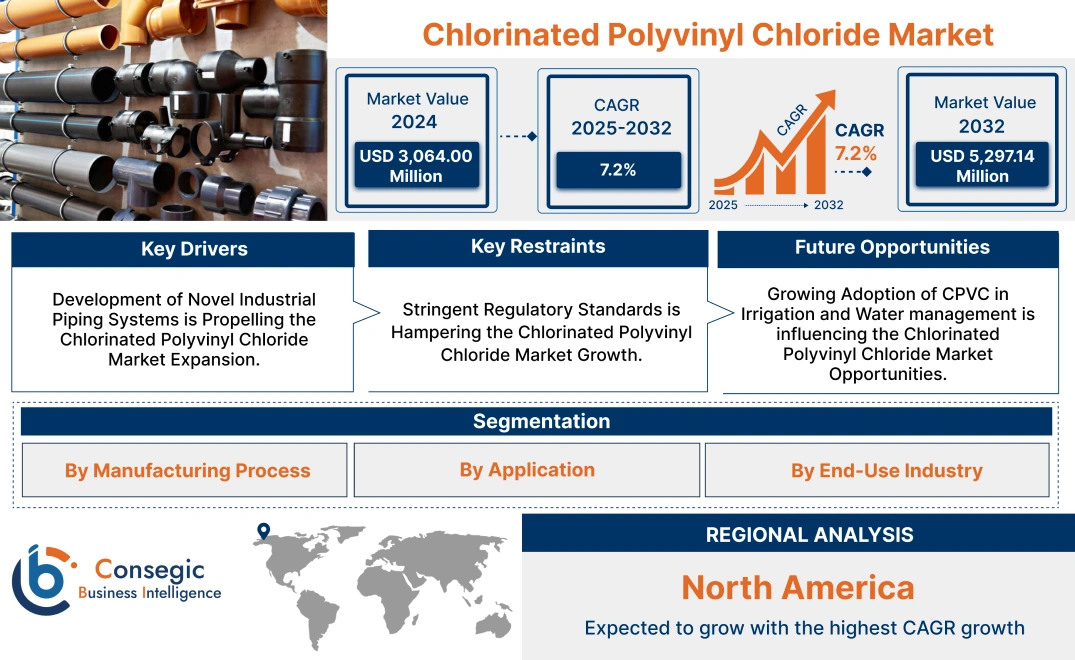
Chlorinated Polyvinyl Chloride Market size is growing with a CAGR of 7.2% during the forecast period (2025-2032), and the market is projected to be valued at USD 5,297.14 Million by 2032 from USD 3,064.00 Million in 2024.
Chlorinated Polyvinyl Chloride Market Scope & Overview:
Chlorinated Polyvinyl Chloride (CPVC) is a thermoplastic material derived from polyvinyl chloride (PVC). It is produced by chlorinating PVC, which enhances its thermal and chemical resistance properties. It exhibits excellent resistance to heat, corrosion, and chemicals, making it suitable for various applications. CPVC's high-temperature resistance, low thermal expansion, and self-extinguishing properties make it a preferred choice for many applications where safety and durability are crucial. The manufacturing process used for this material mainly includes extrusion, injection molding, and blow molding. These materials find their applications mainly in plumbing and piping systems, fire sprinkler systems, air distribution systems, electrical cables, automotive components, and others. The end-use industry for these materials includes construction, chemical processing, automotive, electronic & electrical, and others.
How is AI Impacting the Chlorinated Polyvinyl Chloride Market?
AI is significantly impacting the Chlorinated Polyvinyl Chloride (CPVC) market by optimizing production, enhancing quality control, and improving supply chain management. AI-driven predictive maintenance reduces downtime, while advanced algorithms accelerate material innovation and product development, leading to specialized CPVC variants. Additionally, AI and automation are improving precision, scalability, and reducing labor costs in CPVC pipe and fitting production. Also, AI-powered systems can monitor production lines in real-time, detecting defects and deviations from quality standards with greater accuracy than traditional methods.
Chlorinated Polyvinyl Chloride Market Dynamics - (DRO) :
Key Drivers:
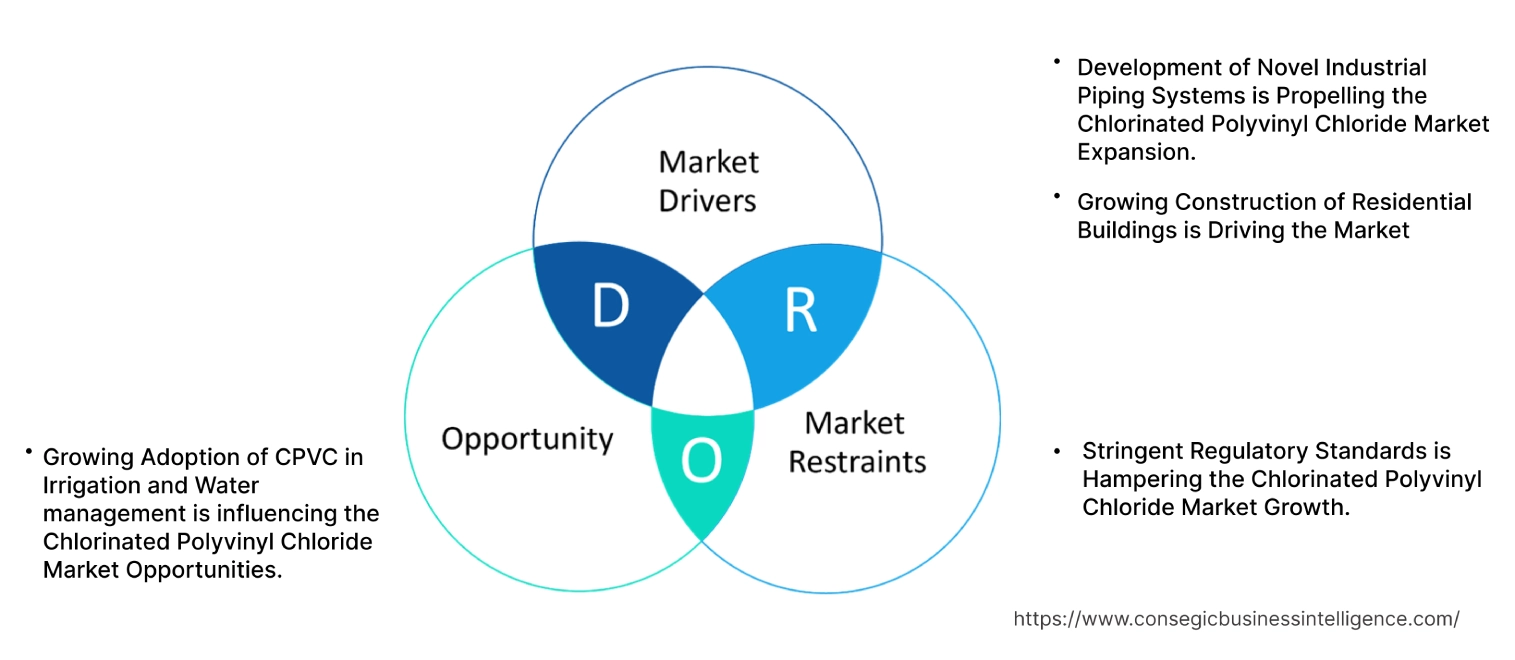
Development of Novel Industrial Piping Systems is Propelling the Chlorinated Polyvinyl Chloride Market Expansion.
The development of innovative industrial piping systems is a key driver for the growth of the Chlorinated Polyvinyl Chloride market. CPVC's exceptional properties, including its high-temperature resistance, corrosion resistance, and impact strength, make it an ideal material for various industrial applications. The increasing requirement for efficient, reliable, durable piping systems, particularly in sectors like chemical processing, pharmaceuticals, and food & beverage among others, is driving the adoption of CPVC. Furthermore, advancements in CPVC pipe and fitting technology, such as improved joining methods and enhanced performance characteristics, are expanding the range of applications for this versatile material.
- In August 2021, Prince Pipes and Fittings Limited, introduced its innovative Prince OneFit with Corzan CPVC Technology. The new product line offers superior performance, ease of installation, and exceptional resistance to corrosion, making it ideal for demanding industrial applications. By reducing downtime and ensuring continuous production, Prince OneFit with Corzan CPVC technology contributes to increased efficiency and productivity for industries across various sectors.
Overall, as industries continue to seek sustainable and cost-effective solutions for industrial applications, the requirement for CPVC is expected to remain strong.
Growing Construction of Residential Buildings is Driving the Market
The rapid urbanization and increasing construction of residential buildings are significant factors driving the growth of the Chlorinated Polyvinyl Chloride market. CPVC's superior properties, such as its high-temperature resistance, corrosion resistance, and impact strength, make it an ideal material for various residential plumbing applications. Its ability to withstand high water temperatures and pressures ensures reliable and efficient performance of plumbing systems. Additionally, CPVC's resistance to corrosion prevents leaks and reduces maintenance costs, leading to long-term savings. The rise in the construction of new residential buildings leads to the utilization of these thermoplastic materials in various applications.
- According to a joint announcement by the S. Census Bureau and the U.S. Department of Housing and Urban Development, approximately 1.31 million new housing units were started and 1.61 million were completed in 2024. As a durable, reliable, and versatile material, CPVC is widely used in residential plumbing systems, including hot and cold water distribution and radiant heating. Its resistance to corrosion, high-temperature tolerance, and ease of installation make it an ideal choice for these applications.
Overall, as per market analysis, the requirement for this thermoplastic construction sector is significantly contributing to the chlorinated polyvinyl chloride market expansion.
Key Restraints:
Stringent Regulatory Standards is Hampering the Chlorinated Polyvinyl Chloride Market Growth.
Stringent regulatory standards imposed by government bodies worldwide pose significant constraints in the Chlorinated Polyvinyl Chloride market. These regulations, designed to protect the environment and public health, increase production costs and slow down product development. Regulatory bodies worldwide impose rigorous guidelines to ensure the safe and responsible use of chemicals, including CPVC. Adherence to these regulations, mainly involving extensive testing and documentation, increases production costs and delays market entry. They also result in significant disruptions to traditional sector supply chains and loss of current raw materials uses.
Moreover, evolving federal regulations accelerate annual compliance and operating costs throughout automotive sector supply chains. Variations in regulatory frameworks across different countries further complicate the process of product approval and distribution. Therefore, these factors hinder the growth of the market, especially in regions with stringent environmental and safety regulations.
Future Opportunities :
Growing Adoption of CPVC in Irrigation and Water management is influencing the Chlorinated Polyvinyl Chloride Market Opportunities.
The increasing adoption of CPVC in irrigation and water management systems is a significant factor in the growth of the market. Its exceptional properties, such as its high-temperature resistance, and impact resistance make it an ideal material for various water management applications. Its ability to withstand harsh environmental conditions, including exposure to sunlight, temperature fluctuations, and soil chemicals, ensures long-lasting performance. Additionally, its smooth interior surface reduces friction loss, improving water flow efficiency. The substantial number of irrigated acres in the United States, coupled with the growing focus on efficient water management, presents a significant opportunity for the adoption of this material in irrigation systems.
- According to the article published by the USDA, in 2024 the 2023 Irrigation and Water Management Survey, there were 212,714 farms in the United States with 53.1 million irrigated acres, utilizing 81 million acre-feet of water. As the requirement for sustainable and efficient solutions continues to grow, the use of CPVC is expected to play a crucial role in optimizing water management practices.
Thus, as per the market analysis, as the requirement for sustainable and efficient water management solutions grows, the use of CPVC in irrigation systems, drip irrigation, and water distribution networks is expected to increase, further driving the chlorinated polyvinyl chloride market opportunities in the coming years
Chlorinated Polyvinyl Chloride Market Segmental Analysis :
By Manufacturing Process:
Based on the manufacturing process, the market is categorized into extrusion, injection molding, and blow molding.
Trends in the Manufacturing Process:
- Advancements in extrusion processing are influencing the segment.
- The trends for energy-efficient manufacturing processing are boosting the segment
The extrusion segment accounted for the largest market share in 2024.
- Extrusion is a manufacturing process used to create products with a consistent cross-sectional profile. Chlorinated polyvinyl chloride extrusion involves melting CPVC resin and forcing it through a die with a specific shape.
- This process is commonly used to produce end products such as pipes, fittings, and other components.
- The molten resin is fed into an extruder, where it is heated and mixed to ensure uniform melting. The melted resin is then forced through a die, which shapes the material into the desired profile.
- The extruded material is cooled and solidified, resulting in a continuous length of product.
- Extrusion is a highly efficient and versatile process for manufacturing end-products.
- It allows to production of a wide range of shapes and sizes, with precise control over the dimensions and properties of the final product.
- Additionally, based on market analysis, extrusion is a cost-effective method for producing large quantities of CPVC products, making it suitable for both residential and commercial applications, thus driving the chlorinated polyvinyl chloride market trends.
The injection molding segment is expected to grow at the fastest CAGR over the forecast period.
- Injection molding is a widely used manufacturing process for producing a variety of plastic products, including those made from Chlorinated Polyvinyl Chloride. In this process, molten CPVC resin is injected into a mold cavity under high pressure.
- The mold, typically made of steel, has a precise shape that determines the final product's geometry.
- As the molten plastic cools and solidifies within the mold, it takes on the shape of the cavity.
- Once the part has cooled sufficiently, the mold opens, and the finished product is ejected.
- Injection molding offers several advantages for this material, including high production rates, precise dimensional control, and the ability to produce complex shapes.
- It is a cost-effective method for mass production and is widely used to manufacture a range of CPVC products, such as pipes, fittings, valves, and other components
- Moreover, the development of injection molding facilities is a factor contributing to the development of the segment.
- For instance, In October 2022, CamdenBoss, a UK-based manufacturer of electro-mechanical components and enclosures, officially unveiled its investment in state-of-the-art injection molding technology. By incorporating injection molding for CPVC components, the company offers a wider range of customized solutions, including intricate enclosures, pipes, and housing, to meet the diverse needs of its customers across various industries.
- Thus, the rising use of injection molding is influencing the market trends in the coming years.
By Application:
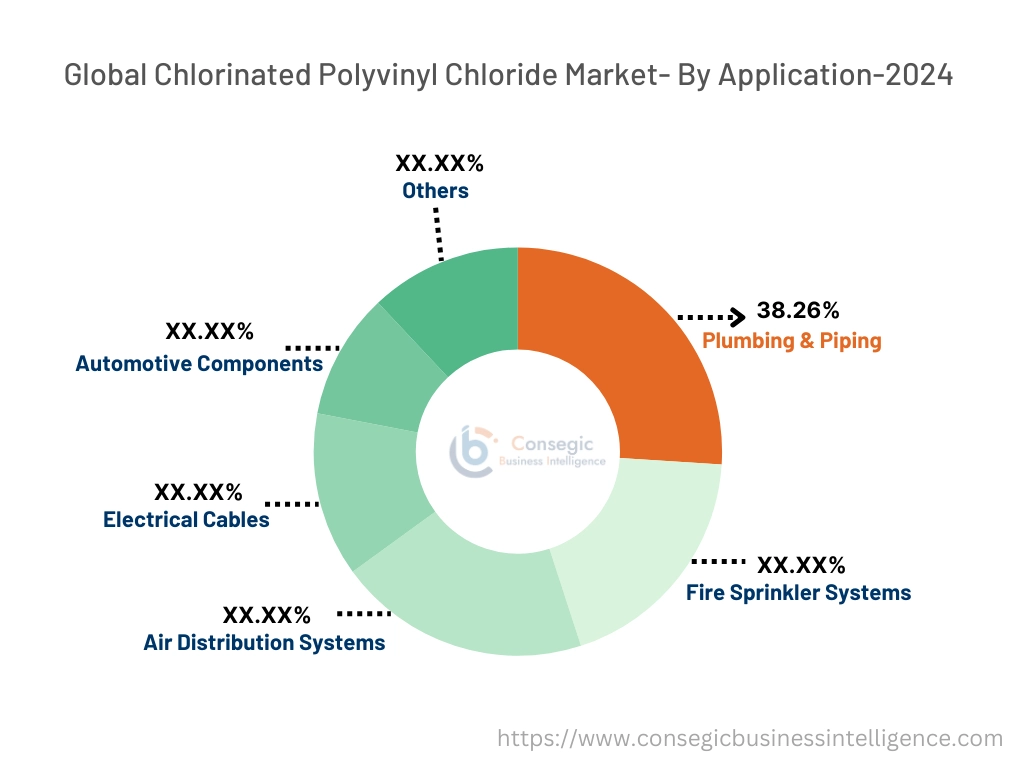
Based on applications, the market is categorized into plumbing & piping, fire sprinkler systems, air distribution systems, electrical cables, automotive components, and others.
Trends in Application:
- The trends for fire sprinkler systems in residential and commercial settings are propelling the segment.
- The rising popularity of enhanced automotive components is influencing the segment.
The plumbing & piping segment accounted for the largest market share of 38.26% in the year 2024.
- Chlorinated Polyvinyl Chloride is a versatile material widely used in plumbing and piping systems due to its superior properties.
- It exhibits excellent resistance to high temperatures, corrosion, and chemicals, making it suitable for various applications.
- In plumbing systems, CPVC pipes and fittings are used for hot and cold-water distribution, as well as for radiant heating systems.
- They withstand high water temperatures and pressures, ensuring reliable and efficient performance.
- In industrial settings, CPVC is used in piping systems for handling chemicals, acids, and other corrosive substances.
- Its resistance to corrosion prevents leaks and maintains system integrity.
- Manufacturers are introducing novel pipes for various applications.
- For instance, in June 2022, Parryware, introduced its premium range of World Class Pipes & Fittings. This range encompasses CPVC, uPVC, and SWR pipes and fittings, designed to deliver exceptional performance and durability. These products are engineered to provide safe and easy-to-install plumbing and drainage solutions for both residential and commercial applications
- Overall, CPVC's combination of properties makes it an ideal material for plumbing and piping applications, providing durability, safety, and long-term performance, thus influencing the chlorinated polyvinyl chloride market trends.
The air distribution systems segment is expected to grow at the fastest CAGR over the forecast period.
- Chlorinated Polyvinyl Chloride is increasingly being used in air distribution systems due to its superior properties.
- Its excellent heat resistance, low thermal expansion, and flame-retardant characteristics make it ideal for applications involving high-temperature air or where fire safety is a concern.
- CPVC pipes and fittings are used to transport heated or cool air in commercial buildings, industrial facilities, and residential homes.
- They are able to withstand high temperatures without deformation or failure, ensuring efficient and reliable air distribution.
- Additionally, CPVC's resistance to corrosion and chemicals makes it suitable for environments with harsh conditions.
- Thus, the rise in the use of this thermoplastic material in air distribution systems is influencing the market in the coming years.
By End-Use Industry:
Based on the end-use industry, the market is categorized into construction, chemical processing, automotive, electronic & electrical, and others
Trends in the End-Use Industry:
- Emphasis on enhanced components to reduce vehicle weight is driving the segment.
- The adoption of CPVC in electronic & electrical components to improve efficiency is influencing the segment.
The construction segment accounted for the largest market share in the year 2024.
- Construction is a major end-use industry for chlorinated polyvinyl chloride.
- CPVC's exceptional properties, including heat resistance, corrosion resistance, and impact strength, make it an ideal material for various construction applications.
- In residential and commercial buildings, CPVC pipes and fittings are widely used for plumbing systems, including hot and cold-water distribution.
- Its ability to withstand high temperatures and pressure ensures a reliable and efficient water supply.
- It is used in radiant heating systems, providing comfortable and energy-efficient solutions.
- Additionally, the rise in construction activity influences the use of CPVC in construction projects.
- For instance, according to the data published by Associated General Contractors of Americas, in 2023, stated that the U.S. construction sector is a major economic force, boasting over 919,000 establishments and employing millions of workers. This robust sector contributes significantly to the nation's GDP and drives requirements for various materials, including chlorinated polyvinyl chloride. As a versatile and durable material, CPVC plays a crucial role in various construction applications, from residential plumbing to industrial piping systems.
- Thus, the rise in the use of this thermoplastic material in construction projects is driving the chlorinated polyvinyl chloride market demand.
The chemical processing segment is expected to grow at the fastest CAGR over the forecast period.
- Chlorinated Polyvinyl Chloride is a versatile material that finds extensive application in the chemical processing sector. Its exceptional chemical resistance, high-temperature tolerance, and mechanical strength make it ideal for handling a wide range of corrosive chemicals and harsh environments.
- CPVC pipes and fittings are used in various chemical processing plants to transport corrosive fluids, acids, and alkalis.
- Its resistance to corrosion prevents leaks, ensuring safety and environmental protection.
- Air distribution systems play a crucial role in chemical processing facilities, ensuring optimal operation and worker safety.
- Additionally, its ability to withstand high temperatures and pressures makes it suitable for high-temperature processes.
- Overall, the use of CPVC in chemical processing industries offers several benefits, including reduced maintenance costs, increased system reliability, and improved safety, thus driving the chlorinated polyvinyl chloride market demand.
Regional Analysis:
The regional segment includes North America, Europe, Asia Pacific, the Middle East and Africa, and Latin America.
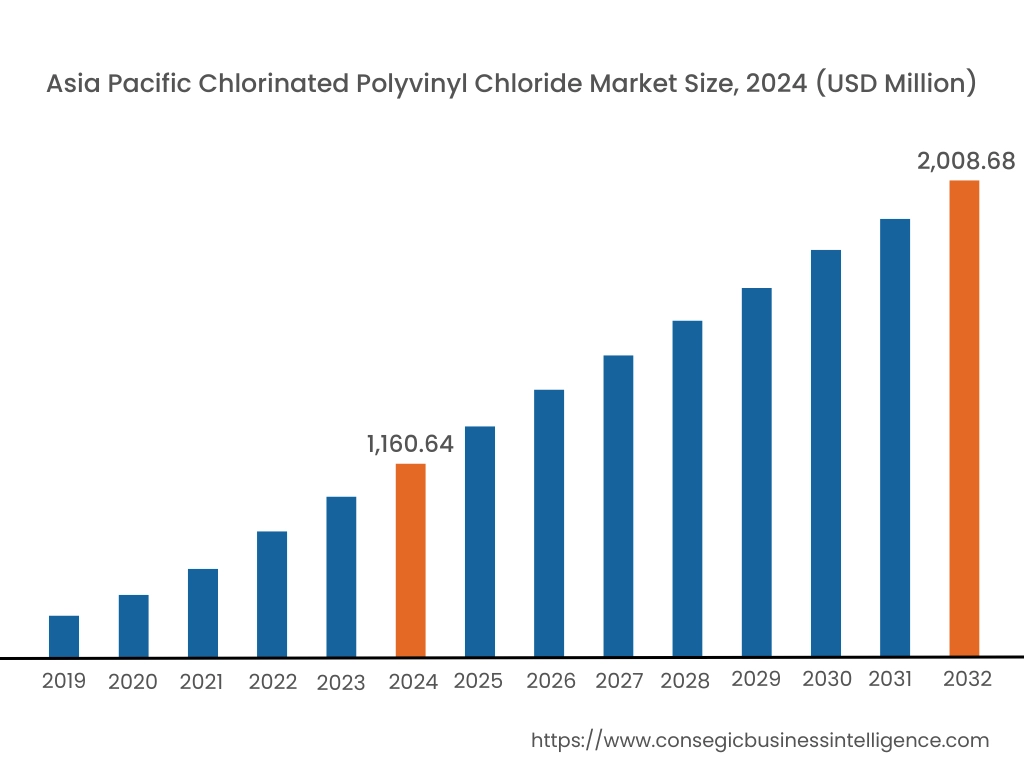
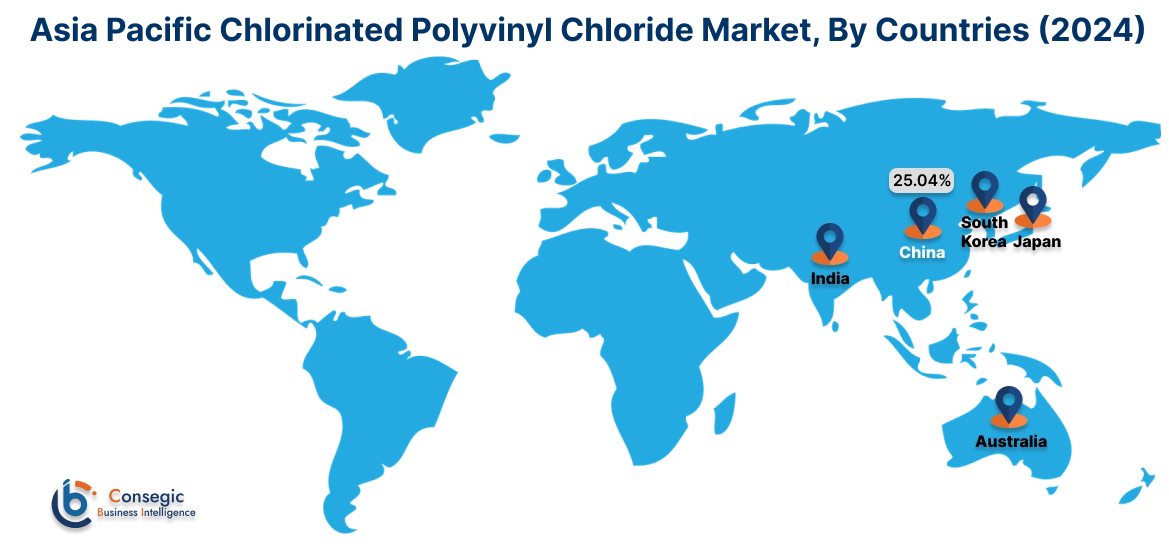
In 2024, Aisa Pacific accounted for the highest chlorinated polyvinyl chloride market share at 37.88% and was valued at USD 1,160.64 Million and is expected to reach USD 2,008.68 Million in 2032. In Asia Pacific, China accounted for the highest chlorinated polyvinyl chloride market share of 25.04%during the base year of 2024.
The Asia-Pacific region is witnessing significant chlorinated polyvinyl chloride market growth. Rapid urbanization and industrialization, coupled with increasing infrastructure development, are driving the requirement for durable and reliable piping solutions. This material, with its superior properties such as heat resistance, corrosion resistance, and impact strength, is well-suited for various applications in the region. The construction sector, in particular, is a major driver of this material, as it is used in plumbing, fire sprinkler systems, and industrial piping. Furthermore, the growing focus on energy efficiency and sustainable building practices is boosting the adoption of CPVC in HVAC systems. As the Asia-Pacific region continues to develop, the requirement for CPVC is expected to remain strong, driven by factors such as population rise, economic development, and increasing infrastructure investments.
- According to the data published by the IBEF, states that the Indian government's proactive approach to attracting private investment, particularly in sectors like infrastructure and education, has created a conducive environment for growth. The significant investment of USD 3.5 billion by PE-VC firms in May 2023 enhances confidence in India's economic potential and influences the use of advanced materials such as CPVC.
Thus, based on the chlorinated polyvinyl chloride market analysis, the aforementioned factors are influencing the use of this thermoplastic material in the coming years.
North America is experiencing the fastest growth with a CAGR of 7.9% over the forecast period. North America is a significant market for Chlorinated Polyvinyl Chloride, driven by its robust construction and industrial sectors. Its exceptional properties, including heat resistance, corrosion resistance, and impact strength, make it a preferred choice for various applications. In the construction sector, this material is widely used in plumbing systems, radiant heating, and fire sprinkler systems. It offers superior performance compared to traditional materials like copper and steel, especially in high-temperature and corrosive environments. The industrial sector also benefits from its durability and chemical resistance, making it suitable for chemical processing, oil and gas, and other industries. Based on the chlorinated polyvinyl chloride market analysis, as the North American market continues to prioritize energy efficiency and sustainability, CPVC's role in various applications is expected to grow further.
In Europe, Chlorinated Polyvinyl Chloride has established itself as a notable material for various applications due to its exceptional properties. Its resistance to high temperatures, corrosion, and chemicals makes it suitable for demanding environments. It is widely used in plumbing systems, particularly for hot water distribution, where its heat resistance and durability are crucial. Additionally, it finds applications in industrial piping systems, handling corrosive chemicals and high-temperature fluids. The construction sector in Europe leverages the benefits of this material for both residential and commercial projects. Its ease of installation, long lifespan, and energy efficiency contribute to sustainable building practices. As European countries prioritize energy efficiency and environmental sustainability, this material is expected to play an increasingly important role in various applications, further driving the market.
The Middle East and Africa regions are experiencing rapid urbanization and industrialization, driving the requirement for advanced materials like chlorinated polyvinyl chloride. Its exceptional properties, such as heat resistance, corrosion resistance, and impact strength, make it an ideal choice for various applications in these regions. In the construction sector, this material is widely used in plumbing systems, fire sprinkler systems, and industrial piping. Its durability and resistance to harsh environmental conditions make it suitable for challenging climates and demanding applications. Additionally, the ease of installation and maintenance reduces costs and improves efficiency. Based on the market analysis, as the region continues to develop, the demand for this material is expected to grow, driven by factors such as increasing infrastructure investments, rising living standards, and growing industrialization.
Latin America is a rapidly growing market for chlorinated polyvinyl chloride. The region's increasing urbanization and industrialization, coupled with a focus on infrastructure development, has led to a surge in the requirement for durable and reliable piping solutions. CPVC, with its superior properties such as heat resistance, corrosion resistance, and impact strength, is well-suited for various applications in the region. The construction sector, in particular, is a major driver of this material, as it is used in plumbing, fire sprinkler systems, and industrial piping. Additionally, the growing emphasis on water conservation and efficient water management is boosting the adoption of this material in water distribution systems. As Latin America continues to develop, the requirement for this material is expected to remain strong, driven by factors such as population rise, economic development, and increasing infrastructure investments.
Top Key Players and Market Share Insights:
The global chlorinated polyvinyl chloride market is highly competitive with major players providing precise products to the national and international markets. Key players are adopting several strategies in research and development (R&D) and product innovation to hold a strong position in the global Chlorinated Polyvinyl Chloride market. Key players in the Chlorinated Polyvinyl Chloride industry include-
- Aditya Birla Group (India)
- The Lubrizol Advanced Corporation (United States)
- Hanwha Chemical Corporation (South Korea)
- GEON (United States)
- Sundow Polymers Co., Ltd. (China)
- Shandong Novista Chemicals Co., Ltd (China)
- Via Chemical Co., Ltd. (China)
- SEKISUI CHEMICAL CO., LTD. (Japan)
- Epigral Ltd (India)
- Kaneka Corporation (Japan)
Recent Industry Developments :
Partnerships:
- In November 2023, Lubrizol Advanced Materials and Grasim Industries made significant strides in the chlorinated polyvinyl chloride industry by launching a novel CPVC resin plant in Gujarat, India. This strategic partnership aims to cater to the growing demand for high-performance CPVC resins in the region. The new plant will enable the production of high-quality CPVC resins, which are widely used in various applications, including plumbing, fire protection, and industrial piping systems. This development further strengthens the position of both companies in the global CPVC market, providing innovative solutions to meet the evolving needs of the sector.
- In August 2021, Lubrizol Advanced Materials, announced a strategic partnership with Prince Pipes and Fittings Limited, a prominent player in the Indian plumbing and piping sector. This collaboration aims to drive innovation and provide high-quality CPVC solutions to the Indian market. By combining Lubrizol's expertise in advanced materials with Prince Pipes and Fittings' strong market presence, the partnership is poised to deliver superior CPVC products that meet the evolving needs of the Indian construction and industrial sectors.
Chlorinated Polyvinyl Chloride Market Report Insights :
| Report Attributes | Report Details |
| Study Timeline | 2019-2032 |
| Market Size in 2032 | USD 5,297.14 Million |
| CAGR (2025-2032) | 7.2% |
| By Manufacturing Process |
|
| By Application |
|
| By End Use Industry |
|
| By Region |
|
| Key Players |
|
| North America | U.S. Canada Mexico |
| Europe | U.K. Germany France Spain Italy Russia Benelux Rest of Europe |
| APAC | China South Korea Japan India Australia ASEAN Rest of Asia-Pacific |
| Middle East and Africa | GCC Turkey South Africa Rest of MEA |
| LATAM | Brazil Argentina Chile Rest of LATAM |
| Report Coverage |
|
Key Questions Answered in the Report
How big is the Chlorinated Polyvinyl Chloride market? −
In 2024, the Chlorinated Polyvinyl Chloride market is USD 3,064.00 Million.
Which is the fastest-growing region in the Chlorinated Polyvinyl Chloride market? +
North America is the fastest-growing region in the Chlorinated Polyvinyl Chloride market.
What specific segmentation details are covered in the Chlorinated Polyvinyl Chloride market? +
Manufacturing Process, Application, and End-Use Industry segmentation details are covered in the Chlorinated Polyvinyl Chloride market.
Who are the major players in the Chlorinated Polyvinyl Chloride market? +
Aditya Birla Group (India), The Lubrizol Advanced Corporation (United States), and Shandong Novista Chemicals Co., Ltd (China) are some of the major players in the market.
Overview
Reputation & Certifications


Our Services
- Market Intelligence & Forecasting
- Custom Research Solutions
- Market Entry Strategy
- Competitive Intelligence
- Customer Insights
- Industry Innovation Analysis
- Investment Advisory