Jump to Content
Clay Absorber Market - Size, Share, Industry Trends, and Forecasts (2025-2032)
Clay Absorber Market Size:
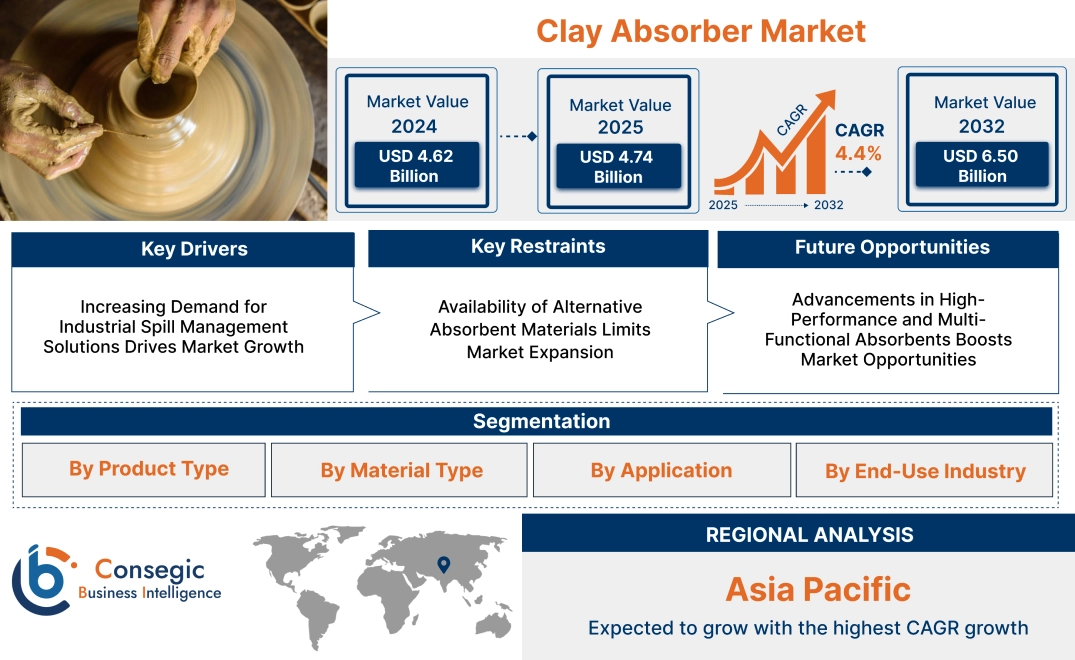
Clay Absorber Market size is estimated to reach over USD 6.50 Billion by 2032 from a value of USD 4.62 Billion in 2024 and is projected to grow by USD 4.74 Billion in 2025, growing at a CAGR of 4.4% from 2025 to 2032.
Clay Absorber Market Scope & Overview:
Clay absorber is a natural, highly porous material used for liquid spill containment, moisture control, and odor elimination across industrial, commercial, and household applications. Sourced primarily from processed clay minerals, it exhibits excellent absorbency and stability, making it effective for handling oils, chemicals, and other fluid waste.
Key characteristics include high surface area, non-toxic composition, and thermal resistance. Its ability to retain large volumes of liquid while preventing surface residue enhances workplace safety and hygiene. The material’s granulated form allows easy application and disposal, ensuring efficiency in spill management.
Sectors such as automotive, manufacturing and waste management utilize it for effective containment and cleanup of hazardous as well as non-hazardous materials. Continuous improvements in processing techniques enhance its absorption capacity, ensuring reliability in various operational environments where spill prevention and moisture control are critical.
Clay Absorber Market Dynamics - (DRO):
Key Drivers:
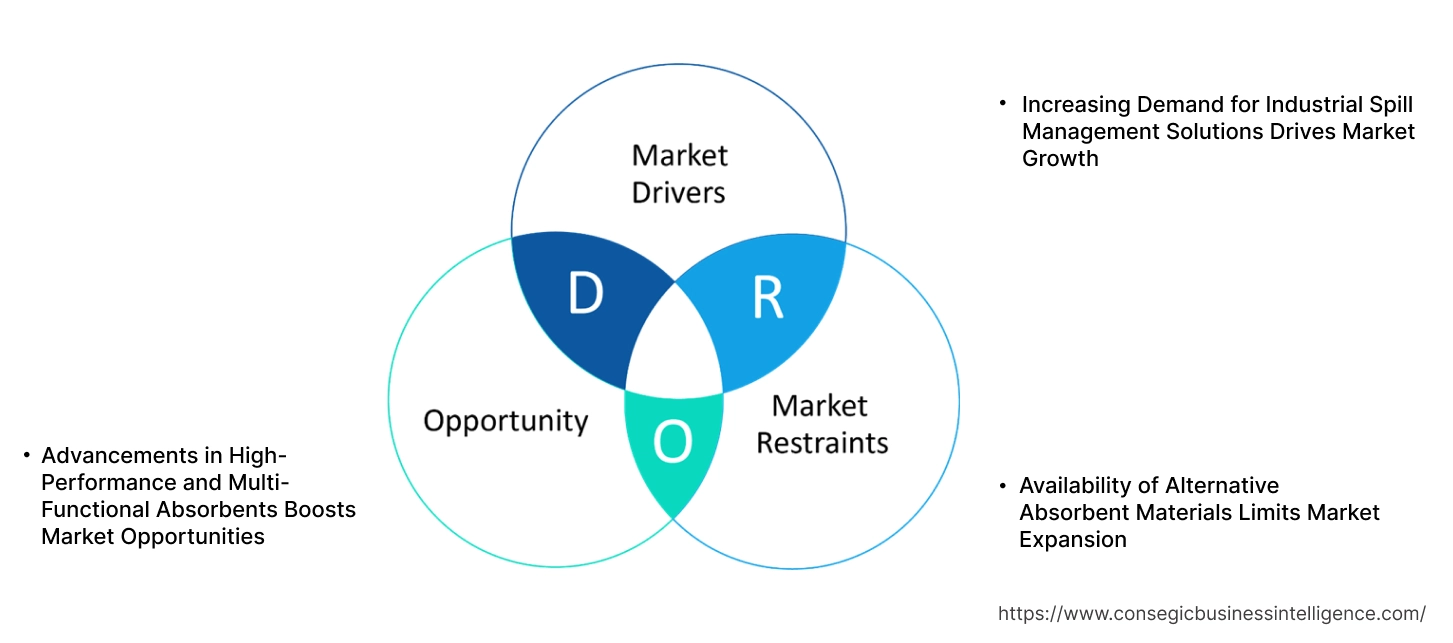
Increasing Demand for Industrial Spill Management Solutions Drives Market Growth
Oil and gas, manufacturing, and chemical processing sectors require highly absorbent materials to manage oil spills, hazardous liquid leaks, and workplace safety compliance. Clay absorbers are widely used for their cost-effectiveness, high absorption capacity, and non-toxic properties, making them essential for environmental cleanup and industrial hygiene programs. The increasing focus on workplace safety regulations and environmental protection standards is further accelerating their use in hazardous material containment and waste management systems. Additionally, the growth of automotive service centers, laboratories, and warehousing facilities is driving demand for reliable and easy-to-use absorbent solutions. As industries continue to seek efficient and sustainable spill control measures, these factors are expected to contribute to clay absorber market expansion, reinforcing its role in industrial safety and spill response applications.
Key Restraints:
Availability of Alternative Absorbent Materials Limits Market Expansion
Alternative materials such as superabsorbent polymers, bio-based absorbents and synthetic spill control products offer higher efficiency, reusability, and reduced weight, making them more appealing to industries looking for advanced spill containment solutions. Synthetic absorbents, including polypropylene-based pads and mats, provide faster absorption rates and lower dust emissions, making them preferable in health-sensitive environments. Additionally, bio-based absorbents derived from corn husks, coconut fibers, and cellulose are gaining traction as environmentally sustainable options. As companies prioritize eco-friendly and lightweight alternatives, traditional clay-based absorbents face competition in price-sensitive and innovation-driven markets. Manufacturers must invest in product differentiation and enhanced absorbency features to maintain market relevance. Addressing these challenges is crucial for ensuring the clay absorber market growth, allowing for continued expansion in industrial and environmental applications.
Future Opportunities:
Advancements in High-Performance and Multi-Functional Absorbents Boosts Market Opportunities
Manufacturers are developing enhanced clay-based materials with greater absorption capacity, low dust emission, and superior spill containment efficiency. These improvements make absorbents more effective in oil refineries, chemical plants, and hazardous material storage facilities, where rapid spill control is essential. Additionally, the growth of smart and specialized absorbent solutions, such as odor-neutralizing clay formulas and moisture-resistant coatings, is expanding the potential applications in industrial hygiene and waste disposal sectors. Research into lightweight, biodegradable, and reusability-enhanced absorbents is further strengthening market adoption. As industries seek highly efficient and cost-effective spill management solutions, these advancements are expected to create new clay absorber market opportunities, supporting sustainable and performance-driven innovations in industrial and environmental cleanup solutions.
Clay Absorber Market Segmental Analysis :
By Product Type:
By product type, the clay absorber market is segmented into granular, powdered and pelletized clay absorbers.
The granular type segment held the largest clay absorber market share in 2024.
- The granular form is widely used in industrial spill cleanup, automotive applications, and pet absorbents, making them the most commonly used form.
- The need for highly effective, fast-acting absorbents is driving the adoption of granular formulations across manufacturing and commercial cleaning industries.
- Clay absorber market analysis highlights that advancements in granule processing have improved absorption capacity and dust control, making them ideal for various applications.
- As per market trends, the increasing use of granular clay in oil spill remediation and industrial waste cleanup is further boosting market demand.
The pelletized clay absorber segment is expected to experience the fastest CAGR during the forecast period.
- The pelletized form provides enhanced absorbency, durability, and controlled release, making them particularly useful in cat litter and environmental cleanup applications.
- The need for efficient and eco-friendly absorbents is rising as industries and households look for sustainable alternatives to synthetic materials.
- Segmental trends indicate that pelletized formulations are gaining popularity in pet care and agricultural soil amendments, ensuring better usability and disposal.
- Thus, with increasing concerns about eco-friendly waste management, this segment is driving clay absorber market growth.
By Material Type:
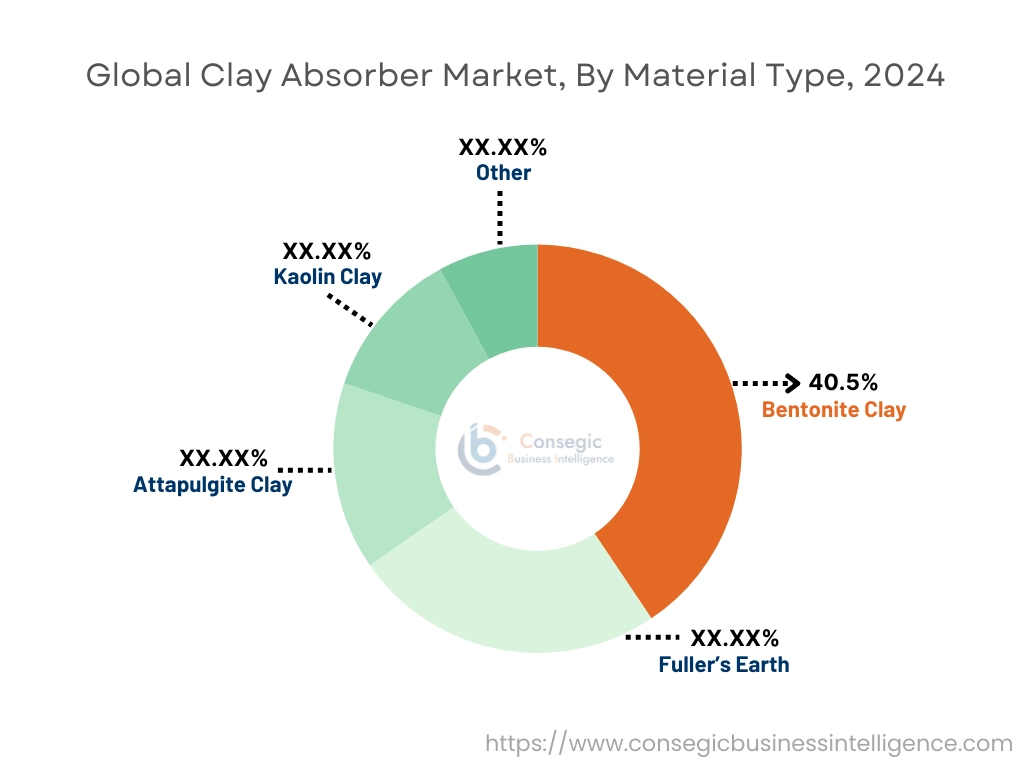
By material type, the market is categorized into bentonite clay, fuller’s earth, attapulgite clay, kaolin clay, and others.
The bentonite clay segment held the largest share of 40.5% in 2024.
- Bentonite clay is widely used in oil spill cleanup, cat litter, and industrial absorbents, ensuring its dominance in the market.
- The need for high-absorbency clay materials is increasing, particularly in hazardous waste containment and industrial cleaning.
- Segmental analysis indicates that bentonite clay’s superior swelling and absorption properties make it ideal for use in various industries.
- As per clay absorber market trends, manufacturers are focusing on enhancing bentonite-based formulations, improving efficiency in moisture and liquid absorption.
The attapulgite clay segment is expected to achieve the fastest CAGR during the forecast period.
- Attapulgite clay is widely used in specialty absorbent applications, including chemical filtration, soil amendments, and pharmaceutical applications.
- The need for low-dust, high-performance absorbents is rising in pet care, food processing, and agricultural industries.
- Market trends indicate that attapulgite-based formulations are gaining traction in eco-friendly absorbent solutions, ensuring sustainability in waste management.
- Thus, with increasing need for high-performance absorbents, this segment is expected to contribute significantly to clay absorber market expansion.
By Application:
By application, the market is segmented into oil & chemical spill absorption, industrial waste management, cat litter & pet absorbents, agricultural soil amendments, food processing & filtration, and others.
The oil & chemical spill absorption segment held the largest clay absorber market share in 2024.
- These absorbents are widely used in oil spill response, chemical leak containment, and hazardous waste management, ensuring their dominant presence in industrial applications.
- The need for effective spill response materials is growing in automotive, oil & gas, and chemical manufacturing industries.
- Clay absorber market analysis highlights that regulatory standards for environmental safety are driving increased adoption of clay-based spill control products.
- As per market trends, industries are shifting towards natural, biodegradable absorbents, ensuring compliance with environmental regulations.
The cat litter & pet absorbents segment is anticipated to experience the fastest CAGR during the forecast period.
- Clay-based cat litter products remain a staple in pet care, offering high absorption, odor control, and affordability.
- The need for dust-free and eco-friendly pet absorbents is rising as consumers seek natural and non-toxic alternatives to synthetic materials.
- Segmental trends analysis highlights innovations in lightweight and fragrance-infused absorbents are improving consumer convenience.
- Thus, with increasing pet ownership and rising consumer awareness of sustainable pet products, this segment is contributing to market growth.
By End-Use Industry:
Based on end-use industry, the market is segmented into automotive & transportation, industrial & manufacturing, oil & gas, agriculture, food & beverage, household & commercial cleaning, and others.
The industrial & manufacturing segment held the largest share in 2024.
- They play a crucial role in factory maintenance, spill control, and industrial cleaning, ensuring their widespread use in heavy manufacturing industries.
- The need for cost-effective, highly absorbent materials is increasing as industries focus on improving workplace safety and regulatory compliance.
- Segmental analysis suggests that the adoption of industrial-grade absorbents is expanding, particularly in high-risk manufacturing environments.
- As per market trends, automation and smart spill-control technologies are being integrated into industrial maintenance processes.
The household & commercial cleaning segment is expected to have the fastest CAGR during the forecast period.
- Clay-based absorbents are widely used in residential cleaning products, commercial cleaning services, and odor control solutions, ensuring steady market growth.
- The need for eco-friendly, natural cleaning materials is rising as consumers seek chemical-free and biodegradable alternatives.
- Clay absorber market trends suggest that innovations in packaging and scent-enhanced formulations are boosting the appeal of clay-based household products.
- Therefore, with a rising focus on sustainability and non-toxic homecare solutions, this segment is contributing to market expansion.
Regional Analysis:
The regions covered are North America, Europe, Asia Pacific, the Middle East and Africa, and Latin America.
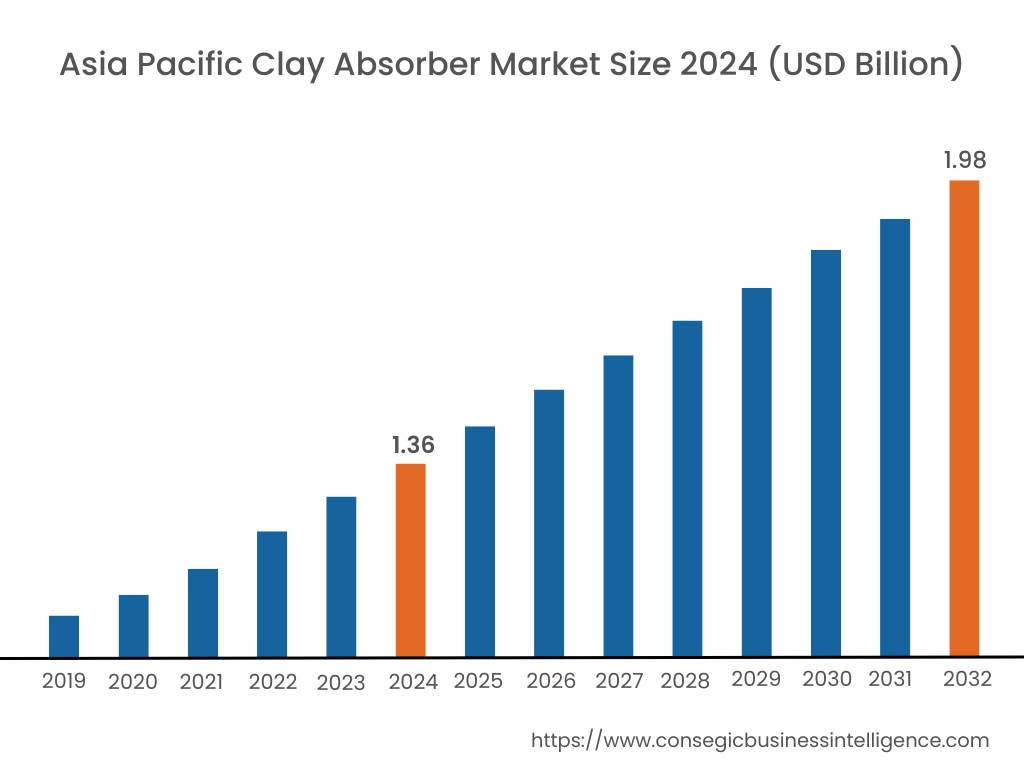
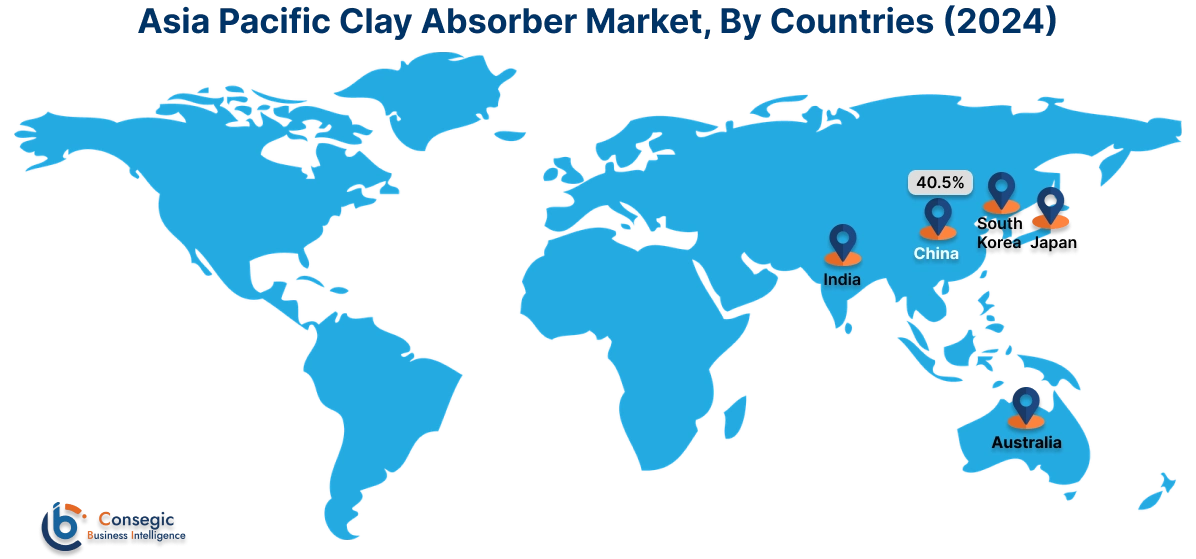
Asia-Pacific region was valued at USD 1.36 Billion in 2024. Moreover, it is projected to grow by USD 1.40 Billion in 2025 and reach over USD 1.98 Billion by 2032. Out of this, China accounted for the maximum revenue share of 40.5%. The Asia-Pacific region is witnessing rapid growth in the clay absorber industry, primarily due to industrial expansion and increasing awareness of environmental sustainability. Countries such as China, India, and Japan are experiencing heightened demand for clay absorbers in various applications, including oil and gas, water treatment, and pet care. The region's focus on adopting eco-friendly materials aligns with the global shift towards sustainable solutions, thereby driving market expansion.
North America is estimated to reach over USD 2.11 Billion by 2032 from a value of USD 1.53 Billion in 2024 and is projected to grow by USD 1.57 Billion in 2025. In North America, the market is expanding due to heightened environmental consciousness and the implementation of strict industrial safety standards. The United States, in particular, has seen a surge in requirement of clay absorbers, especially in sectors such as manufacturing and automotive, where effective spill management is crucial for safety and regulatory compliance. This trend presents a significant clay absorber market opportunity for manufacturers focusing on eco-friendly and efficient absorbent solutions.
Europe exhibits a substantial market for clay absorbers, with countries like Germany, France, and the United Kingdom leading in adoption. The region's stringent environmental regulations and commitment to sustainable industrial practices drive the need for natural and biodegradable absorbents. The growing emphasis on workplace safety and environmental protection further amplifies the clay absorber market demand in this region.
In Latin America, the market for clay absorbers is gradually gaining traction, influenced by the growing adoption of eco-friendly materials. The region's increasing industrial activities and environmental initiatives contribute to the demand for natural absorbents, presenting opportunities for market growth.
The clay absorber market demand in the Middle East and Africa region is emerging, with growth potential linked to the development of industrial sectors and the adoption of sustainable practices. The region's focus on environmental protection and resource conservation drives the need for effective absorbent materials, offering promising prospects for market expansion.
Top Key Players & Market Share Insights:
The clay absorber market is highly competitive with major players providing products and services to the national and international markets. Key players are adopting several strategies in research and development (R&D), product innovation, and end-user launches to hold a strong position in the global clay absorber market. Key players in the clay absorber industry include -
- Clariant (Switzerland)
- Imerys (France)
- EP Minerals (USA)
- Manek Active Clay Pvt. Ltd. (India)
- BASF SE (Germany)
- Tolsa (Spain)
- Taiko Group (Malaysia)
- Trisoplast (Netherlands)
- ENVIGEO (Slovakia)
- German Water & Energy (GWE) (Germany)
Recent Industry Developments :
Product Launches:
- In February 2021, Clariant launched a natural VOC-trapping DESVOCANT adsorbents for packaging & cargo shipments. This product minimizes the exposure of VOC compounds to shipment handlers, merchants and consumers from enclosed containers.
Clay Absorber Market Report Insights:
| Report Attributes | Report Details |
| Study Timeline | 2019-2032 |
| Market Size in 2032 | USD 6.50 Billion |
| CAGR (2025-2032) | 4.4% |
| By Product Type |
|
| By Material Type |
|
| By Application |
|
| By End-Use Industry |
|
| By Region |
|
| Key Players |
|
| North America | U.S. Canada Mexico |
| Europe | U.K. Germany France Spain Italy Russia Benelux Rest of Europe |
| APAC | China South Korea Japan India Australia ASEAN Rest of Asia-Pacific |
| Middle East and Africa | GCC Turkey South Africa Rest of MEA |
| LATAM | Brazil Argentina Chile Rest of LATAM |
| Report Coverage |
|
Key Questions Answered in the Report
How big is the Clay Absorber Market? −
Clay Absorber Market size is estimated to reach over USD 6.50 Billion by 2032 from a value of USD 4.62 Billion in 2024 and is projected to grow by USD 4.74 Billion in 2025, growing at a CAGR of 4.4% from 2025 to 2032.
What specific segmentation details are covered in the Clay Absorber Market report? +
The Clay Absorber market report includes specific segmentation details for product type, material type, end-use industry and application.
What are the end-use industries in the Clay Absorber Market? +
The end-use industries of the Clay Absorber market are automotive & transportation, industrial & manufacturing, oil & gas, agriculture, food & beverage, household & commercial cleaning, others.
Who are the major players in the Clay Absorber Market? +
The key participants in the Clay Absorber market are Clariant (Switzerland), Imerys (France), BASF SE (Germany), EP Minerals (USA), Tolsa (Spain), Taiko Group (Malaysia), Trisoplast (Netherlands), ENVIGEO (Slovakia), German Water & Energy (GWE) (Germany) and Manek Active Clay Pvt. Ltd. (India).
Overview
Reputation & Certifications


Our Services
- Market Intelligence & Forecasting
- Custom Research Solutions
- Market Entry Strategy
- Competitive Intelligence
- Customer Insights
- Industry Innovation Analysis
- Investment Advisory