Jump to Content
Fire Truck Market Size & Industry Share - Growth Trends & Forecasts (2026 - 2034)
Fire Truck Market Size:
Fire Truck Market size is estimated to reach over 15,578.25 (US$M) by 2034 from a value of 9,704.06 (US$M) in 2025 and is projected to grow by 10,228.07 (US$M) in 2026, growing at a CAGR of 5.4% from 2026 to 2034, according to a recent report from Consegic Business Intelligence.
Fire Truck Market Scope & Overview:
A fire truck is a specialized vehicle designed to assist in firefighting operations and emergency response. These vehicles are equipped with essential firefighting equipment such as water pumps, hoses, ladders, and storage compartments for tools and protective gear. Additionally, modern fire trucks integrate advanced systems like water tanks, foam suppression systems, and communication devices to enhance operational efficiency during fire emergencies.
Fire trucks are categorized based on their specific functions, including pumper trucks, aerial ladder trucks, rescue trucks, and tanker trucks, each tailored to meet unique operational requirements. These vehicles are constructed to endure challenging environments and ensure reliability in critical situations. Fire trucks also incorporate features like advanced safety systems, ergonomic designs, and high-performance engines to support firefighting crews during emergency operations.
End-users of these vehicles include fire departments, municipal bodies, industrial facilities, and airports, which depend on reliable fire trucks for effective emergency response and fire suppression in various scenarios.

Fire Truck Market Dynamics - (DRO) :
Key Drivers:
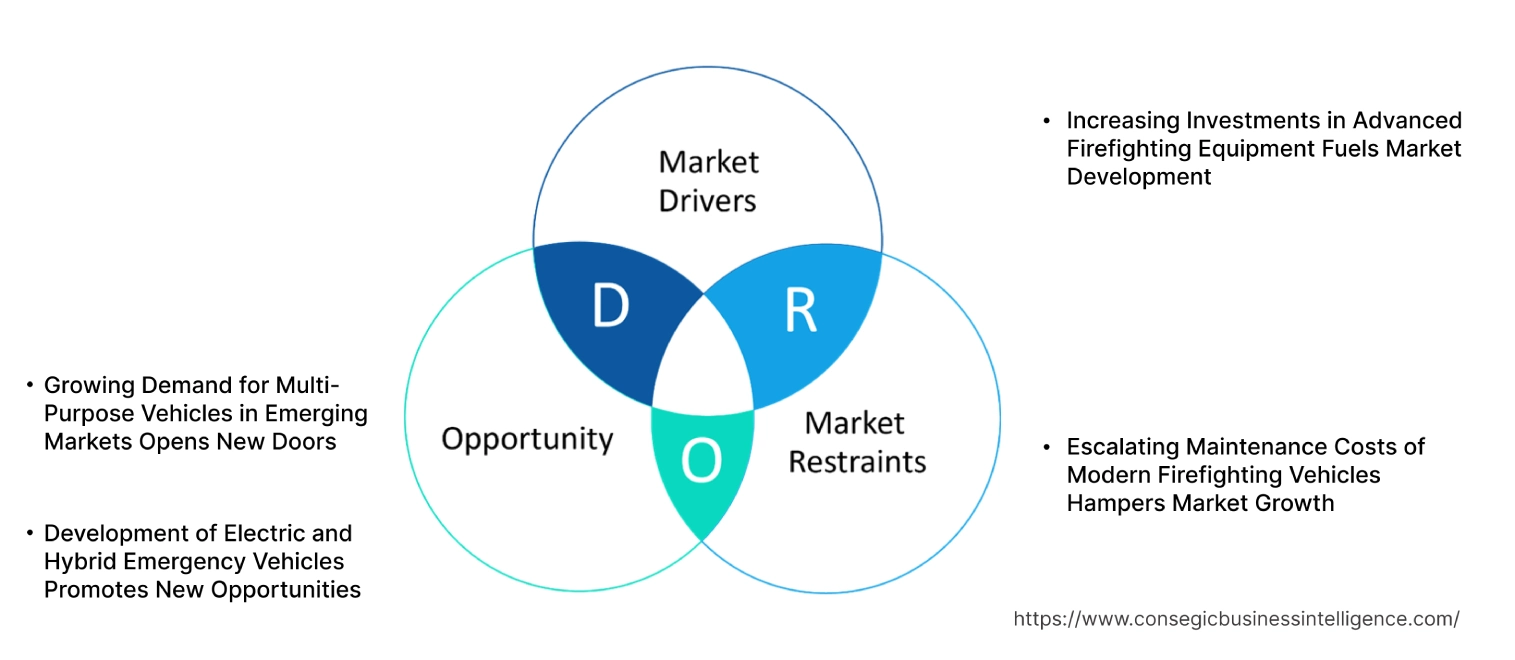
Increasing Investments in Advanced Firefighting Equipment Fuels Market Development
The growing demand for advanced firefighting equipment and technologies is a key driver for market growth. Modern firefighting vehicles are equipped with advanced features such as high-pressure water pumps, foam systems, thermal imaging cameras, and integrated communication systems to improve operational efficiency. These technologies enable quicker response times and more effective handling of fire emergencies, particularly in high-risk areas like industrial zones and densely populated urban regions. Governments and municipalities are increasingly investing in technologically advanced firefighting solutions to enhance public safety, driving fire truck market demand.
Key Restraints :
Escalating Maintenance Costs of Modern Firefighting Vehicles Hampers Market Growth
The maintenance costs associated with advanced firefighting vehicles pose a significant challenge to their adoption, especially by smaller municipalities and fire departments with limited budgets. These vehicles are equipped with specialized components, such as aerial ladders, high-pressure pumps, electronic control units, and integrated communication systems, all of which require regular inspections and maintenance to ensure operational reliability. The complexity of these components often necessitates specialized training for technicians and access to proprietary tools, further increasing maintenance expenses. Additionally, advanced firefighting vehicles equipped with modern technologies, such as thermal imaging systems and foam suppression units, demand routine calibration and software updates, adding to operational costs. Over time, wear and tear on critical systems like hydraulics and electronics leads to costly repairs or replacements. This financial burden is particularly problematic for regions with aging fleets, where vehicles require more frequent maintenance to remain functional. The high costs associated with modern firefighting vehicles deter municipalities from investing in advanced technologies, potentially limiting fire truck market growth.
Future Opportunities :
Development of Electric and Hybrid Emergency Vehicles Promotes New Opportunities
The increasing focus on sustainability in emergency services presents an opportunity for the development of electric and hybrid firefighting vehicles. These vehicles offer reduced emissions, lower operating costs, and quieter operation, making them particularly suitable for urban firefighting scenarios. Governments and municipalities are providing incentives for adopting greener technologies in public services, encouraging manufacturers to invest in the development of energy-efficient firefighting vehicles. The integration of advanced battery technologies and renewable energy systems is expected to significantly drive innovation in the firefighting industry, facilitating the adoption of sustainable firefighting solutions. This shift toward green technologies is poised to contribute to fire truck market expansion, as municipalities and fire departments increasingly prioritize eco-friendly solutions to enhance operational efficiency while meeting environmental standards.
Growing Demand for Multi-Purpose Vehicles in Emerging Markets Opens New Doors
Emerging economies are witnessing rising demand for multi-purpose emergency vehicles that combine firefighting capabilities with other emergency response functions, such as rescue and medical services. These vehicles reduce fleet size and operational costs while enhancing versatility and efficiency, making them an attractive option for budget-conscious municipalities. Manufacturers are increasingly designing modular vehicles that will be customized for various emergency scenarios, catering to the diverse needs of these growing markets. This trend is expected to drive potential fire truck market opportunities, particularly in regions like Asia-Pacific, Latin America, and Africa.
Fire Truck Market Segmental Analysis :
By Type:
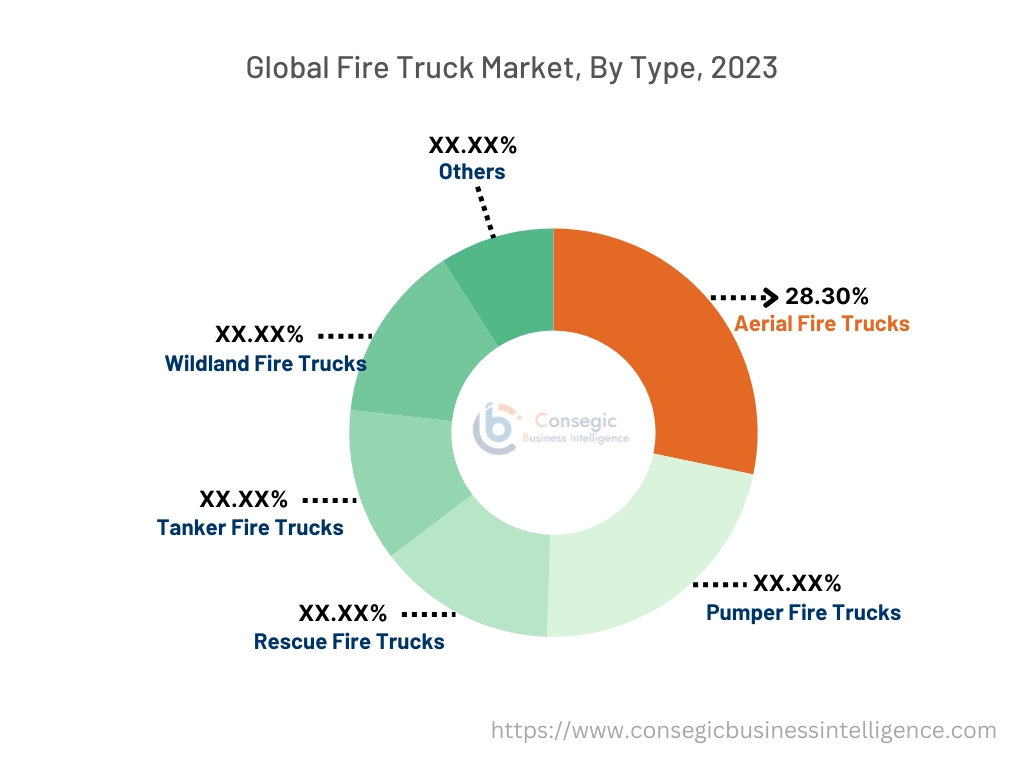
Based on the type, the market is segmented into Aerial Fire Trucks, Pumper Fire Trucks, Rescue Fire Trucks, Tanker Fire Trucks, Wildland Fire Trucks, and Others.
The Aerial Fire Trucks segment accounted for the largest revenue of 28.30% of the total fire truck market share in 2023.
- Aerial trucks are engineered with extendable ladders and platforms to handle complex fire scenarios in high-rise buildings, industrial facilities, and densely populated urban areas.
- These vehicles are equipped with advanced water and foam delivery systems, capable of reaching greater heights and distances, ensuring efficiency in critical firefighting missions.
- The use of advanced hydraulic systems and automated controls in modern aerial trucks allows precise operation, enhancing safety and reliability during emergencies.
- Increasing investments in urban infrastructure and the rising number of high-rise constructions globally are further fueling the adoption of aerial trucks.
- As per fire truck market analysis, the segment’s dominance is driven by the unique capabilities of aerial trucks to address high-altitude fire incidents, making them a critical asset for urban firefighting services.
The Tanker Fire Trucks segment is expected to register the fastest CAGR during the forecast period.
- Tanker trucks are designed to transport large volumes of water, often exceeding 1000 gallons, to areas without adequate water supply, such as rural regions and industrial zones.
- These trucks play a pivotal role in supporting municipal and industrial firefighting teams during prolonged fire incidents where continuous water supply is essential.
- Advancements in tanker designs, including lightweight materials and enhanced mobility, are improving the operational efficiency of these vehicles.
- As per fire truck market trends, the increasing need for robust firefighting solutions in remote and underdeveloped areas supports the rapid growth of the tanker fire trucks segment.
By Application:
Based on the application, the market is segmented into Municipal, Industrial, Commercial, Airport Vehicle Security, and Military.
The Municipal segment accounted for the largest revenue of the total fire truck market share in 2023.
- Municipal firefighting vehicles are designed to handle a variety of fire scenarios, from residential and commercial fires to large-scale urban disasters.
- Government initiatives to upgrade municipal firefighting fleets with advanced technology and improved equipment are driving significant investments in this segment.
- The integration of multifunctional features, such as combined pumper and rescue capabilities, enhances the operational efficiency of municipal fire departments.
- The growing urbanization and increasing need for disaster preparedness are key drivers of the fire truck market growth. As cities expand and face more frequent natural disasters, municipalities are investing in advanced firefighting vehicles to improve response times, enhance safety, and strengthen disaster management capabilities.
The Airport Vehicle Security segment is expected to register the fastest CAGR during the forecast period.
- Specialized firefighting vehicles for airport security are equipped with high-capacity foam systems, rapid acceleration capabilities, and thermal imaging for aviation-related fire emergencies.
- These vehicles are tailored to handle specific threats, such as fuel-based fires on runways, aircraft fires, and emergencies in hangars.
- Airports are increasingly investing in advanced firefighting systems to meet stringent international safety standards and improve overall emergency response capabilities.
- The rise in air travel and global airport expansion is fueling fire truck market expansion with a focus on specialized vehicles for aviation safety.
By Capacity
Based on the capacity, the market is segmented into Up to 500 Gallons, 500-1000 Gallons, and above 1000 Gallons.
The 500-1000 Gallons segment held the largest revenue share in 2023.
- Firefighting vehicles with a capacity of 500-1000 gallons are highly versatile, making them ideal for medium-scale operations in urban and suburban settings.
- These vehicles are extensively used by municipal and industrial fire departments due to their ability to provide an optimal balance between water storage and mobility.
- Technological advancements in pump systems and water delivery mechanisms enhance the efficiency of this capacity range, ensuring swift response during emergencies.
- The widespread use of medium-capacity vehicles is driving fire truck market demand due to their versatility in addressing various firefighting needs, such as urban residential and small industrial fires, offering an efficient solution for municipalities and smaller-scale operations.
The Above 1000 Gallons segment is expected to register the fastest CAGR during the forecast period.
- High-capacity firefighting vehicles are critical for large-scale fire incidents, such as industrial facility fires, wildfires, and emergencies in rural areas with limited access to water sources.
- These vehicles are often equipped with advanced pumping systems capable of delivering high-pressure water and foam over long distances.
- Increasing industrialization and infrastructure development in emerging economies are driving the adoption of large-capacity fire trucks to mitigate fire risks effectively.
- The focus on improving disaster management, especially in areas prone to large-scale emergencies, presents fire truck market opportunities for the above 1000 gallons segment, which is crucial for handling more significant incidents and enhancing firefighting effectiveness in such regions.
By End-User:
Based on the end-user, the market is segmented into Government & Municipal Bodies, Industrial Facilities, and Airports.
The Government & Municipal Bodies segment dominated the market in 2023.
- Government and municipal organizations are the primary purchasers of firefighting vehicles, ensuring community safety and disaster management preparedness.
- Large-scale government investments in modernizing firefighting fleets, coupled with stringent safety regulations, drive the dominance of this segment.
- Collaboration between municipal bodies and manufacturers to adopt customized solutions tailored to specific urban and rural needs enhances the segment’s position.
- As per fire truck market analysis, the increasing emphasis on urban safety and proactive disaster management strategies is propelling the adoption of advanced firefighting vehicles by municipal bodies.
The Airports segment is expected to register the fastest CAGR during the forecast period.
- Airports require high-performance firefighting vehicles with specialized equipment, including large foam tanks, rapid acceleration capabilities, and advanced fire suppression systems.
- The adoption of cutting-edge technologies, such as infrared cameras and chemical-resistant materials, enhances the operational efficiency of airport firefighting vehicles.
- The rapid progress of this segment is fueled by increasing global air traffic, extension of airport infrastructure, and compliance with international aviation safety standards.
- As per fire truck market trends, airports across developing and developed regions are investing in modern firefighting fleets to ensure rapid and efficient response during emergencies.
Regional Analysis:
The regions covered are North America, Europe, Asia Pacific, the Middle East and Africa, and Latin America.
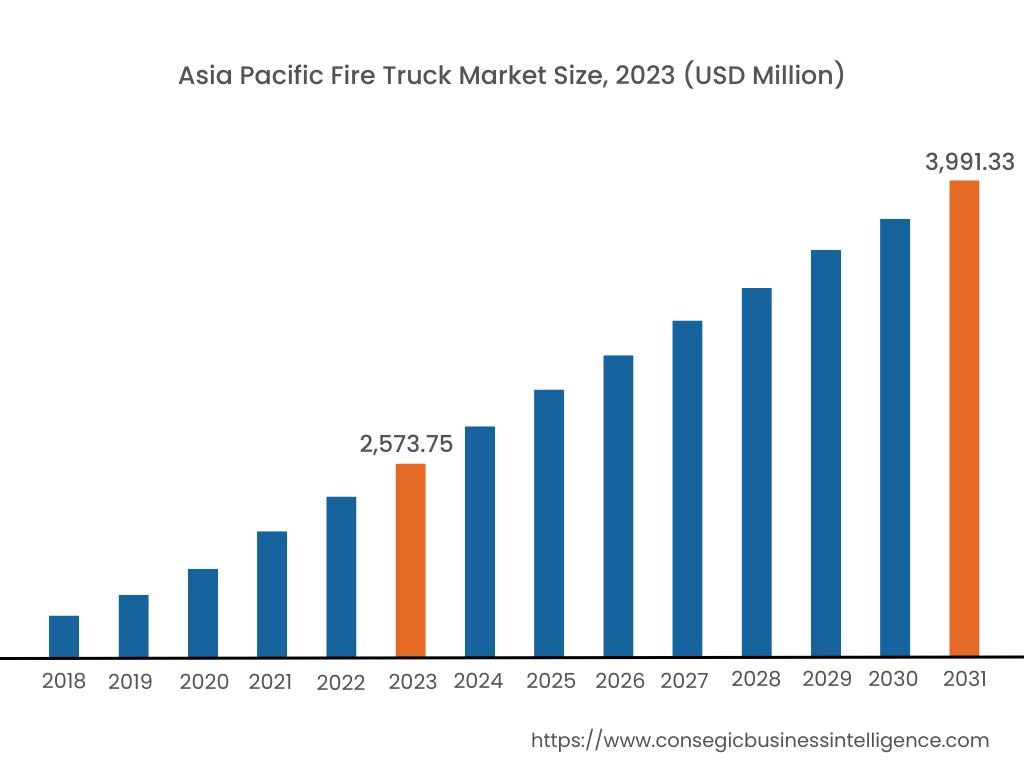
Asia Pacific region was valued at USD 2,573.75 Million in 2023. Moreover, it is projected to grow by USD 2,670.74 Million in 2024 and reach over USD 3,991.33 Million by 2031. Out of these, China accounted for the largest share of 41.2% in 2023. Asia-Pacific is witnessing the fastest growth in the market, driven by rapid urbanization and industrialization in countries like China, India, and Japan. The region has become a global hub for manufacturing and industrial activities, leading to a higher risk of fire incidents. The increasing investments in infrastructure development and the implementation of stringent fire safety regulations are further propelling market development.

North America is estimated to reach over USD 4,377.16 Million by 2031 from a value of USD 2,908.53 Million in 2023 and is projected to grow by USD 3,010.56 Million in 2024. North America holds a substantial share of the market, primarily due to the robust infrastructure and stringent fire safety standards. The United States, in particular, leads the market with a strong need for advanced firefighting vehicles equipped with the latest technologies. The focus on enhancing emergency response capabilities and replacing aging fleets has led to increased procurement of modern fire trucks.
Europe represents a significant portion of the global fire market, with countries like Germany, France, and the United Kingdom leading in terms of adoption and innovation. The region benefits from a well-established fire safety infrastructure and a strong emphasis on public safety. The demand for specialized fire trucks, such as aerial platforms and rescue vehicles, is increasing, driven by the need to address complex fire scenarios in urban areas.
The Middle East & Africa region shows promising potential in the market, particularly in countries like Saudi Arabia, the United Arab Emirates, and South Africa. Increasing investments in infrastructure projects and the expansion of the construction industry are driving the need for fire trucks. The focus on diversifying economies and reducing dependence on oil revenues has led to growth in the industrial sector, thereby increasing the need for effective fire safety measures.
Latin America is an emerging market for fire trucks, with Brazil and Mexico being the primary growth drivers. The rising adoption of fire safety measures, improving infrastructure, and increasing focus on enhancing emergency response capabilities contribute to the market’s enlargement. Government initiatives aimed at modernizing fire departments and promoting public safety are supporting market progress.
Top Key Players & Market Share Insights:
The Fire Truck market is highly competitive with major players providing products and services to the national and international markets. Key players are adopting several strategies in research and development (R&D), product innovation, and end-user launches to hold a strong position in the global Fire Truck market. Key players in the Fire Truck industry include -
- Rosenbauer International AG (Austria)
- Pierce Manufacturing Inc. (USA)
- E-ONE (USA)
- KME Fire Apparatus (USA)
- Ferrara Fire Apparatus (USA)
- Sutphen Corporation (USA)
- GIMAEX (France)
- Bristol Fire Engineering (United Arab Emirates)
- Romprim (Romania)
- Fire & Safety Services, Ltd. (USA)
Recent Industry Developments :
Investments & Funding:
- In March 2023, The St. Paul Fire Department invested in the future with the acquisition of an electric fire truck from Rosenbauer America. This innovative vehicle, part of a broader push for sustainability and reduced emissions, integrates advanced technology designed to improve firefighting operations while minimizing environmental impact. The move marks a significant step in modernizing firefighting infrastructure.
Product Launches:
- In January 2024, Volvo Trucks unveiled its first fully electric truck, designed for cleaner and safer urban transport. This vehicle is optimized for efficient city driving, offering reduced emissions and better safety features for both drivers and pedestrians. The launch marks a significant step in Volvo’s commitment to sustainable transport solutions in urban environments.
Partnerships & Collaborations:
- In November 2023, SRP partnered with the Gilbert Fire & Rescue Department to launch Arizona's first electric fire truck. This truck, built by Pierce Manufacturing, boasts zero emissions, quieter operations, and smoother acceleration compared to diesel trucks. SRP provided $30,000 to support the project, including rebates for the truck’s charging solution. The fire truck offers enhanced safety, and lower maintenance costs, and can be fully charged in two hours.
Fire Truck Market Report Insights :
| Report Attributes | Report Details |
| Study Timeline | 2021-2034 |
| Market Size in 2034 | USD 15,578.25 Million |
| CAGR (2026-2034) | 5.40% |
| Base Year | 2025 |
| By Type |
|
| By Application |
|
| By Capacity |
|
| By End-User |
|
| By Region |
|
| Key Players |
|
| North America | U.S. Canada Mexico |
| Europe | U.K. Germany France Spain Italy Russia Benelux Rest of Europe |
| APAC | China South Korea Japan India Australia ASEAN Rest of Asia-Pacific |
| Middle East and Africa | GCC Turkey South Africa Rest of MEA |
| LATAM | Brazil Argentina Chile Rest of LATAM |
| Report Coverage |
|
Key Questions Answered in the Report
How big is the Fire Truck market? −
Fire Truck Market size is estimated to reach over USD 13,304.45 Million by 2031 from a value of USD 8,750.30 Million in 2023 and is projected to grow by USD 9,064.96 Million in 2024, growing at a CAGR of 5.4% from 2024 to 2031.
What specific segmentation details are covered in the Fire Truck Market report? +
The Fire Truck market report includes segmentation details for type (aerial fire trucks, pumper fire trucks, rescue fire trucks, tanker fire trucks, wildland fire trucks, and others), application (municipal, industrial, commercial, airport vehicle security, military), capacity (up to 500 gallons, 500-1000 gallons, above 1000 gallons), end-user (government & municipal bodies, industrial facilities, airports), and region.
Which is the fastest-growing segment in the Fire Truck market? +
The Airport Vehicle Security segment is expected to register the fastest CAGR during the forecast period, driven by the growing demand for specialized firefighting vehicles for aviation safety.
Who are the major players in the Fire Truck market? +
The major players in the Fire Truck market include Rosenbauer International AG (Austria), Pierce Manufacturing Inc. (USA), E-ONE (USA), KME Fire Apparatus (USA), Ferrara Fire Apparatus (USA), Sutphen Corporation (USA), GIMAEX (France), Bristol Fire Engineering (United Arab Emirates), Romprim (Romania), and Fire & Safety Services, Ltd. (USA).
Overview
Reputation & Certifications


Our Services
- Market Intelligence & Forecasting
- Custom Research Solutions
- Market Entry Strategy
- Competitive Intelligence
- Customer Insights
- Industry Innovation Analysis
- Investment Advisory