Jump to Content
Foldable Electric Vehicle Market - Size, Share, Industry Trends, and Forecasts (2025-2032)
Foldable Electric Vehicle Market Size:
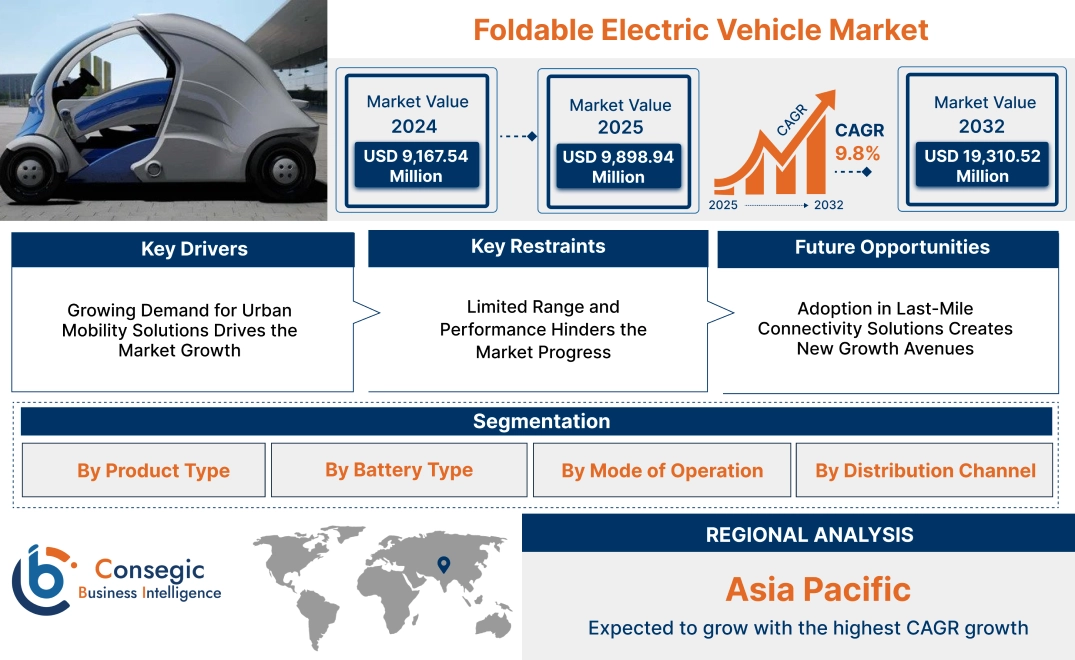
Foldable Electric Vehicle Market size is estimated to reach over USD 19,310.52 Million by 2032 from a value of USD 9,167.54 Million in 2024 and is projected to grow by USD 9,898.94 Million in 2025, growing at a CAGR of 9.8% from 2025 to 2032.
Foldable Electric Vehicle Market Scope & Overview:
A foldable electric vehicle is a compact mode of transportation designed to provide convenience and portability. These vehicles are engineered with foldable frames, allowing for easy storage in small spaces such as car trunks, offices, or public areas. They are particularly suited for short-distance commuting and urban mobility.
These vehicles are equipped with rechargeable batteries, lightweight designs, and efficient motors to ensure eco-friendly and reliable operation. They come in various forms, including foldable e-bikes and e-scooters, and often include smart features like GPS connectivity and adjustable speed controls to enhance user experience.
End-users include urban commuters and individuals seeking portable, sustainable transportation options. These vehicles are integral to addressing modern urban mobility challenges while offering practical and space-saving solutions.
Foldable Electric Vehicle Market Dynamics - (DRO) :
Key Drivers:
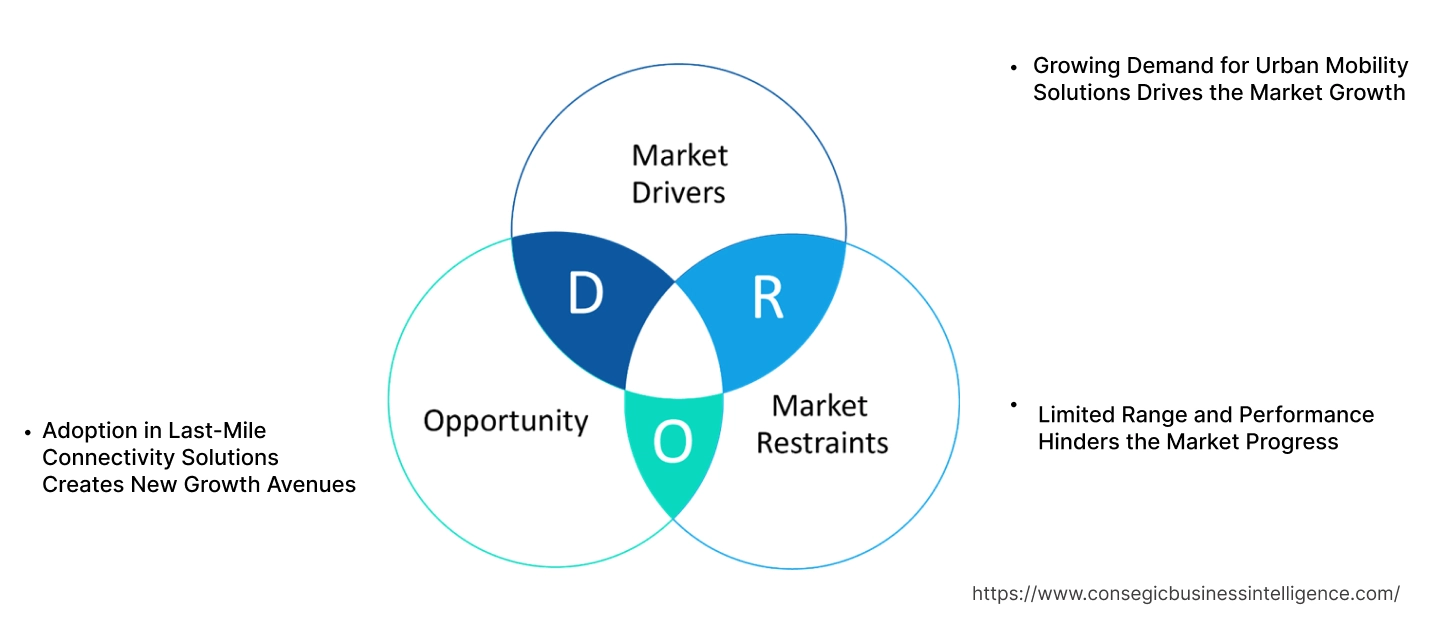
Growing Demand for Urban Mobility Solutions Drives the Market Growth
The growing demand for compact and efficient transportation in urban areas is fueling the foldable electric vehicle market expansion. These vehicles provide a practical solution for city dwellers dealing with limited parking and storage space. Their compact design allows users to easily fold and store them, offering significant convenience for commuters who need a flexible, lightweight mode of transport for short distances. In densely populated cities where traffic congestion and public transportation inefficiencies are common, these vehicles serve as a smart alternative for quick and convenient travel. With rising environmental concerns and the push for more sustainable transport options, the popularity of such vehicles is expected to grow, offering an eco-friendly and practical solution for daily commuting and urban mobility. Their ease of use and ability to navigate tight spaces in crowded cities make them an ideal choice for urban commuters.
Key Restraints:
Limited Range and Performance Hinders the Market Progress
While these compact electric vehicles excel in short-distance urban travel, their limited range and performance make them unsuitable for long-distance use. The battery capacity of these vehicles is designed for quick commutes and low-energy consumption, restricting their ability to travel long distances without requiring frequent recharging. For consumers looking for versatile transportation options that accommodate longer trips or higher speeds, this limitation becomes a significant constraint. Additionally, their performance decrease when carrying heavier loads or traveling on uphill routes, further reducing their effectiveness in more demanding environments. This restricts their appeal to users who need a more flexible solution for various travel scenarios, limiting their potential for broader adoption outside of urban commuting or industry specific niche applications. The lack of sufficient range and power for extended journeys makes these vehicles less practical for consumers seeking an all-encompassing transportation solution, thereby hampering the foldable electric vehicle market growth.
Future Opportunities :
Adoption in Last-Mile Connectivity Solutions Creates New Growth Avenues
The rise of e-commerce and the expansion of delivery services have significantly increased the need for efficient last-mile connectivity solutions. Compact and lightweight electric vehicles are ideal for delivery personnel, enabling them to navigate congested urban areas quickly and effectively. These vehicles offer an eco-friendly alternative to traditional delivery trucks, reducing carbon emissions and contributing to more sustainable urban transportation. Their ability to easily maneuver through traffic and their small footprint make them perfect for navigating crowded streets, especially in areas with limited parking or access. As the demand for faster, more efficient deliveries grows, these vehicles provide a practical and cost-effective solution for businesses looking to optimize their operations while reducing environmental impact. Their integration into last-mile delivery fleets offers a significant opportunity to improve delivery efficiency in urban environments. Thus, the aforementioned factors are boosting new foldable electric vehicle market opportunities.
Foldable Electric Vehicle Market Segmental Analysis :
By Product Type:
Based on product type, the market is segmented into foldable electric scooters, foldable electric bicycles, foldable electric motorbikes, and others.
The foldable electric scooters segment accounted for the largest revenue of the total foldable electric vehicle market share in 2024.
- Foldable electric scooters are widely adopted for urban commuting due to their lightweight design, portability, and ease of use, making them a preferred choice for short-distance travel.
- The increasing trend of micro-mobility solutions and the integration of advanced features like app connectivity and anti-theft systems further support the dominance of this segment.
- These scooters are highly favored by young professionals and students who prioritize cost-effective and eco-friendly transportation options.
- Thus, governments’ support for electric vehicle adoption, including subsidies and incentives, has significantly boosted the foldable electric vehicle market demand across various regions.
The foldable electric bicycles segment is anticipated to grow at the fastest CAGR during the forecast period.
- Foldable electric bicycles offer dual functionality, allowing users to switch between pedal-assisted and electric modes, enhancing their versatility for different terrains.
- These bicycles are increasingly adopted for recreational activities, fitness purposes, and daily commuting, particularly among environmentally conscious consumers.
- Technological advancements such as long-lasting batteries, lightweight frames, and enhanced motor performance contribute to the rapid growth of this segment.
- As per the foldable electric vehicle market analysis, the rising trend of eco-tourism and outdoor activities drives the adoption of foldable electric bicycles in both urban and rural areas.
By Battery Type:
Based on battery type, the market is segmented into lithium-ion batteries, lead-acid batteries, nickel-metal hydride batteries, and others.
The lithium-ion batteries segment held the largest revenue of the total foldable electric vehicle market share in 2024.
- Lithium-ion batteries are widely preferred due to their high energy density, lightweight nature, and longer lifespan compared to other battery types, making them ideal for foldable electric vehicles.
- These batteries support faster charging and extended range, meeting the growing consumer preference for reliable and efficient electric vehicle solutions.
- The segment benefits from continuous advancements in lithium-ion technology, such as improved thermal management systems and increased charge cycles.
- As per the foldable electric vehicle market trends, governments' investments in lithium-ion battery production and recycling facilities further strengthen the dominance of this segment.
The nickel-metal hydride batteries segment is expected to grow steadily during the forecast period.
- Nickel-metal hydride batteries are known for their durability and ability to perform well under extreme environmental conditions, making them suitable for specific foldable electric vehicle applications.
- These batteries are particularly valued for their eco-friendliness and safety profile compared to lead-acid batteries, supporting their adoption in regions with stringent environmental regulations.
- Though overshadowed by lithium-ion batteries, nickel-metal hydride batteries maintain relevance in cost-sensitive markets and niche applications, fueling the foldable electric vehicle market demand.
By Mode of Operation:
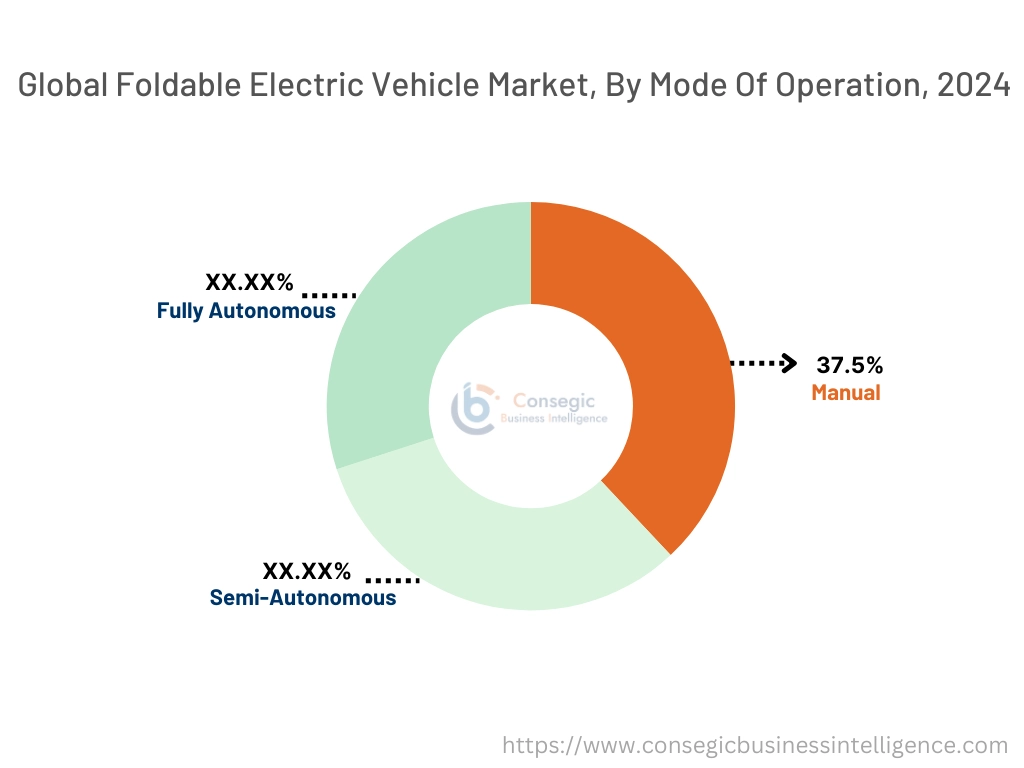
Based on mode of operation, the market is segmented into manual, semi-autonomous, and fully autonomous.
The manual segment accounted for the largest revenue of 37.5% share in 2024.
- Manual foldable electric vehicles are widely adopted due to their simplicity, affordability, and suitability for short-distance commutes in urban environments.
- These vehicles are particularly popular among individual users who prioritize lightweight designs and straightforward operation over advanced automation features.
- The availability of manual models at competitive prices enhances their appeal, especially in emerging economies where cost sensitivity influences purchase decisions.
- Therefore, despite the growth in adoption of autonomous systems, manual vehicles maintain a strong foothold in the market due to their practicality and cost advantages, driving the foldable electric vehicle market growth.
The semi-autonomous segment is anticipated to grow at the fastest CAGR during the forecast period.
- Semi-autonomous foldable electric vehicles offer features such as self-balancing mechanisms, cruise control, and automated braking, enhancing user convenience and safety.
- The integration of IoT-enabled technologies and mobile applications allows users to remotely monitor and control vehicle performance, driving rapid adoption.
- This segment is favored in urban regions where advanced technologies improve commuting efficiency and reduce rider fatigue.
- The growing trend of smart transportation systems and connected vehicles further accelerates the adoption of semi-autonomous vehicles, boosting the foldable electric vehicle market expansion.
By Distribution Channel:
Based on distribution channel, the market is segmented into online retail and offline retail.
The offline retail segment accounted for the largest revenue share in 2024.
- Offline retail, including specialty stores and authorized dealerships, remains a key distribution channel due to the preference for hands-on evaluation and personalized assistance before purchase.
- Customers often rely on offline channels to gain in-depth product information, compare features, and test ride foldable electric vehicles, ensuring a better purchase experience.
- The segment benefits from the growth in establishment of exclusive brand outlets and partnerships between manufacturers and retail chains to expand their market presence.
- As per the foldable electric vehicle market analysis, offline retailers often provide after-sales services, including maintenance and repair, enhancing customer trust and loyalty.
The online retail segment is projected to grow at the fastest CAGR during the forecast period.
- The convenience of online shopping, coupled with the availability of detailed product descriptions and reviews, drives the adoption of online channels for purchasing foldable electric vehicles.
- Online platforms often offer competitive pricing, discounts, and doorstep delivery, appealing to tech-savvy consumers seeking hassle-free purchase options.
- The growing penetration of e-commerce platforms, particularly in emerging economies, has significantly increased the accessibility of foldable electric vehicles.
- As per the foldable electric vehicle market trends, manufacturers are increasingly leveraging their websites and third-party online marketplaces to showcase their product range, further boosting the segment’s expansion.
Regional Analysis:
The regions covered are North America, Europe, Asia Pacific, the Middle East and Africa, and Latin America.

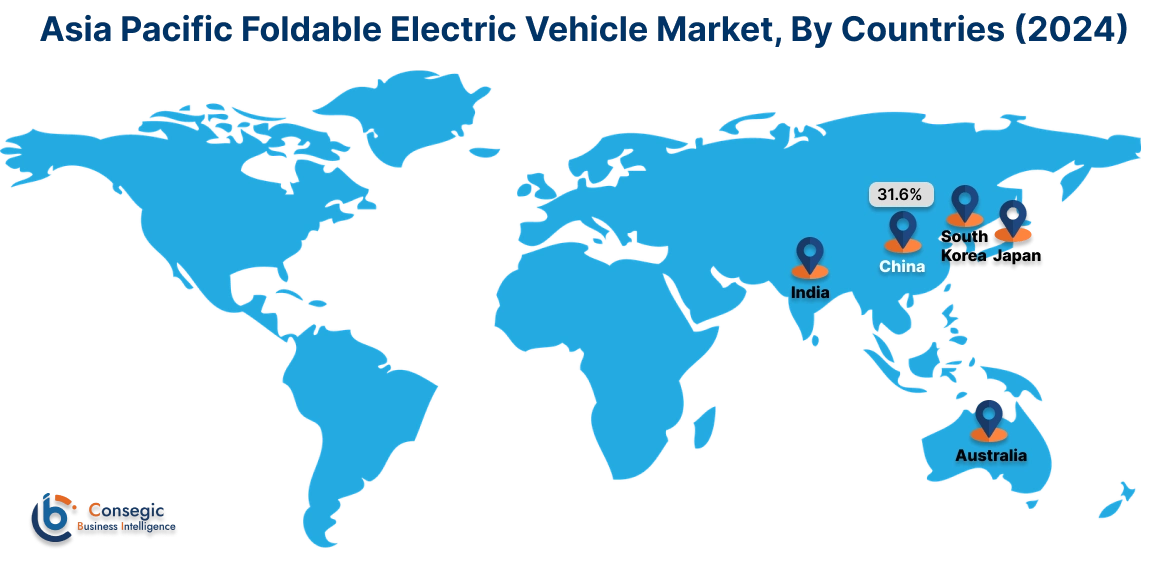
Asia Pacific region was valued at USD 2,699.92 Million in 2024. Moreover, it is projected to grow by USD 2,923.56 Million in 2025 and reach over USD 5,880.05 Million by 2032. Out of this, China accounted for the maximum revenue share of 31.6%. The Asia-Pacific region dominates the foldable EV market, attributed to rapid urbanization and high population density in cities. A prominent trend is the increasing use of foldable electric scooters and bikes as practical solutions for last-mile connectivity. Analysis indicates that technological advancements and the availability of affordable foldable EV options are contributing to foldable electric vehicle market opportunities in this region.
North America is estimated to reach over USD 6,258.54 Million by 2032 from a value of USD 3,040.95 Million in 2024 and is projected to grow by USD 3,277.28 Million in 2025. This region maintains a significant share in the foldable EV market, driven by the increasing adoption of compact and eco-friendly transportation solutions in urban areas. A notable trend is the integration of foldable electric scooters and bikes into daily commutes, addressing traffic congestion and limited parking spaces. Analysis indicates that supportive government policies promoting sustainable mobility and the presence of key industry players are fostering market dynamics in North America.
European countries are pivotal in the foldable EV market, emphasizing sustainability and efficient urban mobility. A significant trend is the adoption of foldable e-bikes and scooters for short-distance travel, supported by well-developed cycling infrastructure. Analysis suggests that environmental awareness and government incentives for reducing carbon emissions are influencing consumer choices towards foldable EVs in this region.
In the Middle East and Africa, the foldable EV market is influenced by the adoption of innovative transportation modes to address urban mobility challenges. The focus is on integrating foldable electric scooters into public transport systems to enhance connectivity. Analysis suggests that investments in sustainable urban development and the rising awareness of eco-friendly transport options are pivotal in shaping the market landscape in these regions.
Latin American countries are increasingly recognizing the potential of foldable EVs in alleviating urban transportation issues. A notable trend is the incorporation of foldable electric bikes into bike-sharing programs, promoting their use for short trips. Analysis indicates that economic factors and the need for cost-effective mobility solutions are key drivers influencing the market in this region.
Top Key Players and Market Share Insights:
The foldable electric vehicle market is highly competitive with major players providing products and services to the national and international markets. Key players are adopting several strategies in research and development (R&D), product innovation, and end-user launches to hold a strong position in the global Foldable Electric Vehicle market. Key players in the Foldable Electric Vehicle industry include -
- City Transformer (Israel)
- Gocycle (UK)
- Xpeng Aero HT (China)
- Pacific Cycles (Taiwan)
- EV Rider (USA)
- Evfarm India Private Limited (India)
Foldable Electric Vehicle Market Report Insights :
| Report Attributes | Report Details |
| Study Timeline | 2019-2032 |
| Market Size in 2032 | USD 19,310.52 Million |
| CAGR (2025-2032) | 9.8% |
| By Product Type |
|
| By Battery Type |
|
| By Mode of Operation |
|
| By Distribution Channel |
|
| By Region |
|
| Key Players |
|
| North America | U.S. Canada Mexico |
| Europe | U.K. Germany France Spain Italy Russia Benelux Rest of Europe |
| APAC | China South Korea Japan India Australia ASEAN Rest of Asia-Pacific |
| Middle East and Africa | GCC Turkey South Africa Rest of MEA |
| LATAM | Brazil Argentina Chile Rest of LATAM |
| Report Coverage |
|
Key Questions Answered in the Report
What is the size of the Foldable Electric Vehicle Market? −
The Foldable Electric Vehicle Market size is estimated to reach over USD 19,310.52 Million by 2032 from a value of USD 9,167.54 Million in 2024 and is projected to grow by USD 9,898.94 Million in 2025, growing at a CAGR of 9.8% from 2025 to 2032.
What are the key segments in the Foldable Electric Vehicle Market? +
The market is segmented by product type (foldable electric scooters, foldable electric bicycles, foldable electric motorbikes, and others), battery type (lithium-ion batteries, lead-acid batteries, nickel-metal hydride batteries, and others), mode of operation (manual, semi-autonomous, and fully autonomous), and distribution channel (online retail and offline retail).
Which segment is expected to grow the fastest in the Foldable Electric Vehicle Market? +
The foldable electric bicycles segment is anticipated to grow at the fastest CAGR during the forecast period, driven by increasing adoption for recreational activities, fitness purposes, and daily commuting.
Who are the major players in the Foldable Electric Vehicle Market? +
Key players in the Foldable Electric Vehicle market include City Transformer (Israel), Gocycle (UK), Pacific Cycles (Taiwan), EV Rider (USA), Evfarm India Private Limited (India), Xpeng Aero HT (China).
Overview
Reputation & Certifications


Our Services
- Market Intelligence & Forecasting
- Custom Research Solutions
- Market Entry Strategy
- Competitive Intelligence
- Customer Insights
- Industry Innovation Analysis
- Investment Advisory