Jump to Content
Handheld Imagers Market - Size, Share, Industry Trends, and Forecasts (2025-2032)
Handheld Imagers Market Size:
Handheld Imagers Market size is estimated to reach over USD 7.93 Billion by 2032 from a value of USD 3.89 Billion in 2024 and is projected to grow by USD 4.19 Billion in 2025, growing at a CAGR of 9.3% from 2025 to 2032.
Handheld Imagers Market Scope & Overview:
The handheld imagers are portable imaging devices designed for real-time visualization and analysis across various applications, including security, industrial inspection, medical diagnostics, and environmental monitoring. These devices utilize advanced technologies such as infrared imaging, terahertz imaging, ultrasound, and X-rays to capture high-resolution images in compact, easy-to-use formats.
Key characteristics of this market include portability, durability, and high accuracy in capturing detailed visuals under challenging conditions. The benefits include enhanced operational efficiency, real-time decision-making, and versatility across multiple industries.
Applications span security screening, thermal imaging for building inspections, non-destructive testing (NDT) in industrial processes, and point-of-care medical imaging for diagnostic purposes. End-users include law enforcement agencies, industrial inspectors, healthcare providers, and military personnel, driven by increasing handheld imagers market demand for compact and efficient imaging solutions, advancements in imaging technologies, and growing adoption in sectors prioritizing safety and precision.
How is AI Transforming the Handheld Imagers Market?
The utilization of AI is significantly transforming the handheld imagers market, particularly in security/surveillance and medical imaging applications, among others. The integration of AI in handheld imagers helps in enhancing image analysis, interpretation, and overall functionality. This includes automated diagnostics, predictive maintenance, and advanced analytics, which further contribute to improved accuracy, efficiency, and reliability.
Additionally, AI integration in handheld imaging devices leads to faster and more efficient processing, enhanced image quality, and improved outcomes. Thus, the aforementioned factors are expected to positively impact the market growth in upcoming years.

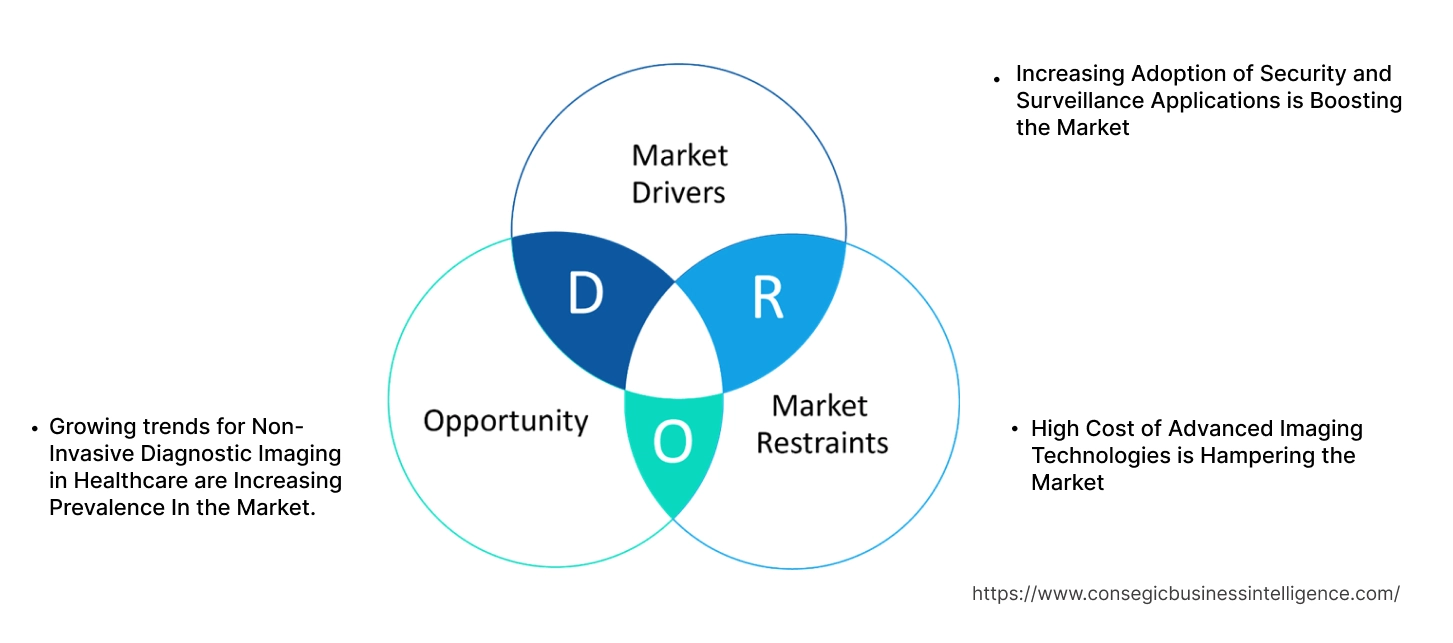
Handheld Imagers Market Dynamics - (DRO) :
Key Drivers:
Increasing Adoption of Security and Surveillance Applications is Boosting the Market
The rising demand for security and surveillance solutions across sectors such as defense, law enforcement, and border control is a key driver for the market. Handheld imaging devices, including thermal imagers, optical imagers, and multispectral cameras, are widely used for detecting concealed objects, monitoring activity in low-light conditions, and identifying potential threats. With the growing focus on public safety and the need to address security concerns in airports, military bases, and critical infrastructure, handheld imagers have become indispensable tools for enhancing situational awareness. Additionally, advancements in imaging technologies, such as improved resolution and compact designs, have further supported the adoption of these devices in security operations.
Key Restraints:
High Cost of Advanced Imaging Technologies is Hampering the Market
Devices equipped with high-resolution sensors, multispectral imaging capabilities, and real-time analytics features involve substantial manufacturing and R&D expenses. These high costs limit the accessibility of handheld imagers, particularly for smaller organizations and agencies with budget constraints. Moreover, the maintenance and calibration of these devices add to their overall operational costs, which can deter potential buyers in cost-sensitive markets. This financial barrier restricts the widespread adoption of handheld imagers, especially in emerging economies.
Future Opportunities :
Growing trends for Non-Invasive Diagnostic Imaging in Healthcare are Increasing Prevalence In the Market
Handheld thermal imagers and infrared imaging devices are increasingly used in non-invasive diagnostics for monitoring body temperature, detecting inflammation, and assessing blood flow. These devices have gained traction during the COVID-19 pandemic for rapid temperature screening in public spaces, demonstrating their utility in healthcare and public health management. Furthermore, advancements in portable ultrasound technology have enabled healthcare professionals to perform point-of-care imaging in remote or resource-limited areas, expanding access to diagnostic services. Companies investing in compact, affordable, and user-friendly handheld imagers for medical applications are well-positioned to capture this growing market segment.
These dynamics highlight the critical role of handheld imagers in security, surveillance, and healthcare applications. While cost challenges remain a barrier, innovations in imaging technologies and expanding use cases in non-invasive diagnostics offer significant scope for handheld imagers market expansion and diversification.
Handheld Imagers Market Segmental Analysis :
By Technology:
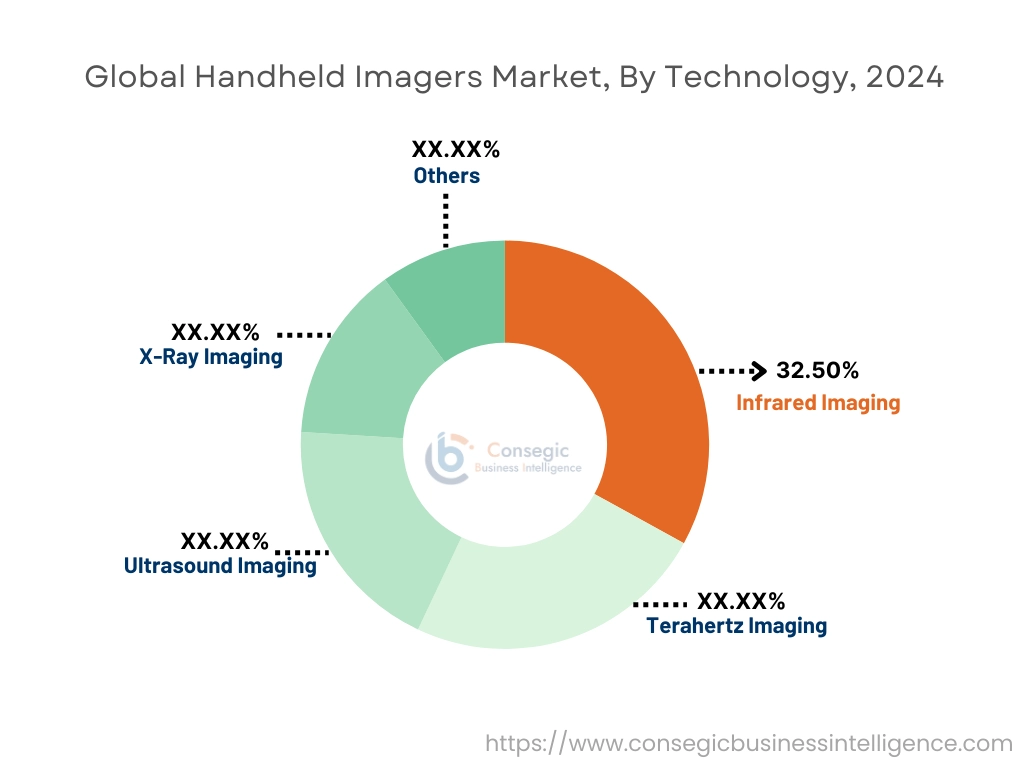
Based on technology, the market is segmented into infrared imaging, terahertz imaging, ultrasound imaging, x-ray imaging, and others.
The infrared imaging segment accounted for the largest revenue of handheld imagers market share of 32.50% in 2024.
- Infrared imaging is widely adopted for applications in security, industrial inspection, and building diagnostics due to its ability to detect heat signatures.
- Advancements in thermal sensors and image resolution enhance the efficiency of infrared imaging in handheld devices.
- Increasing adoption in military, surveillance, and public safety operations supports segment dominance.
- Rising trends for non-contact temperature measurement and heat loss detection in industrial and residential settings drive growth.
The terahertz imaging segment is anticipated to register the fastest CAGR during the forecast period.
- Terahertz imaging technology is gaining traction in applications such as non-invasive security scanning and industrial inspection.
- Its ability to detect concealed objects and analyze materials without ionizing radiation drives its adoption.
- Expanding the use of advanced medical imaging for detecting cancerous tissues supports this segmental trend.
- Ongoing advancements in portable terahertz imaging systems make the technology more accessible for diverse applications.
By Product Type:
Based on product type, the market is segmented into handheld thermal imagers, handheld IR scanners, handheld terahertz scanners, portable ultrasound devices, and others.
The handheld thermal imagers segment accounted for the largest revenue of handheld imagers market share in 2024.
- Handheld thermal is extensively used in military, industrial, and building diagnostics for detecting heat patterns and anomalies.
- With the increasing handheld imagers market trends for portable thermal devices in firefighting and search-and-rescue operations support this segment.
- Rising adoption of preventive maintenance across industries, such as power and manufacturing, boosts demand.
- Advancements in lightweight, battery-efficient designs enhance user convenience and expand market potential.
The handheld terahertz scanners segment is anticipated to register the fastest CAGR during the forecast period.
- Handheld terahertz scanners are increasingly used in security and healthcare applications for non-invasive scanning.
- Rising handheld imagers market demand for portable, high-resolution imaging devices in airport and border security enhances adoption.
- Expanding research into terahertz imaging for material analysis and medical diagnostics supports handheld imagers market growth.
- Technological innovations in compact, user-friendly scanner designs drive market expansion.
By Application:
Based on application, the market is segmented into security and surveillance, industrial inspection, building diagnostics, and others.
The security and surveillance segment accounted for the largest revenue share in 2024.
- The extensive use in military, law enforcement, and public safety applications for threat detection and perimeter security is creating handheld imagers market opportunities.
- Increasing demand for thermal and infrared imaging for night vision and covert surveillance strengthens market dominance.
- Advancements in AI-driven imaging solutions enhance real-time threat assessment and facial recognition capabilities.
- Expanding adoption of portable, rugged, and high-resolution imaging devices in border security and counterterrorism operations supports segment growth.
The industrial inspection segment is anticipated to register the fastest CAGR during the forecast period.
- Handheld imagers are increasingly used for non-destructive testing (NDT) and predictive maintenance in manufacturing and infrastructure.
- Rising adoption of thermal and ultrasonic imaging for detecting structural defects and equipment malfunctions supports demand.
- Advancements in high-resolution imaging technologies improve inspection efficiency in oil & gas, automotive, and aerospace industries.
- Growing emphasis on workplace safety and regulatory compliance accelerates the integration of handheld imaging solutions in industrial settings.
By End-User Industry:
Based on end-user industry, the market is segmented into military & defense, manufacturing, healthcare, construction, and security.
The military & defense segment accounted for the largest revenue share in 2024.
- Military and defense organizations rely on handheld imagers for tactical surveillance, reconnaissance, and threat detection.
- Increasing investments in advanced imaging technologies, including night vision and multispectral imaging, strengthens market presence.
- Rising security concerns and border control measures fuel growth for portable imaging devices in defense applications.
- Ongoing modernization programs in defense forces globally contribute to increased adoption of high-performance imaging solutions.
The healthcare segment is anticipated to register the fastest CAGR during the forecast period.
- Handheld imaging devices, such as portable ultrasound and infrared scanners, are gaining popularity for point-of-care diagnostics.
- Increasing demand for non-invasive medical imaging in emergency care, telemedicine, and home healthcare supports handheld imagers market opportunities.
- Advancements in AI-assisted imaging solutions improve diagnostic accuracy and patient outcomes in real time.
- Expanding the use of thermal imaging for fever detection and vascular diagnostics enhances the trends of healthcare applications.
Regional Analysis:
The regions covered are North America, Europe, Asia Pacific, the Middle East and Africa, and Latin America.
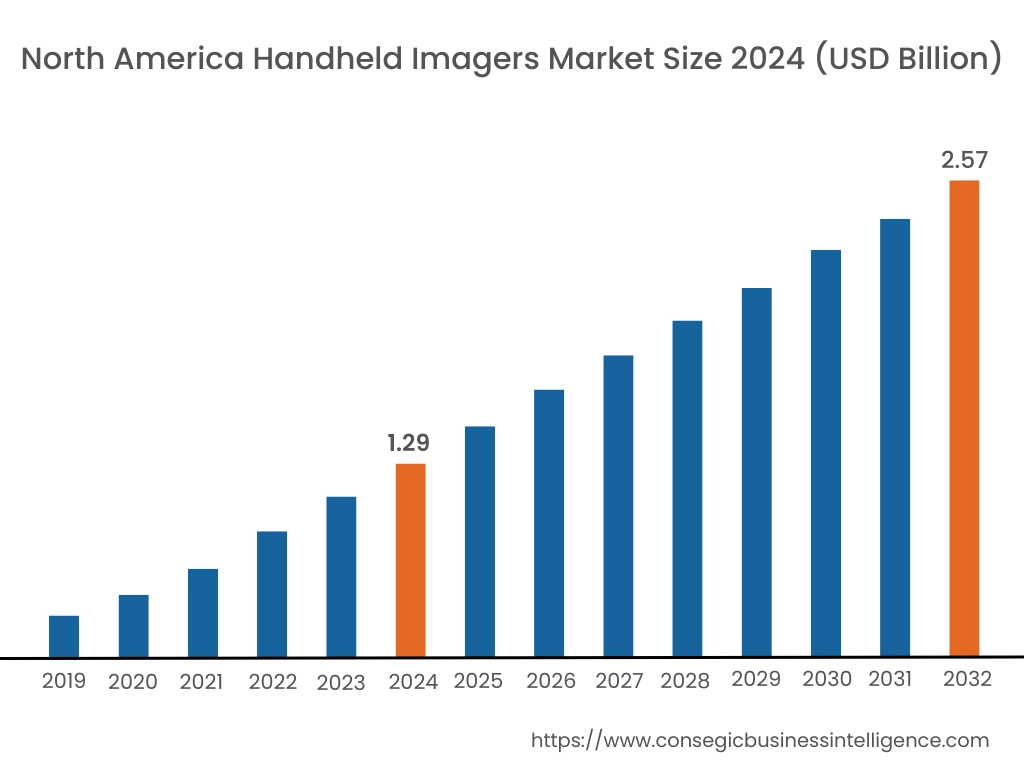
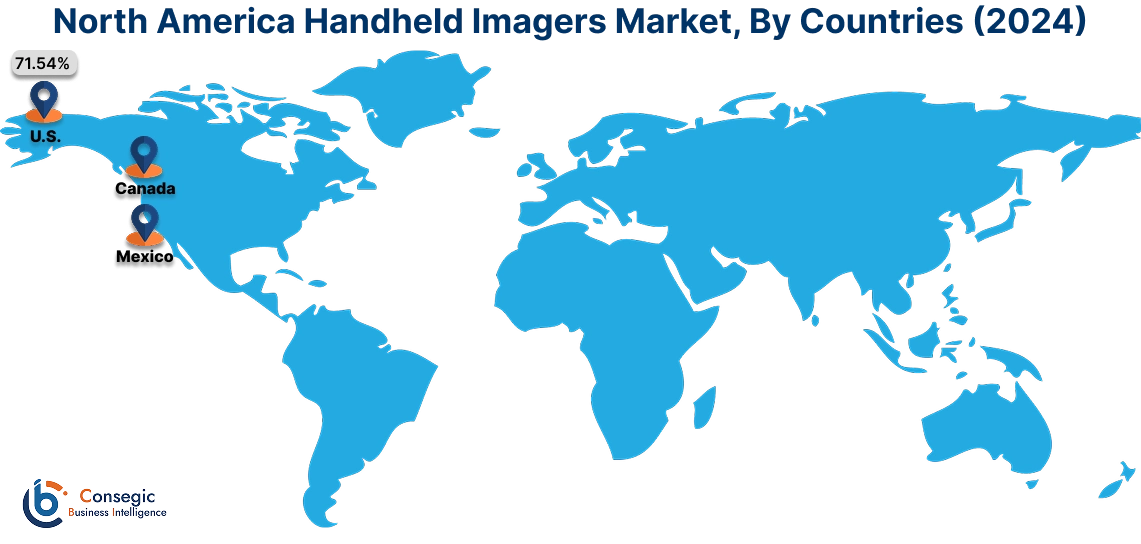
In 2024, North America was valued at USD 1.29 Billion and is expected to reach USD 2.57 Billion in 2032. In North America, the U.S. accounted for the highest share of 71.54% during the base year of 2024. North America holds a significant share of the market, driven by strong adoption across defense, healthcare, and industrial sectors. The U.S. leads the region due to increasing trends for thermal imaging and advanced detection technologies in law enforcement and military applications. Additionally, the use of handheld imagers for medical diagnostics, particularly in detecting thermal anomalies, contributes significantly to market dynamics. Canada supports the market with the growing adoption of portable imaging solutions in industrial inspections and healthcare applications. The handheld imagers market analysis of the region underscores strong investments in R&D for next-generation imaging technologies.
In Asia Pacific, the market is experiencing the fastest growth with a CAGR of 9.8% over the forecast period. The market is fueled by rapid industrialization, increasing security concerns, and expanding healthcare infrastructure in China, India, and Japan. China dominates the market with significant investments in handheld thermal and X-ray imaging technologies for use in security, manufacturing, and healthcare. India’s growing infrastructure and defense industry support the adoption of affordable imaging devices for inspections and monitoring. Japan emphasizes high-precision imaging technologies in healthcare and industrial applications, leveraging its strong technological capabilities. Regional analysis indicates a shift toward cost-effective and compact imaging devices to cater to emerging markets.
Europe is a prominent market supported by rising trends across sectors such as automotive, construction, and healthcare. Countries like Germany, the UK, and France are key contributors. Germany drives the market with its emphasis on advanced thermal imaging solutions for industrial maintenance and automotive applications. The UK focuses on integrating portable imagers into security and surveillance systems, while France sees growing adoption in medical diagnostics and building inspections. Regional analysis highlights the increasing incorporation of portable and lightweight imagers in smart city projects, particularly for infrastructure monitoring and energy audits.
The Middle East & Africa region is witnessing steady growth in the global handheld imagers market, driven by rising investments in security and surveillance systems and increasing applications in oil & gas inspections. Countries like Saudi Arabia and the UAE are adopting portable imaging solutions for critical infrastructure monitoring and defense applications as part of their modernization efforts. In Africa, South Africa is emerging as a key market, focusing on the adoption of thermal imagers for wildlife monitoring and industrial safety. Regional handheld imagers market analysis suggests that limited access to advanced imaging technologies and high costs may hinder broader adoption in some areas.
Latin America is an emerging market, with Brazil and Mexico leading the region. Brazil’s growing industrial sector and rising investments in security and infrastructure projects drive handheld imagers market trends. Mexico focuses on expanding the use of thermal and X-ray imagers in border security and manufacturing applications. Regional analysis highlights increasing adoption in construction and healthcare diagnostics, supported by growing awareness of the benefits of portable imaging technologies. However, economic instability and inconsistent supply chains may pose challenges to handheld imagers market expansion in smaller economies.
Top Key Players & Market Share Insights:
The handheld imagers market is highly competitive with major players providing products and services to the national and international markets. Key players are adopting several strategies in research and development (R&D), product innovation, and end-user launches to hold a strong position in the global handheld imagers market. Key players in the handheld imagers industry include -
- FLIR Systems, Inc. (USA)
- Testo SE & Co. KGaA (Germany)
- Hikvision Digital Technology Co., Ltd. (China)
- InfraTec GmbH (Germany)
- Opgal Optronic Industries Ltd. (Israel)
- Fluke Corporation (USA)
- Jenoptik AG (Germany)
- Rosenbauer International AG (Austria)
- L3 Technologies, Inc. (USA)
- Bosch Security Systems (Germany)
Recent Industry Developments :
Research & Developments:
- In September 2024, researchers at University College London (UCL) developed a groundbreaking handheld scanner that generates 3D photoacoustic images in seconds, a significant advancement in medical imaging technology. This new device delivers real-time, highly detailed images of blood vessels, helping clinicians in diagnosing conditions like cancer, cardiovascular disease, and arthritis. Unlike older photoacoustic tomography (PAT) scanners, which take over five minutes to generate an image, this scanner works between 100 to 1,000 times faster, reducing motion-induced blurring and providing clinically useful images in real time. This innovation makes it suitable for clinical use, allowing for dynamic physiological assessments and improved early diagnosis, particularly in frail or elderly patients.
Product Launch:
- In October 2024, Thales Group secured a contract to supply Sophie Ultima handheld thermal imagers to the Canadian Armed Forces as part of the Night Vision Systems Modernization (NVSM) project. The imagers, known for their advanced infrared capabilities, will enhance detection and recognition ranges in challenging environments. This development highlights the increasing demand for high-performance thermal imaging technology in the defense and security sectors.
- In April 2024, GE HealthCare launched the Vscan Air SL handheld ultrasound system with integrated Caption AI technology, designed to improve cardiac assessments at the point of care. The AI-powered system provides real-time guidance, enabling even less experienced users to capture high-quality images and estimate ejection fraction quickly, enhancing diagnostic efficiency. This development reflects the growing demand for portable, AI-driven diagnostic tools in the medical imaging market.
Handheld Imagers Market Report Insights:
| Report Attributes | Report Details |
| Study Timeline | 2019-2032 |
| Market Size in 2032 | USD 7.93 Billion |
| CAGR (2025-2032) | 9.3% |
| By Technology |
|
| By Product Type |
|
| By Application |
|
| By End-User Industry |
|
| By Region |
|
| Key Players |
|
| North America | U.S. Canada Mexico |
| Europe | U.K. Germany France Spain Italy Russia Benelux Rest of Europe |
| APAC | China South Korea Japan India Australia ASEAN Rest of Asia-Pacific |
| Middle East and Africa | GCC Turkey South Africa Rest of MEA |
| LATAM | Brazil Argentina Chile Rest of LATAM |
| Report Coverage |
|
Key Questions Answered in the Report
What is the size of the Handheld Imagers Market? −
Handheld Imagers Market size is estimated to reach over USD 7.93 Billion by 2032 from a value of USD 3.89 Billion in 2024 and is projected to grow by USD 4.19 Billion in 2025, growing at a CAGR of 9.3% from 2025 to 2032.
What are the key drivers of the Handheld Imagers Market? +
The market is driven by increasing demand for security and surveillance applications, advancements in imaging technologies, and growing adoption of non-invasive medical diagnostics. The rising use of handheld imagers in law enforcement, defense, and industrial inspections further boosts market growth.
Which industries use handheld imagers the most? +
Handheld imagers are widely used in military & defense, industrial inspection, healthcare, construction, and security. Major applications include thermal imaging for security, ultrasound imaging in healthcare, and terahertz imaging for material analysis.
What are the major challenges in the Handheld Imagers Market? +
The high cost of advanced imaging technologies, including sensors, multispectral capabilities, and real-time analytics, is a significant challenge. Additionally, maintenance and calibration costs limit accessibility, particularly in cost-sensitive markets.
Which region dominates the Handheld Imagers Market? +
North America leads the market due to strong demand from defense, law enforcement, and medical applications. The U.S. is the primary contributor, driven by investments in advanced imaging technologies for surveillance and healthcare diagnostics.
Overview
Reputation & Certifications


Our Services
- Market Intelligence & Forecasting
- Custom Research Solutions
- Market Entry Strategy
- Competitive Intelligence
- Customer Insights
- Industry Innovation Analysis
- Investment Advisory