Jump to Content
HIDA Scan Market - Size, Share, Industry Trends, and Forecasts (2025-2032)
HIDA Scan Market Size:
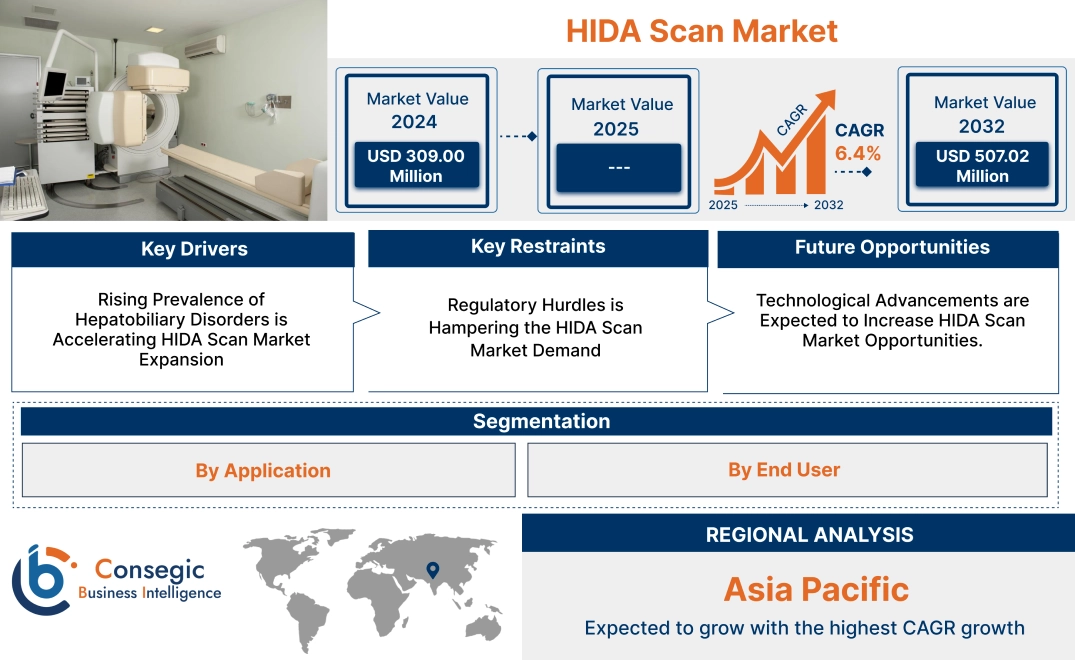
HIDA Scan Market size is growing with a CAGR of 6.4% during the forecast period (2025-2032), and the market is projected to be valued at USD 507.02 Million by 2032 from USD 309.00 Million in 2024.
HIDA Scan Market Scope & Overview:
HIDA scan stands for hepatobiliary iminodiacetic acid scan. It is also known as hepatobiliary scintigraphy. It is a nuclear medicine imaging test used to check the functioning of different organs. These organs include liver, gallbladder, bile ducts, and small intestines. During this medical test, a small amount of safe radioactive substance is injected into bloodstream of the human body. The substance then moves to the liver and into other organs. This allows a special camera called gamma camera to take pictures as it moves through the body.
Doctors use this scan to diagnose various conditions. It helps doctors to identify inflammation in gallbladder. Moreover, it helps in identifying blockages in bile ducts. It also helps in checking if there is any leakage from the bile duct. In addition, this scan also shows functioning and complications after surgery like live transplant. Furthermore, it is useful in identifying issues such as biliary atresia. The scan is beneficial as it provides detailed information about patient's condition.
HIDA Scan Market Dynamics - (DRO) :
Key Drivers:
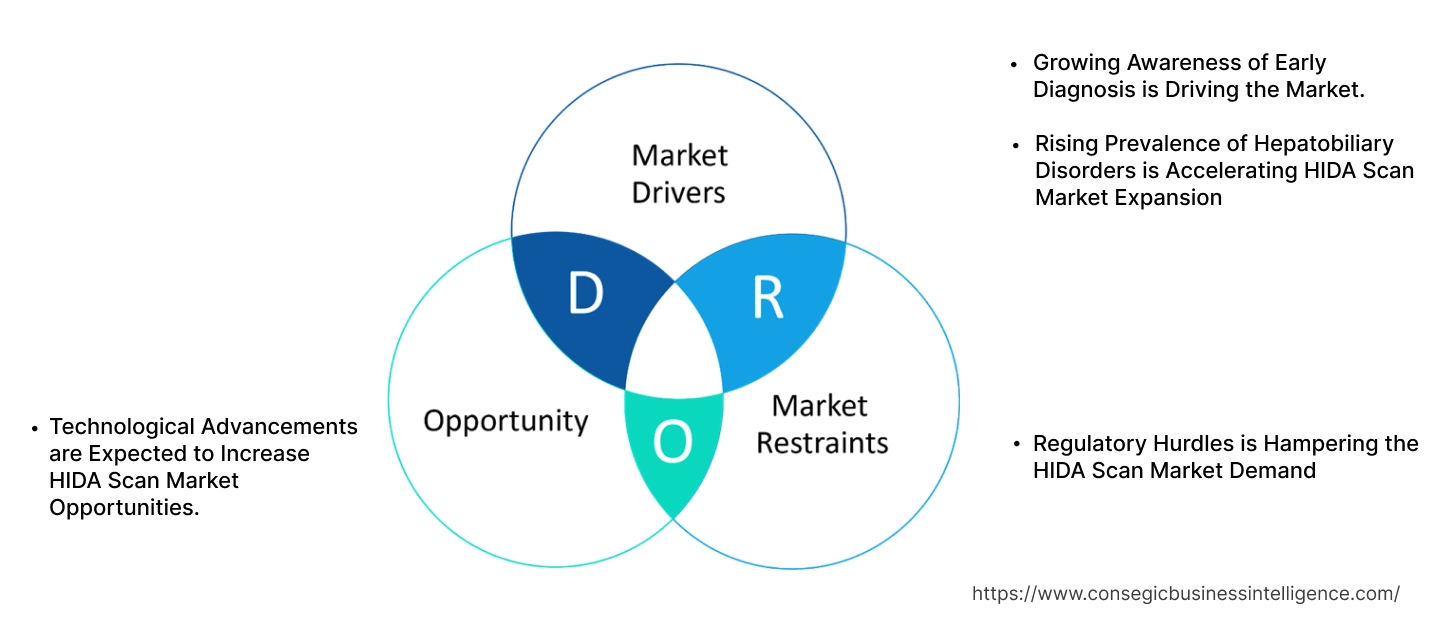
Rising Prevalence of Hepatobiliary Disorders is Accelerating HIDA Scan Market Expansion
Due to increased busy lifestyles, unhealthy eating habits are observed globally. The individuals are relying on fast food and are eating a lot of processed foods. The consumption of alcohol is also increased. The dedicated amount of time for exercise is reduced. These trends have increased obesity rates. Due to this, individuals are facing more issues with their liver, gallbladder and bile ducts. This has increased cases of hepatobiliary disorders requiring hepatobiliary iminodiacetic acid scan for effective diagnosis.
For instance,
- Minnesota Department of Health published an article in 2024, stating in U.S., every year about 300 babies are born with life-threatening liver disease called biliary atresia.
Overall, the rising prevalence of hepatobiliary disorders is significantly boosting the HIDA scan market expansion.
Growing Awareness of Early Diagnosis is Driving the Market.
There has been a shift in approaches in individuals towards their health. More people are becoming aware of the benefits of catching health issues in early stage before they get serious. This awareness is due to educational campaigns conducted by healthcare organizations. Moreover, patients are also becoming aware of various diseases and what diagnostic procedures are available for it. This has been possible through information provided by different communication platforms.
For instance,
- PocketHealth published an article in 2024 stating what is HIDA scan. They provided knowledge on what conditions are diagnosed through it. They also stated what are the before and after procedure scenarios.
Thus, growing awareness of early diagnosis is accelerating the global HIDA scan market growth.
Key Restraints:
Regulatory Hurdles is Hampering the HIDA Scan Market Demand
The approval process of devices and drugs used in scan requires rigorous testing. It makes sure that manufacturers comply with stringent regulatory standards. This includes clinical trials such as phase 1, phase 2 and others. These clinical trials are necessary by the regulatory body to ensure devices or drugs used in scan are safe and effective.
Moreover, the regulatory process varies in every country and region. For example, globally there are different regulatory bodies such as FDA, EMA, or others. These agencies have different requirements. This creates barriers for companies who aim for international commercialization. In addition, manufacturers face financial and operational problems due to post-approval pharmacovigilance requirements. Furthermore, strict rules against disposal of radioactive material also create challenges. Hence, regulatory hurdles are hampering the HIDA scan market demand.
Future Opportunities :
Technological Advancements are Expected to Increase HIDA Scan Market Opportunities.
Advancements in technology are creating potential for the market. Radiopharmaceuticals are drugs used to examine bile flow. There is development of advanced radiopharmaceutical which is more safer. The precision which helps doctors to get clear images is also improved. This improved precision is leading to early diagnosis of health conditions. Moreover, gamma cameras are used to take images of different organs such as liver and gallbladder. Advancements in these cameras are also proving beneficial for the scan.
For instance,
- American Scientific Research Journal published an article in 2024, stating that development of new material such as cadmium zinc telluride is improving sensitivity. It also enhancing energy resolution. In addition, AI performing automated analysis is improving accuracy of diagnosis.
HIDA Scan Market Segmental Analysis :
By Application:
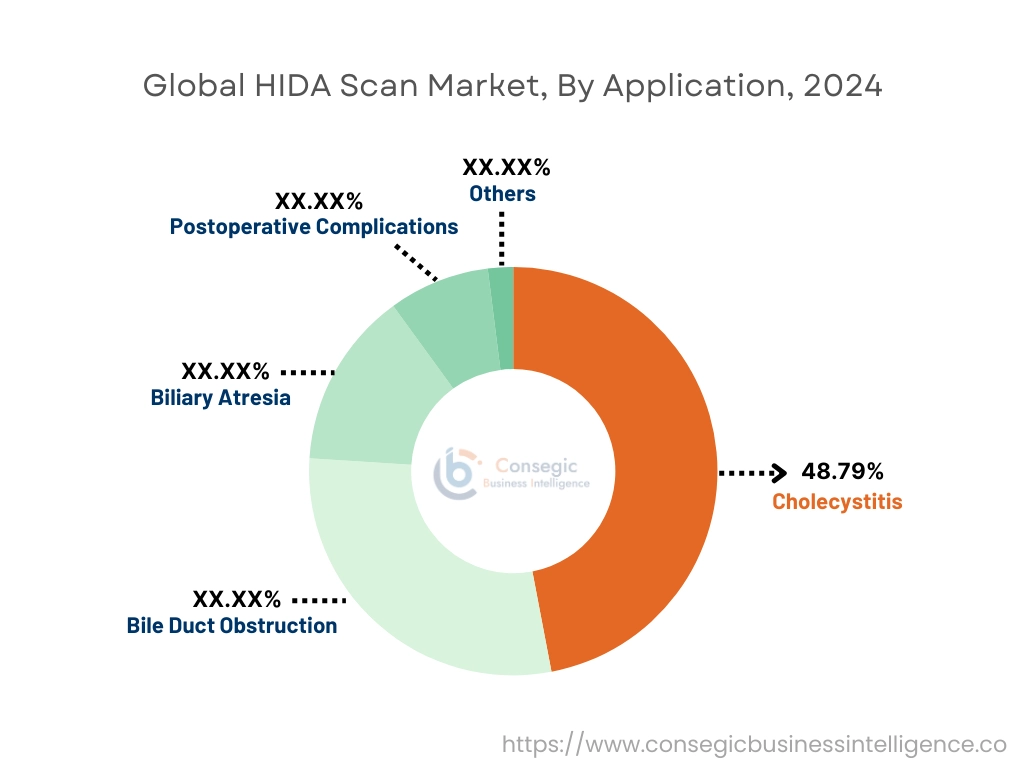
Based on application, the market is categorized into cholecystitis, bile duct obstruction, biliary atresia, postoperative complications, and others.
Trends in Application:
- Increased usage of hepatobiliary iminodiacetic acid scan for the diagnosis of biliary atresia in newborns.
- Increased usage of scan for the diagnosis of patients with suspected bile duct strictures.
The cholecystitis segment accounted for the largest market share of 48.79% in 2024.
- Cholecystitis dominates the HIDA scan market trends. The condition refers to the inflammation of the gallbladder. This condition happens when a gallstone blocks the flow of the bile.
- People with this condition experience pain in the upper right side of the abdomen. Medical professionals use hepatobiliary scintigraphy when other imaging tests fail to provide clear answers.
- Individuals globally are consuming diets high in fats, leading to obesity. Moreover, obesity with lack of exercise is leading to an increase in cases of cholecystitis. This has required demand for accurate diagnosis.
- For instance, in 2024, the research article published in National Center for Biotechnology Information states in U.S., each year 200,000 people are diagnosed with acute cholecystitis.
- Overall, as per the market analysis, the rising prevalence of cholecystitis is driving a segment in HIDA scan market growth.
The biliary atresia segment is expected to grow at the fastest CAGR over the forecast period.
- Biliary atresia is a rare condition that affects newborns. It occurs when bile ducts carrying bile from liver to intestines are blocked. It causes a bile to build up in the liver.
- This leads to scarring and damage to liver. If patients do not treat this condition early, it leads to serious liver problems. One of the major problems is cirrhosis.
- Individuals with this condition face symptoms such as yellowing of skin and dark urine. They also face the issues with weight gain and swollen belly. Hepatobiliary scintigraphy is important for this condition, as it helps to identify this disease on an early basis.
- According to market analysis, the segment is emerging. It is due to growing awareness among patients and healthcare professionals. Improved diagnostic procedures are also supporting segmental growth for the upcoming years.
By End Use:
Based on end-use, the market is categorized into hospitals & clinics, diagnostic centers, and others.
Trends in the End-Use:
- Increased adoption of AI-based diagnostic tools in hospitals for improved accuracy and better patient outcomes.
- Growing diagnostic imaging centers providing hepatobiliary scintigraphy services.
The hospitals & clinics segment accounted for the largest market share in 2024.
- Hospitals & clinics dominate the HIDA scan market trends. These facilities have all the equipment’s to perform this scan. Also, they have multiple skilled professionals to handle a large volume of cases.
- Moreover, they have expertise in handling more serious and complex cases of hepatobiliary disorders.
- Another reason they dominate is that they closely work with insurance providers. This makes these scans more accessible and affordable to patients.
- More hospitals and clinics are installing equipment required to perform HIDA scan.
- For instance, in 2024, Vernon Jubilee Hospital replaced their traditional camera. They installed a new gamma camera with the newest technology. The installation of a new diagnostic tool has increased the accessibility of hepatobiliary iminodiacetic acid scans to patients. This is positively impacting market share.
- Overall, as per the market analysis, more hospitals and clinics are adopting technologies to perform hepatobiliary scintigraphy. This is driving segmental growth in the HIDA scan industry.
The diagnostic centers segment is expected to grow at the fastest CAGR over the forecast period.
- Diagnostic centers segment is emerging in market growth. It offers faster and more convenient services when compared to hospitals.
- These centers only focus on diagnostic testing. This helps patients get an appointment sooner. They also reduce longer waiting times. This makes them choice for patients who need non-urgent scans.
- Diagnostic centers have now access to high-quality imaging equipment. This includes gamma cameras which provide accurate results. They also operate at lower cost than hospitals. This makes them an affordable option for many patients.
- Patients are becoming aware of early diagnosis of any disease. More people are choosing to go to diagnostic centers and get their health checked. This will drive the segmental growth for the forecasted years.
Regional Analysis:
The regional segment includes North America, Europe, Asia Pacific, the Middle East and Africa, and Latin America.
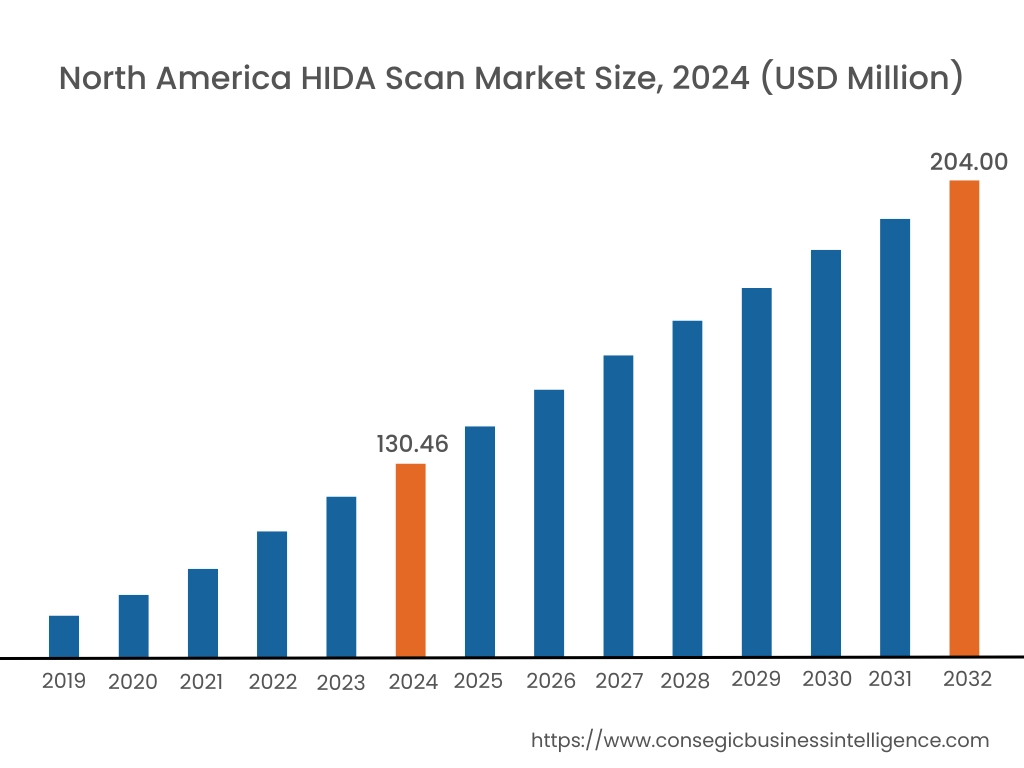
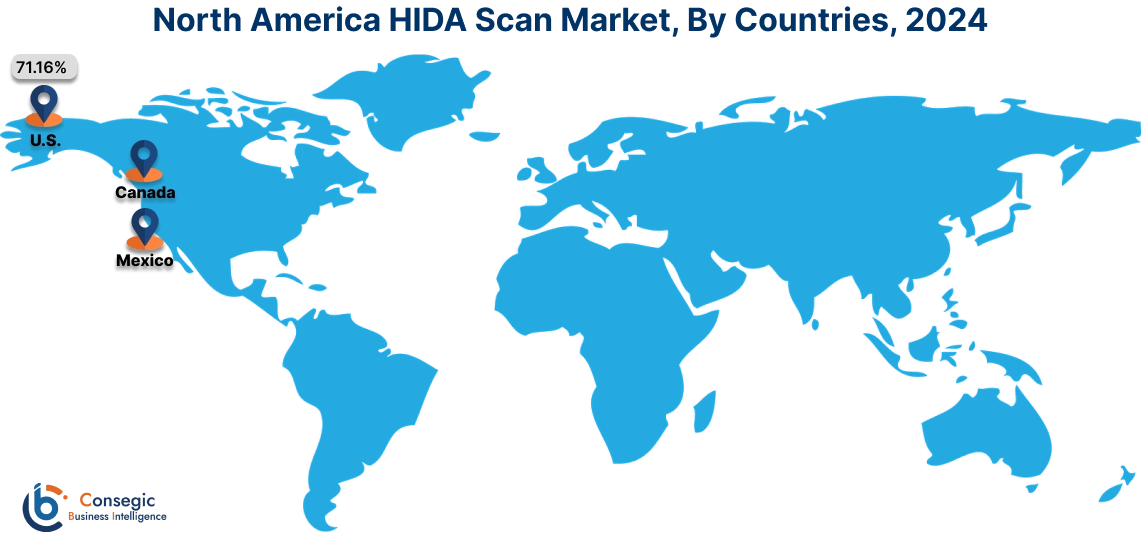
In 2024, North America accounted for the highest HIDA scan market share at 42.22% and was valued at USD 130.46 Million and is expected to reach USD 204.00 Million in 2032. In North America, the U.S. accounted for the HIDA scan market share of 71.16% during the base year of 2024. In the region, more people are being diagnosed with hepatobiliary disorders. These disorders include issues related to gallbladder, liver, and bile duct. Poor diet and obesity are the factors which are making these disorders common in this region. Owing to the rise in these conditions, doctors are relying on HIDA scan to avoid misdiagnosis. These scans also help medical professionals in diagnosing these conditions early. Moreover, the region is increasing its manufacturing capabilities due to increased demand.
For instance,
- In 2024, NorthStar Medical Radioisotopes opened a new radiopharmaceutical manufacturing facility in Wisconsin. This increasing the availability of essential radiopharmaceuticals has ensured a reliable supply chain of raw materials required for this test.
Overall, the rising prevalence of hepatobiliary disorders and expansion of radiopharmaceutical manufacturing is driving the market in region.
In Asia Pacific, the HIDA scan market is experiencing the fastest growth with a CAGR of 7.6% over the forecast period. The market is driven by several trends. People in this region are becoming more informed about the importance of catching health problems early. Campaigns by healthcare industry providers and government are helping people to get educated more on diagnostic procedures such as HIDA scan. They are making people aware that diagnosis improves treatment outcomes which reduces long-term healthcare costs to patients. At the same time, the region is expanding its diagnostic centers. Governments are making sure that rural areas have also access to these diagnostic procedures. Morever, many centers in the region are offering specialized imaging services. This makes the scan accessible to more population. Also, they offer affordable and faster service, which appeals to patients more.
Europe's HIDA scan market analysis states that several trends are responsible for the progress of the market in the region. Procedures that required hospitalization are now performed in outpatient settings. This has led healthcare providers in Europe to shift towards outpatient care as well. These centers before operating surgeries check if individuals are not suffering any other health issues. This has boosted the demand of hepatobiliary scintigraphy. Moreover, reimbursement policies in European countries have made these scans accessible. Public and private health insurance covers a significant amount of diagnostic imaging costs. This financial support encourages patients to undergo these procedures. It also motivates healthcare industry to invest in advanced diagnostic technologies.
The Middle East and Africa (MEA) HIDA scan market analysis states that the region is also witnessing several trends for notable surge. In the region, many countries are investing in modernizing hospitals. New hospitals are equipped with advanced diagnostic tools. This is making specialized procedures such as hepatobiliary scintigraphy more accessible to patients. These improvements are especially observed in urban areas, as that area has a high need for diagnostic services. Morever, governments are taking many initiatives in the region. They are doing funding programs to improve healthcare access. These efforts include subsidizing diagnostic equipment and training healthcare professionals. In addition, newer radiopharmaceuticals are enhancing the accuracy of these tests.
Latin America's HIDA scan market size is also emerging and limited retail penetration in rural areas poses challenges. Hospitals and diagnostic centers in the region are adopting newer technologies. This adoption includes integrating AI technology. It helps in enhancing imaging precision. This is also beneficial in speeding up diagnostic procedures. Moreover, the region is having more collaboration between healthcare providers and global technology companies. These partnerships are making diagnostic tools more accessible required for this scan. With better access to diagnostic tools, hospitals are now offering high-quality diagnostic services, which also include hepatobiliary iminodiacetic acid scan. This teamwork is helping to address the growing demand for diagnostic solutions.
Top Key Players and Market Share Insights:
The HIDA Scan market is highly competitive with major players providing products to the national and international markets. Key players are adopting several strategies in research and development (R&D) and product innovation to hold a strong position in the global HIDA Scan market. Key players in The HIDA Scan industry include-
- GE Healthcare (U.S.)
- Siemens Healthineers (U.S.)
- Serac Imaging Systems (UK)
- Cardinal Health, Inc. (U.S.)
- Philips Healthcare (Netherlands)
- Digirad Corporation (U.S.)
- DDD Diagnostics A/S (Denmark)
- Toshiba Medical Systems (Japan)
HIDA Scan Market Report Insights :
| Report Attributes | Report Details |
| Study Timeline | 2019-2032 |
| Market Size in 2032 | USD 507.02 Million |
| CAGR (2025-2032) | 6.4% |
| By Application |
|
| By End Use |
|
| By Region |
|
| Key Players |
|
| North America | U.S. Canada Mexico |
| Europe | U.K. Germany France Spain Italy Russia Benelux Rest of Europe |
| APAC | China South Korea Japan India Australia ASEAN Rest of Asia-Pacific |
| Middle East and Africa | GCC Turkey South Africa Rest of MEA |
| LATAM | Brazil Argentina Chile Rest of LATAM |
| Report Coverage |
|
Key Questions Answered in the Report
How big is the HIDA Scan market? −
In 2024, the HIDA Scan market is USD 309.00 Million.
Which is the fastest-growing region in the HIDA Scan market? +
Asia Pacific is the fastest-growing region in the HIDA Scan market.
What specific segmentation details are covered in the HIDA Scan market? +
Application and End-Use segmentation details are covered in the HIDA Scan market
Who are the major players in the HIDA Scan market? +
GE Healthcare (U.S.), Siemens Healthineers (U.S.), Philips Healthcare (Netherlands), Digirad Corporation (U.S.), DDD Diagnostics A/S (Denmark), Toshiba Medical Systems (Japan), Serac Imaging Systems (UK), and Cardinal Health, Inc. (U.S.)
Overview
Reputation & Certifications


Our Services
- Market Intelligence & Forecasting
- Custom Research Solutions
- Market Entry Strategy
- Competitive Intelligence
- Customer Insights
- Industry Innovation Analysis
- Investment Advisory