Jump to Content
Hypersensitivity Pneumonitis Market - Size, Share, Industry Trends, and Forecasts (2025-2032)
Hypersensitivity Pneumonitis Market Size:
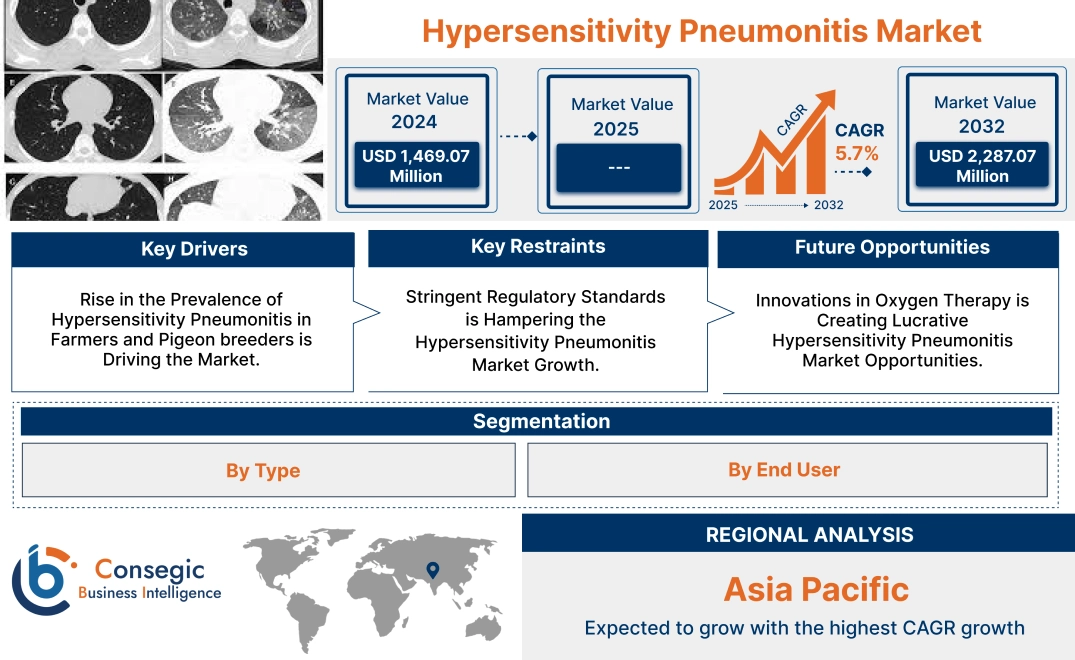
Hypersensitivity Pneumonitis Market size is growing with a CAGR of 5.7% during the forecast period (2025-2032), and the market is projected to be valued at USD 2,287.07 Million by 2032 from USD 1,469.07 Million in 2024.
Hypersensitivity Pneumonitis Market Scope & Overview:
Hypersensitivity pneumonitis (HP) is a rare inflammatory lung disease that is triggered by repeated exposure to inhaled allergens, such as mold spores, bird proteins, or certain industrial dusts. The immune system reacts to these allergens, causing inflammation and damage to the air sacs present in the lungs. This led to symptoms, including cough, shortness of breath, chills, fever, and fatigue among others. The diagnosis for this condition mainly includes X-rays, CT scans, bronchoscopy, lung function tests, and others. The treatment generally includes corticosteroids, immunosuppressants, bronchodilators, oxygen therapy, and others. The End-user for the diagnosis and treatment of this condition includes hospitals & clinics, homecare settings, and others.
Hypersensitivity Pneumonitis Market Dynamics - (DRO) :
Key Drivers:
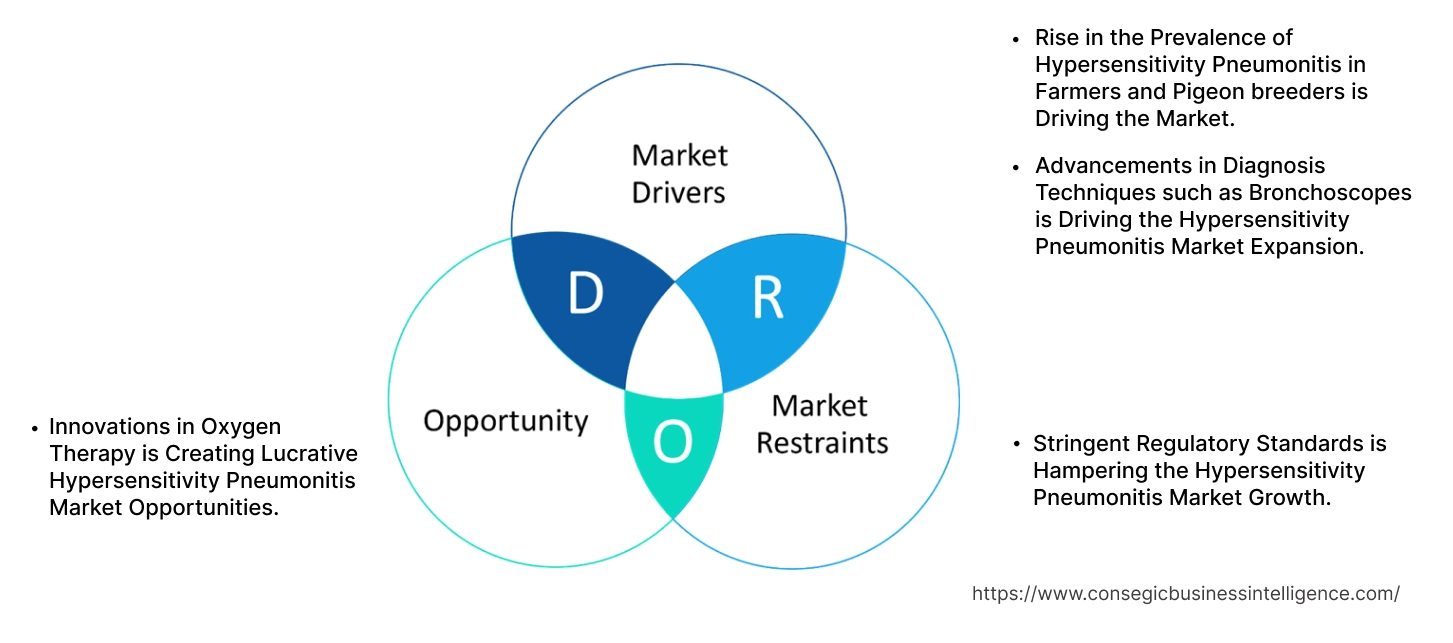
Rise in the Prevalence of Hypersensitivity Pneumonitis in Farmers and Pigeon breeders is Driving the Market.
Agricultural practices generally involve increased use of fertilizers, pesticides, and irrigation, which create environments that are susceptible to mold growth. Large-scale farming operations that mainly include handling large quantities of hay, grain dust, and other agricultural products, increasing exposure to allergens, which triggers HP. Pigeon breeders have an increased risk of developing because of repeated exposure to proteins found in pigeon droppings, feathers, and dander.
For instance,
- According to the data published by the National Library of Medicine, in 2022, the incidence of HP is observed to be 1.3% to 12.0% in farmers and 8.0% to 10.0% in pigeon breeders.
Thus, the rise in the prevalence of this condition in farmers and pigeon breeders is driving the hypersensitivity pneumonitis market growth.
Advancements in Diagnosis Techniques such as Bronchoscopes is Driving the Hypersensitivity Pneumonitis Market Expansion.
Bronchoscopy is a minimally invasive procedure that allows for direct visualization of the airways, enables clinicians to obtain tissue samples through bronchoalveolar lavage (BAL) and transbronchial biopsy. These procedures provide valuable information for accurate diagnosis, allowing for earlier intervention and more targeted treatment approaches. Advancements such as introduction of robotic bronchoscopy leads to high accuracy in diagnosis.
For instance,
- In 2023, FDA cleared the Galaxy System for Navigated Robotic Bronchoscopy, developed by Noah Medical. This innovative system aims to enhance the diagnosis and treatment of lung diseases such as hypersensitivity pneumonitis and lung cancer.
Thus, improved diagnostic accuracy leads to better patient outcomes, which drives growth within the hypersensitivity pneumonitis market.
Key Restraints:
Stringent Regulatory Standards is Hampering the Hypersensitivity Pneumonitis Market Growth.
Stringent regulatory standards imposed by government bodies worldwide pose significant constraints in the market. These regulations, designed to protect the environment and public health, increase production costs and slow down product development. The development and approval of new therapies for this condition require rigorous clinical trials and extensive data to demonstrate safety and efficacy. This rigorous regulatory oversight, while essential for patient safety, significantly increases the time and cost associated with bringing new treatments to market. Compliance with these regulations increases the cost of product growth and testing. Moreover, evolving federal regulations accelerate annual compliance and operating costs throughout medical industry supply chains. Thus, the impact of these stringent regulations on the Hypersensitivity Pneumonitis market expansion is multifaceted.
Future Opportunities :
Innovations in Oxygen Therapy is Creating Lucrative Hypersensitivity Pneumonitis Market Opportunities.
Advancements in oxygen delivery systems, such as portable oxygen concentrators and pulse oximeters, are enhancing patient mobility and improving quality of life for individuals with the condition. The introduction of portable oxygen concentrators has enhanced oxygen delivery for individuals with this condition. These compact and lightweight devices provide a constant supply of oxygen, allowing patients to maintain their independence and engage in daily activities with greater freedom.
For instance,
- In 2024, Inogen launched the Rove 4 portable oxygen concentrator (POC). This innovative device offers the highest oxygen output, delivering up to 840 ml/min of medical-grade oxygen, while maintaining a remarkably lightweight and compact design.
Thus, advancements in oxygen therapy for the treatment of HP is creating lucrative hypersensitivity pneumonitis market opportunities in the coming years.
Hypersensitivity Pneumonitis Market Segmental Analysis :
By Type:
Based on type, the market is categorized into diagnosis and treatment.
Trends in the Type:
- High-resolution computed tomography (HRCT) scans have become essential for imaging in HP, providing detailed images of lung abnormalities.
- Growing trends for corticosteroids is influencing the treatment option for this condition,
The treatment segment accounted for the largest market share in 2024 and is expected to grow at the fastest CAGR over the forecast period.
The treatment segment is further categorized into corticosteroids, immunosuppressants, bronchodilators, oxygen therapy, and others.
- Treatment for hypersensitivity pneumonitis focuses on reducing inflammation and preventing further exposure to the triggering allergen.
- Corticosteroids, such as prednisone help to reduce inflammation in the lungs.
- In severe cases or when corticosteroids are ineffective, immunosuppressant medications are used to suppress the overactive immune response.
- Supportive care measures such as oxygen therapy and pulmonary rehabilitation, also help improve quality of life for individuals with pneumonitis.
- Various pulmonary rehabilitation centers are being introduced as a support care for various lung conditions.
- For instance, in 2024, MetroWest Medical Center introduced Pulmonary Rehabilitation Program which provide outpatient solutions for lung disease. The program focuses on exercise and education to help patients to control symptoms and complications related to lung disease.
- Thus, based on the market analysis, the demand of novel treatment and support care options is driving the hypersensitivity pneumonitis market trends.
By End User:
Based on end users, the market is categorized into hospitals & clinics, homecare settings and others.
Trends in the End User:
- The diagnosis and management of HP mainly require specialized expertise. This is leading to an increased demand for specialized clinics and centers that focus on interstitial lung diseases.
- There is an increasing trend in patient-centered care, which involves actively engaging patients in their treatment decisions and providing personalized care.
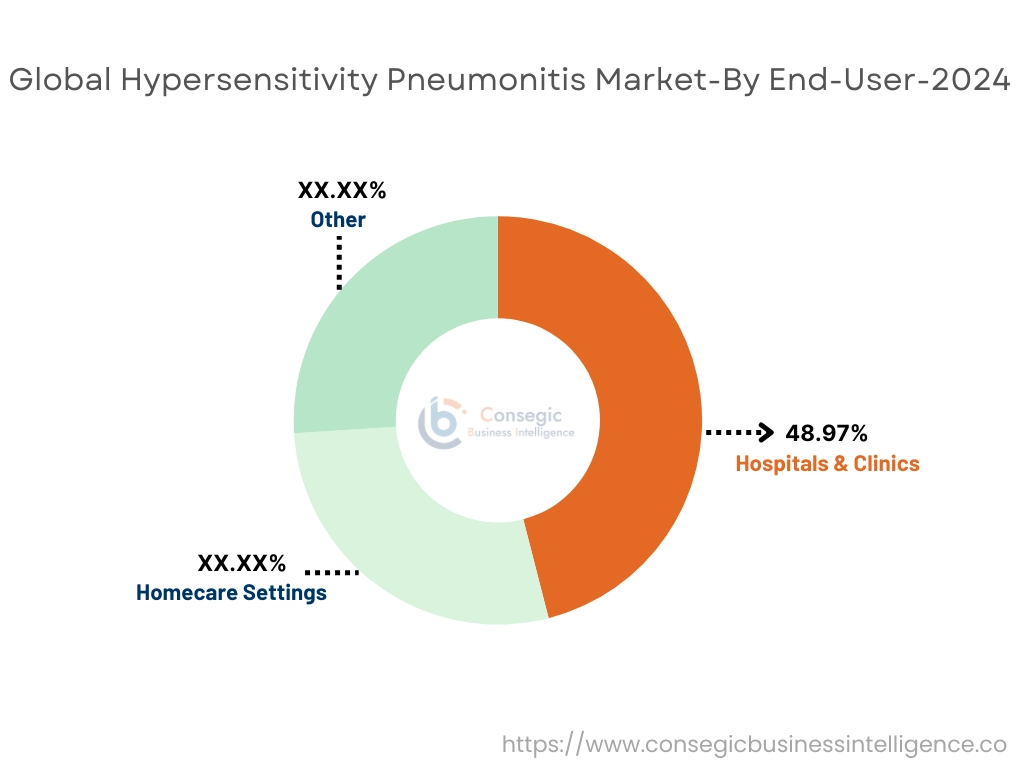
The hospitals & clinics segment accounted for the largest hypersensitivity pneumonitis market share of 48.97% in the year 2024.
- Hospitals and clinics play a critical role in the diagnosis and treatment of hypersensitivity pneumonitis.
- These settings provide access to specialized diagnostic tools and expertise necessary for accurate disease identification.
- Hospitals and clinics also provide the necessary infrastructure for administering and monitoring treatment, including corticosteroids, immunosuppressants, and other medications.
- Furthermore, these settings facilitate access to pulmonary rehabilitation programs, which significantly improve the quality of life for individuals with HP by enhancing their exercise tolerance and overall well-being.
- Various clinics are being introduced that offer efficient diagnosis and treatment for rare conditions.
- For instance, in 2025, Asian Hospital launched a new Interstitial Lung Disease (ILD) Center. This specialized center will provide comprehensive care for patients with ILD, a group of disorders that cause scarring and inflammation in the lungs by offering advanced diagnostic capabilities, innovative treatment options.
- Thus, based on the market analysis, these aforementioned factors are influencing the hypersensitivity pneumonitis market demand.
The homecare settings segment is expected to grow at the fastest CAGR over the forecast period.
- After initial diagnosis in a hospital or clinic, patients transition to homecare where they continue their care plan under the guidance of healthcare professionals.
- This includes home-based pulmonary rehabilitation programs, which focus on improving exercise tolerance, breathing techniques, and overall quality of life.
- Homecare nurses provide essential support, such as medication administration, monitoring of vital signs, and education on disease management strategies.
- Additionally, homecare settings facilitate the implementation of necessary environmental modifications to minimize exposure to triggering allergens, which is crucial for preventing disease progression and improving patient outcomes.
- Thus, based on the market analysis, the effective care and treatment of this condition in home care settings is influencing the hypersensitivity pneumonitis market trends in the coming years.
Regional Analysis:
The regional segment includes North America, Europe, Asia Pacific, the Middle East and Africa, and Latin America.
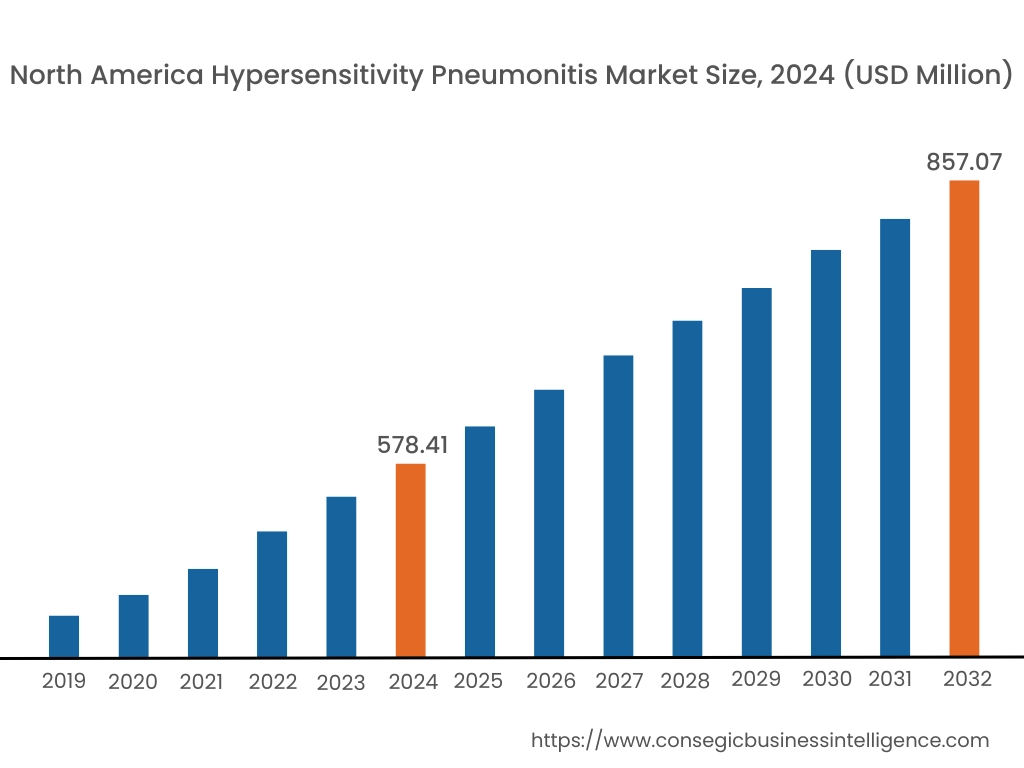
In 2024, North America accounted for the highest market share at 39.38% and was valued at USD 578.41 Million and is expected to reach USD 857.07 Million in 2032. In North America, U.S. accounted for the highest market share of 71.33% during the base year of 2024.
Pneumonitis is considered as an important cause of interstitial lung disease. Diagnosis mainly consists of detailed medical history, including occupational and environmental exposures is crucial. Physical examination reveals findings such as crackles in the lungs. Chest X-rays show abnormalities, but high-resolution computed tomography (HRCT) scanning is mainly necessary to visualize characteristic patterns of lung involvement. Bronchoscopy with bronchoalveolar lavage (BAL) provides important information by analyzing lung fluid for inflammatory cells and identifying potential allergens. HP represents a significant health concern for individuals exposed to triggering allergens in occupational or environmental settings, which leads to the prevalence of this condition in the U.S.
For instance,
- According to the data published by the Ats Interstitial Lung Disease Primer: Hypersensitivity Pneumonitis report, states that prevalence of HP in the U.S. ranges from 1.67 to 2.71 per 10 0,00 individuals.
Thus, based on the hypersensitivity pneumonitis market analysis, the prevalence and rise in diagnosis of this condition in North America is influencing the development of the market.

Asia Pacific is experiencing the fastest growth with a CAGR of 6.7% over the forecast period. The Asia Pacific region exhibits a diverse range of agricultural practices, industrial activities, and environmental conditions, leading to a wide array of potential exposures that trigger hypersensitivity pneumonitis. These exposures include a variety of allergens such as mold spores, animal proteins (from birds, livestock, etc.), and various industrial dusts. Climate change alters environmental conditions, leading to changes in mold growth and the distribution of allergens. Urbanization increases exposure to air pollution and other environmental triggers, potentially contributing to the rise in HP cases. These factors lead to the demand of novel specialty hospitals and clinics that cater to the diagnosis and treatment of this condition.
Europe presents a contribution to the Hypersensitivity Pneumonitis market analysis. Europe has seen significant advancements in the treatment of pneumonitis. Oxygen therapy has been refined with the introduction of portable oxygen concentrators and high-flow nasal cannula systems, enhancing patient mobility and quality of life. Additionally, research into novel therapeutic approaches is ongoing, including the investigation of antifibrotic medications like nintedanib, which have shown promise in slowing the progression of lung fibrosis in some interstitial lung diseases. Advancements in pulmonary rehabilitation programs, including tailored exercise regimens and respiratory therapies, are improving the overall management of HP and enhancing patient outcomes in European healthcare settings, thus driving the market trends.
The Middle East and Africa (MEA) region is witnessing notable Hypersensitivity Pneumonitis market demand characterized by significant potential. Awareness programs and government initiatives for pneumonitis in the Middle East and Africa are crucial for improving diagnosis and treatment. These efforts focus on raising awareness among healthcare professionals and the general public about the causes, symptoms, and prevention of HP. Additionally, policies aimed at improving workplace safety and environmental regulations help reduce exposure to potential triggers and prevent the development of HP. As per the market analysis, by implementing comprehensive strategies that combine public awareness, healthcare system strengthening, and preventive measures, the Middle East and Africa effectively address the challenges posed by pneumonitis, thus influencing the market trends
Latin America is an emerging region in the Hypersensitivity Pneumonitis market share, with significant potential for innovation. In Latin America, homecare settings are crucial in the long-term management of this condition. After initial diagnosis and treatment in hospitals or clinics, patients mainly prefer home-based care, where they continue their treatment plans under the guidance of healthcare professionals. This involves home-based pulmonary rehabilitation programs, which focus on improving exercise tolerance, breathing techniques, and overall quality of life. Additionally, homecare settings facilitate the implementation of necessary environmental modifications to minimize exposure to triggering allergens, which is crucial for preventing disease progression and improving patient outcomes.
Top Key Players and Market Share Insights:
The global Hypersensitivity Pneumonitis market is highly competitive with major players providing precise products to the national and international markets. Key players are adopting several strategies in research and development (R&D) and product innovation to hold a strong position in the global Hypersensitivity Pneumonitis market. Key players in the Hypersensitivity Pneumonitis industry include-
- Lupin (India)
- Lotus (Taiwan)
- Merck & Co., Inc (United States)
- Sandoz AG (Switzerland)
- AdvaCare Pharma (United States)
- Boehringer Ingelheim (Germany)
- Tivan Sciences (India)
- Abbott (United States)
- Cipla USA, Inc. (United States)
- Teva Pharmaceutical (Israel)
Hypersensitivity Pneumonitis Market Report Insights :
| Report Attributes | Report Details |
| Study Timeline | 2019-2032 |
| Market Size in 2032 | USD 2,287.07 Million |
| CAGR (2025-2032) | 5.7% |
| By Type |
|
| By End-User |
|
| By Region |
|
| Key Players |
|
| North America | U.S. Canada Mexico |
| Europe | U.K. Germany France Spain Italy Russia Benelux Rest of Europe |
| APAC | China South Korea Japan India Australia ASEAN Rest of Asia-Pacific |
| Middle East and Africa | GCC Turkey South Africa Rest of MEA |
| LATAM | Brazil Argentina Chile Rest of LATAM |
| Report Coverage |
|
Key Questions Answered in the Report
How big is the Hypersensitivity Pneumonitis market? −
In 2024, the Hypersensitivity Pneumonitis market is USD 1,469.07 Million.
Which is the fastest-growing region in the Hypersensitivity Pneumonitis market? +
Asia Pacific is the fastest-growing region in the Hypersensitivity Pneumonitis market.
What specific segmentation details are covered in the Hypersensitivity Pneumonitis market? +
Type, and End User segmentation details are covered in the Hypersensitivity Pneumonitis market.
Who are the major players in the Hypersensitivity Pneumonitis market? +
Lupin (India), Lotus (Taiwan), and Boehringer Ingelheim (Germany) are some of the major players in the market.
Overview
Reputation & Certifications


Our Services
- Market Intelligence & Forecasting
- Custom Research Solutions
- Market Entry Strategy
- Competitive Intelligence
- Customer Insights
- Industry Innovation Analysis
- Investment Advisory