Jump to Content
Large Language Model (LLM) Market - Size, Industry Share, Growth Trends and Forecasts (2026 - 2034)
Large Language Model (LLM) Market Size:
Large Language Model (LLM) Market size is estimated to reach over USD 45.47 Billion by 2034 from a value of USD 8.63 Billion in 2025 and is projected to grow by USD 10.38 Billion in 2026, growing at a CAGR of 20.28% from 2026 to 2034.
Large Language Model (LLM) Market Scope & Overview:
Large language model (LLM) is an advanced artificial intelligence system built on deep learning networks. It is trained on massive amounts of text data for understanding, summarizing, translating, and generating human-like language. Moreover, large language model (LLM) offers several benefits, including high efficiency through task automation, 24/7 intelligent customer support, accelerated software coding, and seamless multilingual communication, among others. Additionally, the large language model (LLM) market is experiencing considerable growth, primarily driven by rising enterprise demand for generative AI, process automation, and data analytics, combined with significant investments in cloud infrastructure and constant algorithmic improvements that enhance reasoning, multimodality, and efficiency.

Large Language Model (LLM) Market Dynamics - (DRO):
Market Drivers:
Rising enterprise demand for generative AI, process automation, and data analytics is driving the large language model (LLM) market growth
Rising enterprise demand for generative AI, process automation, and data analytics is among the key factors driving the large language model (LLM) market. Modern businesses face relentless pressure to boost operational efficiency, reduce manual overhead, and extract actionable insights from vast, unstructured data reserves. Generative AI tools help in addressing these challenges by automating complex workflows, drafting content, summarizing reports, and accelerating software development with superior speed. Moreover, with the integration of generative AI with advanced data analytics, large language models are capable of transforming raw corporate data into intuitive, conversational interfaces, which in turn enables non-technical stakeholders to query databases and receive immediate, data-driven answers without relying on dedicated data science teams.
In addition, process automation powered by intelligent LLMs is capable of dynamically interpreting context, handling exception cases, and adapting to shifting business environments across customer support, supply chain management, and financial auditing. As companies across diverse industries recognize the above competitive benefits and productivity gains, corporate technology budgets increasingly shift toward scalable, enterprise-grade AI solutions. The above factors are further driving the market.
- For instance, in July 2026, OpenAI launched the GPT-5.6 family of models, featuring the flagship Sol, balanced Terra, and cost-efficient Luna, with price decrements up to 80%, tailored specifically for scalable and high-performance enterprise automation, reasoning, and multi-modal workflows.
Hence, the growing enterprise need for generative AI, process automation, and data analytics is increasing the adoption of large language model (LLM), thereby driving the market size.
Market Restraints:
Operational limitations and challenges associated with LLMs are restraining the market growth
The operational limitations and challenges associated with large language model (LLM) are among the primary factors limiting the market growth. Moreover, the substantial computational and financial cost required to train and deploy large language models usually creates high barriers to entry, particularly for smaller enterprises operating on limited budgets. In addition to infrastructure expenses, LLMs suffer from inherent reliability flaws, most notably hallucinations, where models generate plausible yet factually incorrect or fabricated information that may introduce catastrophic risks in high-stakes domains such as healthcare, finance, and legal compliance.
Additionally, the use of LLMs is also linked to data privacy and security concerns, wherein organizations hesitate to integrate proprietary or sensitive data into public architectures due to the constant threat of data leakage and regulatory non-compliance with frameworks like GDPR. Furthermore, latency issues during real-time inference may hinder seamless enterprise integration, while the environmental impact of massive data center energy consumption contributes to regulatory scrutiny and sustainability concerns. Hence, the aforementioned factors are hindering the large language model (LLM) market expansion.
Future Opportunities:
Domain-specific customizations and vertical solutions, such as healthcare, BFSI, and legal sectors, are expected to drive the large language model (LLM) market opportunities
The large language model (LLM) market is shifting rapidly from general-purpose tools to domain-specific customizations and vertical solutions designed for high-stakes industries such as healthcare, banking, financial services, insurance, and legal sectors, among others. By refining LLMs on proprietary enterprise data and enforcing strict compliance requirements, organizations can gain massive value. In healthcare, customized LLMs streamline clinical documentation, accelerate drug discovery, and summarize complex patient histories while adhering to privacy mandates.
Moreover, in the BFSI industry, tailored architectures automate rigorous compliance checks, enhance fraud detection, and parse dense financial disclosures with high precision. Meanwhile, the legal sector leverages LLMs for rapid contract analysis, precise e-discovery, and exhaustive case law research, which in turn helps in reducing manual overhead. Since these sectors require advanced security, explainability, and domain expertise, vendors and enterprises that successfully build specialized systems capture higher-margin contracts and secure long-term loyalty. The above factors are anticipated to further drive the market.
- For instance, in December 2023, Google launched MedLM, which is a family of foundation models developed specifically for the healthcare industry. These models build on earlier research from Med-PaLM and Med-PaLM 2. They are designed to help doctors, hospitals, and life science teams handle medical tasks.
Hence, the above factors are projected to boost market opportunities during the forecast period.
Large Language Model (LLM) Market Segmental Analysis:
By Offering:
Based on offering, the market is segmented into solutions/platforms and services.
Trends in the offering:
- Factors including the growing demand for multimodal applications, rapid shift toward agentic workflows that execute multi-step tasks, cost-effective inference optimization for edge and smaller open-weight models are key trends driving the large language model (LLM) market.
- The market is driven by the rising need for secure domain-specific applications, edge deployment for lower latency and data privacy, multimodal feature integrations, along with strict regulatory compliance requirements.
The solutions/platforms segment accounted for the largest revenue share in the large language model (LLM) market share in 2025, and it is anticipated to register a significant CAGR during the forecast period.
- The solutions/platforms segment includes enterprise-grade infrastructure, developer tools, orchestration, and frameworks that enable organizations to deploy, fine-tune, and scale artificial intelligence models without building systems from scratch.
- It offers several benefits, including accelerated workflow automation, reduced custom development costs, seamless domain-specific customization, and enhanced operational scalability, among others.
- Also, the market is driven by factors such as the rising demand for secure domain-specific applications, edge deployment for lower latency and data privacy, multimodal feature integrations, and strict regulatory compliance requirements.
- Thus, the above factors are further expanding the large language model (LLM) market size.
By Deployment Mode:
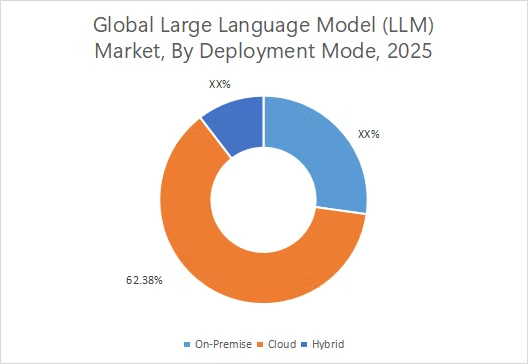
Based on deployment mode, the market is segmented into on-premise, cloud, and hybrid.
Trends in the deployment mode:
- The adoption of on-premise deployment is primarily driven by higher security and privacy, lower network bandwidth costs, and more control over server hardware.
- Factors including rapid digital transformation among business enterprises, combined with rising enterprise cloud adoption, pay-as-you-go pricing models, higher scalability, and relatively lower costs are key aspects driving the cloud deployment segment.
The cloud segment accounted for the largest revenue share of 62.38% in the market in 2025, and it is anticipated to register a substantial CAGR during the forecast period.
- The cloud deployment segment involves hosting and running AI models on remote, third-party internet infrastructure rather than local computers, which offers significant benefits like flexible scaling, lower setup costs, and easy API integrations.
- Moreover, cloud deployment offers a wide range of benefits including minimal capital expense, rapid implementation, ease of utilization and integration, faster processing, higher scalability, and relatively lower costs in comparison to other types of deployment models.
- In addition, factors including rapid digital transformation among business enterprises, rising enterprise cloud adoption, pay-as-you-go pricing models, higher scalability, and relatively lower costs are among the key prospects driving the cloud deployment segment.
- Consequently, the above benefits of cloud deployment are further driving its adoption among enterprises, thereby propelling the market growth.
By Application:
Based on application, the market is segmented into customer service & conversational agents, text generation & content creation, code generation, information retrieval, sentiment analysis, and others.
Trends in the application:
- The market is driven by the rapid development toward automated agentic AI capable of end-to-end task execution, low-latency voice AI integrations, unified omnichannel deployments across messaging apps, and hyper-personalization powered by real-time CRM and customer history data.
- Key trends driving the market growth include expanding enterprise automation needs, advancements in multilingual models, and rising API-based cloud deployments.
The customer service & conversational agents segment accounted for the largest revenue share in the market in 2025.
- In customer service, LLMs are used to power smart conversational agents that handle complex questions, match human tone, and offer 24/7 personalized support without rigid scripts.
- Moreover, the adoption of LLMs in customer service applications offers several benefits such as 24/7 availability, significant reductions in operational and labor costs, instant query resolution, and high scalability during peak traffic, among others.
- Also, the market is primarily driven by the rapid evolution toward autonomous agentic AI capable of end-to-end task execution, low-latency voice AI integrations, unified omnichannel deployments across messaging apps, and hyper-personalization powered by real-time CRM and customer history data.
- Consequently, the aforementioned factors are further driving the market.
The text generation & content creation segment is anticipated to register a substantial CAGR during the forecast period.
- The text generation and content creation segment involves deep learningmodels to automatically draft, rewrite, and scale human-like text such as marketing copy, articles, and reports, among others.
- Its primary benefits include significant productivity gains, lower operational costs, and tailored personalization, among others.
- Also, the segment is primarily driven by constant improvements in deep learning algorithms, combined with the growing enterprise demand for automated copywriting, personalized marketing, and efficient document summarization, among others.
- Hence, the rising adoption of LLM solutions for facilitating text generation and content creation applications is expected to boost the market during the forecast period.
By End User:
Based on end user, the market is segmented into BFSI, retail & e-commerce, healthcare & life sciences, IT & telecommunication, media & entertainment, and others.
Trends in the end user:
- The BFSI segment is mainly driven by the rising need for financial institutions to automate complex document processing, streamline rigorous compliance monitoring, and elevate digital customer engagement through advanced conversational agents.
- Factors including the growing unstructured electronic health record data, rapid integration of retrieval-augmented generation for verifiable medical accuracy, and rising enterprise investments in secure, domain-specific LLMs are key trends driving the healthcare & life sciences market.
The BFSI segment accounted for significant revenue in the market in 2025.
- BFSI (Banking, Financial Services, and Insurance) sector utilizes LLMs to gather unstructured financial text, automate compliance, and power hyper-personalized virtual assistants.
- Large language models (LLMs) are mainly used in the BFSI industry for automating customer service through smart chatbots, detecting fraud by analyzing text patterns, processing loan and insurance claims faster, and summarizing complex financial reports.
- Banks and insurance companies are actively deploying domain-specific large language models to extract risk insights from vast repositories of unstructured financial data, analyze complicated legal contracts, and execute real-time sentiment analysis on customer interactions.
- In addition, the BFSI segment is primarily driven by the rising need for financial institutions to automate complex document processing, streamline rigorous compliance monitoring, and elevate digital customer engagement through advanced conversational agents.
- Consequently, the increasing adoption of LLMs in BFSI firms is further propelling the market.
The healthcare & life sciences segment is anticipated to register the fastest CAGR during the forecast period.
- In healthcare and life sciences, LLMs are mostly used to assist with clinical documentation, speed up drug discovery by evaluating biomedical literature, support diagnostic decisions, as well as power patient communication tools.
- Moreover, the primary benefits of using LLMs include substantial reduction in clinician burnout through automated medical documentation, accelerated drug discovery through molecular and literature analysis, and improved patient engagement through context-aware virtual health assistants.
- In addition, the growing unstructured electronic health record (EHR) data, rapid integration of retrieval-augmented generation for verifiable medical accuracy, and rising enterprise investments in secure, domain-specific LLMs are key aspects driving the market.
- Therefore, the above factors are expected to drive the market during the forecast period.
Large Language Model (LLM) Market Regional Analysis:
The regions covered are North America, Europe, Asia Pacific, Middle East and Africa, and Latin America.
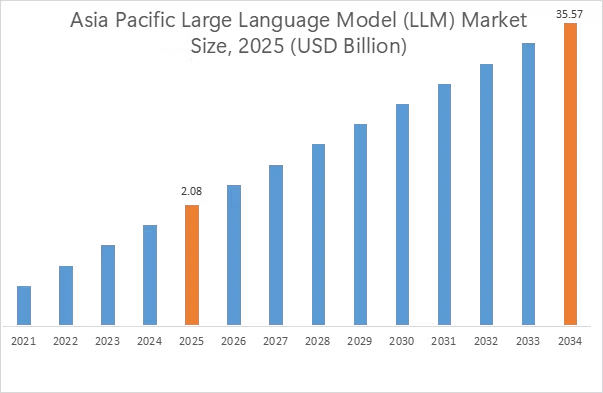
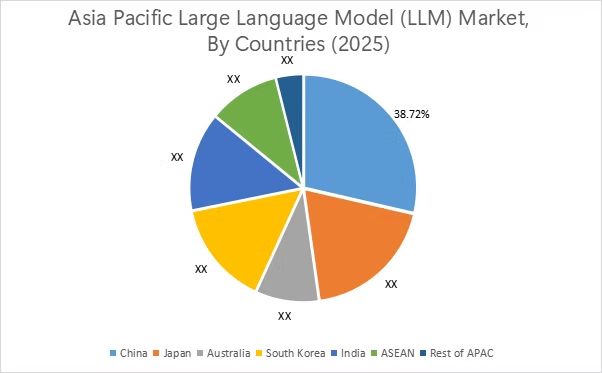
Asia Pacific region was valued at USD 2.08 Billion in 2025. Moreover, it is projected to grow by USD 2.82 Billion in 2026 and reach over USD 35.57 Billion by 2034. Out of this, China accounted for the maximum revenue share of 38.72%. As per the large language model (LLM) market analysis, the adoption of LLMs in the Asia-Pacific region is primarily driven by factors including significant government-led digital initiatives and increasing private sector investments in AI infrastructure across China, India, South Korea, and Japan, among others. Additionally, rising government funding for AI research hubs, combined with increasing corporate need for localized, multilingual NLP solutions and automated customer service systems, are further accelerating the market expansion.
- For instance, Baidu, a Chinese multinational technology company, released its Ernie 4.5 family of large language models under an open-source Apache 2.0 license in 2025. It features ten multimodal variants ranging from lightweight options to massive, high-performance systems. The above factors are driving the market in the Asia Pacific region.
North America is estimated to reach over USD 54.24 Billion by 2034 from a value of USD 3.27 Billion in 2025 and is projected to grow by USD 4.41 Billion in 2026. In North America, the market growth is mostly driven by the presence of a mature technology ecosystem, dense hyperscale computing infrastructure, and substantial capital investments from both private enterprises and government bodies into AI research. Moreover, the regional concentration of key AI developers, premier research institutions, and major cloud service providers enables rapid commercial deployment and constant technological advancements, which are further contributing to the large language model (LLM) market demand.
- For instance, in July 2026, Anthropic launched Claude Opus 5, an advanced model engineered specifically for long-running workflows, deep reasoning, and complex agentic coding tasks. The new model excels at managing multi-file software engineering, professional knowledge analysis, and autonomous error-correction without requiring constant user intervention. The above factors are expected to propel the large language model (LLM) market trends in North America during the forecast period.
Meanwhile, according to the regional analysis, factors including rising cloud infrastructure adoption, collaborative public-private investments in AI initiatives, increasing enterprise automation needs, and a strong focus on multilingual and localized AI solutions are key prospects driving the market in Europe. Furthermore, the market in Latin America, Middle East, and African regions is expected to grow at a considerable rate due to factors such as growing digital transformation among businesses, rising enterprise shift towards cloud-native architecture, and government-backed national AI strategies and substantial investments in AI infrastructure, among others.
Top Key Players & Market Share Insights:
The global large language model (LLM) market is highly competitive with major players providing solutions to the national and international markets. Key players are adopting several strategies in research and development (R&D), product innovation, and end-user launches to hold a strong position in the large language model (LLM) market. Key players in the large language model (LLM) industry include-
- Anthropic(United States)
- Mistral AI(France)
- OpenAI (United States)
- Google (United States)
- Meta Platforms (United States)
- DeepSeek (China)
- Alibaba Cloud (China)
- AI LLC (United States)
- Baidu (China)
- Cohere (Canada)
Recent Industry Developments:
Product Launch:
- In July 2026, AI LLC introduced Grok 4.5, its most advanced reasoning and multi-modal model to date, designed to handle complex logic, mathematics, and agentic workflows. The model excels at autonomous problem-solving, real-time data integration, and nuanced creative generation.
- In April 2024, Meta introduced Llama 3, a next-generation series of open-source LLMs engineered to significantly outperform prior versions across reasoning, coding, and complex instruction execution. Trained on vast, precisely filtered datasets utilizing massive custom GPU infrastructure, the initial release featured highly optimized 8 billion and 70 billion parameter variants.
Large Language Model (LLM) Market Report Insights:
| Report Attributes | Report Details |
| Study Timeline | 2021-2034 |
| Market Size in 2034 | USD 131.27 Billion |
| CAGR (2026-2034) | 32.1% |
| By Offering |
|
| By Deployment Mode |
|
| By Application |
|
| By End User |
|
| By Region |
|
| Key Players |
|
| Report Coverage |
|
Key Questions Answered in the Report
Which is the fastest-growing region in the market? −
Asia-Pacific is the region experiencing the most rapid growth in the market.
What specific segmentation details are covered in the large language model (LLM) report? +
The report includes specific segmentation details for offering, deployment mode, application, end user, and region.
Who are the major players in the market? +
The key participants in the market are Anthropic (United States), Mistral AI (France), OpenAI (United States), Google (United States), Meta Platforms (United States), DeepSeek (China), Alibaba Cloud (China), X.AI LLC (United States), Baidu (China), Cohere (Canada), and others.
How big is the large language model (LLM) market? +
The large language model (LLM) market was valued at USD 7.93 Billion in 2025 and is projected to grow to USD 131.27 Billion by 2034.
Overview
Reputation & Certifications


Our Services
- Market Intelligence & Forecasting
- Custom Research Solutions
- Market Entry Strategy
- Competitive Intelligence
- Customer Insights
- Industry Innovation Analysis
- Investment Advisory