Jump to Content
Laser Resurfacing Market - Size, Share, Industry Trends, and Forecasts (2025-2032)
Laser Resurfacing Market Size:
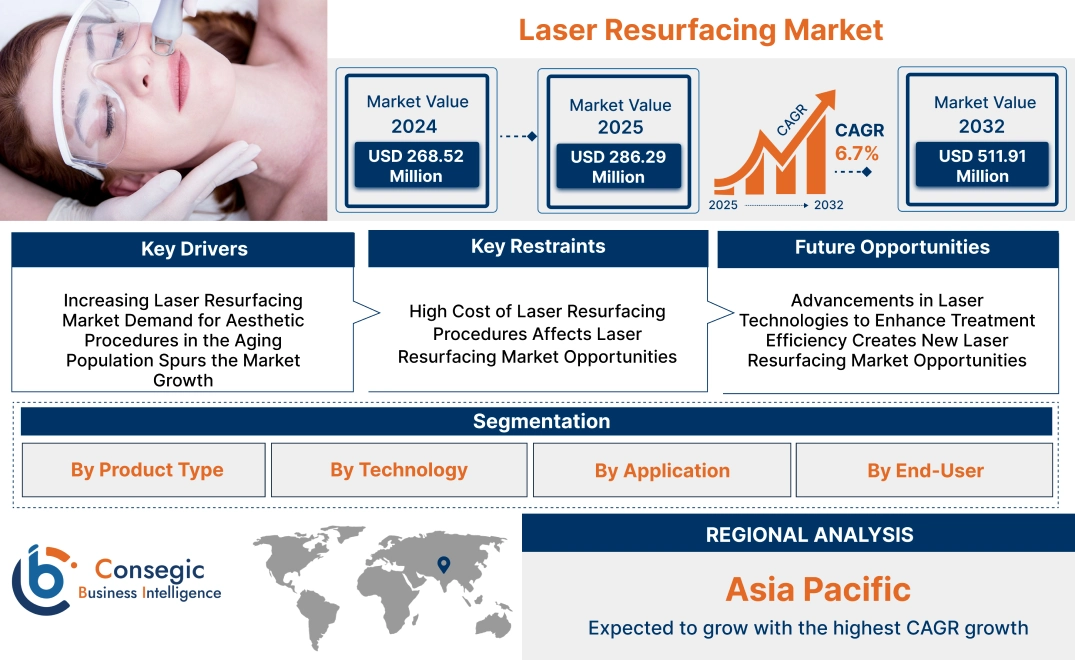
Laser Resurfacing Market size is estimated to reach over USD 511.91 Million by 2032 from a value of USD 268.52 Million in 2024 and is projected to grow by USD 286.29 Million in 2025, growing at a CAGR of 8.4% from 2025 to 2032.
Laser Resurfacing Market Scope & Overview:
Laser resurfacing is a dermatological procedure that uses concentrated light beams to improve skin texture, tone, and appearance. It targets damaged skin layers to stimulate collagen production and promote regeneration. The procedure is known for its precision, minimal invasiveness, and shorter recovery times compared to traditional treatments. Laser resurfacing addresses wrinkles, acne scars, sun damage, and pigmentation issues effectively.
This treatment offers benefits including improved skin elasticity, reduced blemishes, and enhanced overall skin quality. It finds applications in cosmetic clinics, dermatology centers, and hospitals specializing in aesthetic treatments. End-use industries include skincare and aesthetic medicine, catering to individuals seeking advanced solutions for skin rejuvenation and enhancement.
Laser Resurfacing Market Dynamics - (DRO) :
Key Drivers:
Increasing Laser Resurfacing Market Demand for Aesthetic Procedures in the Aging Population Spurs the Market Growth
The aging population is increasingly seeking aesthetic procedures to address age-related skin issues such as wrinkles, fine lines, and uneven skin tone. Laser resurfacing is an effective solution as it rejuvenates the skin by promoting collagen production and reducing visible signs of aging. The procedure provides minimally invasive treatment with shorter recovery times compared to traditional surgical methods.
For instance, fractional CO2 lasers are commonly used to treat skin laxity and texture issues, enhancing overall skin appearance.
Therefore, the growing preference for aesthetic enhancement among the aging population is propelling the adoption of laser resurfacing technologies.

Key Restraints:
High Cost of Laser Resurfacing Procedures Affects Laser Resurfacing Market Opportunities
Laser resurfacing procedures are expensive, which limits their accessibility to a smaller segment of the population. The high costs arise from the advanced technology used in laser devices and the expertise required for safe and effective treatment. Additionally, the cost of multiple sessions further adds to the financial burden for patients.
For example, the average cost of ablative laser skin resurfacing is significantly higher than non-invasive skincare treatments like chemical peels.These financial constraints reduce the adoption rate, particularly in regions with lower disposable incomes, hindering the laser resurfacing market growth.
Future Opportunities :
Advancements in Laser Technologies to Enhance Treatment Efficiency Creates New Laser Resurfacing Market Opportunities
The development of innovative laser technologies is expected to open new opportunities in the market. These advancements include devices offering improved precision, reduced downtime, and tailored treatment options for various skin types and conditions. Emerging technologies such as picosecond and erbium lasers are designed to minimize side effects while delivering effective results.
For instance, hybrid fractional lasers are gaining attention for their ability to combine ablative and non-ablative treatments, enhancing the outcomes for patients with minimal recovery time.
Therefore, the introduction of advanced laser systems is likely to expand the scope of laser resurfacing applications and drive future laser resurfacing market growth.
Laser Resurfacing Market Segmental Analysis :
By Product Type:
Based on product type, the market is segmented into ablative and non-ablative laser resurfacing.
The ablative segment accounted for the largest revenue in laser resurfacing market share in 2024.
- Ablative lasers work by removing the top layer of skin to promote the regeneration of smoother and younger-looking skin.
- These lasers are highly effective in treating deep wrinkles, acne scars, and skin irregularities.
- They are commonly used in cosmetic and dermatology clinics due to their proven results in improving skin texture and tone.
- Their growing adoption is attributed to advancements in fractional ablative lasers that minimize downtime while delivering superior results.
- Therefore, according to laser resurfacing market analysis, ablative lasers are a key revenue driver for the market.
The non-ablative segment is anticipated to register the fastest CAGR during the forecast period.
- Non-ablative lasers penetrate the skin without damaging the outer layer, stimulating collagen production and addressing mild to moderate skin issues.
- They are widely preferred for minimal recovery time and lower risk of side effects, appealing to a broader patient demographic.
- Applications in skin tightening, wrinkle reduction, and pigmentation correction have seen increased trend, especially in outpatient settings.
- Thus, according to laser resurfacing market analysis, the growth of non-ablative lasers highlights the market's shift toward safer and quicker treatment solutions.
By Technology:
Based on technology, the market is segmented into fractional CO2 laser, erbium YAG laser, picosecond laser, and others.
The fractional CO2 laser segment accounted for the largest revenue in laser resurfacing market share in 2024.
- Fractional CO2 lasers offer precision in treating deeper skin layers, addressing wrinkles, scars, and sun damage effectively.
- They are preferred in clinical settings for their versatility and ability to deliver significant results in fewer sessions.
- Their use in treating both cosmetic concerns and medical conditions such as warts and skin tags adds to their popularity.
- Therefore, according to market analysis, the segment's dominance is attributed to its wide-ranging applications and clinical efficacy.
The picosecond laser segment is anticipated to register the fastest CAGR during the forecast period.
- Picosecond lasers deliver ultra-short energy bursts, enabling the treatment of pigmentation issues, tattoos, and scars with minimal thermal damage.
- Their rising adoption is driven by advanced technology that provides effective results with reduced downtime.
- These lasers are particularly popular among younger demographics seeking quick and effective skin treatments.
- Thus, according to market analysis, the rapid laser resurfacing market trend of picosecond lasers underscores their increasing adoption for precision and versatility in dermatological applications.
By Application:
Based on application, the market is segmented into wrinkle and fine line reduction, acne scar removal, skin tightening, pigmentation and spot correction, and others.
The wrinkle and fine line reduction segment accounted for the largest revenue share in 2024.
- Treatments targeting wrinkles and fine lines are among the most sought-after procedures in cosmetic dermatology.
- Laser resurfacing is highly effective in promoting collagen remodeling, leading to smoother and more youthful skin.
- Growing awareness about aesthetic procedures and the increasing geriatric population drive laser resurfacing market trend for these treatments.
- Therefore, according to market analysis, this segment benefits from the growing focus on anti-aging solutions.
The acne scar removal segment is anticipated to register the fastest CAGR during the forecast period.
- Acne scar treatments address a prevalent concern among younger and middle-aged demographics.
- Laser resurfacing is a proven solution for improving the appearance of scars, with high patient satisfaction rates.
- The increasing adoption of minimally invasive procedures contributes to the segment's rapid trend.
- Thus, according to market analysis, the segment's expansion is driven by the rising trend for effective and less invasive scar treatments.
By End User:
Based on end-user, the market is segmented into hospitals, dermatology clinics, and others.
The dermatology clinics segment accounted for the largest revenue share by 54.80% in 2024.
- Dermatology clinics are the primary providers of laser resurfacing treatments, equipped with advanced technologies and skilled professionals.
- These clinics cater to both cosmetic and therapeutic needs, offering personalized care and convenience to patients.
- Therefore, according to market analysis, the growing number of specialized clinics across urban and suburban areas bolsters this segment's dominance.
The hospital segment is anticipated to register the fastest CAGR during the forecast period.
- Hospitals increasingly adopt laser resurfacing technologies for comprehensive care, including treating complex skin conditions.
- Their ability to integrate advanced technologies with a multidisciplinary approach attracts patients seeking holistic treatment.
- Rising investments in hospital infrastructure and technological upgrades contribute to this segment's growth.
- Thus, according to market analysis, the hospital segment's growth reflects its expanding role in providing diverse dermatological solutions.

Regional Analysis:
The regional segment includes North America, Europe, Asia Pacific, Middle East and Africa, and Latin America.

In 2024, North America was valued at USD 89.07 Million and is expected to reach USD 165.91 Million in 2032. In North America, the U.S. accounted for the highest share of 71.60% during the base year of 2024. North America leads the laser resurfacing market, particularly in the United States and Canada. High laser resurfacing market demand for aesthetic treatments, advanced healthcare infrastructure, and the growing popularity of non-invasive procedures significantly contribute to the market’s performance in this region. The increasing awareness of the benefits of laser resurfacing, coupled with the availability of cutting-edge technology, drives laser resurfacing market expansion. The presence of prominent market players and a strong emphasis on research and development also play pivotal roles in shaping the market landscape in North America.

In Asia Pacific, the market is experiencing the fastest growth with a CAGR of 8.9% over the forecast period. Asia-Pacific is experiencing rapid trend in the laser resurfacing market, with countries such as Japan, China, and South Korea witnessing increasing adoption of these treatments. Rising disposable incomes, coupled with the growing trend of cosmetic enhancements, are key factors influencing the market in this region. Additionally, advancements in laser technologies and the increasing number of aesthetic clinics have led to broader availability of laser resurfacing procedures. The demand for non-invasive skin treatments and the rising focus on self-care are also significant factors contributing to market development in Asia-Pacific.
Europe’s laser resurfacing market benefits from a well-established healthcare system and high demand for aesthetic treatments. Countries like Germany, France, and the United Kingdom are major contributors to laser resurfacing market trend. The increasing number of people seeking cosmetic procedures, combined with technological advancements, drives the adoption of laser resurfacing treatments. The growing preference for minimally invasive procedures and the availability of advanced equipment also influence the laser resurfacing market expansion in Europe. However, high treatment costs and regulatory challenges in certain countries may limit widespread adoption.
The Middle East and Africa (MEA) region is witnessing gradual growth in the laser resurfacing market, with countries like the UAE, Saudi Arabia, and South Africa leading the demand. The increasing number of medical tourism patients seeking aesthetic treatments, including laser resurfacing, plays a crucial role in expanding the market. Rising disposable incomes, coupled with a growing focus on appearance and self-care, further fuel the demand for these services. However, limited awareness in certain African countries and the relatively high cost of treatments in the region pose challenges to broader market penetration.
Latin America’s laser resurfacing market is experiencing steady growth, particularly in countries such as Brazil, Mexico, and Argentina. Rising disposable incomes, increasing awareness of cosmetic procedures, and the demand for non-invasive skin treatments drive the market in this region. Brazil stands out as a major market for aesthetic procedures, including laser resurfacing, due to the strong cultural emphasis on appearance. However, the high cost of treatments and limited access to advanced laser technology in certain areas may restrict market potential in some Latin American countries.
Top Key Players and Market Share Insights:
The Global Laser Resurfacing Market is highly competitive with major players providing products and services to the national and international markets. Key players are adopting several strategies in research and development (R&D), product innovation, and end-user launches to hold a strong position in the Global Laser Resurfacing Market. Key players in the Laser Resurfacing industry include-
- Lumenis Ltd. (Israel)
- Cynosure, Inc. (United States)
- Quanta System S.p.A. (Italy)
- Cutera, Inc. (United States)
- Asclepion Laser Technologies GmbH (Germany)
- Candela Corporation (United States)
- Alma Lasers (Israel)
- Fotona d.o.o. (Slovenia)
- Sciton, Inc. (United States)
- Syneron Medical Ltd. (Israel)
Recent Industry Developments :
Product launches:
- In Oct 2024, Powered by MRP launched ECHO, a new laser hair removal technology in the U.S. was launched, featuring innovative BSL Technology for faster, more precise treatments across all skin types without ultrasound gel or cryogen.
Partnerships & Collaborations:
- In October 2024, Apollo Biowellness, through its subsidiary Evolutionary Biologics, entered into a joint venture with Reveal Lasers LLC. This collaboration focuses on distributing Evolutionary Biologics' premium biologic solutions across the aesthetic and regenerative health markets. The partnership aims to integrate biologic products with Reveal Lasers' advanced laser technologies, providing comprehensive treatment protocols for plastic surgeons, dermatologists, and medical spas worldwide.
Mergers and Acquisitions:
- In Jan 2024, Cynosure, a leading provider of energy-based medical aesthetic treatment systems, and Lutronic, a global innovator in medical laser technologies, announced a strategic merger. This combination aimed to create a global leader in medical aesthetic systems with a diversified, innovative product portfolio and a commercial presence in over 130 countries
- In July 2024, Reveal Lasers LLC, a subsidiary of Reveal Lasers LTD, acquired the AgeJET Advanced Plasma Skin Therapy device through a strategic merger with NEOconcepts LLC. This acquisition enabled Reveal Lasers LLC to enhance its product portfolio and provide advanced treatment options in the plasma skin resurfacing market.
Business Expansion:
- In 2024, Alma Lasers, a leading provider of laser and light-based technologies, opened its fifth Alma Academy. This expansion is part of Alma's strategy to broaden its global presence and offer advanced training in aesthetic treatments, including laser resurfacing.
Laser Resurfacing Market Report Insights :
| Report Attributes | Report Details |
| Study Timeline | 2019-2032 |
| Market Size in 2032 | USD 511.91 million |
| CAGR (2025-2032) | 8.4% |
| By Product Type |
|
| By Technology |
|
| By Application |
|
| By End-User |
|
| By Region |
|
| Key Players |
|
| North America | U.S. Canada Mexico |
| Europe | U.K. Germany France Spain Italy Russia Benelux Rest of Europe |
| APAC | China South Korea Japan India Australia ASEAN Rest of Asia-Pacific |
| Middle East and Africa | GCC Turkey South Africa Rest of MEA |
| LATAM | Brazil Argentina Chile Rest of LATAM |
| Report Coverage |
|
Key Questions Answered in the Report
How big is the Laser Resurfacing Market? −
In 2024, the Laser Resurfacing Market was USD 268.52 million.
What will be the potential market valuation for the Laser Resurfacing Market by 2032? +
In 2032, the market size of Laser Resurfacing Market is expected to reach USD 511.91 million.
What are the segments covered in the Laser Resurfacing Market report? +
The product type, technology, application, and end-user are the segments covered in this report.
Who are the major players in the Laser Resurfacing Market? +
Lumenis Ltd. (Israel), Cynosure, Inc. (United States), Candela Corporation (United States), Alma Lasers (Israel), Fotona d.o.o. (Slovenia), Sciton, Inc. (United States), Syneron Medical Ltd. (Israel), Quanta System S.p.A. (Italy), Cutera, Inc. (United States), Asclepion Laser Technologies GmbH (Germany) are the major players in the Laser Resurfacing market.
Overview
Reputation & Certifications


Our Services
- Market Intelligence & Forecasting
- Custom Research Solutions
- Market Entry Strategy
- Competitive Intelligence
- Customer Insights
- Industry Innovation Analysis
- Investment Advisory