Jump to Content
Marine Internet of Things Market - Size, Share, Industry Trends, and Forecasts (2025 - 2032)
Marine Internet of Things Market Size:
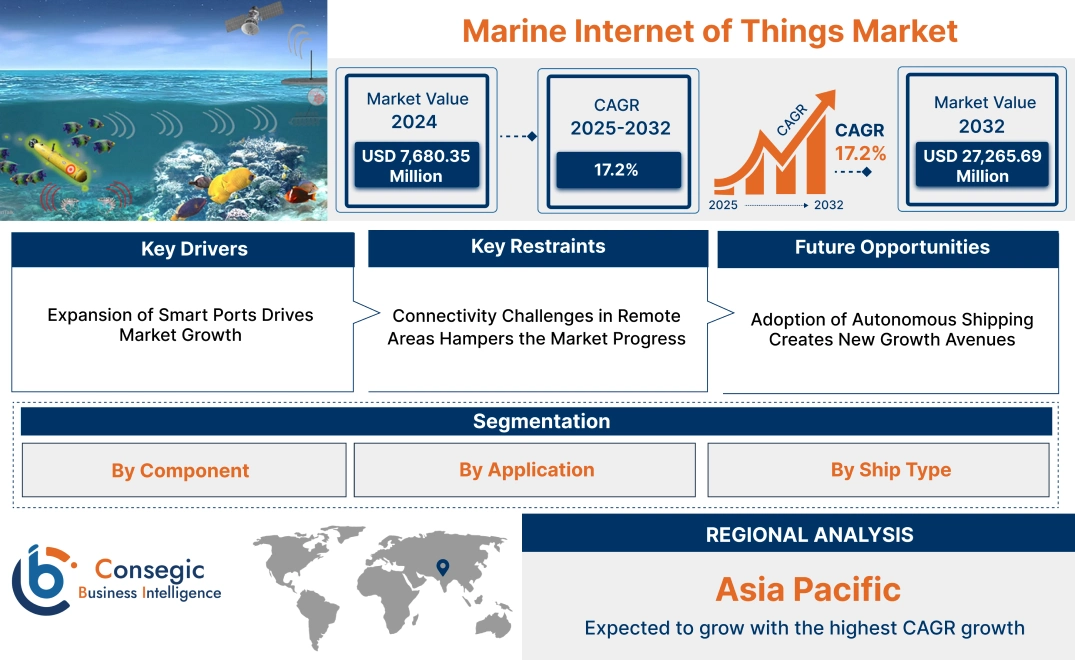
Marine Internet of Things Market size is estimated to reach over USD 27,265.69 Million by 2032 from a value of USD 7,680.35 Million in 2024 and is projected to grow by USD 8,861.45 Million in 2025, growing at a CAGR of 17.2% from 2025 to 2032.
Marine Internet of Things Market Scope & Overview:
The Marine Internet of Things (IoT) refers to the integration of IoT technologies into maritime operations to enhance connectivity, efficiency, and safety. This ecosystem connects sensors, devices, and systems on ships, ports, and offshore platforms, enabling real-time monitoring, data collection, and analytics. Marine IoT solutions are widely applied in areas such as vessel tracking, predictive maintenance, cargo monitoring, and environmental compliance.
These systems are designed to operate in harsh marine environments, featuring robust connectivity solutions such as satellite and cellular networks. They integrate with advanced platforms for data visualization and analysis, providing actionable insights to optimize operations. The ability to remotely monitor and control marine assets enhances decision-making and operational efficiency in various maritime activities.
End-users include shipping companies, port operators, and offshore energy firms seeking advanced solutions for managing fleet operations, improving logistics, and ensuring safety. The Marine IoT plays a critical role in modernizing the maritime industry by enabling smarter and more connected operations.
Marine Internet of Things Market Dynamics - (DRO) :
Key Drivers:
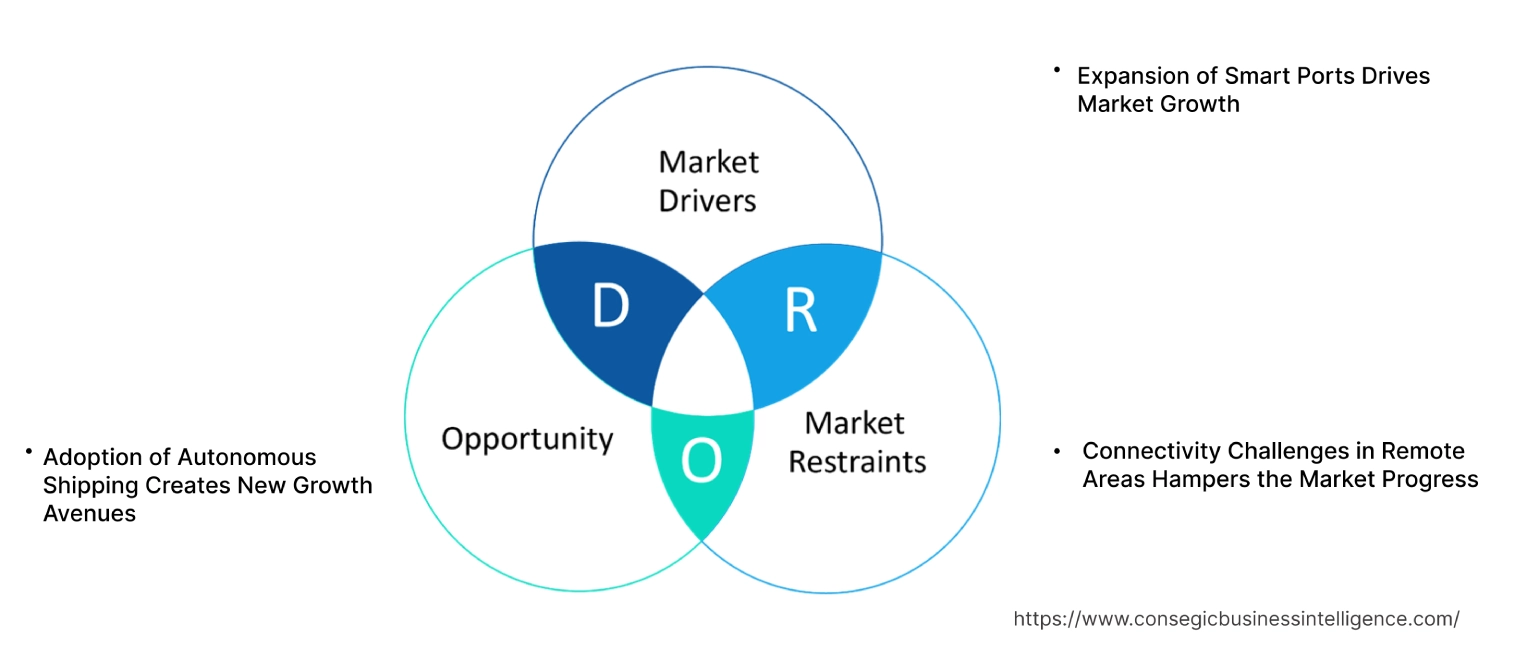
Expansion of Smart Ports Drives Market Growth
The integration of IoT in smart port operations is revolutionizing the maritime logistics chain by enabling real-time data exchange between ships and port systems. IoT-powered solutions enhance coordination in docking, cargo handling, and customs clearance, significantly reducing turnaround times and improving operational efficiency. For instance, IoT sensors monitor port equipment, ensuring timely maintenance and minimizing disruptions. Automated data sharing between vessels and ports optimizes resource allocation, such as berth availability and crane scheduling, contributing to seamless operations.
Additionally, IoT systems enhance security by monitoring cargo movement and tracking unauthorized access in real-time. With the growing adoption of smart port technologies, ports worldwide are achieving higher throughput and sustainability goals by reducing idle times and resource wastage. This transformation is pivotal for meeting the increasing global trade demands and aligning with trends in digitalization and smart infrastructure. Thus, the aforementioned factors are driving the marine Internet of Things market growth.
Key Restraints:
Connectivity Challenges in Remote Areas Hampers the Market Progress
Reliable connectivity remains a significant constraint for maritime IoT implementation, particularly in remote regions where internet coverage is limited or absent. Many maritime nodes, including vessels and offshore facilities, operate in areas beyond the reach of terrestrial networks. This lack of consistent internet access hampers real-time data sharing, predictive maintenance, and effective monitoring of maritime operations. Additionally, disruptions in satellite connectivity due to adverse weather conditions or equipment failures further degrade system performance. These connectivity issues limit the full potential of IoT applications in maritime environments, creating barriers to seamless communication and efficient operations in isolated areas further limiting the marine Internet of things market demand.
Future Opportunities :
Adoption of Autonomous Shipping Creates New Growth Avenues
The growing focus on autonomous vessels is driving the integration of IoT technologies to enable advanced functionalities such as navigation, collision avoidance, and remote monitoring. IoT systems, combined with artificial intelligence and machine learning, facilitate real-time data processing and smart decision-making, ensuring enhanced safety and operational efficiency. These technologies support autonomous ships in analyzing environmental factors, identifying potential obstacles, and optimizing routes without human intervention.
As the maritime industry prioritizes cost reduction, fuel efficiency, and compliance with environmental regulations, the adoption of IoT-enabled autonomous shipping solutions is expanding. The integration of these technologies is not only revolutionizing traditional shipping practices but also paving the way for fully autonomous vessel operations in the near future, offering significant advancements in maritime logistics and navigation. Therefore, the above-mentioned factors are boosting marine Internet of Things market opportunities.
Marine Internet of Things Market Segmental Analysis :
By Component:
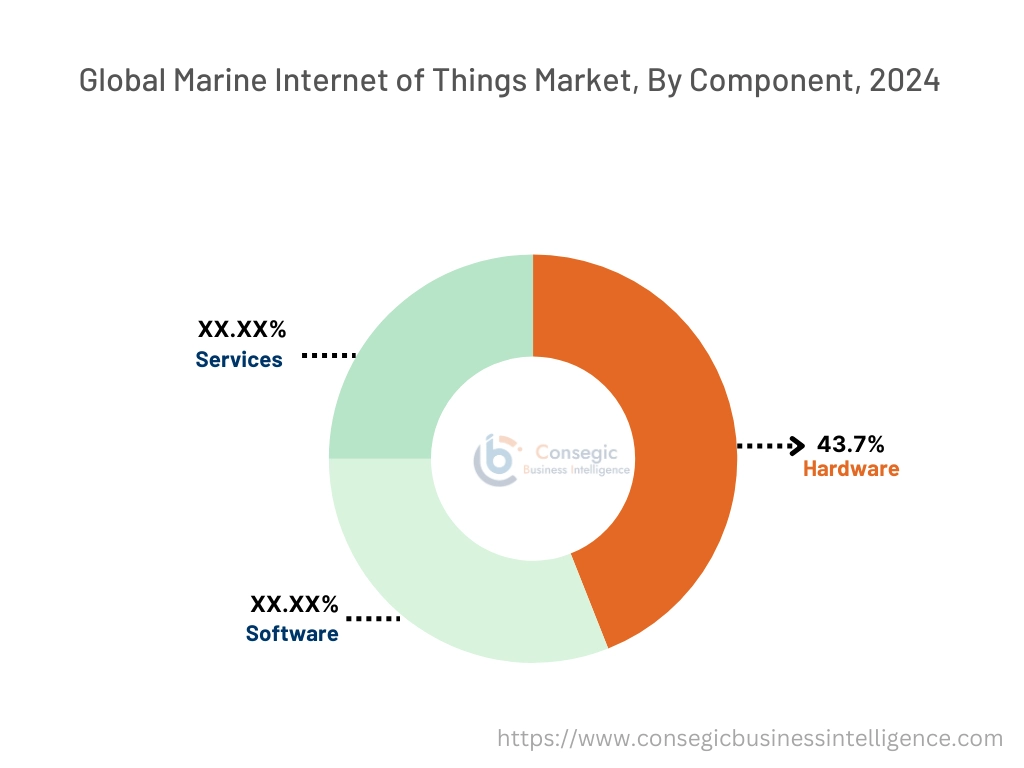
Based on components, the market is segmented into hardware, software, and services.
The hardware segment held the largest revenue of 43.7% of the total marine Internet of Things market share in 2024.
- Sensors and GPS devices are critical for real-time data acquisition, facilitating vessel tracking and cargo monitoring.
- Communication devices, including satellite transponders and cellular modems, enable seamless data transmission across maritime environments.
- Increasing adoption of advanced hardware solutions in commercial shipping and naval operations contributes significantly to the dominance of this segment.
- As per the marine Internet of Things market analysis, the segment benefits from advancements in marine hardware, including compact designs and enhanced durability, addressing diverse maritime needs.
The services segment is projected to grow at the fastest CAGR during the forecast period.
- Installation services ensure the seamless integration of IoT solutions with existing maritime infrastructure.
- Maintenance and support services minimize downtime by addressing system malfunctions and ensuring operational continuity.
- Increasing reliance on expert services for predictive maintenance and system upgrades drives the growth of this segment.
- As per the marine Internet of Things market trends, the extension of the global shipping fleet is creating opportunities for service providers to support IoT adoption in the marine sector.
By Application:
Based on application, the market is segmented into vessel tracking, predictive maintenance, cargo monitoring, navigation & route optimization, and environmental monitoring.
The vessel tracking segment accounted for the largest revenue of the total marine Internet of Things market share in 2024.
- Real-time vessel tracking systems enhance operational efficiency by enabling fleet management and route optimization.
- Increasing regulatory mandates for vessel monitoring and reporting drive the adoption of tracking solutions across maritime sectors.
- Advanced IoT solutions integrated with GPS and satellite systems offer high precision, boosting demand for vessel tracking applications.
- The dominance of this segment reflects the critical importance of accurate positioning and tracking for commercial and defense vessels, contributing to the marine Internet of Things market expansion.
The predictive maintenance segment is expected to grow at the fastest CAGR during the forecast period.
- IoT-enabled predictive maintenance solutions reduce downtime and operational costs by identifying potential equipment failures in advance.
- This segment benefits from growing awareness of the economic advantages of condition-based maintenance in shipping operations.
- Predictive maintenance solutions are increasingly adopted by commercial fleets to improve vessel reliability and safety.
- Therefore, technological advancements in AI and machine learning are enhancing the accuracy and efficiency of predictive maintenance systems, fueling the marine Internet of Things market demand.
By Ship Type:
Based on ship type, the market is segmented into commercial and defense.
The commercial segment held the largest revenue share of the marine Internet of Things market in 2024.
- Commercial vessels, including cargo ships and tankers, rely heavily on IoT solutions for navigation, cargo monitoring, and fuel optimization.
- Increasing globalization and maritime trade drive the adoption of IoT technologies in commercial shipping operations.
- Advanced connectivity and automation systems enhance operational efficiency, ensuring the dominance of this segment.
- Thus, the commercial segment benefits from rising investments in digital transformation initiatives across the shipping sector, which further boosts the marine Internet of Things market growth.
The defense segment is anticipated to grow at the fastest CAGR during the forecast period.
- Naval vessels are adopting IoT solutions for enhanced surveillance, communication, and mission-critical operations.
- Increasing defense budgets and a focus on maritime security contribute to the rapid adoption of IoT in this segment.
- IoT-enabled systems provide real-time situational awareness, improving strategic decision-making in naval operations.
- As per segmental trends analysis, the demand for advanced connectivity solutions in defense vessels is accelerating the growth of this segment, creating significant marine Internet of Things market opportunities.
Regional Analysis:
The regions covered are North America, Europe, Asia Pacific, the Middle East and Africa, and Latin America.
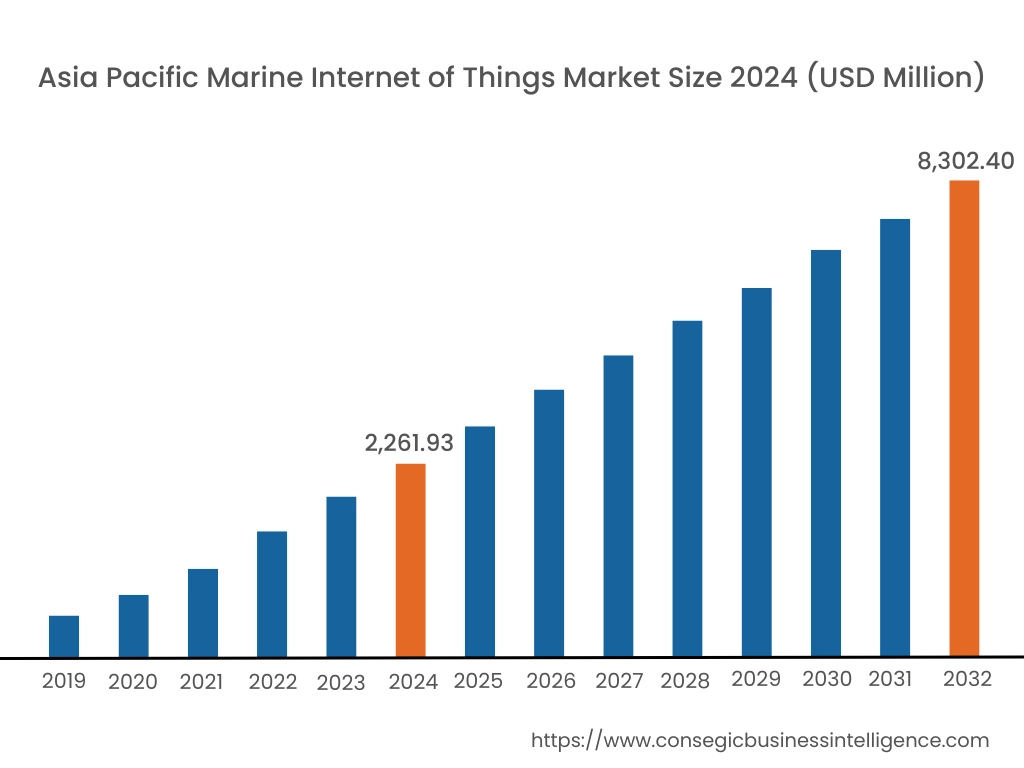
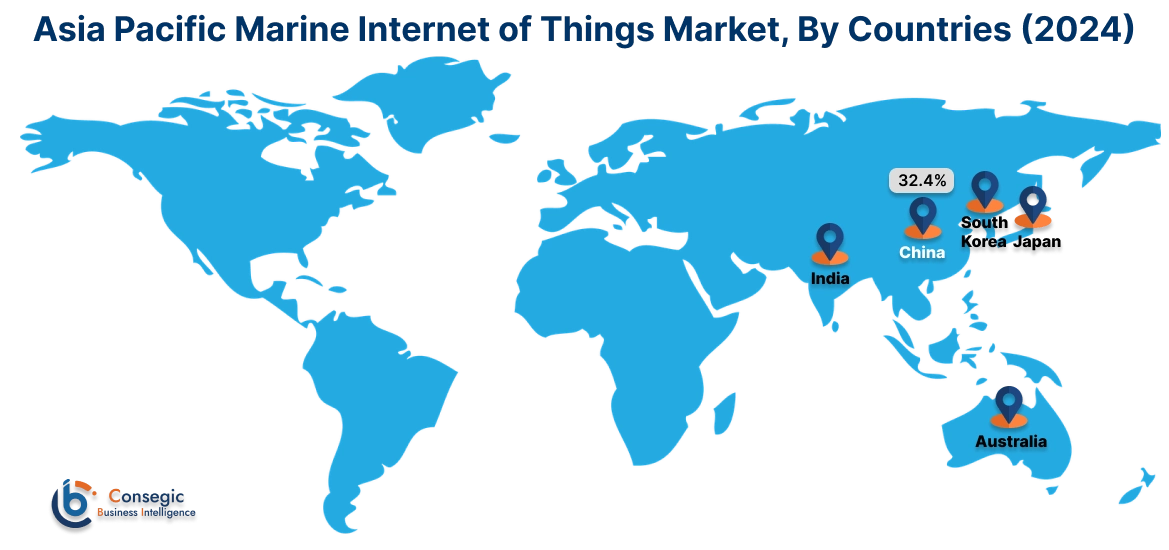
Asia Pacific region was valued at USD 2,261.93 Million in 2024. Moreover, it is projected to grow by USD 2,617.15 Million in 2025 and reach over USD 8,302.40 Million by 2032. Out of this, China accounted for the maximum revenue share of 32.4%. The Asia-Pacific region is experiencing rapid advancements in the marine IoT market, driven by industrial expansion and technological progress in countries such as China, Japan, and South Korea. The proliferation of international seaborne trade and the increasing demand for real-time tracking and monitoring of vessels have intensified the adoption of IoT solutions. Government initiatives supporting maritime safety and smart port development further influence marine Internet of Things market expansion.
North America is estimated to reach over USD 8,836.81 Million by 2032 from a value of USD 2,547.64 Million in 2024 and is projected to grow by USD 2,933.80 Million in 2025. This region commands a substantial share of the marine IoT market, driven by the early adoption of advanced maritime technologies and a robust shipping sector. The United States, in particular, has integrated IoT solutions across sectors such as commercial shipping, defense, and offshore oil and gas operations. A prominent trend is the incorporation of IoT-enabled predictive maintenance systems to enhance vessel efficiency and safety. The marine Internet of Things market trends indicate that the presence of key industry players and continuous investment in research and development bolster the region's market leadership.
Europe represents a significant segment of the global marine IoT market, with countries like Germany, France, and the United Kingdom at the forefront of adoption and innovation. The region's focus on sustainable shipping practices and stringent environmental regulations has accelerated the deployment of IoT solutions for monitoring emissions and optimizing fuel consumption. Analysis reveals a growth in the trend towards utilizing IoT in autonomous shipping and smart port initiatives to improve operational efficiency.
The Middle East & Africa region is gradually embracing marine IoT technologies, particularly within the commercial shipping and offshore oil exploration sectors. Nations like the United Arab Emirates are investing in innovative maritime solutions to enhance operational efficiency and comply with international safety standards. Analysis suggests an emerging trend towards adopting IoT for real-time monitoring of environmental conditions and asset tracking.
Latin America is an emerging market for marine IoT, with countries such as Brazil and Mexico contributing to its development. The region's focus on modernizing maritime infrastructure and improving port operations has spurred interest in IoT solutions. As per the marine Internet of Things market analysis, government policies aimed at enhancing technological capabilities influence market trends.
Top Key Players and Market Share Insights:
The Marine Internet of Things market is highly competitive with major players providing products and services to the national and international markets. Key players are adopting several strategies in research and development (R&D), product innovation, and end-user launches to hold a strong position in the global Marine Internet of Things market. Key players in the Marine Internet of Things industry include -
- Cisco Systems, Inc. (USA)
- NTT Group (Japan)
- Wilhelmsen Holding ASA (Norway)
- Orange Business Services (France)
- Marine Digital GmbH (Germany)
- Accenture Plc. (Ireland)
- Ericsson AB (Sweden)
- Vodafone Group Plc (UK)
- Wärtsilä Oyj Abp (Finland)
- Dualog AS (Norway)
Recent Industry Developments :
Partnerships & Collaborations:
- In October 2024, Siren Marine, in collaboration with Yamaha, launched Siren 3, tailored for small to mid-sized boats. With robust IoT connectivity, it supports SirenWAVE sensors, an internal antenna for compact installation, and integration with NMEA 2000 and Yamaha CommandLink Boaters can monitor and control their vessels remotely via the Siren Connected Boat app. Designed for enhanced convenience and security, Siren 3 brings advanced functionality to a wider audience.
Product Launches:
- In December 2024, Vaisala launched the WM80 ultrasonic wind sensor for wind energy and maritime applications. The Vaisala WM80 ultrasonic wind sensor delivers highly accurate wind data, enhancing wind turbine efficiency and maritime safety. Its rugged design withstands extreme conditions like icing and high winds while requiring zero maintenance. Key features include advanced ultrasonic signal technology for precise measurements up to 90m/s, corrosion-resistant construction, and easy installation. Ideal for turbine control and vessel navigation, the WM80 supports dynamic positioning, operational efficiency, and safety in demanding environments.
Marine Internet of Things Market Report Insights :
| Report Attributes | Report Details |
| Study Timeline | 2019-2032 |
| Market Size in 2032 | USD 27,265.69 Million |
| CAGR (2025-2032) | 17.2% |
| By Component |
|
| By Application |
|
| By Ship Type |
|
| By Region |
|
| Key Players |
|
| North America | U.S. Canada Mexico |
| Europe | U.K. Germany France Spain Italy Russia Benelux Rest of Europe |
| APAC | China South Korea Japan India Australia ASEAN Rest of Asia-Pacific |
| Middle East and Africa | GCC Turkey South Africa Rest of MEA |
| LATAM | Brazil Argentina Chile Rest of LATAM |
| Report Coverage |
|
Key Questions Answered in the Report
What is the size of the Marine Internet of Things market? −
The Marine Internet of Things Market size is estimated to reach over USD 27,265.69 Million by 2032 from a value of USD 7,680.35 Million in 2024 and is projected to grow by USD 8,861.45 Million in 2025, growing at a CAGR of 17.2% from 2025 to 2032.
What are the key segments in the Marine Internet of Things market? +
The Marine Internet of Things market is segmented based on component, application, ship type, and region. By component, the market includes hardware, software, and services. The application segment comprises vessel tracking, predictive maintenance, cargo monitoring, navigation & route optimization, and environmental monitoring. By ship type, the market is segmented into commercial and defense vessels. Regionally, the market is divided into Asia-Pacific, Europe, North America, Latin America, and the Middle East & Africa.
Which segment is expected to grow the fastest in the Marine Internet of Things market? +
The predictive maintenance segment is anticipated to grow at the fastest CAGR during the forecast period. This growth is driven by the increasing awareness of the economic benefits of condition-based maintenance and the adoption of IoT-enabled solutions to improve vessel reliability and safety.
Who are the major players in the Marine Internet of Things market? +
Key players in the Marine Internet of Things market include Cisco Systems, Inc. (USA), NTT Group (Japan), and Accenture Plc. (Ireland), Ericsson AB (Sweden), Vodafone Group Plc (UK), Wärtsilä Oyj Abp (Finland), Dualog AS (Norway), Wilhelmsen Holding ASA (Norway), Orange Business Services (France), and Marine Digital GmbH (Germany). These companies are driving market growth through partnerships, collaborations, and innovative product offerings.
Overview
Reputation & Certifications


Our Services
- Market Intelligence & Forecasting
- Custom Research Solutions
- Market Entry Strategy
- Competitive Intelligence
- Customer Insights
- Industry Innovation Analysis
- Investment Advisory