Jump to Content
Phytosphingosine Market - Size, Share, Industry Trends, and Forecasts (2025-2032)
Phytosphingosine Market Size:
The phytosphingosine market size is growing with a CAGR of 6.0% during the forecast period (2025-2032), and the market is projected to be valued at USD 2.90 Billion by 2032 from USD 1.84 Billion in 2024. Additionally, the market value for the 2025 attributes to USD 1.94 Billion.
Phytosphingosine Market Scope & Overview:
The phytosphingosine also known as hydroxysphinganine. It is naturally occurring lipid found in plants, fungi, and animals. It has chemical formula as C18H39NO3. This lipid is synthesized through acylation, de novo pathway and microbial fermentation. It is a white crystalline powder which is available in both low purity (<98%) and high purity (≥98%). It offers advantages such as anti-inflammation, anti-ageing, ant-fungal and skin brightening effects. Due to these advantages, this lipid is used in various applications such as facewash, moisturizer, cleansing wipes, and others. Additionally, growing focus towards sustainability is boosting the adoption of organic cosmetics and skincare products, further driving the market growth.
How is AI Impacting the Phytosphingosine Market?
AI is transforming the phytosphingosine market by accelerating innovation and improving efficiency. In research and development, AI algorithms can predict the properties of novel compounds, speeding up the discovery of new applications beyond traditional skincare, such as in pharmaceuticals. In manufacturing, AI-powered systems optimize fermentation processes, enhance yields, and ensure consistent product quality, addressing previous challenges of high costs and inconsistent supply. Furthermore, AI helps in analyzing market trends and consumer preferences, allowing companies to develop personalized products for specific skin concerns. This data-driven approach fosters more targeted product development and marketing strategies, fueling market growth.

Phytosphingosine Market Dynamics - (DRO):
Key Drivers:
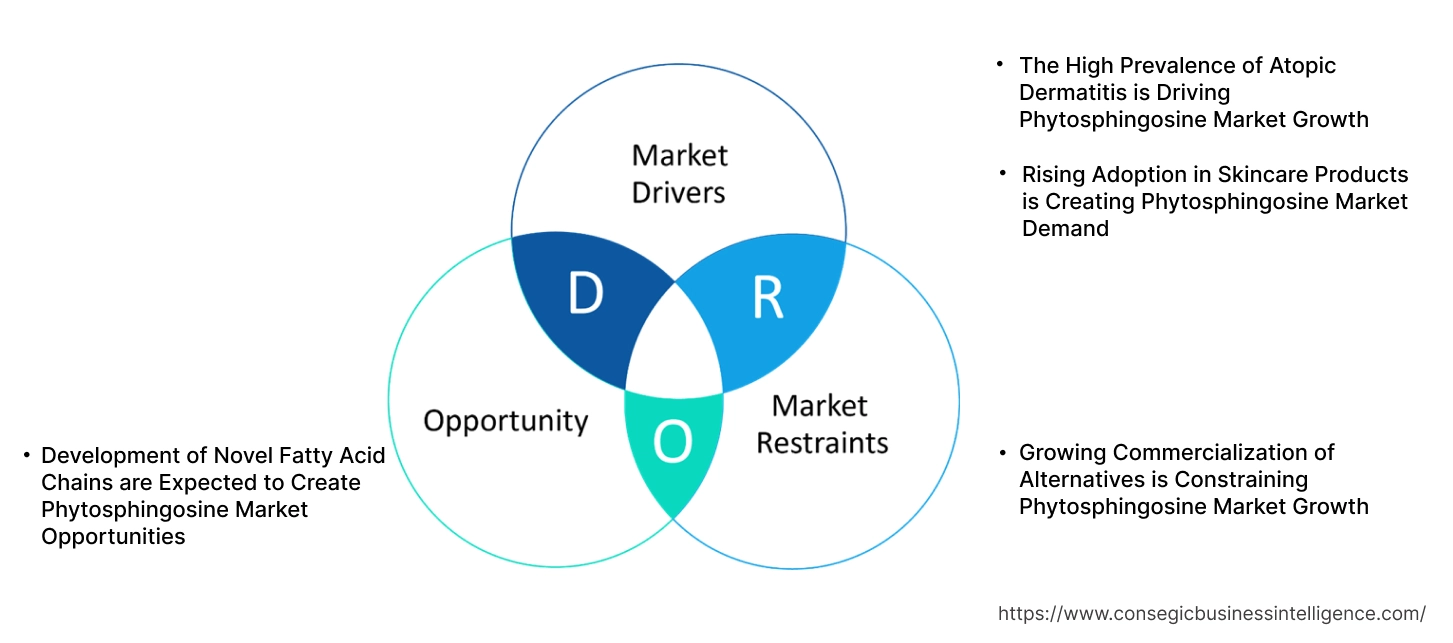
The High Prevalence of Atopic Dermatitis is Driving Phytosphingosine Market Growth
Atopic dermatitis is a chronic skin condition characterized by dry, itchy, and inflamed skin. The phytosphingosine is used in the treatment of atopic dermatitis which reduces redness and swelling of the skin. It also enhances moisture retention in atopic dermatitis. The case of atopic dermatitis is high due to hormonal changes, unhealthy lifestyle, pollution and other factors further driving the market.
- According to research article published in British Journal of Dermatology, the global prevalence of atopic dermatitis is 2.6% in 2023. This high prevalence of atopic dermatitis is driving the use of this acid in the treatment to reduce redness, hydration and skin moisture.
Thus, the high prevalence of atopic dermatitis is leading to phytosphingosine market expansion.
Rising Adoption in Skincare Products is Creating Phytosphingosine Market Demand
Adoption of phytosphingosine lipid is growing in skincare products such as toners and cleansers. Companies are widely adopting this lipid in their toners due to their antibacterial properties. The new range of cleansers offered by the companies also contains this lipid due to its exfoliating properties. Moreover, companies are also incorporating this lipid in their daily skincare products.
- In 2024, Ningen Skin Sciences Private Limited launched Night Repair Creme in India. It contains phytosphingosine which offers nourishment and rejuvenation of the skin. The improvement in skin renewal and reduction in skin wrinkles is further boosting the adoption of this product.
Thus, rising adoption of skincare products is creating phytosphingosine market demand.
Key Restraints:
Growing Commercialization of Alternatives is Constraining Phytosphingosine Market Growth
The commercialization of alternatives such as niacinamide, sphingosine, and hyaluronic acid amongst others is growing. They provide similar functions to that of phytosphingosine. Niacinamide is widely used in facewash, serums, and shampoo due to its lower production costs and greater availability. Furthermore, hyaluronic acid is preferred in moisturizers and cleansers due to better thickening and moisturizing properties, further reducing reliance. Additionally, plant-based oils, such as avocado oil and aloe vera oil are widely used to moisture the skin due to their deeper skin penetration ability. Hence, the growing commercialization of alternatives is constraining market growth due to low cost and greater availability.
Future Opportunities:
Development of Novel Fatty Acid Chains are Expected to Create Phytosphingosine Market Opportunities
Fatty acid chains are long strings of carbon and hydrogen atoms, forming the building blocks of fats and oils. The current fatty acid chains used in the production of skin formulations have lower bioactivity and less skin barrier repair ability. These fatty acid chains also degrade over time due to less stability. To address this, companies are developing novel fatty acid chains to improve bioactivity and skin penetration.
- In 2024, Evonic launched SPHINOX Immulance based ceramide-based fatty acid chains which includes phytosphingosine. This fatty acid chain strengthens the skin’s immune barrier and is microbiome friendly. It will create opportunities for the phytosphingosine manufacturers due to rising demand for fatty acid chains with high stability in skin-friendly formulations.
Hence, development of novel fatty acid chains is expected to create phytosphingosine market opportunities.
Phytosphingosine Market Segmental Analysis :
By Purity:
Based on purity, the market is categorized into low purity (<98%) and high purity (≥98%).
Trends in Purity:
- As per phytosphingosine market trends, high purity lipid is treating skin conditions such as psoriasis.
- Adoption of low purity phytosphingosine is growing in large scale production of skincare products as per market trends.
The high purity (≥98%) segment accounted for the largest market share in the year 2024.
- The high purity (≥98%) phytosphingosine contains a high proportion of this lipid with minimal impurities. It has superior consistency, stability and effectiveness.
- Due to these properties, it is increasingly used in premium cosmetics and hair care products.
- It is also used in the treatment of skin diseases such as psoriasis to regulate epidermal cell growth and water loss from the skin.
- Furthermore, smoking, excessive alcohol consumption, and obesity are growing among the individuals. This is leading to a high number of individuals affected by psoriasis.
- For instance, according to National Psoriasis Foundation, 125 million people are affected by psoriasis worldwide in 2022. This high number of psoriasis cases is driving the use of high purity phytosphingosine to prevent water loss from the skin.
- Hence, as the prevalence of skin diseases is growing, the need for this high purity lipid is also growing, in turn driving the segment.
The low purity (<98%) segment is expected to grow at the fastest CAGR over the forecast period.
- The low purity (<98%) phytosphingosine contains slightly more impurities as compared to the high purity grade.
- It works well in combination with emollients, humectants, and mild preservatives, making it ideal in daily skincare products.
- Also, its manufacturing process is more cost effective which allows for large-scale production, without compromising on bioactivity.
- The demand for daily skincare products such as moisturizers and face masks are growing. To cater for this, companies are incorporating this low purity lipid in the production of these skincare products due to its cost effectiveness.
- Hence, as the need for skincare products is growing, the adoption of this low purity lipid is also increasing. This will drive the segment share for the forecasted years as per market trends.
By Application:
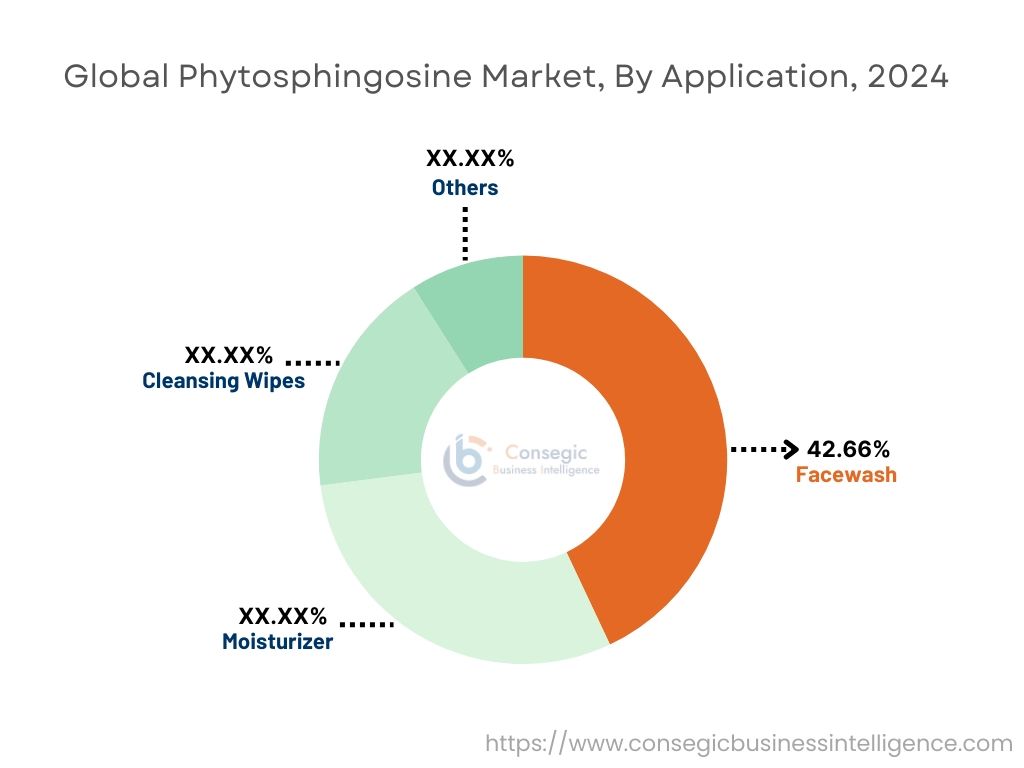
Based on application, the market is categorized into facewash, moisturizer, cleansing wipes, and others.
Trends in Application:
- As per phytosphingosine market trends, this lipid is used widely in facewash to strengthen a healthy skin barrier.
- Adoption of phytosphingosine is growing in moisturizer to promote healthy-looking skin complexion as per market trends.
The facewash segment accounted for the largest market share of 42.66% in the year 2024.
- In facewash, phytosphingosine is widely used due to its antimicrobial, emulsifying, and exfoliating properties.
- Its key advantage is to strengthen a healthy skin barrier, especially for those with sensitive or acne-prone skin.
- This lipid is mainly sourced from soybeans which makes it an important ingredient in plant-based personal care products including facewash.
- The consumer preference for plant-based and sustainable personal care products is growing. To cater for this, companies are incorporating this lipid in their new range of facewash.
- Thus, as consumer preference for plant-based personal care products is growing, the use of this lipid is also increasing in facewash, thereby driving the segment.
The moisturizer segment is expected to grow at the fastest CAGR over the forecast period.
- In moisturizer, phytosphingosine is increasingly used to retain skin hydration as well as to prevent moisture loss.
- It also prevents dryness and promotes healthy-looking complexion in the skin though moisturizers.
- Further, the adoption of moisturizers is growing due to increased awareness of skin health and growing demand for anti-aging skin. To cater with this, companies are adopting this lipid in their new range of moisturizers.
- For instance, in 2023, Plum launched Hemp and Ceramides Moisturizer which contains It is driving the use of this lipid moisturizer to retain moisture in the skin.
- Therefore, as the adoption of moisturizers is expanding, the use of this lipid to retain skin hydration is also increasing. This will drive the segment for the forecasted years as per market trends.
Regional Analysis:
The regional segment includes North America, Europe, Asia Pacific, Middle East & Africa, and Latin America.
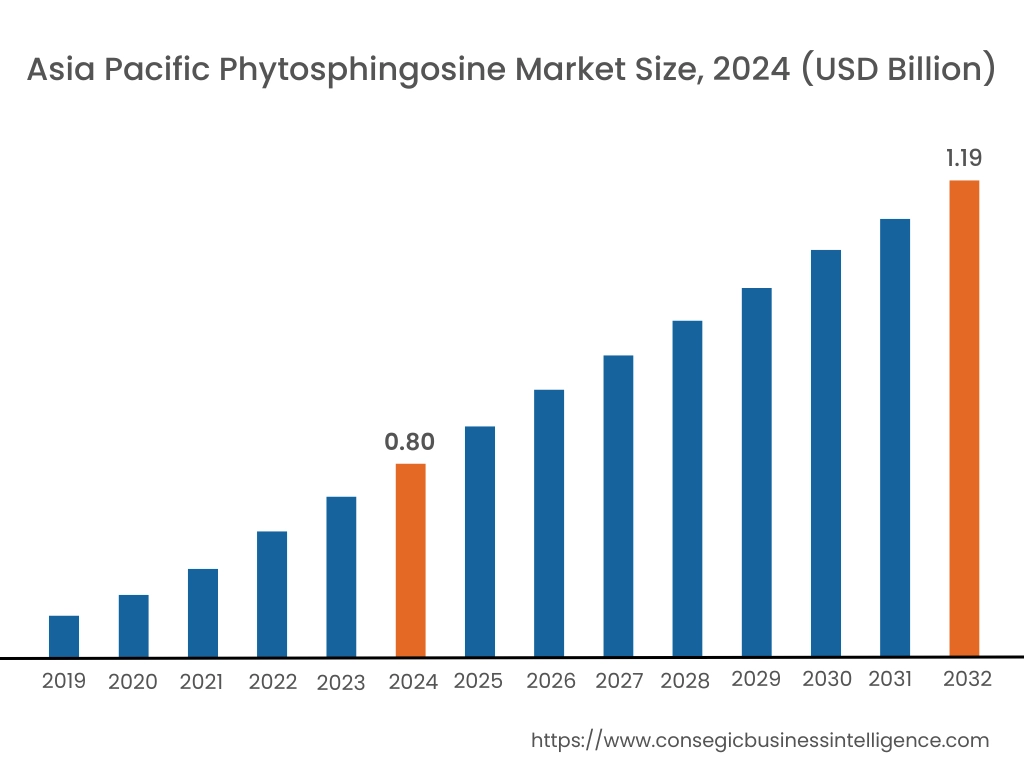
In 2024, Asia Pacific accounted for the highest market share at 43.51% and was valued at USD 0.80 Billion and is expected to reach USD 1.19 Billion in 2032. In Asia-Pacific, the China accounted for the highest phytosphingosine market share of 34.11% during the base year of 2024. As per analysis, Asia Pacific region holds a dominant position in the market due to expanding use of organic skincare products. Phytosphingosine lipids are derived from natural sources such as yeast, plants and some mammalian tissues. Due to its origin, this lipid is widely incorporated in organic skincare products such as face scrub and serums. Moreover, in the countries such as China, India, Japan, and South Korea, consumers are widely preferring organic skincare products further driving the market adoption.
- In 2024, survey conducted by Earthraga, revealed that 95.4% of respondents preferred organic skincare products in India. This is further driving the use of phytosphingosine in organic skincare products such as face scrub and serums.
Therefore, due to the above-mentioned factors, the Asia Pacific region is dominating in the market as per analysis.

Europe is expected to witness the fastest CAGR of 6.9% over the forecast period of 2025-2032. According to phytosphingosine market analysis, Europe region is growing considerably in the market driven by stringent European Union cosmetic regulations. These regulations encourage the use of safe and scientifically backed ingredients in skincare formulations. Additionally, countries such as Germany, France, and United Kingdom are major contributors in the market due to strong research and development in cosmetics and personal care sector. Hence, the phytosphingosine market share of Europe is expected to emerge rapidly through stringent regulations as per analysis.
According to phytosphingosine market analysis, the North America region is growing rapidly driven by advancements in technology. Advanced fermentation and hydrolysis processes have enhanced the purity of the product. Countries such as United States is the major contributor in the market due to innovations in manufacturing and automation driven production. These are optimizing production efficiency and ensuring high quality lipid for various applications such as cleansing wipes and premium facewash.
The Middle East & Africa region is experiencing moderate growth in the market driven by rising prevalence of skin conditions such as rosacea and acne. The phytosphingosine is widely used in the treatment of these conditions due to its anti-inflammatory and antimicrobial properties. Countries such as South Africa, Egypt, and Saudi Arabia are major contributors in the market due to growing cases of skin-related disorders. This is further driving the market growth across the region.
As per analysis, the market in Latin America is driven by rising disposable income and changing lifestyle. Countries such as Brazil and Argentina are major contributors in the region due to increased spending on clean beauty products, thereby driving demand for phytosphingosine. Additionally, government collaboration to enhance the production and commercialization of this lipid is growing. This is leading to phytosphingosine market expansion across the region.
Top Key Players & Market Share Insights:
The phytosphingosine industry is highly competitive with major players providing products to the national and international markets. Key players are adopting several strategies in research and development (R&D) and product innovation to hold a strong position in the global phytosphingosine market. Key players in the phytosphingosine industry include-
- Evonik Industries AG (Germany)
- Tokyo Chemical Industry Pvt. Ltd. (Japan)
- Doosan Corporation (South Korea)
- Sungwun Pharmacopia (South Korea)
- Beckmann-Kenko GMBH (Germany)
- Rheinmetall AG (Germany)
- FN Herstal S.A. (Belgium)
- Beretta Holding S.p.A. (Italy)
- Smith & Wesson Brands, Inc. (United States)
- Sig Sauer, Inc. (United States)
Recent Industry Developments :
Product Launch:
- In 2021, Vogue India launched cream-gel formula. It contains Vitamin C, Phytosphingosine, and other ingredients which reduce skin fatigue.
Phytosphingosine Market Report Insights:
| Report Attributes | Report Details |
| Study Timeline | 2019-2032 |
| Market Size in 2032 | USD 2.90 Billion |
| CAGR (2025-2032) | 6.0% |
| By Purity |
|
| By Application |
|
| By Region |
|
| Key Players |
|
| North America | U.S. Canada Mexico |
| Europe | U.K. Germany France Spain Italy Russia Benelux Rest of Europe |
| APAC | China South Korea Japan India Australia ASEAN Rest of Asia-Pacific |
| Middle East and Africa | GCC Turkey South Africa Rest of MEA |
| LATAM | Brazil Argentina Chile Rest of LATAM |
| Report Coverage |
|
Key Questions Answered in the Report
How big is the phytosphingosine market? −
In 2024, the phytosphingosine market is USD 1.84 Billion.
Which is the fastest-growing region in the phytosphingosine market? +
Europe is the fastest-growing region in the phytosphingosine market.
What specific segmentation details are covered in the phytosphingosine market? +
Purity and Application are covered in the phytosphingosine market.
Who are the major players in the phytosphingosine market? +
Evonik Industries AG (Germany), Tokyo Chemical Industry Pvt. Ltd. (Japan), and Thermo Fisher Scientific Inc. (United States) are some of the major players in the market.
Overview
Reputation & Certifications


Our Services
- Market Intelligence & Forecasting
- Custom Research Solutions
- Market Entry Strategy
- Competitive Intelligence
- Customer Insights
- Industry Innovation Analysis
- Investment Advisory