Jump to Content
Public and Personal Safety Market - Size, Share, Industry Trends, and Forecasts (2025 - 2032)
Public and Personal Safety Market Size:
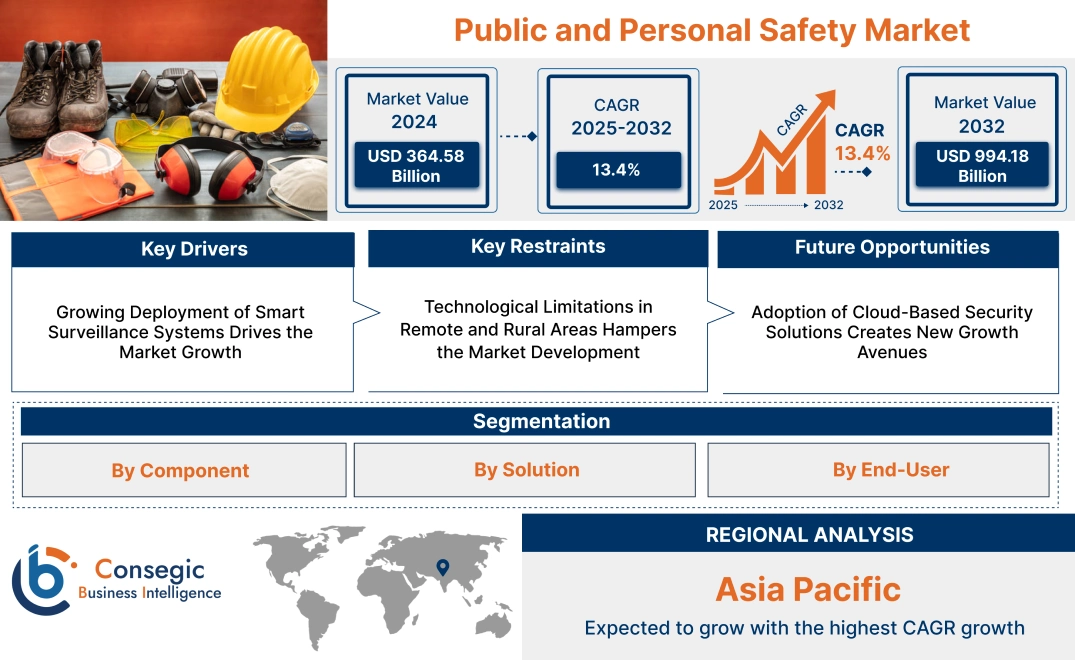
Public and Personal Safety Market size is estimated to reach over USD 994.18 Billion by 2032 from a value of USD 364.58 Billion in 2024 and is projected to grow by USD 406.79 Billion in 2025, growing at a CAGR of 13.4% from 2025 to 2032.
Public and Personal Safety Market Scope & Overview:
The public and personal safety market encompasses technologies, solutions, and systems designed to protect individuals and communities from potential risks, emergencies, and threats. This includes a broad range of tools such as surveillance systems, emergency response equipment, wearable safety devices, and communication systems that enable effective monitoring, alerting, and response in critical situations. These solutions are tailored to address safety concerns across various environments, including public spaces, residential areas, and workplaces.
Public safety solutions focus on protecting communities by enabling law enforcement, emergency responders, and government agencies to monitor, prevent, and manage incidents. Personal safety systems, on the other hand, include devices and technologies that individuals use to ensure their own security, such as mobile safety apps, alarms, and wearables. Both public and personal safety systems often incorporate advanced technologies such as real-time monitoring, data integration, and automated alerts to enhance efficiency and reliability.
End-users of these solutions include law enforcement agencies, emergency services, enterprises, and individual consumers seeking enhanced security and protection. These systems play a vital role in safeguarding lives, assets, and infrastructure across multiple environments.
Public and Personal Safety Market Dynamics - (DRO) :
Key Drivers:
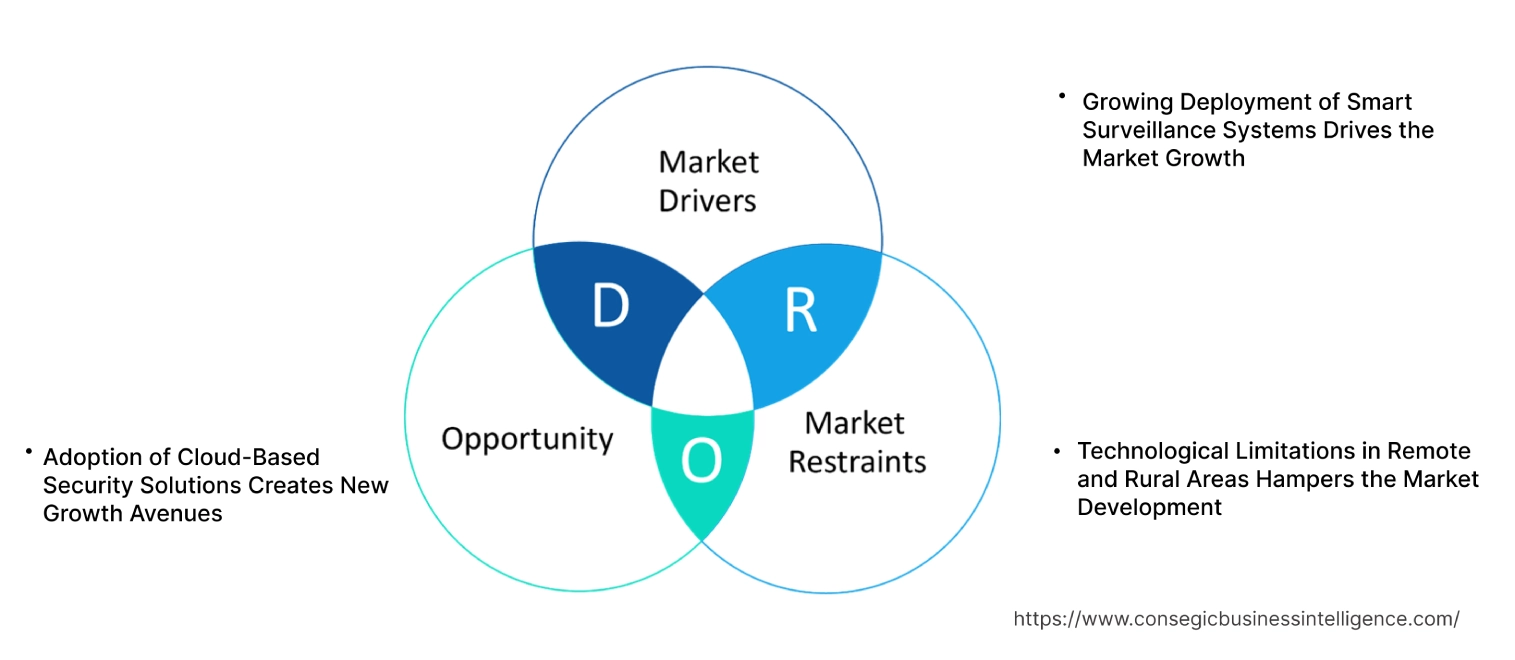
Growing Deployment of Smart Surveillance Systems Drives the Market Growth
The increasing adoption of advanced surveillance technologies is significantly enhancing public and personal safety systems. High-resolution CCTV cameras, AI-powered video analytics, and facial recognition tools are enabling real-time monitoring and accurate threat detection. These technologies allow public safety agencies and private enterprises to respond swiftly to security breaches, emergencies, or suspicious activities.
The integration of smart surveillance systems with IoT and cloud-based platforms further improves situational awareness by providing centralized data access and analysis. This combination ensures seamless monitoring across urban areas, critical infrastructure, and public spaces. Smart surveillance systems are particularly valuable in urban security applications, where they enable efficient traffic management, crowd control, and crime prevention. As cities invest in modern safety infrastructure and smart technologies, the demand for integrated surveillance solutions continues to grow, supporting the creation of safer, smarter environments. Thus, the aforementioned factors are driving the public and personal safety market growth.
Key Restraints:
Technological Limitations in Remote and Rural Areas Hampers the Market Development
Public safety solutions heavily depend on advanced communication networks and reliable infrastructure for effective operation. However, in remote and rural areas, inadequate network coverage and limited connectivity present significant constraints. The lack of robust infrastructure leads to latency in data transmission, making real-time monitoring and response systems less effective. Technologies such as video surveillance, GPS tracking, and emergency communication systems often face disruptions, compromising their ability to function seamlessly.
Moreover, the absence of reliable power sources and high-speed internet further exacerbates these issues, hindering the deployment of advanced safety solutions. This technological gap reduces the efficiency of critical safety measures, such as incident detection, threat alerts, and emergency response. Addressing these limitations is particularly important as rural and remote regions often face unique safety challenges, such as natural disasters or delayed emergency services, where real-time monitoring and connectivity play a crucial role in enhancing public safety outcomes. Therefore, technological limitations restrains the public and personal safety market demand.
Future Opportunities :
Adoption of Cloud-Based Security Solutions Creates New Growth Avenues
Cloud-based security platforms are transforming the management of large-scale surveillance and safety operations by offering centralized data storage, remote accessibility, and scalability. These solutions allow organizations, including governments and enterprises, to monitor, analyze, and manage security operations seamlessly from any location. The integration of cloud platforms with artificial intelligence (AI) and IoT technologies enhances efficiency by enabling automated threat detection, predictive analysis, and real-time situational awareness.
Cloud-based systems also support quick data sharing between stakeholders, improving coordination during emergencies or incidents. Their cost-effectiveness, due to reduced infrastructure and maintenance requirements, makes them attractive for organizations looking to optimize safety measures. Moreover, these platforms facilitate advanced security applications like smart surveillance, remote monitoring, and multi-site management, ensuring flexibility across diverse environments. As industries continue to digitize operations, cloud-based solutions are poised to become a critical component in enhancing safety systems' performance and reliability while addressing evolving security needs, creating significant public and personal safety market opportunities.
Public and Personal Safety Market Segmental Analysis :
By Component:
Based on component, the market is segmented into hardware, software, and services.
The hardware segment held the largest revenue of the total public and personal safety market share in 2024.
- Cameras, sensors, and alarms form the backbone of surveillance and monitoring systems, ensuring real-time detection and prevention of safety incidents.
- The adoption of wearable devices, such as body cameras and personal safety trackers, has grown significantly across law enforcement and emergency services.
- Continuous advancements in hardware, including AI-integrated cameras and IoT sensors, are enhancing security infrastructure and operational capabilities.
- Therefore, the market trends shows that the dominance of this segment is driven by large-scale investments in smart safety infrastructure across public, residential, and industrial applications, contributing to the public and personal safety market expansion.
The services segment is expected to register the fastest CAGR during the forecast period.
- Consulting services help businesses and government agencies design and implement tailored safety solutions that meet specific operational challenges.
- Integration services ensure smooth deployment and interoperability of surveillance, communication, and disaster management systems.
- Ongoing support and maintenance services play a critical role in ensuring optimal performance, reliability, and upgrades of safety infrastructure.
- As per the public and personal safety market analysis, the rapid adoption of managed services, particularly in emerging economies, reflects the need for expert solutions to ensure seamless safety operations.
By Solution:
Based on solution, the market is segmented into surveillance systems, emergency & disaster management systems, communication systems, and biometrics systems.
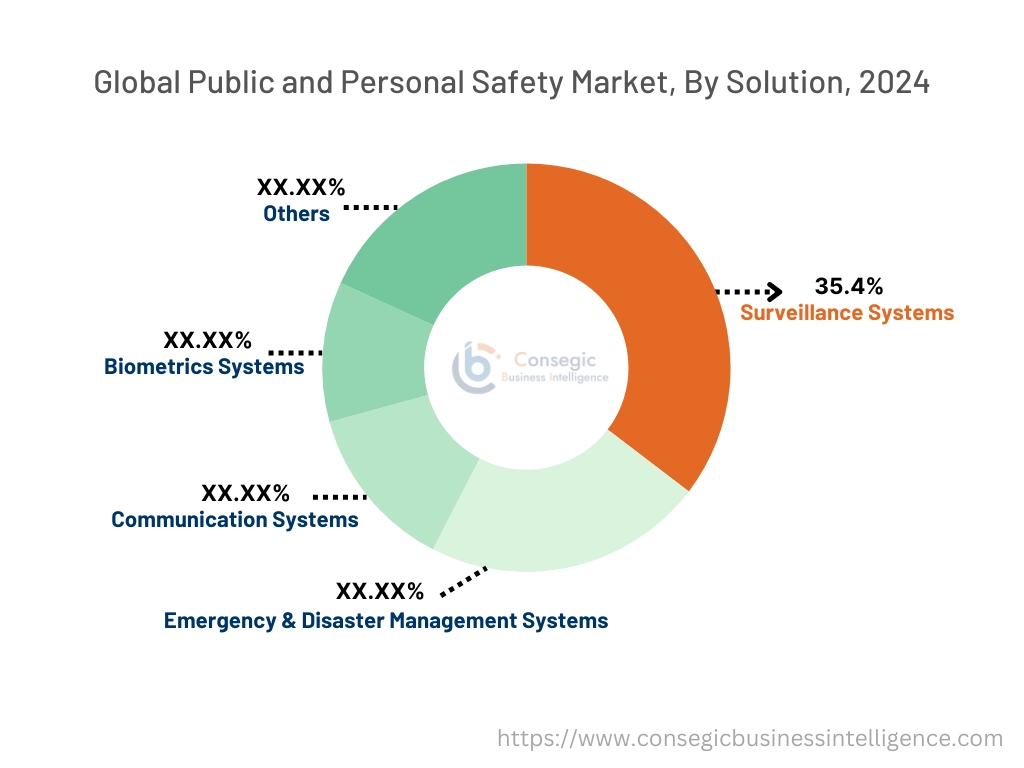
The surveillance systems segment accounted for the largest revenue of 35.4% of the total public and personal safety market share in 2024.
- Surveillance systems, including CCTV cameras, video analytics, and drones, are deployed extensively for monitoring public spaces, commercial buildings, and residential areas.
- Integration of AI-based facial recognition and smart analytics tools enables advanced monitoring, threat detection, and automated alerts.
- Governments and businesses are investing heavily in modern surveillance systems as part of smart city and critical infrastructure initiatives.
- As per the public and personal safety market trends, the segment's dominance reflects the growing emphasis on real-time situational awareness and threat prevention across multiple sectors.
The emergency & disaster management systems segment is expected to register the fastest CAGR during the forecast period.
- These systems provide critical support during natural disasters, accidents, and public emergencies by coordinating quick and efficient responses.
- Adoption of advanced communication tools, including command centers and emergency alert systems, ensures effective resource deployment.
- Real-time analytics and location-based technologies improve disaster preparedness and minimize response time, ensuring public safety.
- Thus, as per market trends, increasing incidents of natural calamities and industrial hazards are prompting governments to invest in robust disaster management solutions, fueling the public and personal safety market growth.
By End-User:
Based on end-user, the market is segmented into government & public sector, commercial enterprises, residential, and industrial.
The government & public sector segment dominated the market in 2024.
- Government bodies rely heavily on surveillance, disaster management, and communication systems to ensure public safety and national security.
- Law enforcement agencies are leveraging wearable devices and biometrics systems for enhanced monitoring, tracking, and rapid decision-making.
- Large-scale infrastructure protection initiatives, such as smart cities and traffic management systems, are boosting investments in advanced safety technologies.
- The segment's dominance is attributed to increasing government expenditure on ensuring citizen safety and critical infrastructure resilience, which further boosts the public and personal safety market demand.
The residential segment is expected to register the fastest CAGR during the forecast period.
- Growth in concerns over property security and personal safety have led to increased adoption of smart home security systems, including cameras and alarms.
- Residential end-users are increasingly adopting personal safety devices and mobile-based alert systems for real-time monitoring.
- Advancements in IoT-enabled devices and integrated home automation solutions are enhancing the accessibility of residential safety systems.
- Thus, as per market trends, the rapid adoption of connected devices and smart monitoring systems reflects the rising demand for self-sufficient safety solutions across households, facilitating the public and personal safety market expansion.
Regional Analysis:
The regions covered are North America, Europe, Asia Pacific, the Middle East and Africa, and Latin America.
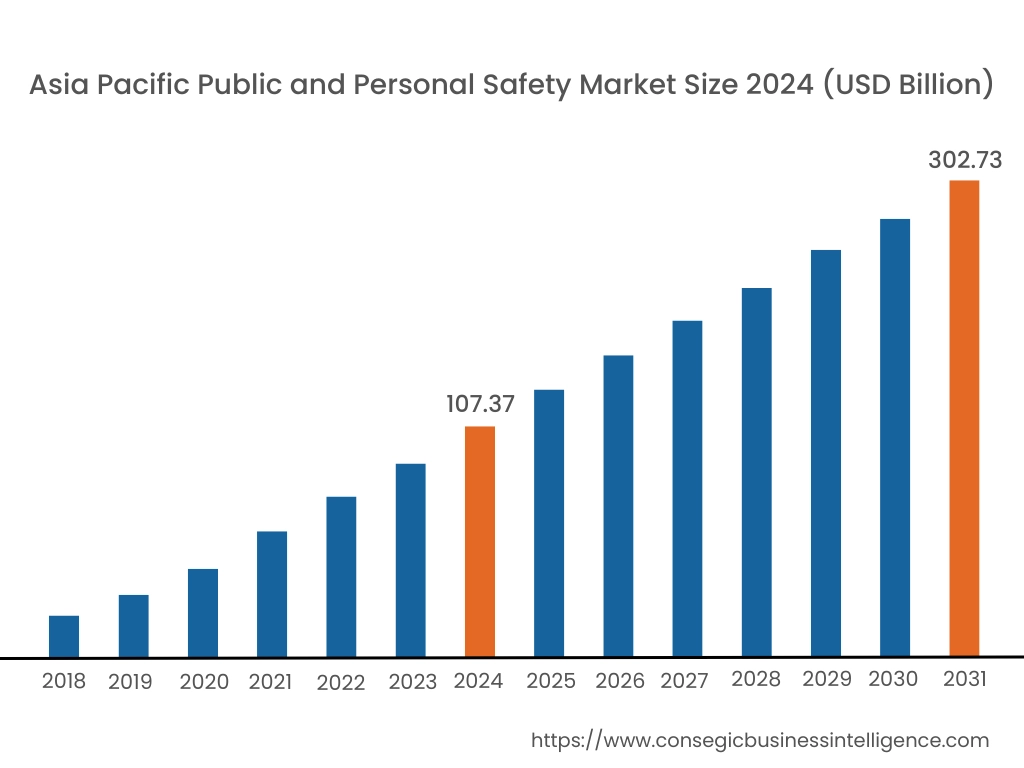
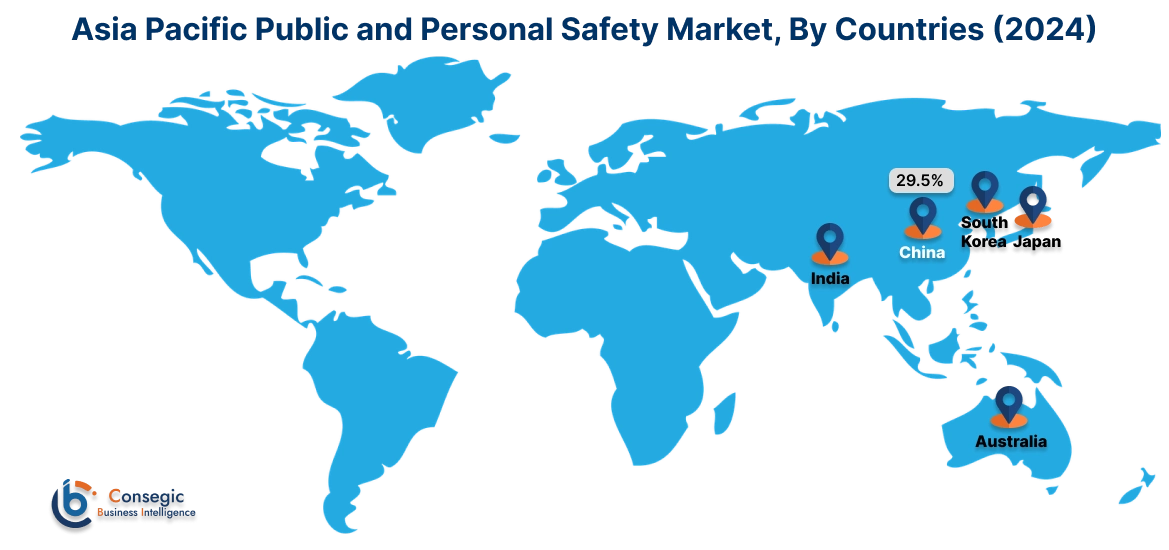
Asia Pacific region was valued at USD 107.37 Billion in 2024. Moreover, it is projected to grow by USD 120.14 Billion in 2025 and reach over USD 302.73 Billion by 2032. Out of this, China accounted for the maximum revenue share of 29.5%. The Asia-Pacific region is experiencing rapid development in the market, driven by industrialization and technological advancements in countries such as China, Japan, and India. The expansion of urban areas and the rising demand for enhanced security measures have intensified the need for advanced safety solutions. Government initiatives promoting smart city projects further influence public and personal safety market opportunities.
North America is estimated to reach over USD 322.21 Billion by 2032 from a value of USD 120.93 Billion in 2024 and is projected to grow by USD 134.68 Billion in 2025. This region holds a significant share of the public and personal safety market, driven by the increasing adoption of advanced safety solutions and a heightened focus on security measures. The United States, in particular, has seen a rise in the implementation of surveillance systems and personal safety devices across various sectors, including government, retail, and transportation. A notable trend is the integration of cutting-edge technologies such as artificial intelligence (AI) and the Internet of Things (IoT) into safety solutions, enhancing their effectiveness and efficiency. The public and personal safety market analysis indicates that the presence of key market players and continuous technological advancements contribute to the region's market dominance.
Europe represents a substantial share of the global public and personal safety market, with countries like Germany, France, and the United Kingdom leading in adoption and innovation. The region's emphasis on sustainability and energy efficiency has propelled the utilization of eco-friendly safety solutions. Analysis indicates a growth in trend towards the deployment of integrated safety systems that combine surveillance, access control, and emergency response functionalities, offering comprehensive security solutions across various sectors.
The Middle East & Africa region shows a growth in interest for advanced safety solutions, particularly in the construction and industrial sectors. Countries like Saudi Arabia and South Africa are investing in modern safety technologies to enhance public security and comply with international standards. Analysis suggests an increasing trend towards adopting integrated safety systems that provide real-time monitoring and rapid response capabilities.
Latin America is an emerging market for public and personal safety solutions, with Brazil and Mexico being key contributors. As per the public and personal safety market trends, the region's growing focus on enhancing public security and the implementation of government policies aimed at crime reduction have spurred the adoption of advanced safety technologies.
Top Key Players and Market Share Insights:
The Public and Personal Safety market is highly competitive with major players providing products and services to the national and international markets. Key players are adopting several strategies in research and development (R&D), product innovation, and end-user launches to hold a strong position in the global Public and Personal Safety market. Key players in the Public and Personal Safety industry include –
- Motorola Solutions (USA)
- Cisco Systems (USA)
- Huawei Technologies (China)
- Siemens AG (Germany)
- Alcatel-Lucent Enterprise (France)
- Honeywell International (USA)
- Thales Group (France)
- NEC Corporation (Japan)
- Hexagon AB (Sweden)
- General Dynamics Corporation (USA)
Recent Industry Developments :
Product Launches:
- In December 2024, Rail Vision launched its A.S.H. SaaS platform—a revolutionary solution for railway safety and operational efficiency. D.A.S.H. (Discover, Analyze, Secure, Harness) provides actionable insights by integrating seamlessly with Rail Vision’s AI-driven MainLine and ShuntingYard systems. The platform uses advanced detection, big data analysis, and robust safety tools to enhance decision-making and streamline rail operations. It can integrate with other big data platforms and sensors, fostering synergy for rail industry challenges.
- In November 2024, Valiance Solutions launched CivicEye, an AI-powered platform, which is designed to transform urban management and public safety by offering real-time insights, intelligent monitoring, and actionable analytics. It addresses key challenges such as crime detection, traffic violations, road hazards, crowd density, and urban space optimization. By blending advanced computer vision and AI, CivicEye empowers authorities to proactively monitor and manage cities, ensuring safer and more efficient urban spaces.
Partnerships & Collaborations:
- In November 2024, Cytta Corp and bSafe Group AS partnered to launch CYTTAbSAFE, a groundbreaking safety and emergency response solution. Combining bSafe’s SOS safety technology with CyttaCARES for crisis management, the suite ensures real-time security for individuals, schools, and law enforcement agencies. Features include voice-activated SOS alerts, live video streaming, Bluetooth emergency buttons, and secure two-way communication for institutions. This partnership addresses the rising demand for scalable, real-time safety solutions in the U.S. and Europe.
- In October 2024, BlackBerry QNX, in collaboration with Intel, introduced a safety-certified software-defined platform for industrial automation to meet Industry 5.0 standards. The platform simplifies the development and certification of safe, secure systems for manufacturing and robotics, complying with IEC 61508 SIL 3 safety requirements. It supports real-time performance and hardware/software integration, enabling cost and time savings for safety-critical environments where machines work alongside humans. This collaboration accelerates industrial innovation by ensuring functional safety and reliability.
Public and Personal Safety Market Report Insights :
| Report Attributes | Report Details |
| Study Timeline | 2019-2032 |
| Market Size in 2032 | USD 994.18 Billion |
| CAGR (2025-2032) | 13.4% |
| By Component |
|
| By Solution |
|
| By End-User Industry |
|
| By Region |
|
| Key Players |
|
| North America | U.S. Canada Mexico |
| Europe | U.K. Germany France Spain Italy Russia Benelux Rest of Europe |
| APAC | China South Korea Japan India Australia ASEAN Rest of Asia-Pacific |
| Middle East and Africa | GCC Turkey South Africa Rest of MEA |
| LATAM | Brazil Argentina Chile Rest of LATAM |
| Report Coverage |
|
Key Questions Answered in the Report
What is the size of the Public and Personal Safety Market? −
Public and Personal Safety Market size is estimated to reach over USD 994.18 Billion by 2032 from a value of USD 364.58 Billion in 2024 and is projected to grow by USD 406.79 Billion in 2025, growing at a CAGR of 13.4% from 2025 to 2032.
What are the key components covered in the Public and Personal Safety Market report? +
The market is segmented into hardware, software, and services. The hardware segment includes cameras, sensors, alarms, and wearables, which are essential for surveillance and monitoring systems. The software segment is focused on enhancing functionality and adaptability of safety systems. Services include consulting and support & maintenance, which are vital for system integration and ongoing performance.
Which solution segment is expected to grow the fastest in the Public and Personal Safety Market? +
The emergency & disaster management systems segment is expected to register the fastest CAGR during the forecast period. This growth is driven by increasing incidents of natural calamities and industrial hazards, prompting governments and enterprises to invest in robust disaster management solutions for quicker, more efficient responses.
Who are the key players in the Public and Personal Safety Market? +
Key players in the Public and Personal Safety Market include Motorola Solutions (USA), Cisco Systems (USA), Honeywell International (USA), Thales Group (France), NEC Corporation (Japan), Hexagon AB (Sweden), General Dynamics Corporation (USA), Huawei Technologies (China), Siemens AG (Germany), and Alcatel-Lucent Enterprise (France).
Overview
Reputation & Certifications


Our Services
- Market Intelligence & Forecasting
- Custom Research Solutions
- Market Entry Strategy
- Competitive Intelligence
- Customer Insights
- Industry Innovation Analysis
- Investment Advisory