Jump to Content
Rectenna Market - Size, Share, Industry Trends, and Forecasts (2025-2032)
Rectenna Market Size:
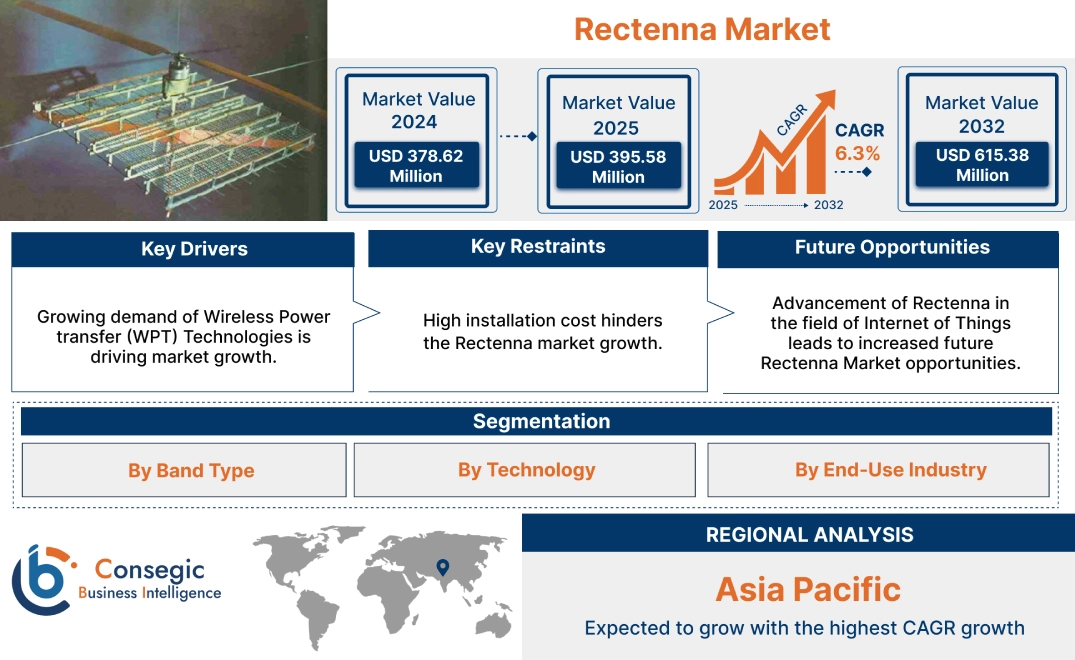
Rectenna Market size is estimated to reach over USD 615.38 Million by 2032 from a value of USD 378.62 Million in 2024 and is projected to grow by USD 395.58 Million in 2025, growing at a CAGR of 6.3% from 2025 to 2032.
Rectenna Market Scope & Overview:
Rectenna (rectifying antenna) systems are special types of receiving antenna used to convert electromagnetic energy into direct current (DC) electricity. They are classified as DC power combining, RF power combining, and hybrid power combining. They are used in wireless power transmission systems that transmit power by radio waves. A simple rectifying antenna element consists of a dipole antenna with a diode connected across the dipole elements. The diode rectifies the AC induced in the antenna by the microwaves, to produce DC power, which powers a load connected across the diode. Attracting an ever-increasing interest among researchers, they occupy a unique position in RF and microwave engineering systems. These systems are used for remotely charging batteries in several sensor networks at internet of things (IoT) applications as commonly used in smart buildings, implanted medical devices and automotive applications. They are primarily used in industries related to wireless power transmission and energy harvesting, with key end-use applications in consumer electronics (like smartphones and wearables), automotive (electric vehicles with wireless charging), industrial automation, medical devices, IoT sensor networks, and renewable energy systems.
Rectenna Market Dynamics - (DRO):
Key Drivers:
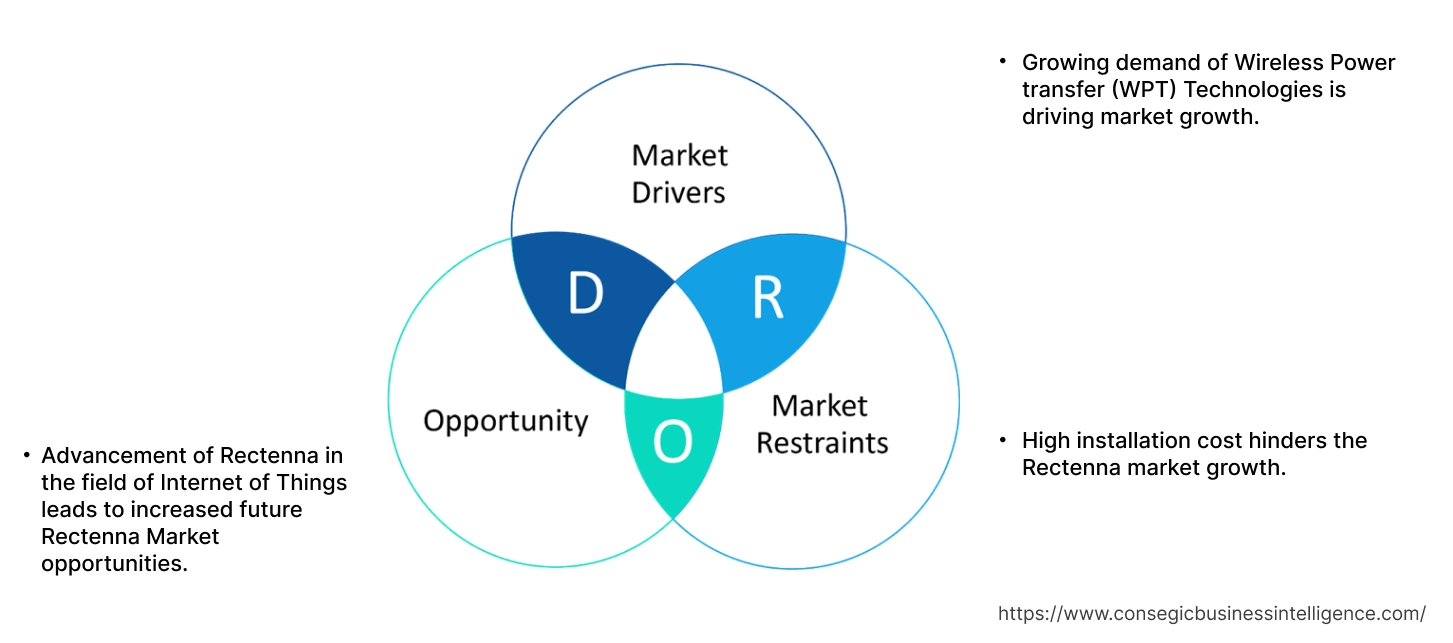
Growing demand of Wireless Power transfer (WPT) Technologies is driving market growth.
Wireless power transfer refers to the transmission of electrical power from a power source to a receiver without the need for physical wires. It is revolutionizing how we interact with technology allowing the ability to charge and power devices without the clutter of cables. WPT technology has transitioned from communication to energy transmission after more than one hundred years of exploration and development in electromagnetics. It has gradually entered people’s daily lives and industrial scenes, providing a convenient and flexible power supply for consumer electronic devices and industrial electronics applications. It has become a commonplace technology, widely adopted in various applications such as electric toothbrushes, smartphones, and in automated guided vehicles used in factories.
Distinct types of rectennas have been developed for high-power applications and to determine the entire system’s performance. The construction of energy conversion circuits to capture energy from a low power RF dedicated source at high frequencies has recently been the focus of study in wireless power transfer (WPT). They acts as a receiver that converts incoming radiofrequency (RF) energy into usable direct current (DC) electricity by using a diode to rectify the alternating current induced in the antenna, allowing for the transmission of power wirelessly through electromagnetic waves.
They are the cornerstone of WPT and Radio frequency energy harvesting (RFEH) systems and critically affect the amount of DC power delivered to the load. Their antenna element directly impacts the radiation to AC harvesting efficiency, which vary the harvested power by orders of magnitude.
- For instance, in March 2023, NGK INSULATORS, LTD. announced its collaboration with Energous Corporation, a leading developer of RF-based charging for wireless power networks for IoT, and e-peas, maker of highly efficient power source IC technology, to spread the use of Wireless Power Transmission/Transfer (WPT) systems.
Thus, the surge in the trend of Wireless Power Transmission results in the Rectenna Market expansion.
Key Restraints:
High installation cost hinders the Rectenna market growth.
The towering initial cost of these rectifying antennas is the prime reason for the market restraint. Their development and setup require specialized equipment and materials and precise fabrication techniques to optimize the antenna design, matching circuits, and rectifier components to achieve high energy conversion efficiency, which drive up production cost, potentially restricting their widespread use. High-performance antennas may necessitate specialized materials with specific electrical properties for optimal performance, adding to the cost. This makes it difficult for smaller companies and industries to utilize this product and for end-users to afford it. Additionally, setting up a rectifying antenna system, including the necessary infrastructure for power transmission and distribution, is costly.
Thus, their high initial setup cost hinders the Rectenna Market.
Future Opportunities:
Advancement of Rectenna in the field of Internet of Things leads to increased future Rectenna Market opportunities.
These technology holds significant future potential for powering a wide range of devices, particularly in the realm of the Internet of Things (IoT), by harvesting ambient radiofrequency (RF) energy, with further potential in applications like remote environmental monitoring, wearable electronics, implantable medical devices, and powering devices in areas with limited infrastructure, all while contributing to a more sustainable energy landscape. They are integrated into small, low-power IoT sensors and devices, enabling them to operate wirelessly without the need for frequent battery replacements, especially in remote areas with limited access to power.
Integrating them into wearable devices like fitness trackers or smart clothing allows them to harvest energy from surrounding RF signals, eliminating the need for frequent charging. Miniaturized versions are used to power implantable medical devices, eliminating the need for external power sources and potentially improving patient comfort. They are utilized to power sensors in smart city applications, including environmental monitoring, traffic management, and street lighting, by harvesting energy from nearby cellular networks.
- For instance, in October 2024, Rohde & Schwarz developed a radio frequency (RF) wireless power tester which utilizes the company’s test and measurement equipment along with wireless charging development kits available on the market. The wireless power tester system supports the AirFuel Alliance Test specification for RF charging, which is a contactless power transfer technology that enables multiple devices to be powered simultaneously within several meters of the power source. This eliminates the need for wires and the hassle of maintaining batteries. RF wireless powering has a wide range of applications, and its most prominent use cases are for low power IoT devices.
Thus, integration benefits the trend of these rectifying antennas and helps their growth providing future market opportunities.
Rectenna Market Segmental Analysis :
By Band Type:
Based on Band type, market is segmented into Single band and multiband.
Multi Band accounts for the largest revenue share and is expected to register the fastest CAGR during the forecast period.
- A multiband rectenna is a device that can receive and convert radio frequency (RF) power from multiple frequency bands into direct current (DC) power.
- They are used for increasing the scavenging received power with the same device.
- They receives RF waves with either vertical polarization or horizontal polarization at this frequency, which means this antenna is dual polarized by using the cross-polarized dipole structure.
- This antenna is omnidirectional at this frequency, meaning it can receive the signals indented from different angles.
- Thus, the market analysis highlights that the surge in trend of Multi Bands results in their large revenue share and is the leading cause of Rectenna Market Expansion.
By Technology:
Based on technology, the market is segmented into Wireless Power Transmission and energy harvesting.
The Wireless Power Transmission segment accounts for the largest revenue in the Rectenna Market share in 2024.
- Wireless systems have gained immense importance in the various field due to their applicability in wireless power transfer (WPT) configurations.
- Wireless power transmission (WPT) can overcome the limitation of cabled power supply and has great potential in solar power satellites (SPSs), power supplies of multi-targets, and sensor networks.
- RF rectennas are used for several forms of wireless power transfer. In the microwave range, experimental devices have reached a power conversion efficiency of 85–90%.
- These system can also be used for remotely charging batteries in several sensor networks in internet of things (IoT) applications as commonly used in smart buildings, implanted medical devices and automotive applications.
- For instance, in February 2024, WiGL Inc, a developer of touchless wireless charging for IoT devices, and Energous Corporation, a leading developer of RF-based intelligent wireless power networks, announced the next phase of their efforts to commercialize WiGL’s wirelessly powered IoT products. WiGL and Energous have completed the third and final milestone of their partnership to develop and design WiGL’s touchless Wireless Power Transfer (tWPT) product, successfully meeting Federal Communication Commission (FCC) compliance.
- Therefore, according to the market analysis the surge in the Wireless Power Transmission segment drives the Rectenna Market demand.
Energy Harvesting segment is anticipated to register the fastest CAGR during the forecast period.
- The low-energy electronic devices or connected objects manufacturing industry have experienced growth in production in recent years leading to the implementation and further development of ambient energy recovery systems, including radiofrequency (RF) energy harvesting systems.
- These systems are used to harvest electromagnetic energy in the air by processing energy sources to charge low-power electronic devices.
- The electromagnetic energy density in the ambient environment is extremely low and not uniform, which demands a high gain multi-band rectifying antenna system operating at mostly available energy bands and a suitable rectifier circuit that offers large power conversion efficiency.
- It is found to be the best alternative to conventional batteries for providing endless power to the sensor networks connected to perform various applications in a smart city.
- In June 2023, Powercast, the one-stop-shop for all things wireless power, and Nichicon, a world leader in manufacturing electronic components, are collaborating to add radio frequency (RF) charging capabilities to Nichicon’s new Small Lithium Titanate Oxide (LTO) Rechargeable Batteries (SLBs). Powercast’s tiny receiving antenna and Powerharvester PCC110 RF-to-DC converter chip embedded in the stylus harvests RF sent over the air from Powercast’s Ubiquity transmitter, converting it to DC to wirelessly recharge Nichicon’s embedded SLB04255L040 battery. The battery then powers the flashlight LED at the end of the stylus, with RF technology recharging the battery when it is not in use.
- Thus, the market analysis shows the emerging trend of energy harvesting to power low energy devices is leading to Rectenna Market Expansion.
By End Use Industry:
Based on end use industry, the market is segmented into consumer electronics, automotive, industrial, energy and power.
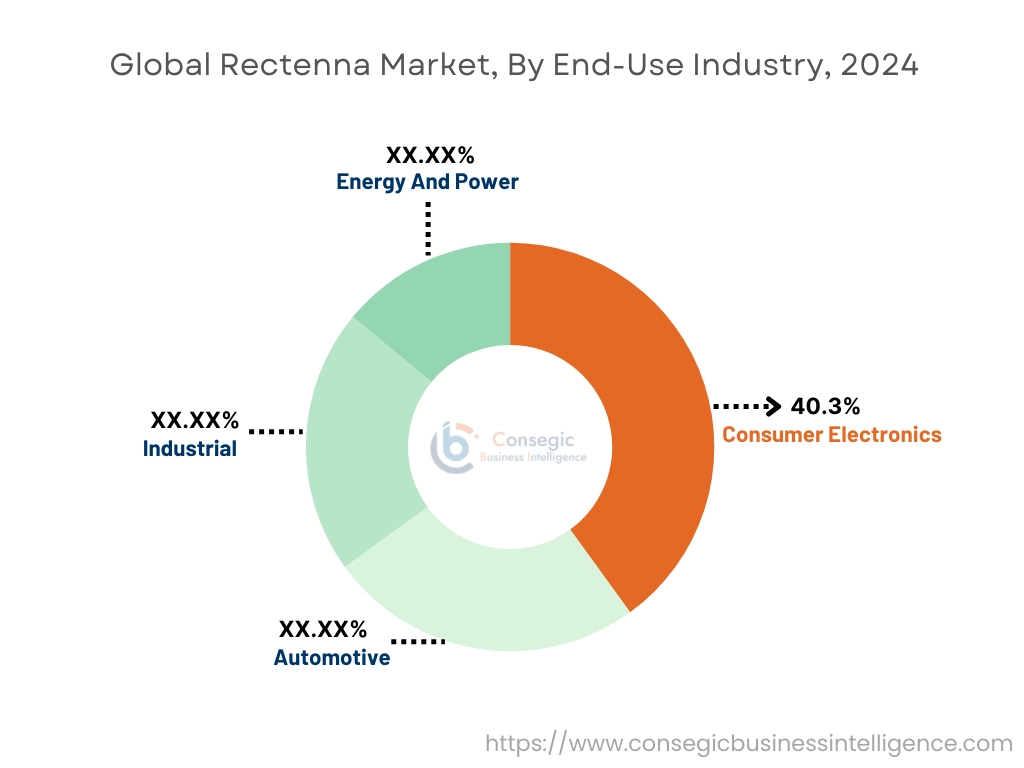
The consumer electronics segment accounted for the largest revenue share in the Rectenna Market of 40.3% in 2024.
- They are used in consumer electronics by providing a way to wirelessly power small devices through radiofrequency (RF) energy harvesting, most commonly seen in applications like RFID tags, contactless smart cards, and some wearable devices.
- In these applications, a small antenna embedded within the device receives RF signals and convert them into usable DC power to operate its circuitry without the need for a battery replacement.
- The small RFID tags used in retail and inventory management are often powered by these antennas that receive signals from a reader to activate their microchip and transmit data.
- Similar to RFID tags, smart cards can use them to power their embedded chips when held near a reader.
- For instance, In September 2022, Powercast Corporation, the leader in radiofrequency (RF)-based over-the-air wireless power technology, has created a unique cellular-based RF Power-Over-Distance Wireless Charging Platform, built around Sequans Monarch cellular IoT connectivity technology. Operating in the lower 600 – 900 MHz frequency bands licensed by mobile carriers, the over-the-air RF charging platform enables carriers to monetize underused low-frequency bands and offer “Power as a Service” to charge low-power devices and smart home IoT sensors that eliminate disposable batteries.
- Thus, the wide range of electronic applications is driving the Rectenna Market trend.
Energy and Power segment is anticipated to have the fastest CAGR during the forecast period.
- In the energy sector, they are used to convert electromagnetic radiation (like microwaves) into usable direct current (DC) electricity, enabling wireless power transmission by capturing radio waves and rectifying them into a usable power source.
- They are primarily utilized in research areas like harvesting energy from the sun, capturing wasted heat from industrial processes, or powering remote devices through wireless transmission. All this is done by utilizing a combination of a receiving antenna and a rectifying circuit within the antenna itself.
- They are used to transmit power over long distances without wires, potentially powering devices in remote locations or implantable medical devices.
- By capturing heat radiation from industrial processes, they are used to generate electricity from otherwise wasted energy.
- For instance, in January 2023, a team of researchers at the University of Massachusetts Amherst has announced that they have invented a low-cost, innovative way to harvest the waste energy from visible light communication by using the human body as an antenna. This waste energy can be recycled to power an array of wearable devices, or even, perhaps, larger electronics.
- Thus, the rising demand in the Energy and power sector leads to potential future Rectenna Market opportunities.
Regional Analysis:
The regions covered are North America, Europe, Asia Pacific, the Middle East and Africa, and Latin America.
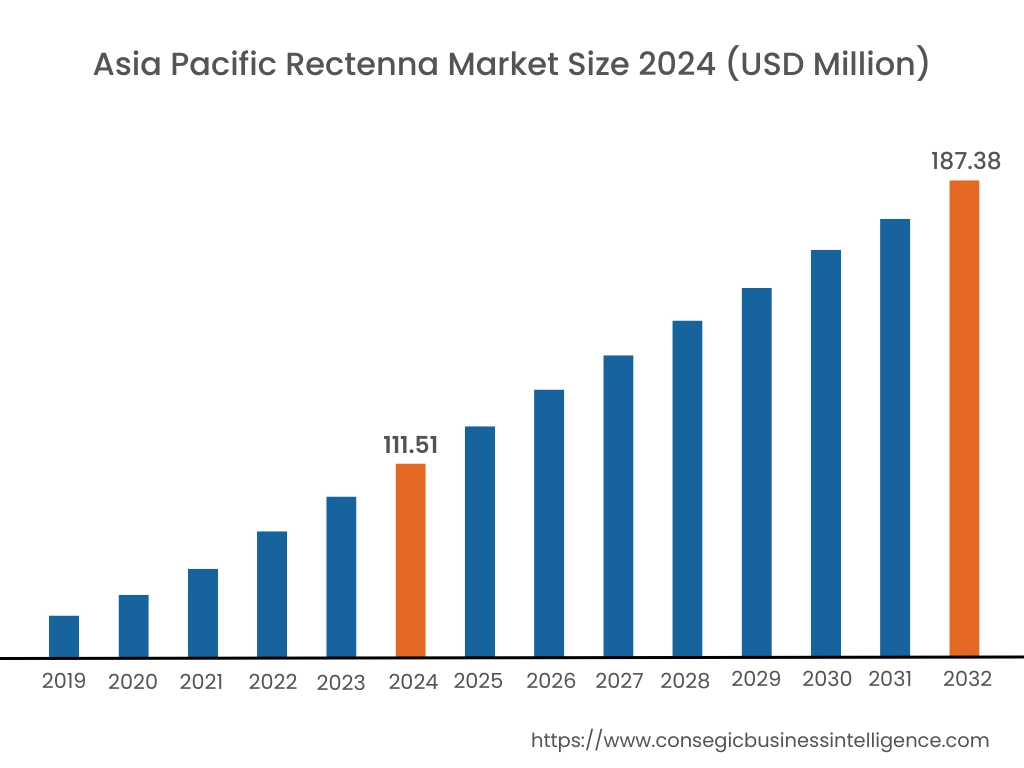
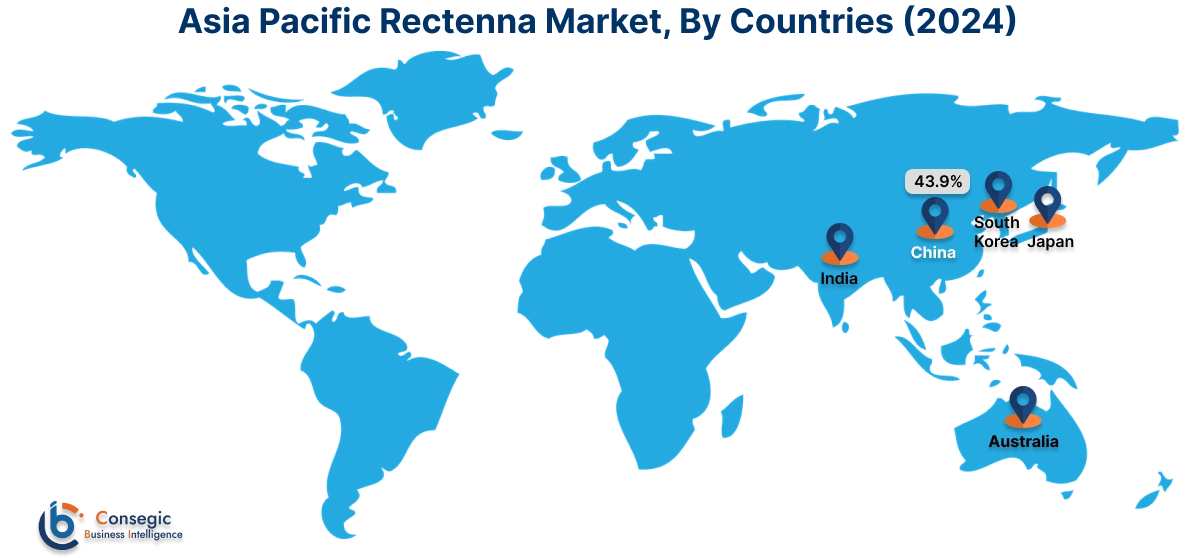
Asia Pacific region was valued at USD 111.51 Million in 2024. Moreover, it is projected to grow by USD 116.83 Million in 2025 and reach over USD 187.38 Million by 2032. Out of this, China accounted for the maximum revenue share of 43.9%.
In the Asia-Pacific region, rectenna technology is an emerging trend and is being explored for various applications including powering low-power IoT devices in smart cities, wireless charging of portable electronics, remote powering of sensors in agriculture, medical implants, and even harvesting ambient RF energy from existing telecommunication networks, particularly in regions with high population density and widespread mobile network coverage.
Due to the vast number of connected devices in smart cities across Asia, they can be used to wirelessly power sensors for environmental monitoring, traffic management, and infrastructure health monitoring, eliminating the need for battery replacements. Miniaturized versions are integrated into wearable devices like fitness trackers or smart clothing, allowing continuous power supply without the need for frequent charging. Dense urban environments in Asian countries present a large potential market for wireless power transmission technologies like rectifying antennas. Many Asian countries are actively pursuing renewable energy sources, and they can be integrated into systems that harvest energy from ambient radio waves.
- For instance, in July 2024, National University of Singapore (NUS) researchers develop new battery-free technology to power electronic devices using ambient radiofrequency signals. This technology converts ambient or ‘waste’ RF signals into direct current (DC) voltage. This can be used to power small electronic devices without the use of batteries. The team optimized spin-rectifier devices and designed a single SR-based rectifying antenna operational between -62 dBm and -20 dBm to convert ambient wireless radio frequency signals at less power.
Thus, the market analysis highlights the growing trend of rectifying antennas in the APAC region.
North America is estimated to reach over USD 199.44 Million by 2032 from a value of USD 125.59 Million in 2024 and is projected to grow by USD 130.96 Million in 2025.
North America is considered a leading market in the global Rectenna Market due to its advanced technological infrastructure and focus on energy-efficient solutions. North America is a key area for their research, development, and potential application.
Several research institutions and companies in United States are actively exploring applications for them, including wireless power transmission for devices like smartphones, IoT sensors, and even large-scale energy harvesting from satellites. Areas like electric vehicle charging, remote power delivery to disaster zones, and powering devices in hard-to-reach locations are potential applications for this technology in North America.
They are used to create wireless charging zones in public spaces like airports, train stations, or shopping malls, allowing users to conveniently charge their devices without cables.
- In March 2025, KYOCERA AVX, a leading global manufacturer of advanced electronic components engineered to accelerate technological innovation and build a better future, is proud to join the STMicroelectronics Partner Program and make its antenna products and services accessible to ST customers.
Thus, the market analysis shows the huge demand of these antennas in the North American region.
In Europe, there has been a growth in rectennas for applications like powering low-power IoT devices, environmental monitoring sensors, implantable medical devices, and even harvesting energy from ambient radio waves in urban areas, with a focus on research and development for efficient and compact designs to integrate into various applications across different sectors, particularly in areas like healthcare, smart infrastructure, and renewable energy harvesting.
There has been significant growth in wireless network sensors to power small, distributed sensors for environmental monitoring, including air quality, water quality, and structural health monitoring in remote areas where battery replacement is difficult.
Several applications in European countries includes utilizing them to power small, distributed sensors for environmental monitoring, including air quality, water quality, and structural health monitoring in remote areas where battery replacement is difficult. Development of miniaturized devices to power small implantable medical devices like pacemakers or neural stimulators, potentially eliminating the need for battery replacements through wireless power transmission. Therefore, the market analysis highlights the growing market in the European region for powering IoT devices, monitoring sensors, in medical devices and many more, are driving the market.
In the Middle East, rectenna technology is particularly useful for applications like powering low-power sensors in harsh environments, enabling wireless energy transfer for remote monitoring systems in desert areas, powering small electronics in arid regions with limited infrastructure, and even contributing to solar energy harvesting through their advanced designs that convert light into electricity, with research institutions like Qatar Environment and Energy Research Institute (QEERI) actively exploring this potential.
They have the capability to operate in extreme temperatures and dust conditions prevalent in desert regions. Wireless power transmission provides energy to remote areas with limited access to power grids. They are used to supplement solar power generation by harvesting additional energy from ambient electromagnetic radiation.
Various other applications include use of rectenna-powered sensors to monitor the health of bridges, pipelines, and other critical infrastructure in remote locations. Enabling wireless power transmission to small sensors in agricultural fields to monitor irrigation needs, soil conditions, and crop health.
In Africa, these technology could be particularly useful for running low-power devices in remote areas with limited access to electricity, such as wireless sensor networks for environmental monitoring, small medical devices, communication relays in rural areas, and even charging small electronic devices like phones and lanterns by harvesting ambient radiofrequency (RF) signals from cell towers or broadcast signals, offering a sustainable energy source where grid electricity is scarce. Therefore, the market analysis shows the emerging requirement of these rectifying antennas in the desert areas and developing countries.
In Latin America, this technology is particularly useful for applications like powering remote sensors in agriculture, providing wireless power to off-grid communities in rural areas, charging electric vehicles in public charging stations, and powering small electronic devices in areas with limited grid access due to their ability to harvest energy from microwave radiation and convert it into usable DC power, even in locations with poor infrastructure or limited access to electricity.
Deploying wireless sensor networks in remote areas like the Amazon rainforest to monitor deforestation, air quality, and wildlife populations, powered by these technology harvesting energy from the surrounding environment. Powering sensors and actuators in precision agriculture systems to monitor soil moisture, weather conditions, and crop health in rural areas, enabling optimized irrigation and fertilization practices.
Thus, these applications leads to a growth of Rectenna Market in the Latin American region.
Top Key Players & Market Share Insights:
The Rectenna market is highly competitive with major players providing products and services to the national and international markets. Key players are adopting several strategies in research and development (R&D), product innovation, and end-user launches to hold a strong position in the global Rectenna market. Key players in the Rectenna industry include –
- Antenova Ltd. (UK)
- Power Integration, Inc. (US)
- STMicroelectronics (Switzerland)
- Pulse Electronics (US)
- Akrion technologies (US)
- Molex (US)
- Renesas Electronics (Japan)
- Laird Connectivity (US)
- Vishay Intertechnology, Inc. (US)
- Abracon LLC (US)
- Texas Instruments (US)
Recent Industry Developments :
- In December 2024, INFRGY’s latest innovation, a radio frequency (RF) power transfer system demonstrated at the University of Kashmir, builds on established principles of RF energy harvesting to deliver a scalable, real-world application.
Rectenna Market Report Insights:
| Report Attributes | Report Details |
| Study Timeline | 2019-2032 |
| Market Size in 2032 | USD 615.38 Million |
| CAGR (2025-2032) | 6.3% |
| By Band Type |
|
| By Technology |
|
| By End-Use Industry |
|
| By Region |
|
| Key Players |
|
| North America | U.S. Canada Mexico |
| Europe | U.K. Germany France Spain Italy Russia Benelux Rest of Europe |
| APAC | China South Korea Japan India Australia ASEAN Rest of Asia-Pacific |
| Middle East and Africa | GCC Turkey South Africa Rest of MEA |
| LATAM | Brazil Argentina Chile Rest of LATAM |
| Report Coverage |
|
Key Questions Answered in the Report
What are Rectennas? −
Rectennas or rectifying antennas are special types of receiving antennas used for the conversion of electromagnetic energy to direct current (DC) electricity. They are mostly used for wireless power transmissions that transmits power through radio waves. They are used for various applications such as wireless battery charging, power transmission, and energy harvesting.
What are the major drivers of Rectenna growth? +
The major driver of Rectenna market growth is the growing use of wireless power transmission systems. Wireless power transfer is the transmission of electrical power source to a receiver. It provides a convenient and flexible power supply for consumer electronic devices and industrial applications. Rectennas converts radio frequency into direct current, the transfer of power wirelessly through electromagnetic waves.
What segmentation details are covered in the Rectenna Market report, and how is the dominating segment impacting market growth? +
The Rectenna Market is segmented based on band type, technology, and end-use industry. Further, a sub segment of band type is multiband, which accounts for the largest and is expected to be the fastest growing segment, as it is able to receive and convert radio frequency power from multiple bands into direct current. They are dual polarized by using the cross-polarized dipole and are omnidirectional.
What are the key players of Rectenna Market? +
Antenova Ltd. (UK), Power Integration, Inc. (US), Renesas Electronics (Japan), Laird Connectivity (US), Vishay Intertechnology, Inc. (US), Abracon LLC (US), Texas Instruments (US), STMicroelectronics (Switzerland), Pulse Electronics (US), Akrion technologies (US), Molex (US).
Overview
Reputation & Certifications


Our Services
- Market Intelligence & Forecasting
- Custom Research Solutions
- Market Entry Strategy
- Competitive Intelligence
- Customer Insights
- Industry Innovation Analysis
- Investment Advisory