Jump to Content
Shikimic Acid Market - Size, Share, Industry Trends, and Forecasts (2025-2032)
Shikimic Acid Market Size:
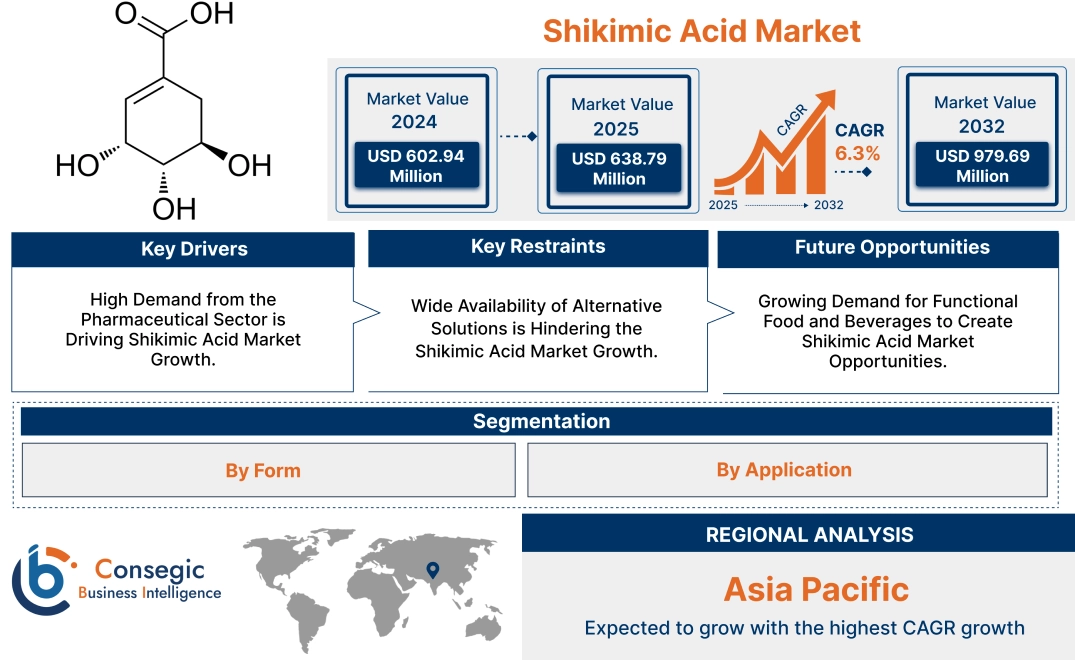
The Shikimic Acid Market size is growing with a CAGR of 6.3% during the forecast period (2025-2032), and the market is projected to be valued at USD 979.69 Million by 2032 from USD 602.94 Million in 2024. Additionally, the market value for 2025 is attributed to USD 638.79 Million.
Shikimic Acid Market Scope & Overview:
Shikimic acid (SA) is a naturally occurring cyclic hydroxy acid that acts as an important precursor component for biosynthesis of aromatic amino acids and other aromatic compounds produced in plants and microorganisms. Another name for this compound is shikimate. The compound is distinguished by the presence of several pharmacological effects such as anti-thrombotic, anti-inflammatory, whitening, hair-growth, and bactericidal properties. These beneficial properties provide shikimic acid with a diverse range of applications. Primary applications are pharmaceutical intermediates, cosmetic formulations, and functional food and beverage products. This compound is majorly used as a raw material for producing the anti-influenza drug Tamiflu. As a result, the growing adoption in the pharmaceutical and cosmetic sectors is positively impacting the market.
Shikimic Acid Market Dynamics - (DRO):
Key Drivers:
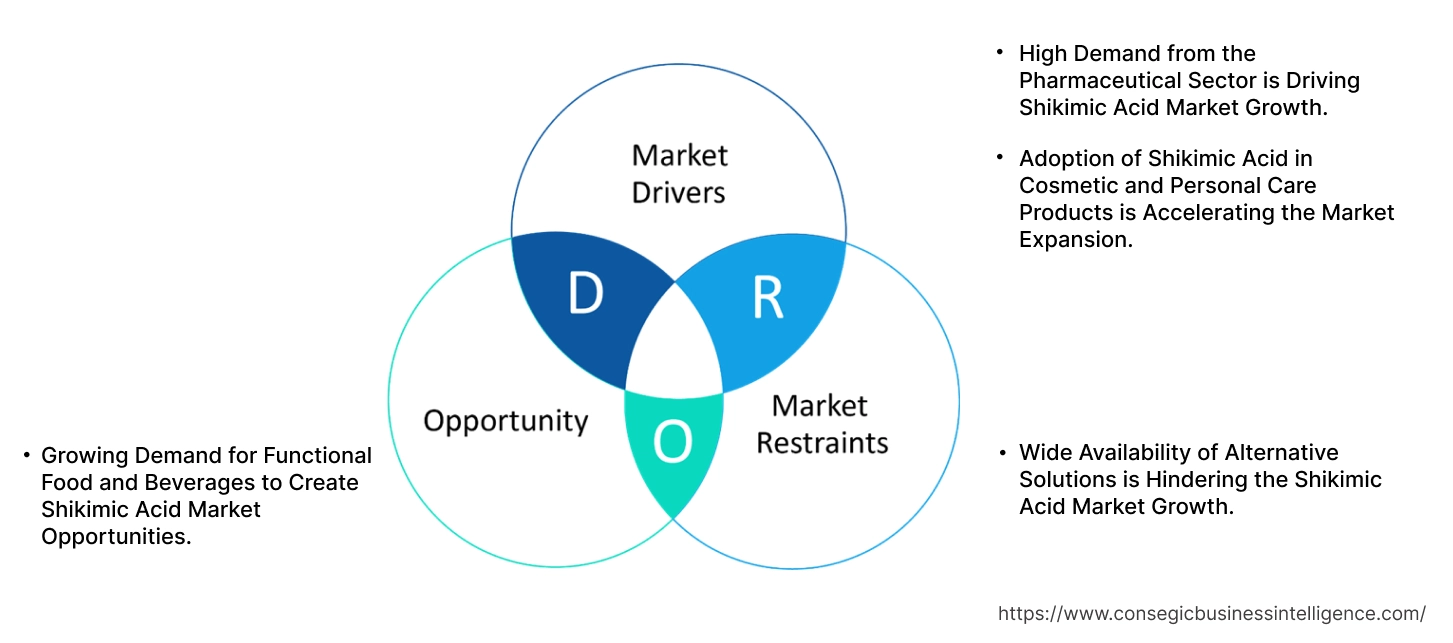
High Demand from the Pharmaceutical Sector is Driving Shikimic Acid Market Growth.
One of the primary factor driving the market is the utilization of shikimic acid as a precursor in the synthesis of oseltamivir. Oseltamivir (Tamiflu) is an antiviral medication used to treat and prevent influenza. Beyond its primary use, SA is also employed in pharmaceuticals for its fever-reducing, antioxidant, blood-thinning, anti-clotting, anti-inflammatory, and pain-relieving properties. Consequently, as pharmaceutical production increases, the adoption of this compound is rising contributing to the higher market revenue.
- For instance, according to the data published by Germany Trade and Invest, pharmaceutical production volume across the Germany reached USD 39.38 billion in 2022, representing an 8.2% annual growth rate.
Additionally, flu outbreaks and global concerns about pandemics create a consistent need for anti-viral medications. This in turn results in the requirement for shikimate. Thus, the combination of aforementioned factors is directly contributing to shikimate’s substantial requirement.
Adoption of Shikimic Acid in Cosmetic and Personal Care Products is Accelerating the Market Expansion.
The adoption of SA in cosmetic and personal care products, particularly in skin care is one important factor supporting the market revenue. The role of shikimic acid as an antioxidant, anti-inflammatory, and skin-rejuvenating agent makes it critical compound for cosmetic formulations. The growing focus on the development of anti-aging, skin-brightening, and skin-rejuvenating products is fueling the use of the compound.
- For instance, in October 2024, Lira Clinical expanded their SMART PEELS line offerings with three new peels: Exo Retinoid, Exo Mandelic, and Shikimic Plus. These innovative peels are designed to address various skin concerns while minimizing inflammation, boosting skin volume, and supporting a healthy skin barrier.
As a result, the proven benefits of shikimate for skin health are supporting the shikimic acid market expansion.
Key Restraints:
Wide Availability of Alternative Solutions is Hindering the Shikimic Acid Market Growth.
Key players are focusing on the development of easily available and highly effective solutions. This has resulted in an increase in development to produce alternatives with similar properties to SA. This serves as a primary factor contributing to the hindrance of the overall upward trajectory of the market. These alternatives such as production of essential aromatic amino acids via microbial fermentation reduce the reliance on extraction of shikimate. Genetically modified microorganisms are used for direct synthesis, offering a more efficient and sustainable production method. Furthermore, certain cosmetic ingredients such as ascorbic acid, hyaluronic acid, and alpha hydroxy acids are well-established and readily available alternatives. These factors are supporting players to adopt alternatives. As a result, the above-mentioned factors are limiting the shikimic acid market expansion.
Future Opportunities:
Growing Demand for Functional Food and Beverages to Create Shikimic Acid Market Opportunities.
Functional foods and beverages are the products that are fortified with nutrients or ingredients that provide health benefits beyond basic nutrition. Growing consumer understanding of nutrient-rich food benefits is influencing global food and beverage players to incorporate nutritional additives such as shikimic acid, thereby driving product innovation and the development of new health and wellness-focused product lines. Hence, the increasing demand for functional food and beverages is supporting market revenue over the forecast period.
- For instance, according to the data published by Agriculture and Agri-Food Canada, the retail sales of functional packaged foods in India are expected to grow at the CAGR of 5.3% over the forecast period.
Therefore, the above-mentioned factors are creating lucrative market opportunities in future years.
Shikimic Acid Market Segmental Analysis :
By Form:
Based on Form, the market is bifurcated into powder and liquid.
Trends in Form:
- The powder is widely preferred form due to its ease of handling, storage, and transportation attributes.
- Emphasis on stringent quality control and traceability to ensure food safety and regulatory compliance is positively impacting the adoption of powder form.
The powder segment accounted for the largest market share in 2024.
- The powder form with crystalline white or off-white appearance holds a prominent position in the market due to ease of handling and cost-effectiveness.
- The focus is on reducing transportation issues associated with the products as well as minimizing the risk of spoilage.
- Additionally, the powder form of shikimate allows for convenient storage and its distribution is more organized and efficient. This results in a reduction in production and transportation costs, further fueling the segment's revenue.
- Additionally, the key players are also engaged in developing new strategies for powdered formulation for bulk usage across several sectors including pharmaceuticals, cosmetics, and food & beverage.
- Thus, as per the analysis, the aforementioned factors support high adoption of powder form in the overall shikimic acid market demand.
The liquid segment is expected to grow at the fastest CAGR over the forecast period.
- The liquid form is expected to grow at the fastest rate in the future years due to the confluence of several factors. One of these key factors is the efficiency in manufacturing processes for liquid formulations.
- Utilization of liquid form of shikimate supports easier customization of concentrations of products, catering to specific application needs. This in turn increases its adoption across a diverse range of applications such as cosmetics.
- For instance, in 2023, Skeyndor launched the Probiome Peel range developed using shikimic acid along with glycolic, malic, and hydroxyphenoxy propionic acids. The liquid peel solution combines accelerated skin cell rejuvenation with microbiome restoration.
- These factors combined are expected to create new pathways for the liquid form in the overall shikimic acid market demand.
By Application:
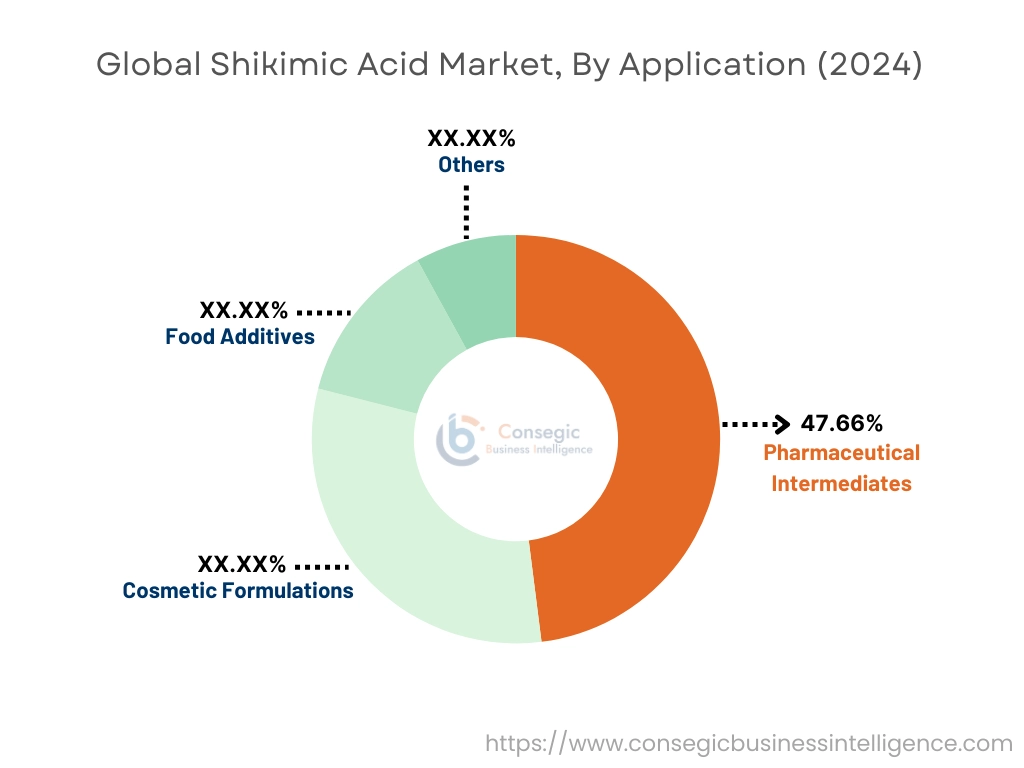
Based on Application, the market is categorized into pharmaceutical intermediates, cosmetic formulations, food additives, and others.
Trends in the Application
- Emphasis on clean beauty products with natural, plant-derived ingredients is rising.
- The increasing trend for functional foods and beverages is positively impacting the adoption of shikimate.
The pharmaceutical intermediates segment accounted for the largest market share of 47.66% in 2024.
- The pharmaceutical intermediates segment holds prominence in the base year due to the necessity for antiviral medications. Shikimic acid plays a primary role as a crucial precursor for the synthesis of oseltamivir, an antiviral drug used to treat and prevent influenza.
- Additional pharmaceutical applications of SA include its use as an antithrombotic, antipyretic, anticoagulant, antioxidant, anti-inflammatory, and analgesic agent across various drug formulations.
- The major increase in the adoption of antiviral medications for influenza treatment and prevention are contributing to the substantial need for this compound.
- Thus, as per analysis, the market revenue for pharmaceutical intermediates segment is the largest in the overall shikimic acid market trend.
The cosmetic formulations segment is expected to grow at the fastest CAGR over the forecast period.
- The cosmetic formulations segment contribution is driven by technological advancement using shikimate and their expanding application domains.
- Shikimate is used in cosmetic formulations for its antioxidant and skin-enhancing properties. It is also utilized in hair growth products.
- The focus towards natural and plant-derived ingredients in cosmetics is contributing significantly to the market. Hence, increasing adoption of skincare products that are developed using natural ingredients is further contributing to the segment's revenue over the future years.
- For instance, as per the survey analysis provided by Milieu in 2023, it stated that 66% of Southeast Asian consumers prioritize natural ingredients in skin care products.
- Henceforth, according to market analysis, the cosmetic formulations segment is expected to grow at the fastest rate in future years in the overall shikimic acid market trend.
Regional Analysis:
The regional segment includes North America, Europe, Asia Pacific, the Middle East and Africa, and Latin America.
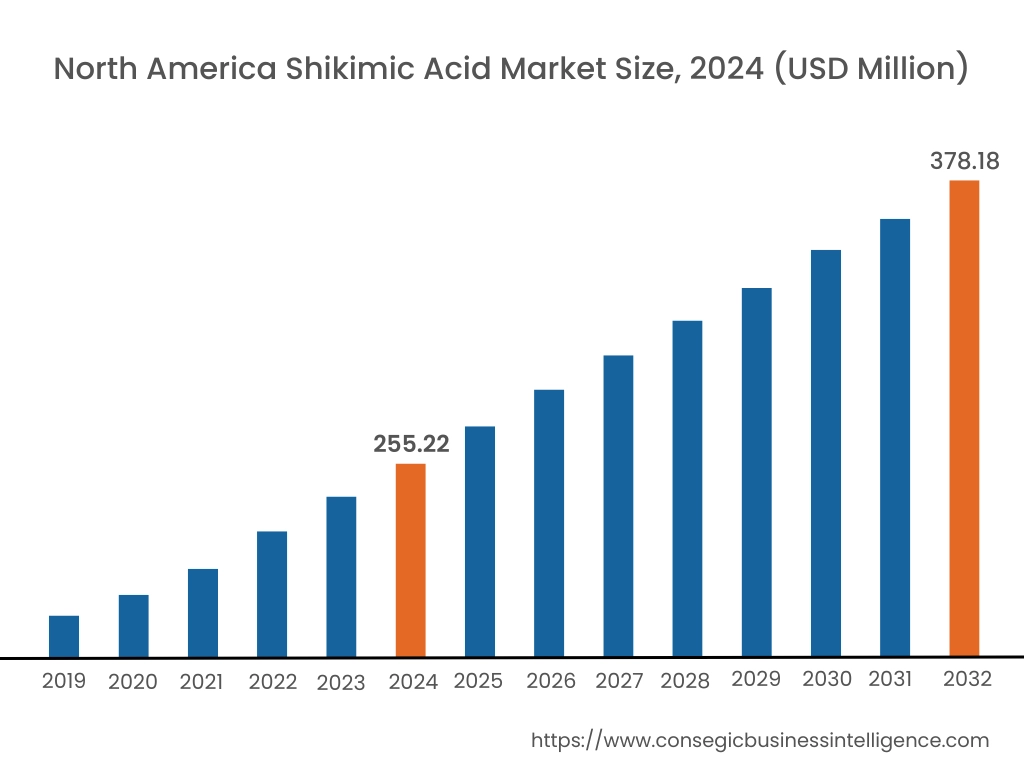
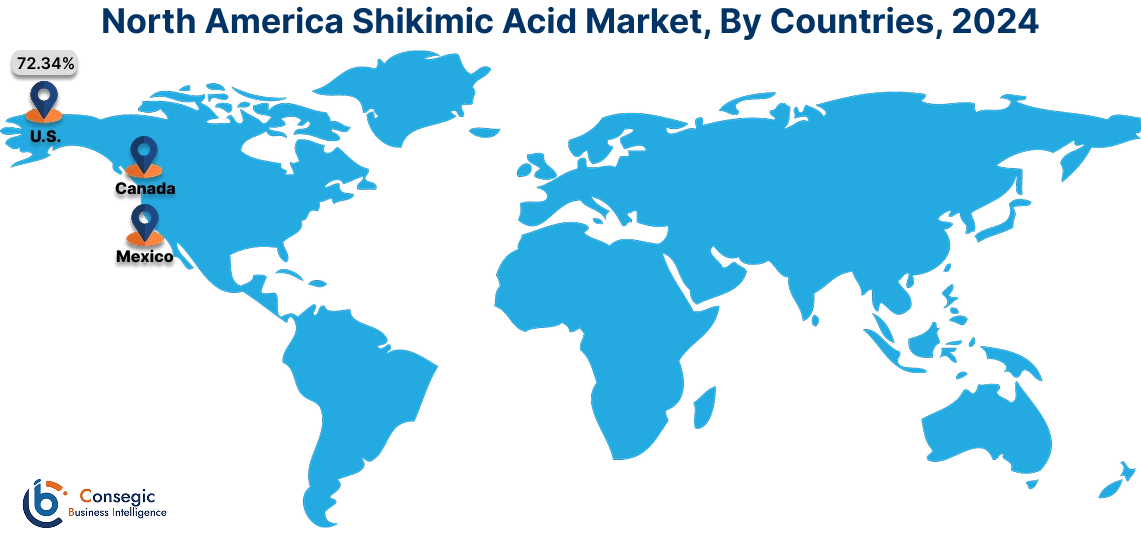
In 2024, North America accounted for the highest market share at 42.33% and was valued at USD 255.22 Million and is expected to reach USD 378.18 Million in 2032. In North America, the U.S. accounted for the largest shikimic acid market share of 72.34% during the base year of 2024. The North American shikimic acid market share is dominating primarily due to the large pharmaceutical industry across the region. The region presents various pharmaceutical companies that are significant consumers of shikimate, particularly for the production of antiviral medications. This well-established pharmaceutical sector increases the adoption rate of SA for research and development of new applications. Additionally, advanced research infrastructure and research funding supports the upward trajectory of the market.
- For instance, in September 2022, the US Government announced the federal funding of more than USD 2 billion for biotechnology and biomanufacturing to reduce U.S. reliance on foreign materials and bioproduction. For this funding, Department of Defense has planned to invest USD 1 billion in U.S. pharmaceutical manufacturing infrastructure over five years.
Thus, due to the above-mentioned factors North America showcases dominant regional contribution of the shikimic acid market analysis.
In Asia Pacific, the shikimic acid industry is experiencing the fastest growth with a CAGR of 8.6% over the forecast period primarily due to rising demand from cosmetic and personal care sector. The growth of the cosmetic and personal care sector in countries such as China, Japan, South Korea, and India due to the increasing consumer awareness of skincare and haircare is creating the high adoption of SA in the product formulations. Additionally, the growing market for functional foods across the region, driven by rising disposable incomes and health awareness, is also contributing to the requirement for shikimate. These are the major factors and trends contributing to the market growth in this region.
In Europe’s shikimic acid market analysis, cosmetics and personal care serve as the most widely used sector wherein shikimate has been used. The preference for natural cosmetic products aligning with the clean beauty trend is growing. Consumers now demand sustainable, multifunctional cosmetics with natural ingredients. In addition to this, strong skincare awareness and anti-aging focus drive the need for effective and safe ingredients. Moreover, European countries present well-established cosmetic sector. Thus, ongoing innovations in cosmetic product formulations support the requirement for shikimate as a crucial ingredient.
In the Middle East and African (MEA) market, countries are investing in improving their healthcare systems. This includes building new hospitals, clinics, and diagnostic centers, which increases the need for pharmaceuticals that utilize shikimic acid, particularly antiviral medications. As healthcare awareness increases, it creates the necessity for treatments and preventative measures against illnesses such as influenza. Also, consumers in MEA are becoming more conscious of skincare seeking with clinically proven results. Collectively, the aforementioned factors support market revenue across the region.
The Latin America's market is driven by the region's growing cosmetics and personal care sector. Rising disposable incomes and increasing awareness of personal grooming is influencing consumers to invest more in personal care. Hence, the requirement for multifunctional and nature-derived ingredients is rising. This trend is influenced as consumers are increasingly seeking products that are capable of addressing specific skin concerns and improving their overall appearance. They are increasingly seeking high-quality cosmetics personalized to their skin, hair, and body condition. Consequently, shikimic acid market opportunities are expected to be lucrative over the forecast period.
Top Key Players & Market Share Insights:
The Global Shikimic Acid Market is highly competitive with major players providing products to the national and international markets. Key players are adopting several strategies in research and development (R&D) and product innovation to hold a strong position in the global Shikimic Acid market. Key players in the Shikimic Acid industry include
- Merck KGaA (Germany)
- Fengchen Group Co.,Ltd (China)
- Biosynth (United Kingdom)
- Thermo Fisher Scientific Inc. (U.S.)
- Cayman Chemical (U.S.)
- HiMedia Laboratories (India)
- Tokyo Chemical Industry (Japan)
- MP Biomedicals (U.S.)
- Green Chemicals Co., Ltd. (Japan)
- Sandoo Pharmaceuticals and Chemicals Co.,Ltd. (China)
Shikimic Acid Market Report Insights:
| Report Attributes | Report Details |
| Study Timeline | 2019-2032 |
| Market Size in 2032 | USD 979.69 Million |
| CAGR (2025-2032) | 6.3% |
| By Form |
|
| By Application |
|
| By Region |
|
| Key Players |
|
| North America | U.S. Canada Mexico |
| Europe | U.K. Germany France Spain Italy Russia Benelux Rest of Europe |
| APAC | China South Korea Japan India Australia ASEAN Rest of Asia-Pacific |
| Middle East and Africa | GCC Turkey South Africa Rest of MEA |
| LATAM | Brazil Argentina Chile Rest of LATAM |
| Report Coverage |
|
Key Questions Answered in the Report
How big is the Shikimic Acid market? −
In 2024, the Shikimic Acid market is USD 602.94 Million.
Which is the fastest-growing region in the Shikimic Acid market? +
Asia Pacific is the fastest-growing region in the Shikimic Acid market.
What specific segmentation details are covered in the Shikimic Acid market? +
By Form and Application segmentation details are covered in the Shikimic Acid market.
Who are the major players in the Shikimic Acid market? +
Merck KGaA (Germany), HiMedia Laboratories (India), Tokyo Chemical Industry (Japan), MP Biomedicals (U.S.), Green Chemicals Co., Ltd. (Japan) are some of the major players in the market.
Overview
Reputation & Certifications


Our Services
- Market Intelligence & Forecasting
- Custom Research Solutions
- Market Entry Strategy
- Competitive Intelligence
- Customer Insights
- Industry Innovation Analysis
- Investment Advisory