Jump to Content
Ship-To-Shore Cranes Market - Size, Share, Industry Trends, and Forecasts (2025-2032)
Ship-To-Shore Cranes Market Size:
Ship-To-Shore Cranes Market size is estimated to reach over USD 4,032.56 Million by 2032 from a value of USD 2,889.29 Million in 2024 and is projected to grow by USD 2,961.98 Million in 2025, growing at a CAGR of 4.5% from 2025 to 2032.
Ship-To-Shore Cranes Market Scope & Overview:
Ship-to-shore (STS) cranes refer to equipment which is used for loading and unloading between ships and terminals. Moreover, ship to shore cranes enhance operational efficiency by reducing docking times and improving cargo transfer speed. Additionally, STS cranes optimizes port operations while minimizing human intervention. Further, they are widely used in container terminals, bulk cargo handling, and automated port operations for supporting seamless logistics and enhancing trade efficiency.

Ship-To-Shore Cranes Market Dynamics - (DRO) :
Key Drivers:
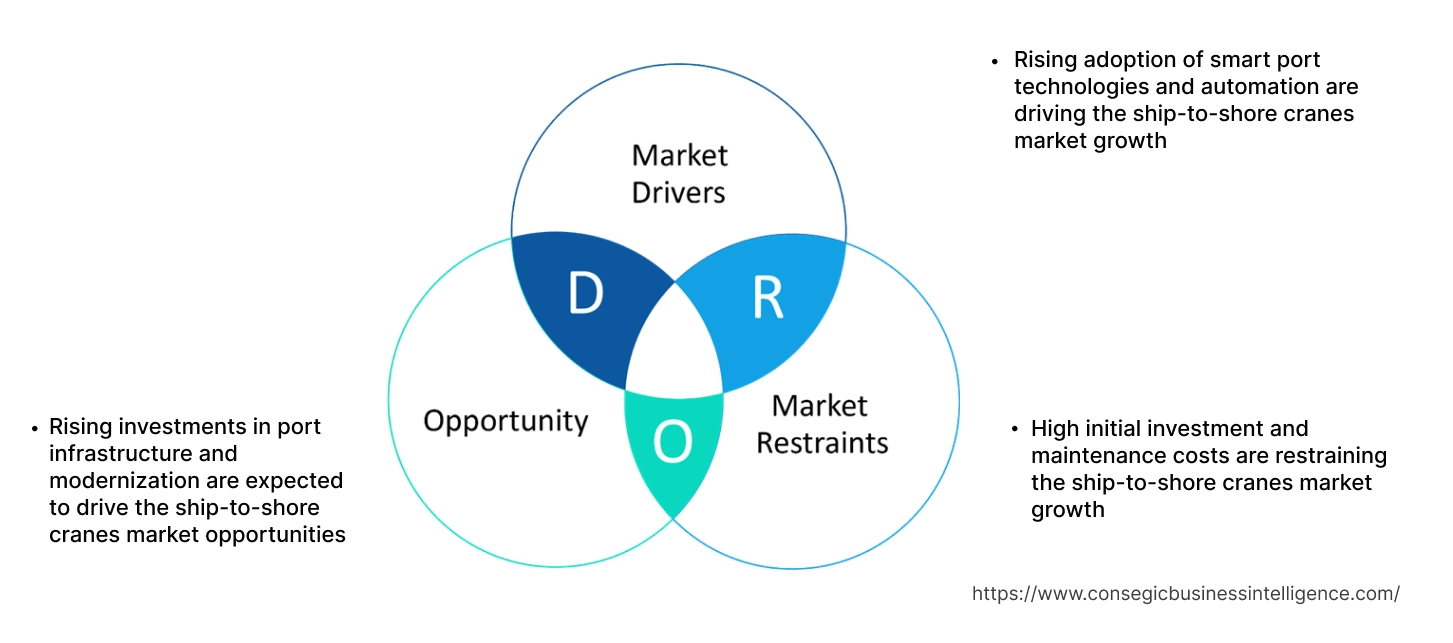
Rising adoption of smart port technologies and automation are driving the ship-to-shore cranes market growth
There is an increasing integration of automated and smart port technologies due to real time data analytics, predictive maintenance, energy efficient operations, and others. Further, ports are increasing the deployment of automated ship to shore cranes equipped with modern technologies and advanced network infrastructure to enhance operational efficiency, reduce errors, and minimize human intervention. Additionally, rising investments in container loading automation are further optimizing port operations, supported by improved infrastructure for container storage and transfer on the landside.
- For instance, in June 2023, Liebherr Container Cranes announced the sale of three large dual trolley ship to shore container cranes to HHLA (Hamburger Hafen und Logistik AG), a European logistic provider.
Thus, as per the ship-to-shore cranes market analysis, the rising deployment of ship to shore cranes in ports is driving the market.
Key Restraints:
High initial investment and maintenance costs are restraining the ship-to-shore cranes market growth
The primary restraining factors associated with ship-to-shore cranes market include high initial investment and frequent maintenance costs. Moreover, installing STS cranes require substantial investment for small and mid-sized ports.
Additionally, according to Electric Power and Research Institute, STS cranes, either diesel or electric, usually costs USD 10-12 million. Further, the maintenance and operational costs, including periodic inspections, repairs, and technological advancements increases the overall cost. Thus, the above factors such as high initial investment and maintenance costs are restraining the ship-to-shore cranes market expansion.
Future Opportunities :
Rising investments in port infrastructure and modernization are expected to drive the ship-to-shore cranes market opportunities
The increasing investments in port infrastructure and modernization projects are driving the demand for ship to shore cranes. Further, port authorities and terminal operators are upgrading crane infrastructure to enhance cargo handling efficiency, improve operational productivity, and accommodate larger and ultra large container vessels. Additionally, rising advancements in automation, electrification, and others are further accelerating the adoption of ship to shore cranes.
- For instance, in November 2024, the S. Department of Transportation’s Maritime Administration announced an investment of USD 580 million from the Bipartisan Infrastructure Law for funding 31 port improvement projects in 15 states across the United States.
Thus, as per the analysis, the rising investments in modernizing port infrastructure are projected to drive the global ship-to-shore cranes market opportunities during the forecast period.
Ship-To-Shore Cranes Market Segmental Analysis :
By Product Type:
Based on the product type, the market is segmented into high profile cranes and low profile cranes.
Trends in the Product Type:
- There is an increasing trend towards utilization of high profile cranes for improving port efficiency.
- The adoption of low profile cranes near airports is driven by height restrictions near airports and urban areas.
High profile cranes accounted for the substantial revenue share in the total ship-to-shore cranes market share in 2024.
- High profile cranes are large ship to shore cranes with a fixed structure and A-frame design which enables them to handle containers efficiently.
- High-profile cranes feature booms that can be raised, enabling ships to dock smoothly and facilitating their passage after being fully loaded.
- Further, high profile STS cranes are designed with a hinged boom, improving navigation for vessels during berthing operations.
- Thus, the rising adoption of high profile cranes for handling large containers are further driving the ship-to-shore cranes market size.
Low profile cranes is anticipated to register significant CAGR growth during the forecast period.
- Low-profile ship-to-shore cranes are normally used in terminals and ports that are situated near airports, featuring fixed and low-height booms.
- Moreover, these cranes are equipped with a non-pivoting telescopic boom that extends outward over vessels, facilitating efficient load and unloading operations.
- Additionally, low-profile cranes are designed for places with limited height or restrictions such as airport.
- Thus, the rising utilization of low profile cranes near airports, and other related application is expected to drive the market during the forecast period.
By Lifting Capacity:
Based on the lifting capacity, the market is segmented into panamax, post panamax, super post panamax, and others.
Trends in the Lifting Capacity:
- There is an increasing trend towards utilization of high capacity cranes such as panamax for accommodating panamax and post panamax vessels.
- The utilization of super post panamax cranes is driven by expansion of deep water ports and rising global trade.
Super post panamax segment accounted for the largest revenue in the total ship-to-shore cranes market share in 2024, and it is anticipated to register a substantial CAGR growth during the forecast period.
- Super post panamax cranes are high capacity container handling cranes designed for loading and unloading ultra large container vessels with a width of 22 or more container rows.
- Further, super post panama ship-to-shore cranes are widely used in major sea ports and container terminals to handle large scale cargo operations.
- For instance, in December 2023, APM Terminals Elizabeth commissioned two new ZPMC super-post Panamax ship-to-shore cranes. The cranes feature 23-container outreach that is optimized for accommodating neo-panamax vessels and ultra-large container vessels.
- Thus, the rising adoption of super post panamax cranes are driving the ship-to-shore cranes market trends.
By Power Supply:
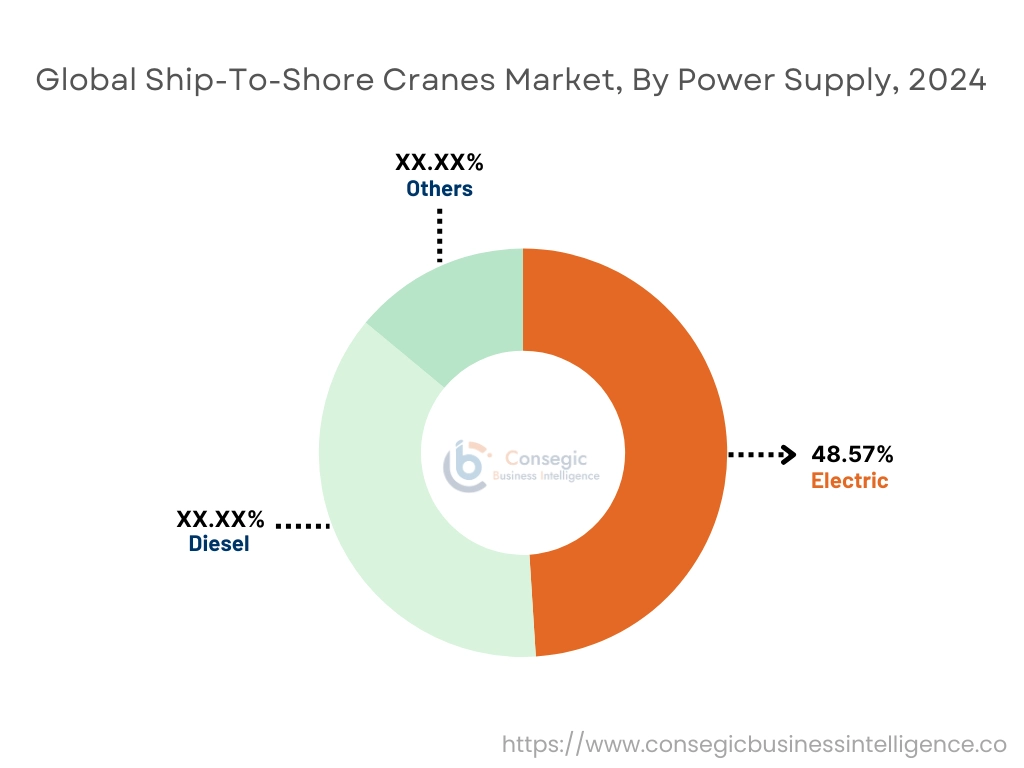
Based on the power supply, the market is segmented into electric, diesel, and others.
Trends in the Power Supply:
- There is an increasing utilization of electric powered cranes to enhance energy efficiency and reduce emissions.
- Increasing utilization of hybrid power solutions such as electric with diesel, which is primarily driven by sustainable port operations.
Electric segment accounted for the largest revenue share of 48.57% in the total market in 2024 and it is anticipated to register a significant CAGR growth during the forecast period.
- Electric-powered ship-to-shore cranes are increasingly being adopted due to their energy efficiency and lower operating costs.
- Further, electric ship to shore cranes offers various advantages including longer equipment life, reduced emissions, improved reliability, and others.
- For instance, in January 2025, the Port of Savannah unveiled new electric ship to shore cranes, expanding Ocean terminal fleet to eight super post panamax cranes, all designed by Konecranes.
- Therefore, the rising adoption of electric ship to shore cranes are further driving the ship-to-shore cranes market trends.
By Outreach:
Based on the outreach, the market is segmented into less than 40m, 40m to 49m, 50m to 60m, and above 60m.
Trends in the Outreach:
- There is an increasing utilization of post panamax cranes for accommodating panamax and post panamax vessels due to outreach of 40m to 49m.
- Rising adoption of super post-panamax cranes with an outreach of 50m-60m, driven by the need to handle larger vessels and improve port efficiency.
40m to 49m accounted for the largest revenue share in the total market in 2024.
- The 40m to 49m outreach is designed to accommodate panamax and post panamax vessels for efficient container handing.
- Further, these cranes offer enhanced operational flexibility, allowing ports to manage rising cargo volumes.
- For instance, Liebherr offers post panamax crane it its product offerings. It has an outreach of 40-45m for accommodating panamax as well as post panamax vessels.
- According to the analysis, the rising utilization of cranes with 40m to 49m outreach is further driving the ship-to-shore cranes market size.
50m to 60m is anticipated to register a substantial CAGR growth during the forecast period.
- Ship-to-shore crane with 50m to 60m outreach is primarily used for handling post panamax and super post panamax vessels.
- Further, post panamax and super post panamax vessels requires extended reach for efficient cargo operations.
- For instance, Liebherr offers super-post panamax ship-to-shore crane it its product offerings. It has an outreach of 50-60m for accommodating super panamax vessels and post panamax vessel.
- Therefore, the rising advancements in ship-to-shore cranes for extending outreach capabilities are projected to boost the market growth during the forecast period.
Regional Analysis:
The regions covered are North America, Europe, Asia Pacific, the Middle East and Africa, and Latin America.
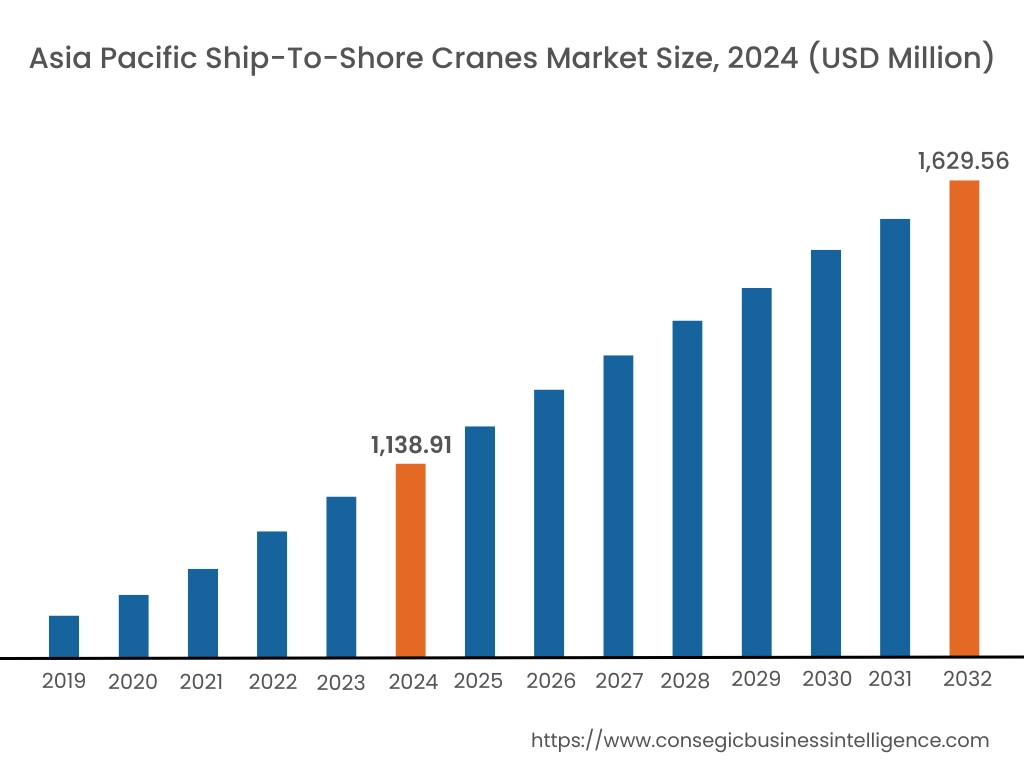
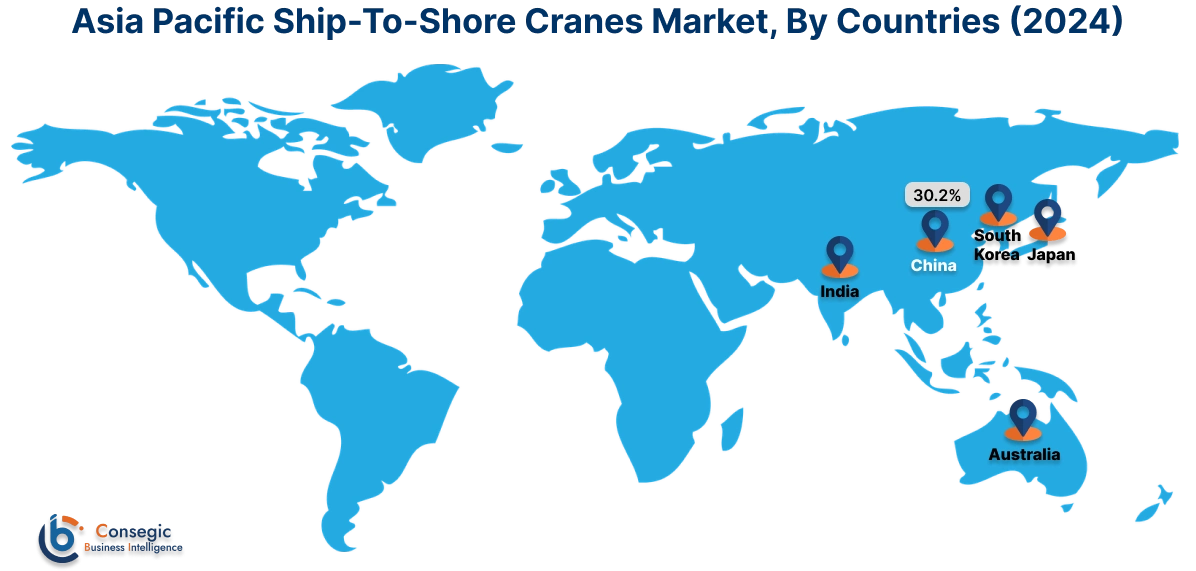
Asia Pacific region is estimated to reach over USD 1,629.56 Million by 2032 from a value of USD 1,138.91 Million in 2024 and is projected to grow by USD 1,170.02 Million in 2025. Out of this, China accounted for the maximum revenue share of 30.2%. As per the ship-to-shore cranes market analysis, there is an increasing adoption of ship to shore cranes at port, particularly in countries such as China, India, and Japan, for enhancing cargo handling efficiency, accommodating larger vessels, and improving port infrastructure among others. The rapid development and growing investments in ports are accelerating the ship-to-shore cranes market expansion.
- For instance, according to the IBEF (India Brand Equity Foundation), the Government of India launched a Maritime Development Fund (MDF) of USD 2.87 Billion to promote maritime infrastructure. This is further driving the adoption of ship to shore cranes, thereby, propelling the market in the Asia-Pacific region.
North America was valued at USD 634.41 Million in 2024. Moreover, it is projected to grow by USD 648.65 Million in 2025 and reach over USD 857.32 Million by 2032.
In North America, the growth of ship-to-shore cranes industry is driven by the rising demand for reliable and efficient cargo handling solutions. Rising adoption of automation and electrification of ports, along with advancements in logistics and other industries are also driving the market. Further, increasing investments in maritime industry are contributing to the development in ship-to-shore cranes market demand.
- For instance, in November 2023, the S. Department of Transportation’s Maritime Administration announced over USD 653 Million to fund 41 port improvement projects. This is further driving the adoption of advanced cranes at ports, which in turn is propelling the market in North America.
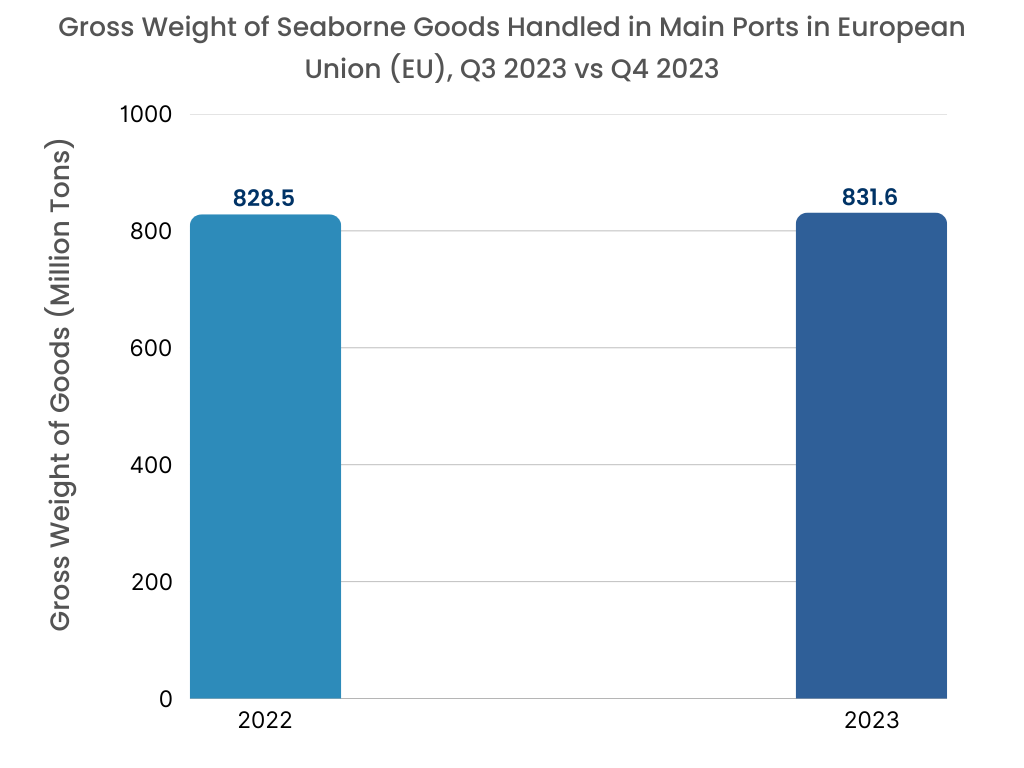
The regional analysis depicts that the rising investments in port infrastructure and increasing adoption of automation solutions are driving the ship-to-shore cranes market demand in Europe. Further, as per the market analysis, the primary factor driving the market in the Middle East and African region includes increasing investment in maritime trade and port development projects. The rising demand for advanced cargo handling solutions, growing trade activities, and others are driving the market demand in the Latin America region.
Top Key Players and Market Share Insights:
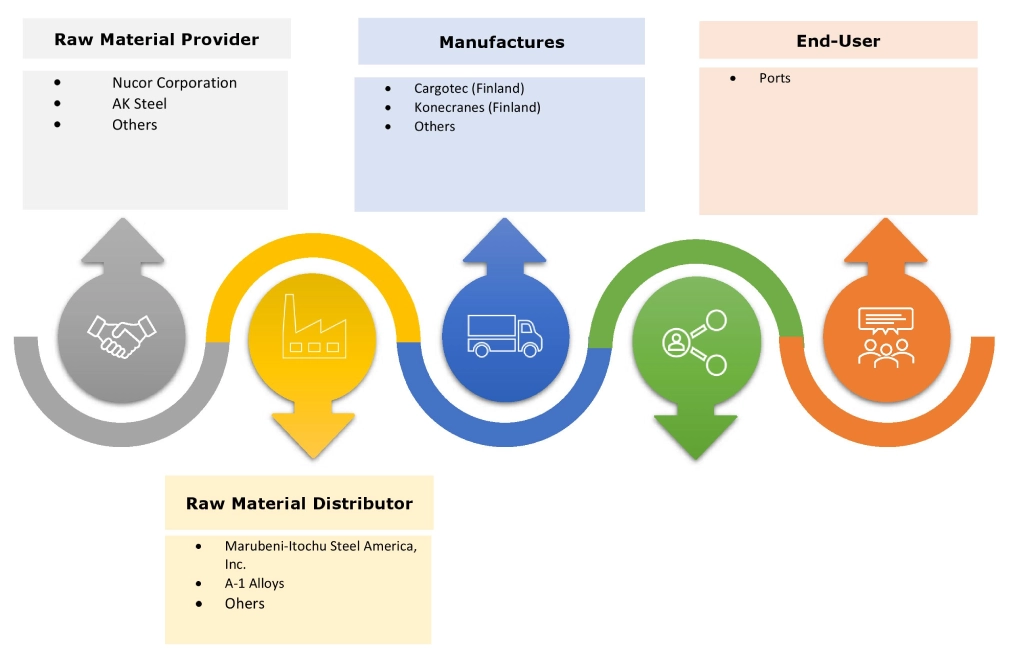
The ship-to-shore cranes market is highly competitive with major players providing products to the national and international markets. Key players are adopting several strategies in research and development (R&D), product innovation, and end-user launches to hold a strong position in the global ship-to-shore cranes market. Key players in the ship-to-shore cranes industry include -
- PACECO CORP. (US)
- Anupam Industries (India)
- Konecranes (Finland)
- Hyundai Samho Heavy Industries (South Korea)
- Henan Weihua Heavy Machinery Co., LTD. (China)
- Liebherr (Switzerland)
- Shanghai Zhenhua Heavy Industries Co., Ltd. (ZPMC) (China)
- Sany Group (China)
- Doosan Corporation (South Korea)
- Cargotec (Finland)
Recent Industry Developments :
Partnerships and Collaborations:
- In October 2024, Liebherr Container Cranes delivered ship to shore container crane to PSA Penn Terminals in Philadelphia.
- In June 2023, Liebherr Container Cranes delivered semi-automated ship to shore container crane to Patrick Terminals, a port operator located in Australia.
Ship-To-Shore Cranes Market Report Insights :
| Report Attributes | Report Details |
| Study Timeline | 2019-2032 |
| Market Size in 2032 | USD 4,032.56 Million |
| CAGR (2025-2032) | 4.5% |
| By Product Type |
|
| By Lifting Capacity |
|
| By Power Supply |
|
| By Outreach |
|
| By Region |
|
| Key Players |
|
| North America | U.S. Canada Mexico |
| Europe | U.K. Germany France Spain Italy Russia Benelux Rest of Europe |
| APAC | China South Korea Japan India Australia ASEAN Rest of Asia-Pacific |
| Middle East and Africa | GCC Turkey South Africa Rest of MEA |
| LATAM | Brazil Argentina Chile Rest of LATAM |
| Report Coverage |
|
Key Questions Answered in the Report
How big is the ship-to-shore cranes market? −
The ship-to-shore cranes market was valued at USD 2,889.29 Million in 2024 and is projected to grow to USD 4,032.56 Million by 2032.
Which is the fastest-growing region in the ship-to-shore cranes market? +
Asia-Pacific is the region experiencing the most rapid growth in the ship-to-shore cranes market.
What specific segmentation details are covered in the ship-to-shore cranes report? +
The ship-to-shore cranes report includes specific segmentation details for product type, lifting capacity, power supply, outreach, and region.
Who are the major players in the ship-to-shore cranes market? +
The key participants in the ship-to-shore cranes market are PACECO CORP. (US), Anupam Industries (India), Liebherr (Switzerland), Shanghai Zhenhua Heavy Industries Co., Ltd. (ZPMC) (China), Sany Group (China), Doosan Corporation (South Korea), Cargotec (Finland), Konecranes (Finland), Hyundai Samho Heavy Industries (South Korea), and Henan Weihua Heavy Machinery Co., LTD. (China).
Overview
Reputation & Certifications


Our Services
- Market Intelligence & Forecasting
- Custom Research Solutions
- Market Entry Strategy
- Competitive Intelligence
- Customer Insights
- Industry Innovation Analysis
- Investment Advisory