Jump to Content
1,2-Pentanediol Market - Size, Share, Industry Trends, and Forecasts (2025-2032)
1,2-Pentanediol Market Size:
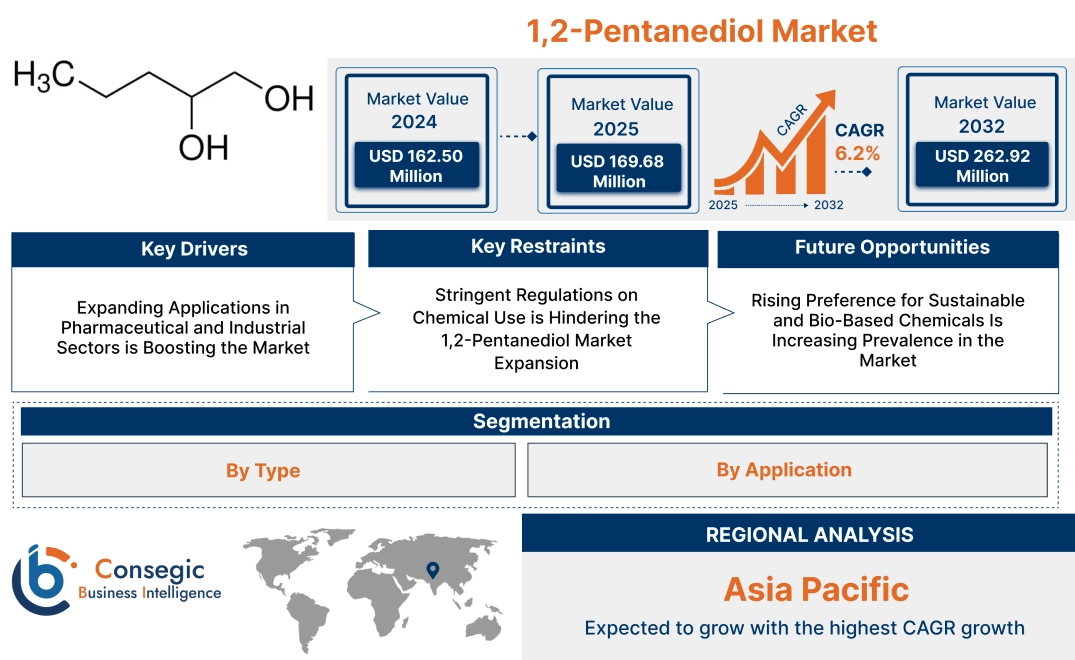
1,2-Pentanediol Market size is estimated to reach over USD 262.92 Million by 2032 from a value of USD 162.50 Million in 2024 and is projected to grow by USD 169.68 Million in 2025, growing at a CAGR of 6.2% from 2025 to 2032.
1,2-Pentanediol Market Scope & Overview:
The 1,2-pentanediol focuses on the production and application of 1,2-pentanediol, a versatile diol compound used in various industries for its moisturizing, antimicrobial, and solvent properties. This chemical is widely utilized in cosmetics, personal care products, pharmaceuticals, and industrial applications due to its excellent compatibility and stability. Key characteristics of this compound include its hygroscopic nature, low volatility, and effective preservation qualities, making it an essential ingredient in formulations. The benefits include enhanced product performance, extended shelf life, and improved skin hydration in personal care applications. Applications span skincare products, pharmaceutical formulations, and industrial solvents. End-users include cosmetics manufacturers, pharmaceutical companies, and chemical industries, driven by increasing growth for high-performance ingredients, advancements in formulation technologies, and growing consumer preference for multifunctional additives.
1,2-Pentanediol Market Dynamics - (DRO) :
Key Drivers:
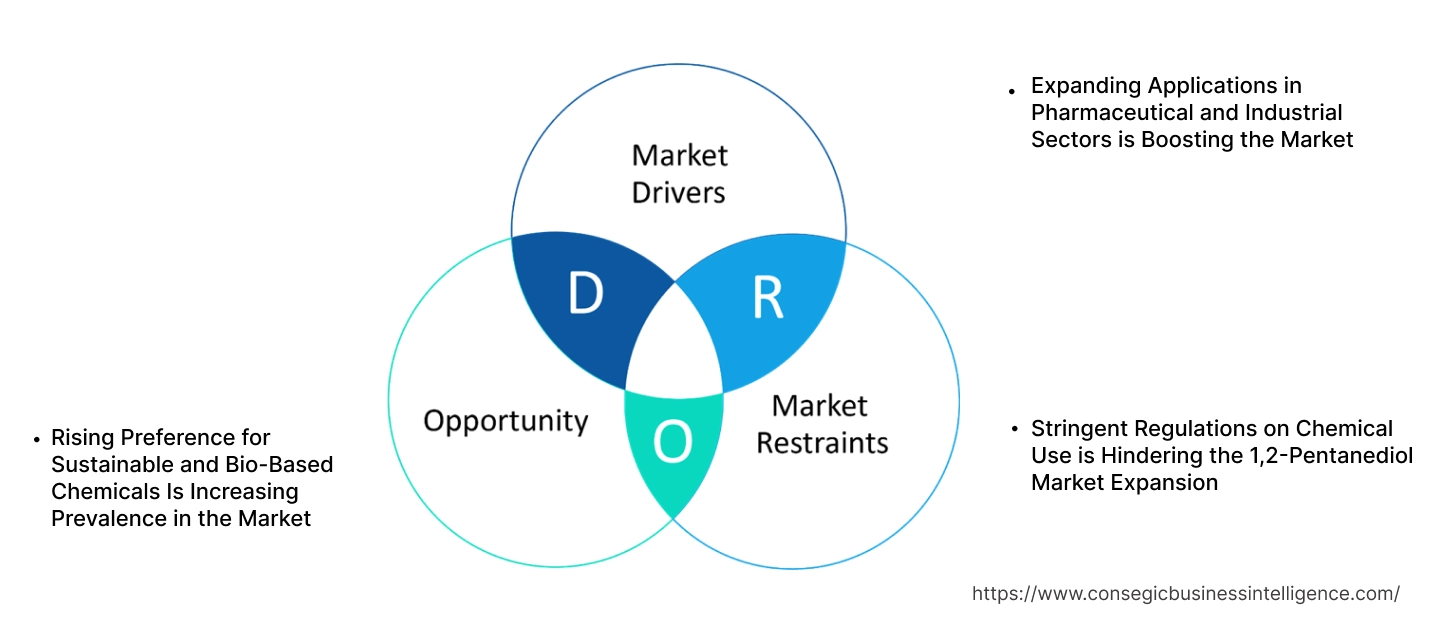
Expanding Applications in Pharmaceutical and Industrial Sectors is Boosting the Market
The versatility of 1,2-pentanediol is driving its increasing application in both pharmaceutical and industrial sectors. In the pharmaceutical industry, it is widely used as a solubilizer, stabilizer, and antimicrobial agent in drug formulations, ensuring consistent efficacy and extended shelf life of medications. Its compatibility with various active ingredients and its ability to enhance formulation stability make it a valuable component in oral, topical, and injectable drug products. With advancements in drug delivery systems, it finds additional uses in innovative pharmaceutical formulations.
In industrial sectors, this compound is gaining prominence as a critical ingredient in coatings, adhesives, and resins. Its superior properties, such as high chemical resistance, excellent durability, and ability to improve product performance, make it essential for high-demand applications like automotive coatings and construction adhesives. Trends indicate that as industries continue to explore multifunctional materials, the role of 1,2-pentanediol in ensuring product reliability and performance will strengthen further, opening avenues for technological advancements.
Key Restraints:
Stringent Regulations on Chemical Use is Hindering the 1,2-Pentanediol Market Expansion
The regulatory landscape surrounding the use of chemicals, particularly in cosmetics, pharmaceuticals, and food-related applications, presents significant challenges for the market. Stringent safety standards and compliance requirements for raw materials and finished products increase the complexity of manufacturing processes. For example, in the personal care and pharmaceutical sectors, regulations demand rigorous testing to ensure that ingredients are non-toxic, hypoallergenic, and environmentally safe. These requirements can lead to increased costs and prolonged approval timelines for manufacturers, creating barriers for market entry and expansion.
Furthermore, the lack of harmonized global standards adds an additional layer of difficulty, as manufacturers must navigate varying regulatory frameworks in different regions. This inconsistency not only complicates the supply chain but also limits the market penetration of 1,2-pentanediol in regions with restrictive regulations. Addressing these regulatory hurdles through innovation and enhanced compliance strategies is essential to enable broader applications of 1,2-pentanediol across industries.
Future Opportunities :
Rising Preference for Sustainable and Bio-Based Chemicals Is Increasing Prevalence in the Market
The global shift toward sustainability is creating significant opportunities for the adoption of bio-based 1,2-pentanediol. With increasing awareness of environmental concerns and the rising focus on clean-label products, industries such as personal care, cosmetics, and pharmaceuticals are actively seeking eco-friendly alternatives to synthetic chemicals. Bio-based 1,2-pentanediol, derived from renewable resources, aligns with these sustainability goals while maintaining the functional benefits of its synthetic counterpart.
The trends toward bio-based materials is particularly pronounced in personal care and cosmetics, where consumers are drawn to formulations labeled as "natural" or "eco-friendly." Analysis shows that incorporating bio-derived ingredients enhances brand value and consumer trust, making bio-based 1,2-pentanediol a key innovation in product development. Furthermore, advancements in green chemistry and biotechnology are enabling more efficient production processes for bio-based 1,2-pentanediol, reducing environmental impact and operational costs. As industries increasingly prioritize sustainability, the adoption of bio-based chemicals is poised to become a cornerstone of 1,2-pentanediol market trends.
1,2-Pentanediol Market Segmental Analysis :
By Type:
Based on type, the market is segmented into cosmetic grade and industrial grade.
The cosmetic grade segment accounted for the largest revenue in 1,2-pentanediol market share in 2024.
- Cosmetic grade 1,2-pentanediol is extensively used as a multifunctional ingredient in personal care and cosmetic formulations.
- It serves as a humectant, emollient, and preservative booster, enhancing product performance and extending shelf life.
- The rising trends of adopting safer and eco-friendly ingredients in skincare and haircare products has driven growth for cosmetic-grade 1,2-pentanediol.
- Additionally, its compatibility with various formulations, including creams, lotions, and serums, has made it a preferred choice for cosmetic manufacturers.
- Cosmetic grade dominates the market due to its versatility and increasing the 1,2-pentanediol market opportunities in the personal care and cosmetics industries.
The industrial grade segment is anticipated to register the fastest CAGR during the forecast period.
- Industrial-grade 1,2-pentanediol is widely used in applications such as pesticide intermediates, solvents, and chemical synthesis.
- The trends of adopting efficient and sustainable chemical intermediates in industrial processes has boosted the industrial-grade 1,2-pentanediol market demand.
- Furthermore, its use as a stabilizer and co-solvent in agrochemicals highlights its growing relevance in the agricultural sector.
- Industrial grade analysis depicts it is expected to grow rapidly, driven by its diverse applications in agrochemicals and industrial processes.
By Application:
Based on application, the market is segmented into pesticide intermediates, cosmetics, and others.
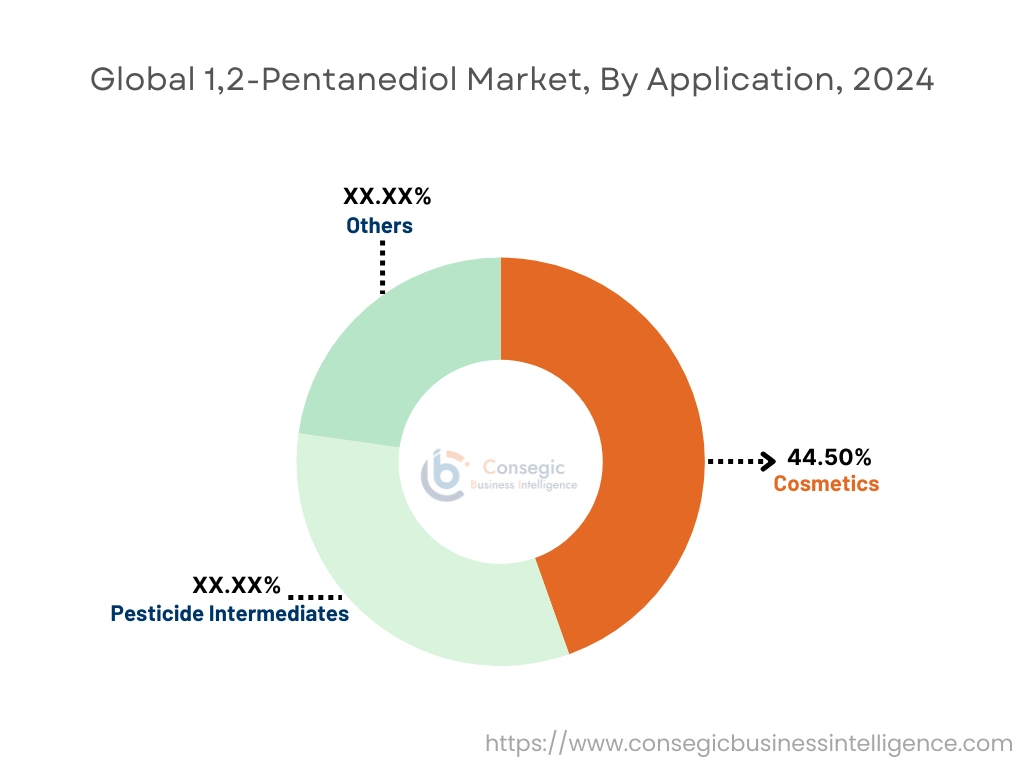
The cosmetics segment accounted for the largest revenue share of 44.50% in 2024.
- 1,2-pentanediol is a critical ingredient in cosmetic formulations, valued for its ability to enhance hydration and improve the texture of skincare products.
- The trends of adopting multifunctional and bio-based ingredients in personal care products has propelled1,2-pentanediol market growth in this segment.
- Moreover, the increasing focus on clean beauty formulations, which prioritize effective and non-toxic ingredients, supports the widespread use of 1,2-pentanediol in cosmetics.
- Therefore, the cosmetics segmental analysis leads the market, driven by its extensive use in personal care products and the trends toward clean beauty formulations.
The pesticide intermediates segment is anticipated to register the fastest CAGR during the forecast period.
- 1,2-pentanediol serves as an essential intermediate in pesticide formulations, ensuring stability and efficacy.
- The increasing demand for high-performance agrochemicals to address rising food production challenges has driven this segment.
- Additionally, the adopting of sustainable and eco-friendly pesticide formulations has further boosted the use of 1,2-pentanediol market trends in this application.
- Thus, the analysis pesticide intermediates are expected to grow rapidly, supported by the rising 1,2-pentanediol market growth for sustainable agrochemical solutions and advancements in agricultural practices.
Regional Analysis:
The regions covered are North America, Europe, Asia Pacific, the Middle East and Africa, and Latin America.
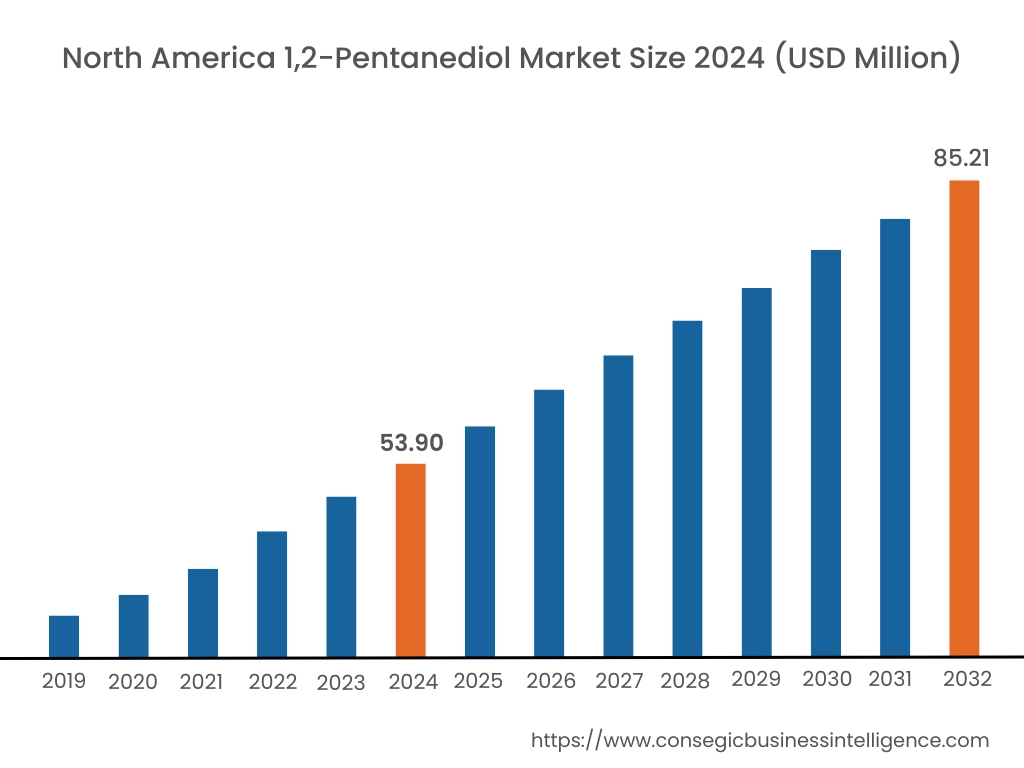
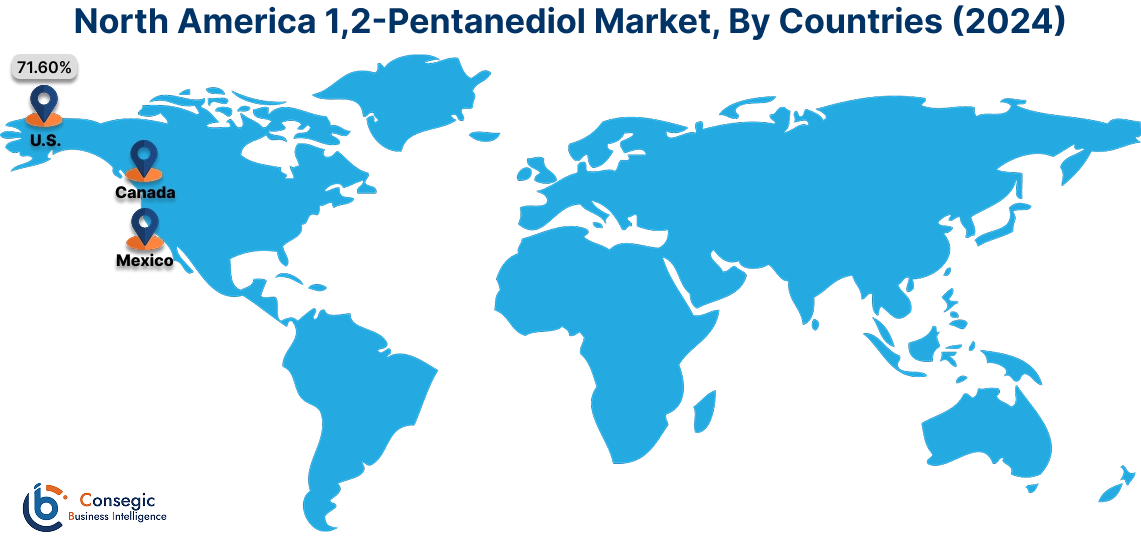
In 2024, North America was valued at USD 53.90 Million and is expected to reach USD 85.21 Million in 2032. In North America, the U.S. accounted for the highest share of 71.60% during the base year of 2024. North America holds a substantial share in the market due to its wide application in personal care, cosmetics, and industrial sectors. The U.S. dominates the region, with increasing utilization of 1,2-pentanediol as a multifunctional ingredient in skincare and haircare products, particularly as a moisturizer and preservative booster. The growing demand for high-performance industrial solvents in coatings and adhesives further drives the 1,2-pentanediol market opportunities. Canada contributes to the market with its expanding personal care sector and rising adoption of sustainable and bio-based ingredients. However, stringent regulatory requirements for cosmetic formulations may pose challenges for market participants.
In Asia Pacific, the market is experiencing the fastest growth with a CAGR of 6.6% over the forecast period. The 1,2-pentanediol market analysis shows that the growth is fueled by rapid industrialization and the expanding personal care and pharmaceutical sectors in China, Japan, and India. China leads the market with its large-scale production capabilities and increasing use of 1,2-pentanediol in cosmetics and industrial applications, including coatings and adhesives. Japan’s demand is driven by its focus on high-quality skincare and haircare products, leveraging the diol’s preservative and moisturizing properties. India’s growing pharmaceutical and personal care industries further support market expansion. However, limited awareness about advanced chemical applications and environmental concerns may hinder market penetration in some areas.
Europe is a key market for 1,2-pentanediol, supported by its application in the pharmaceutical, personal care, and industrial sectors. Countries like Germany, France, and the UK are major contributors. Germany’s advanced chemical industry and focus on high-quality ingredients drive the adoption of 1,2-pentanediol in cosmetic and industrial applications. France emphasizes the use of this diol in premium skincare products due to its antimicrobial properties. The UK is seeing increased incorporation of 1,2-pentanediol market share in pharmaceutical formulations as an excipient. However, the region faces challenges from strict environmental regulations and high production costs.
According to the 1,2-pentanediol market analysis, Middle East & Africa region is experiencing steady growth, primarily driven by increasing adoption in personal care products and industrial applications. The UAE and Saudi Arabia are key markets, leveraging 1,2-pentanediol in cosmetic formulations and as a solvent in coatings for construction projects. In Africa, South Africa’s expanding personal care sector and rising 1,2-pentanediol market demand for antimicrobial ingredients in skincare support market development. However, challenges such as limited local production capabilities and dependency on imports can impact market growth in the region.
Latin America is an emerging market for 1,2-pentanediol, with Brazil and Mexico leading the region. Brazil’s thriving personal care and cosmetics industries utilize 1,2-pentanediol in moisturizing and antimicrobial formulations, catering to the region's growing consumer preference for high-quality skincare products. Mexico’s industrial and pharmaceutical sectors also adopt the diol for use in coatings, adhesives, and pharmaceutical preparations. However, economic instability and limited access to advanced production technologies in some parts of the region may restrict 1,2-pentanediol market expansion.
Top Key Players & Market Share Insights:
The 1,2-pentanediol market is highly competitive with major players providing products and services to the national and international markets. Key players are adopting several strategies in research and development (R&D), product innovation, and end-user launches to hold a strong position in the global 1,2-pentanediol market. Key players in the 1,2-pentanediol industry include -
- BASF SE (Germany)
- Evonik Industries AG (Germany)
- Jiangsu First Chemical Co., Ltd. (China)
- Symrise AG (Germany)
- Santa Cruz Biotechnology, Inc. (United States)
- LANXESS AG (Germany)
- Minasolve SAS (France)
- Kokyu Alcohol Kogyo Co., Ltd. (Japan)
- Realsun Chemical Co., Ltd. (China)
- Jujing Chemical Co., Ltd. (China)
1,2-Pentanediol Market Report Insights:
| Report Attributes | Report Details |
| Study Timeline | 2019-2032 |
| Market Size in 2032 | USD 262.92 Million |
| CAGR (2025-2032) | 6.2% |
| By Type |
|
| By Application |
|
| By Region |
|
| Key Players |
|
| North America | U.S. Canada Mexico |
| Europe | U.K. Germany France Spain Italy Russia Benelux Rest of Europe |
| APAC | China South Korea Japan India Australia ASEAN Rest of Asia-Pacific |
| Middle East and Africa | GCC Turkey South Africa Rest of MEA |
| LATAM | Brazil Argentina Chile Rest of LATAM |
| Report Coverage |
|
Key Questions Answered in the Report
What is the expected size of the 1,2-Pentanediol market by 2032? −
The market is projected to reach over USD 262.92 Million by 2032.
What drives the demand for 1,2-Pentanediol? +
Key drivers include its versatile applications in cosmetics, pharmaceuticals, and industrial products, along with its moisturizing, antimicrobial, and solvent properties.
What are the major restraints in the market? +
Stringent regulations on chemical use in end-user applications and inconsistent global standards present challenges to market growth.
What opportunities exist in the 1,2-Pentanediol market? +
The rising preference for sustainable and bio-based chemicals offers significant growth potential, particularly in cosmetics and personal care industries.
Which application segment is growing the fastest? +
The pesticide intermediates segment is anticipated to grow at the fastest rate due to increasing demand for high-performance agrochemical solutions.
Overview
Reputation & Certifications


Our Services
- Market Intelligence & Forecasting
- Custom Research Solutions
- Market Entry Strategy
- Competitive Intelligence
- Customer Insights
- Industry Innovation Analysis
- Investment Advisory