Jump to Content
Diketene Derivatives Market - Size, Share, Industry Trends, and Forecasts (2025-2032)
Diketene Derivatives Market Size:
The diketene derivatives market size is growing with a CAGR of 6.7% during the forecast period (2025-2032), and the market is projected to be valued at USD 889.05 Million by 2032 from USD 530.05 Million in 2024. Additionally, the market value for the 2025 is attributes to USD 563.81 Million.
Diketene Derivatives Market Scope & Overview:
Diketene is a colorless liquid organic compound, with the molecular formula C4H4O2, formed by the spontaneous dimerization of ketene. Diketene derivatives are a class of organic compounds characterized by the presence of a four-membered ring with two ketone groups. There are different types of derivatives based on their chemical composition such as esters, acetic anhydride, amides, arylides, and others. These derivatives are used in various application such as active pharmaceutical ingredient (API), agrochemicals, adhesives & sealants, food packaging, and others. Due to high reactivity and versatility, these derivatives are used in various end-use industries such as pharmaceutical, agriculture, paints & coatings, food & beverage, and others. The growing need for drug production is boosting API synthesis, further driving the market growth.
How is AI Impacting the Diketene Derivatives Market?
AI is revolutionizing the diketene derivatives market by optimizing the entire chemical lifecycle. Advanced AI and machine learning algorithms are being utilized to accelerate research and development, predict optimal reaction pathways for new derivatives, and streamline drug discovery processes where these compounds are key intermediates. In manufacturing, AI enables real-time process monitoring and control, leading to higher yields, reduced waste, and improved product purity. Furthermore, AI-driven predictive analytics help manage complex supply chains, allowing companies to respond proactively to market fluctuations. This integration of AI is enhancing efficiency and innovation across the market.

Diketene Derivatives Market Dynamics - (DRO):
Key Drivers:
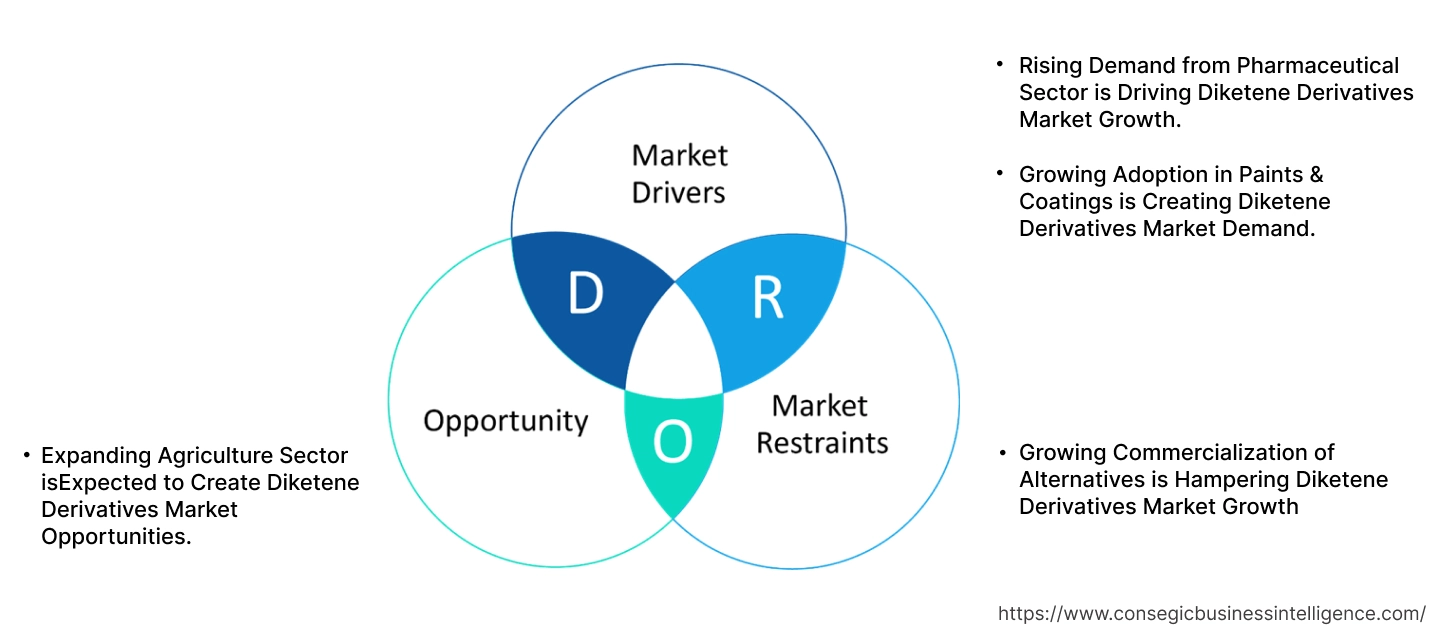
Rising Demand from Pharmaceutical Sector is Driving Diketene Derivatives Market Growth.
In the pharmaceutical sector, diketene derivatives are used in the targeted delivery mechanisms to minimize side effects and enhancing therapeutic outcomes. These derivatives are also used in the production of drugs to enhance their shelf life and stability. Drug production is rising due to increase in chronic diseases and biotechnological advancements further driving the market.
- According to European Federation of Pharmaceutical Industries and Associations, the drug production in Europe is increased by 4.9% in 2022 as compared to the year 2021. This growing drug production is driving the use of diketene derivatives to improve shelf-life of the drugs.
Hence, rising demand in the pharmaceutical sector is leading to diketene derivatives market expansion.
Growing Adoption in Paints & Coatings is Creating Diketene Derivatives Market Demand.
Diketene derivatives are used as co-promoters in paints and coatings to enhance their durability and performance. These derivatives also help to improve adhesion and environmental resistance in coatings. Additionally, the companies are investing in production of paints and coatings to meet adoption in the infrastructure development which is creating requirements for these co-promoters in their production.
- In 2024, PPG invested USD 300 million to expand the manufacturing facilities for paints and coatings in North America. This growing manufacturing of paints and coatings is driving the use of diketene derivatives to enhance their durability.
Hence, growing adoption in paints & coatings is creating diketene derivatives market demand.
Key Restraints:
Growing Commercialization of Alternatives is Hampering Diketene Derivatives Market Growth
The commercialization of bio-based chemicals is growing. They provide similar functions to those of diketene derivatives. Agrochemicals involving pesticides and insecticides which are derived from botanical extracts such as neem oil and weeds are preferred in agriculture due to their low cost and greater availability. Furthermore, in dyes and pigments, natural sources such as indigo, madder, and turmeric are used instead of diketene derivatives to reduce environmental pollution. Additionally, bio-based acetoin is used in the API synthesis, further reducing reliance on these derivatives. Hence, the growing commercialization of alternatives is limiting market expansion due to low cost, sustainability and greater availability.
Future Opportunities:
Expanding Agriculture Sector is Expected to Create Diketene Derivatives Market Opportunities.
In the agriculture, diketene derivatives are used in soil conditioning agents to improve soil structure and nutrient retention. It is also used in crop protection films to protect plants from excessive sunlight and pests. Further, the agriculture sector is expanding supported by growing crop production and government initiatives.
- According to Ministry of Agriculture & Farmers Welfare, Government of India invested USD 6.07 Billion in 2024 to expand agriculture sector in India. This will create market opportunities due to the adoption of these derivatives in soil conditioning agents and crop protection films.
Hence, expanding the agriculture sector is expected to create diketene derivatives market opportunities.
Diketene Derivatives Market Segmental Analysis :
By Derivative Type:
Based on derivative type, the market is categorized into esters, acetic anhydride, amides, arylides, and others.
Trends in Derivative Type:
- According to diketene derivatives market trends, esters are extensively used in the production of pesticides to improve their nutrient-releasing ability.
- Adoption of amides is growing in paper manufacturing to improve their printability as per market trends.
The esters segment accounted for the largest market share in the year 2024.
- Diketene esters are type of derivatives which are derived from reaction of diketene with alcohols and include ethyl acetoacetate, methyl acetoacetate, and others.
- These esters are used as an intermediate in the production of coatings and dyes to improve their chemical stability and efficacy. It is also used in the production the pesticides to improve their nutrient-releasing ability.
- Furthermore, global food demand and disease outbreaks on crops are growing. To cater this, manufacturers are widely adopting diketene esters in pesticides to improve their nutrient release in the crops.
- Hence, as the production of pesticides is growing, the need for diketene esters is also growing, in turn driving the segment.
The amides segment is expected to grow at the fastest CAGR over the forecast period.
- Diketene amides are type of derivatives which are derived from diketene where the reactive ketone group forms an amide linkage with ammonia or amines.
- These amides are used in the manufacturing of dyes due to their high reactivity and stability. They are also utilized in paper manufacturing to improve printability and water resistance.
- Furthermore, the global need for printing, e-commerce, and better-quality paper packaging is growing. To cater this, companies are expanding their paper manufacturing facilities.
- For instance, in 2025, MEPCO has started paper manufacturing facility in Saudi Arabia which will double the total production capacity from 425,000 tonnes to 875,000 tonnes annually. This growing paper manufacturing will drive the use of diketene amides to improve water resistance in the paper manufacturing.
- Hence, as paper production is growing, the need for diketene amides is also increasing. This will drive the segment for the forecasted years.
By Application:
Based on application, the market is categorized into active pharmaceutical ingredient, agrochemicals, adhesives & sealants, food packaging, and others.
Trends in Application:
- As per diketene derivatives market trends, these derivatives are widely used in the development of new APIs.
- Adoption of diketene derivatives is growing in agrochemicals, particularly in fertilizers as per market trends.
The active pharmaceutical ingredient segment accounted for the largest market share in the year 2024.
- The active pharmaceutical ingredient synthesis refers to the process of creating the biologically active compound responsible for a drug's therapeutic effect.
- Diketene derivatives are used as intermediates in the synthesis of various APIs, including antibiotics and anti-inflammatory drugs.
- Their chemical structure allows for easy modification, which is essential for the development of new APIs.
- Furthermore, lifestyle diseases and demand for biologics is growing. To cater this, drug manufactures are widely adopting diketene derivatives in the API synthesis for easy modification.
- Thus, as the development of new APIs is growing, the need for diketene derivatives is also growing. This is in turn driving the segment.
The agrochemicals segment is expected to grow at the fastest CAGR over the forecast period.
- Agrochemicals are chemicals used in agriculture, encompassing fertilizers, pesticides and others to enhance crop yields and protect against pests and diseases.
- The diketene derivatives are used as building blocks in the production of these agrochemicals.
- These derivatives play important role in the production of fertilizers to prevent volatilization and nutrient loss.
- Furthermore, soil nutrient depletion is growing globally. To cater this, government authorities are investing in fertilizer production.
- For instance, in 2024, S. Department of Agriculture announced USD 116 Million investment for domestic fertilizer production. This is facilitating fertilizers production in turn driving the use of these derivatives to prevent nutrient loss in fertilizers.
- Hence, as production of fertilizers is growing the need for diketene derivatives to prevent volatilization is also growing. This will drive the segment for the forecasted years.
By End-Use:
Based on end-use, the market is categorized into pharmaceutical, agriculture, paints & coatings, food & beverage, and others.
Trends in End-Use:
- As per trends, diketene derivatives are widely used in the pharmaceutical sector to enable cost-effective and high yield drug molecules.
- Use of diketene derivatives is growing in agriculture sector in in the biodegradable seed coatings as per trends.
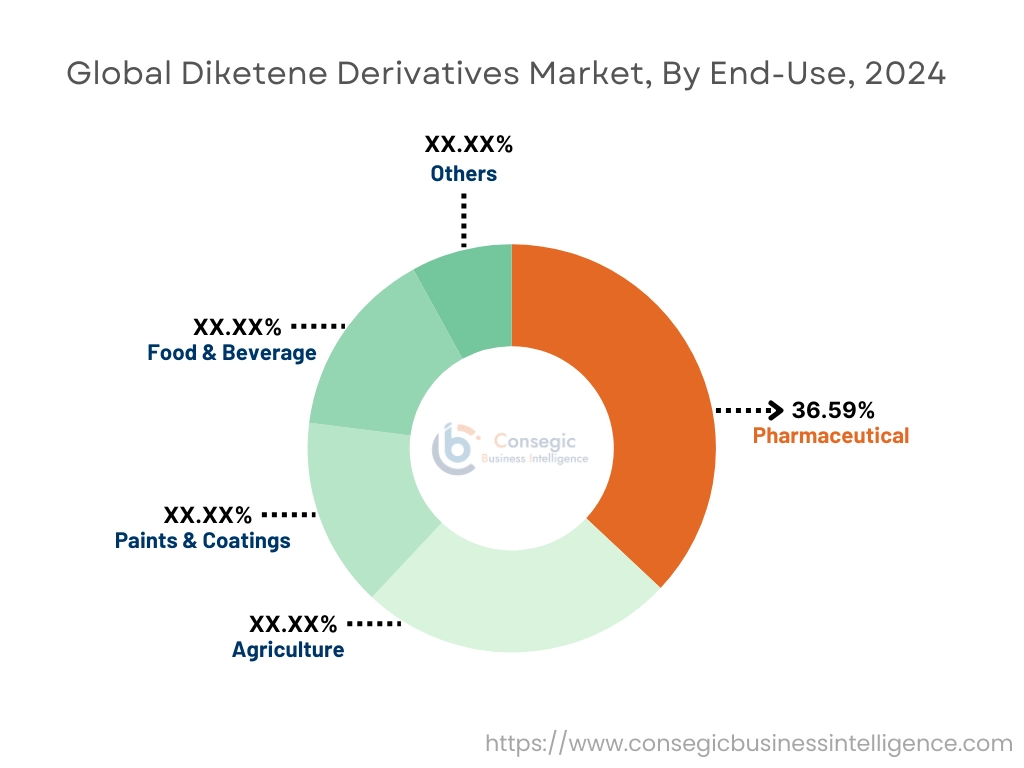
The pharmaceutical segment accounted for the largest market share of 36.59% in the year 2024.
- In the pharmaceutical, diketene derivatives are used in the synthesis of intermediates for antibiotics, analgesics, and cardiovascular drugs.
- They enable cost-effective and high yield synthesis of complex molecules, making pharmaceutical manufacturing more efficient.
- These derivatives are also used in the coating agents in tablets and capsules to improve bioavailability.
- Furthermore, the cost regarding development of new drugs is increasing. To cater this, pharmaceutical companies are increasingly incorporating these derivatives in drug development to enhance cost efficiency.
- Hence, as implementation of stringent rules is growing the need for diketene derivatives for cost effective drug development is also growing. This is in turn driving the segment.
The agriculture segment is expected to grow at the fastest CAGR over the forecast period.
- In agriculture, diketene derivatives are used in plant growth regulators to enhance crop yield and stress resistance.
- These derivatives are also utilized in biodegradable seed coatings, improving nutrient absorption and reducing environmental impact.
- The focus towards sustainable agriculture is growing along with increasing preference for improved seed germination. To cater this, companies are investing in the biodegradable seed coatings.
- For instance, in 2023, Lucent Bio invested USD 3.6 Million in production and commercialization of biodegradable seed coatings. This is leading to more production of biodegradable seed coatings in turn driving the use of these derivatives to improve nutrient absorption.
- Hence, as production of biodegradable seed coatings is growing, demand for diketene derivatives is also growing. This will drive the segment for the forecasted years.
Regional Analysis:
The regional segment includes North America, Europe, Asia Pacific, Middle East & Africa, and Latin America.
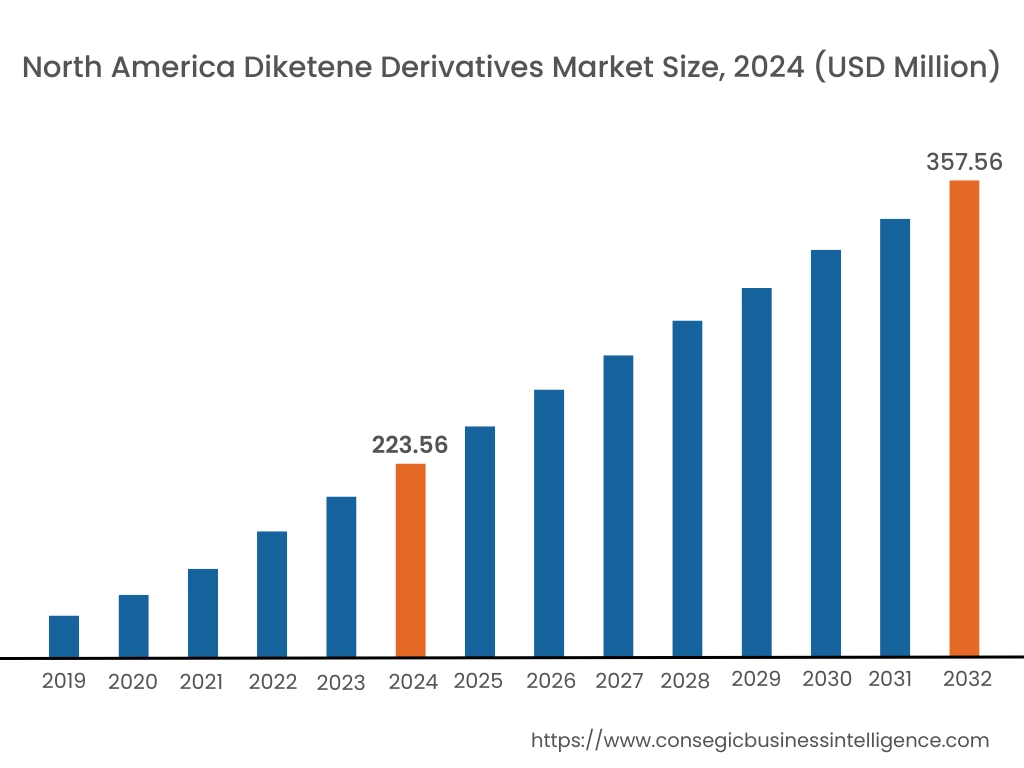
In 2024, North America accounted for the highest market share at 42.18% and was valued at USD 223.56 Million and is expected to reach USD 357.56 Million in 2032. In North America, United States accounted for the highest diketene derivatives market share of 71.55% during the base year of 2024. As per analysis, North America region holds a dominant position in the market due to expanding pharmaceutical industry. Diketene derivatives are widely used in barbiturates and benzodiazepines. They are also used as stabilizing agents in the API synthesis to reduce drug degradation. Additionally, companies are in the region are investing in API synthesis for chronic diseases further driving the market.
- In 2024, Eli Lilly and Company, invested USD 9 Billion to boost API synthesis for obesity and diabetes at the newest Indiana site in United States. This growing API synthesis is driving the use of diketene derivatives to reduce drug degradation.

Therefore, due to the above-mentioned factors, North America region is dominating in the market as per analysis.
Asia Pacific is expected to witness the fastest CAGR of 7.8% over the forecast period of 2025-2032. According to diketene derivatives market analysis, the Asia Pacific region is growing rapidly driven by advancements in technology. Advancements in micro reactors and chemical synthesis have enhanced the production, cost-effectiveness and sustainability of these derivatives. Countries such as China, India, Japan, and South Korea are major contributors in the market due to adoption of digital monitoring and robotics-driven manufacturing processes. These are increasing operational efficiency and ensuring cost effective derivatives for various applications such as food packaging and adhesives. Hence, diketene derivatives market share of Asia Pacific is expected to emerge rapidly through technological advancements as per analysis.
According to diketene derivatives market analysis, Europe region is growing considerably in the market driven by expanding agriculture sector. Diketene derivatives are used in the controlled-released fertilizers to enhance crop yields. These derivatives are also used in the drought-resistance farming, enhancing soil moisture retention. Additionally, the investment in the agriculture sector is also growing further boosting the market growth across the region.
The Middle East & Africa region is experiencing moderate demand in the market driven by the food & beverage sector. Diketene esters are used in the production of flavors, fragrances, and preservatives in food and beverage. They are also used in the packed food products to enhance the moisture resistance and reducing microbial contamination. The consumers in the region are widely consuming packed food products further driving the market growth in the region.
As per market analysis, Latin America is experiencing steady growth in the market driven by the expanding paints & coatings sector. In this sector, diketene derivatives are used in the manufacturing of low volatile and non-toxic paints & dyes. They are also used in the production of organic pigments such as diarylide. In countries such as Brazil and Argentina consumer preference for organic pigments is growing. This is leading to diketene derivatives market expansion across the region.
Top Key Players & Market Share Insights:
The diketene derivatives industry is highly competitive with major players providing products to the national and international markets. Key players are adopting several strategies in research and development (R&D) and product innovation to hold a strong position in the global diketene derivatives market. Key players in the diketene derivatives industry include-
- Lonza (Switzerland)
- Eastman Chemical Company (United States)
- Daicel (Japan)
- Toronto Research Chemicals (Canada)
- Evonik Industries (Germany)
- Mitsuboshi Chemical Co.,Ltd (Japan)
- Teijin Shoji Co. Ltd. (Japan)
- Celanese (United States)
- FMC (United States)
- UCC (United States)
Recent Industry Developments :
Production Facility:
- In 2024, Jubilant Ingrevia started new production facility for diketene derivatives in India. This facility adds additional capacity of 2,000 tons per annum to produce high-value derivatives.
Diketene Derivatives Market Report Insights:
| Report Attributes | Report Details |
| Study Timeline | 2019-2032 |
| Market Size in 2032 | USD 889.05 Million |
| CAGR (2025-2032) | 6.7% |
| By Derivative Type |
|
| By Application |
|
| By End-Use |
|
| By Region |
|
| Key Players |
|
| North America | U.S. Canada Mexico |
| Europe | U.K. Germany France Spain Italy Russia Benelux Rest of Europe |
| APAC | China South Korea Japan India Australia ASEAN Rest of Asia-Pacific |
| Middle East and Africa | GCC Turkey South Africa Rest of MEA |
| LATAM | Brazil Argentina Chile Rest of LATAM |
| Report Coverage |
|
Key Questions Answered in the Report
How big is the diketene derivatives market? −
In 2024, the diketene derivatives market is USD 530.05 Million.
Which is the fastest-growing region in the diketene derivatives market? +
Asia-Pacific is the fastest-growing region in the diketene derivatives market.
What specific segmentation details are covered in the diketene derivatives market? +
Derivative Type, Application, and End-Use are covered in the diketene derivatives market.
Who are the major players in the diketene derivatives market? +
Lonza (Switzerland), Eastman Chemical Company (United States), and Mitsuboshi Chemical Co.,Ltd (Japan) are some of the major players in the market.
Overview
Reputation & Certifications


Our Services
- Market Intelligence & Forecasting
- Custom Research Solutions
- Market Entry Strategy
- Competitive Intelligence
- Customer Insights
- Industry Innovation Analysis
- Investment Advisory