Jump to Content
Agarose Resin Market Size & Industry Share - Growth Trends & Forecasts (2026 - 2034)
Agarose Resin Market Size:
Agarose Resin Market size is estimated to reach over 5,632.16 (US$M) by 2034 from a value of 2,658.33 (US$M) in 2025 and is projected to grow by 2,889.61 (US$M) in 2026, growing at a CAGR of 8.7% from 2026 to 2034, according to a recent report from Consegic Business Intelligence.
Agarose Resin Market Scope & Overview:
Agarose resin is a high-performance chromatography resin derived from agar, a natural polysaccharide. It is widely used for biomolecular separation and purification. This resin is known for its high porosity, thermal stability, and excellent flow properties, making it suitable for a range of laboratory and industrial applications. It exhibits low non-specific binding, ensuring high-purity separation of biomolecules. The key benefits of agarose resin include its ability to provide precise molecular separation, reduce impurities, and ensure scalability from laboratory research to industrial production. Its high mechanical strength supports efficient handling and reproducibility during repeated use. Agarose resin offers flexibility through its compatibility with various chromatography techniques, including ion exchange, affinity, and size exclusion chromatography.
Applications of agarose resin are prominent in the purification of antibodies, proteins, enzymes, and nucleic acids. It is extensively utilized in biopharmaceutical production, academic research, and diagnostics. The end-use industries for agarose resin include pharmaceuticals, biotechnology, healthcare, and research laboratories. Its role in advancing drug development and molecular biology underscores its importance across diverse scientific and industrial domains.

Agarose Resin Market Dynamics - (DRO) :
Key Drivers:
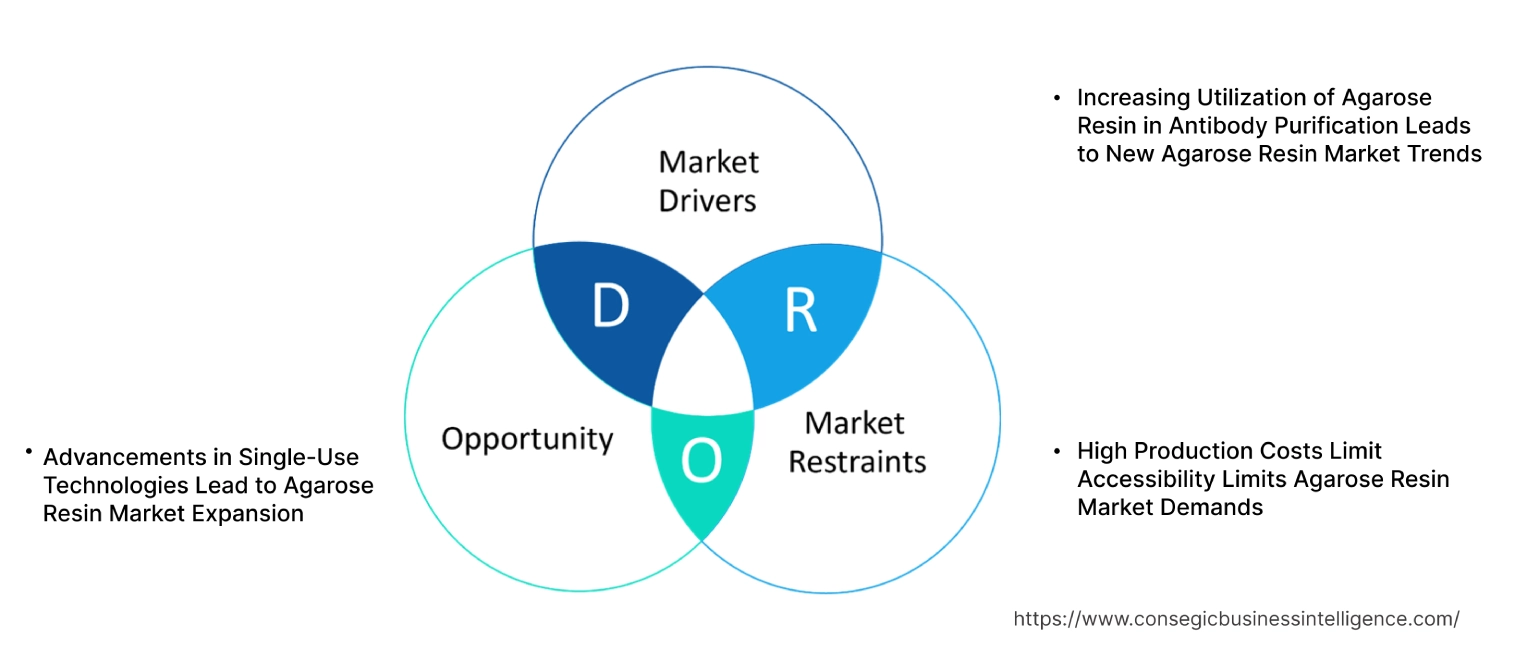
Increasing Utilization of Agarose Resin in Antibody Purification Leads to New Agarose Resin Market Trends
Agarose resin plays a pivotal role in antibody purification, a process integral to biopharmaceutical production. The resin's porous structure allows high-efficiency separation of antibodies from complex mixtures, ensuring purity. In therapeutic monoclonal antibody manufacturing, agarose resin-based chromatographic columns are employed to achieve specific binding and elution. This capability enhances product quality and streamlines production workflows. For example, agarose resin is widely used in Protein A chromatography, a key method for antibody purification in the pharmaceutical industry.
Thus, the growing trend for monoclonal antibody therapies is fueling the adoption of agarose resin in biopharmaceutical purification processes.
Key Restraints :
High Production Costs Limit Accessibility Limits Agarose Resin Market Demands
The production of agarose resin involves advanced manufacturing processes and stringent quality controls, leading to high costs. These costs increase the overall expenses for its end users, particularly in small-scale laboratories and emerging biotechnology companies. The need for specialized equipment and trained personnel further adds to operational expenses. For instance, agarose resin used in affinity chromatography is often priced significantly higher than alternative separation media, creating financial challenges for smaller institutions.This cost barrier restricts the widespread adoption of agarose resin, particularly in cost-sensitive markets, thereby limiting its market expansion.
Future Opportunities :
Advancements in Single-Use Technologies Lead to Agarose Resin Market Expansion
The adoption of single-use technologies in biopharmaceutical manufacturing is poised to create new agarose resin market growth avenues. Single-use systems, designed for one-time use, simplify downstream processes by reducing cross-contamination risks and enhancing operational efficiency. Agarose resin integrated into single-use columns and cartridges could cater to the rising trend for disposable bioprocessing solutions. For instance, single-use chromatography systems incorporating agarose resin are being developed to meet the scalability needs of biologics manufacturing.
Hence, the evolution of single-use technologies in bioprocessing presents a significant agarose resin market opportunity for expanding the application of agarose resin in the coming years.
Agarose Resin Market Segmental Analysis :
By Product Type:
Based on type, the agarose resin market is segmented into crosslinked agarose resin and non-crosslinked agarose resin.
The crosslinked agarose resin sector accounted for the largest revenue in agarose resin market share in 2023.
- Crosslinked agarose resin is widely used due to its high mechanical strength and superior flow properties, making it suitable for high-performance chromatography applications.
- This resin is often employed in processes requiring high pressure, such as industrial-scale protein purification.
- Its robust structure enhances reusability, which contributes to its extensive adoption in industries focused on cost-effective production.
- Crosslinked resins are compatible with various ligands, increasing their versatility across affinity and ion exchange chromatography techniques.
- Its higher chemical resistance ensures better performance during repeated exposure to harsh cleaning agents.
- The growing focus on monoclonal antibody production further supports the trend for crosslinked agarose resin.
- Its efficiency in downstream processing applications, particularly in biopharmaceutical manufacturing, strengthens its market dominance.
- Therefore, according to agarose resin market analysis, the increasing trend for robust and reusable resins for industrial purification processes underscores the dominant position of crosslinked agarose resin in the market.
The non-crosslinked agarose resin sector is anticipated to register the fastest CAGR during the forecast period.
- Non-crosslinked agarose resin is primarily used in applications where low-pressure operations and high-resolution separations are required, such as academic research and diagnostic labs.
- This resin offers high purity and is easy to prepare, making it an attractive choice for applications requiring low-cost solutions.
- Its ability to deliver efficient separation in low-pressure systems contributes to its rising trend in small-scale research and diagnostic applications.
- Non-crosslinked resins offer excellent gel formation properties, making them suitable for specific electrophoresis and analytical applications.
- The increasing focus on developing cost-efficient research tools and diagnostic reagents supports its rapid growth.
- Its high porosity enables better molecular sieving, enhancing performance in analytical studies.
- Thus, according to agarose resin market analysis, the growing adoption of non-crosslinked agarose resin for cost-sensitive and precision-based research activities highlights its rapid growth potential.
By Application:
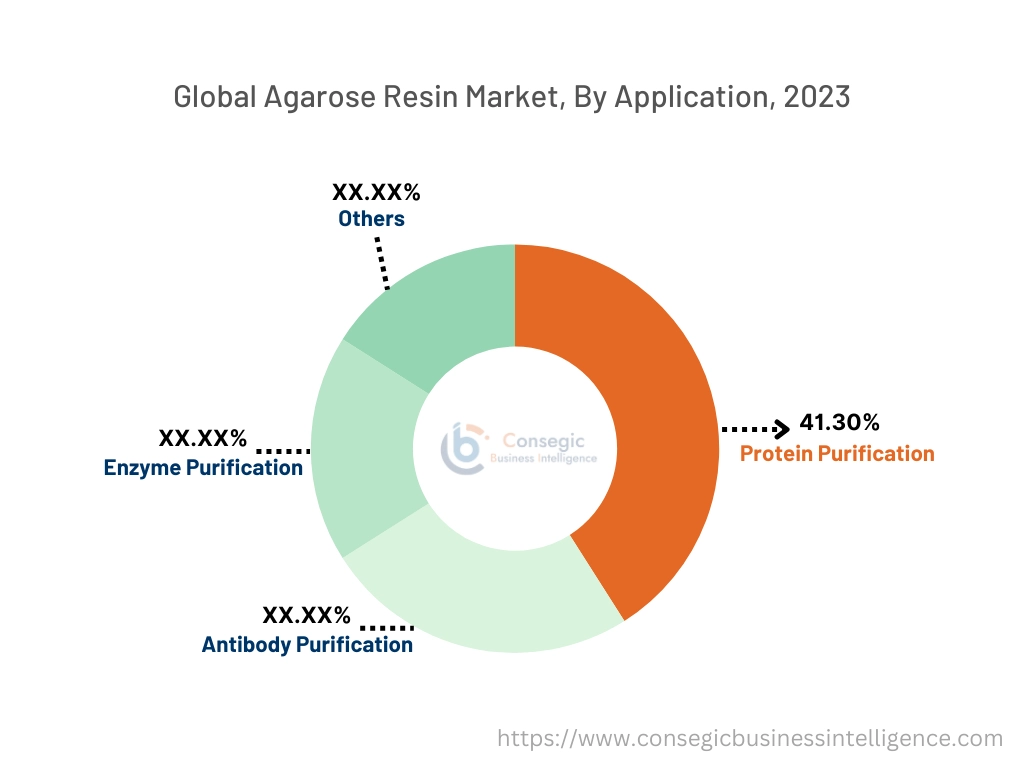
Based on application, the market is segmented into protein purification, antibody purification, enzyme purification, and others.
The protein purification sector accounted for the largest revenue share of 41.30% in the agarose resin market share in 2023.
- Agarose resin plays a critical role in isolating proteins in high purity, which is essential for biopharmaceutical production and proteomics research.
- Its compatibility with multiple chromatography techniques, such as affinity and size exclusion, ensures efficient separation processes.
- Increasing pharmaceutical R&D activities, along with growing biopharmaceutical production, boost the trend for protein purification resins.
- Protein purification using agarose resin ensures enhanced recovery rates, maintaining the structural and functional integrity of target proteins.
- The growing application of purified proteins in enzyme production, diagnostics, and drug development strengthens the market for this segment.
- Agarose resin's high specificity in binding target proteins reduces impurities, contributing to its preferred status among researchers.
- Innovations in protein purification workflows, such as automated systems, are increasing the adoption of agarose resin.
- Therefore, according to market analysis, the extensive use of agarose resin in biopharmaceutical protein purification processes cements its leading market position.
The antibody purification sector is anticipated to register the fastest CAGR during the forecast period.
- Agarose resin's specific affinity properties make it ideal for the efficient isolation of antibodies.
- The rising prevalence of chronic diseases and the growing trend for monoclonal antibody-based therapies drive its adoption in this segment.
- Increasing biopharmaceutical investments and the development of advanced antibody production techniques further propel agarose resin market growth.
- Antibody purification using agarose resin ensures high purity, making it crucial for therapeutic and diagnostic applications.
- Technological advancements in ligand functionalization are enhancing the specificity of agarose resins for antibody isolation.
- The surge in personalized medicine and immunotherapy research supports the increasing demand for antibody purification solutions.
- Its ability to process large volumes efficiently positions agarose resin as a key component in commercial antibody manufacturing.
- Thus, according to market analysis, the rapid development in antibody therapeutics supports the strong growth potential of agarose resin in antibody purification applications.
By Technique:
Based on technique, the market is segmented into affinity chromatography, ion exchange chromatography, size exclusion chromatography, and others.
The affinity chromatography sector accounted for the largest revenue share in 2023.
- Affinity chromatography using agarose resin ensures high selectivity, making it a preferred method for purifying antibodies, proteins, and enzymes.
- The resin's functionalization with specific ligands enhances its ability to isolate target molecules with high efficiency.
- Its adoption in therapeutic protein production and diagnostic kit manufacturing supports its leading position.
- Affinity techniques ensure minimal contamination, making them vital for sensitive pharmaceutical applications.
- Agarose resin-based affinity chromatography offers scalability from laboratory to industrial applications.
- Increasing demand for precision purification solutions in biopharmaceuticals boosts the adoption of affinity techniques.
- Advanced ligand chemistries are enhancing the binding efficiency of agarose resin for affinity chromatography.
- Therefore, according to market analysis, the precision and efficiency of affinity chromatography in critical purification processes drive its leading market share.
The ion exchange chromatography sector is anticipated to register the fastest CAGR during the forecast period.
- Agarose resin's versatility in ion exchange chromatography enables the separation of molecules based on charge properties.
- Increasing demand for biopharmaceuticals and vaccines drives the adoption of this technique.
- Its ability to purify biomolecules in high yields supports its growing application in pharmaceutical and research sectors.
- Ion exchange chromatography is essential for achieving high-resolution separation of proteins and nucleic acids.
- The growing prevalence of high-value therapeutic proteins emphasizes the importance of this technique.
- Agarose resin's compatibility with diverse buffer systems enhances its applicability in complex purification workflows.
- Thus, according to market analysis, the expanding demand for high-yield biomolecule purification highlights the growth potential of ion exchange chromatography.
By End-User:
Based on end-users, the market is segmented into pharmaceutical and biotechnology companies, academic and research institutes, diagnostic laboratories, and others.
The pharmaceutical and biotechnology companies sector accounted for the largest revenue share in 2023.
- These companies extensively utilize agarose resin for large-scale purification processes in biopharmaceutical production.
- Increasing investments in the development of biologics and biosimilars enhance the demand for agarose resin in industrial applications.
- The scalability and efficiency of agarose resin align with the stringent requirements of pharmaceutical manufacturing processes.
- Agarose resin's robust performance in downstream processing ensures cost efficiency and high product yields.
- Its integration into automated bioprocessing systems facilitates faster and more reliable purification workflows.
- The growing prevalence of chronic and rare diseases necessitates the development of advanced biopharmaceuticals, boosting demand.
- The ability to support large-scale production of therapeutics solidifies its application in pharmaceutical companies.
- Therefore, according to market analysis, the dominance of pharmaceutical and biotechnology companies is driven by their significant role in biopharmaceutical production and related applications.
The academic and research institutes sector is anticipated to register the fastest CAGR during the forecast period.
- These institutions rely on agarose resin for various research applications, including protein studies, gene expression analysis, and enzyme purification.
- Growing investments in life sciences research and the increasing number of academic collaborations with industry players support demand.
- The resin's cost-effectiveness and adaptability for small-scale, precision-based research applications contribute to its growth in this sector.
- Agarose resin is integral to molecular biology research, including electrophoresis and nucleic acid purification.
- The growing focus on developing innovative diagnostic tools and therapeutic strategies strengthens the role of research institutes.
- Expansion of university-based bioprocessing facilities fosters demand for agarose resin.
- Thus, according to market analysis, the expanding focus on life sciences research and academic collaborations highlights the growth trajectory of this sector.
Regional Analysis:
The regional segment includes North America, Europe, Asia Pacific, the Middle East and Africa, and Latin America.
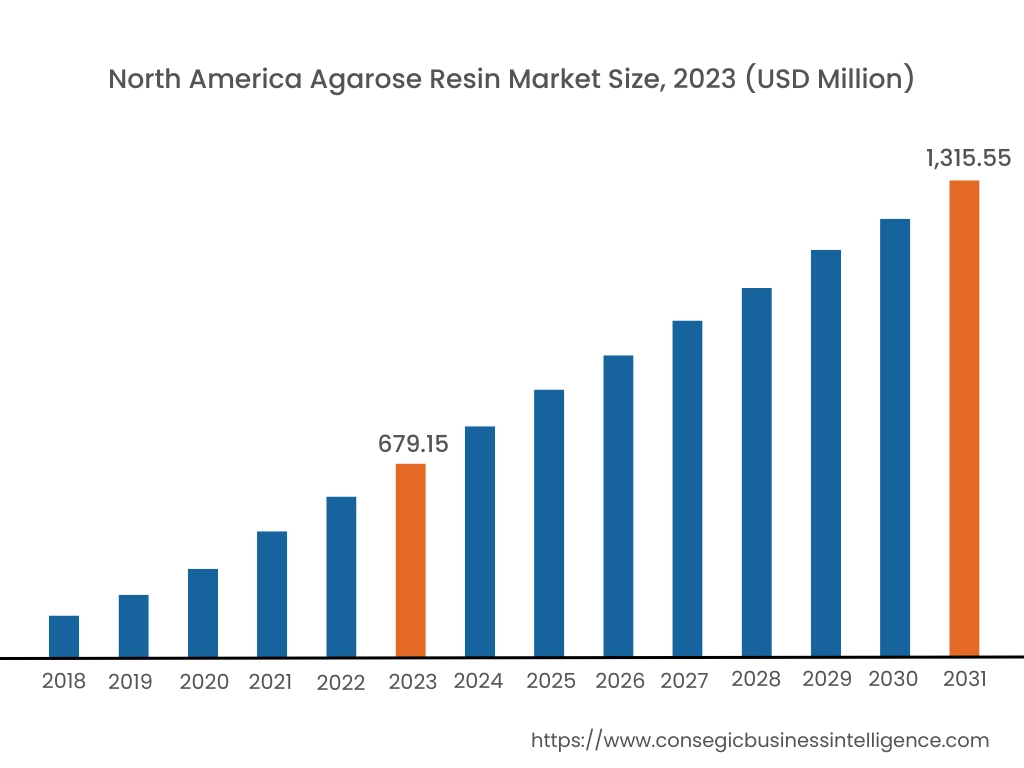
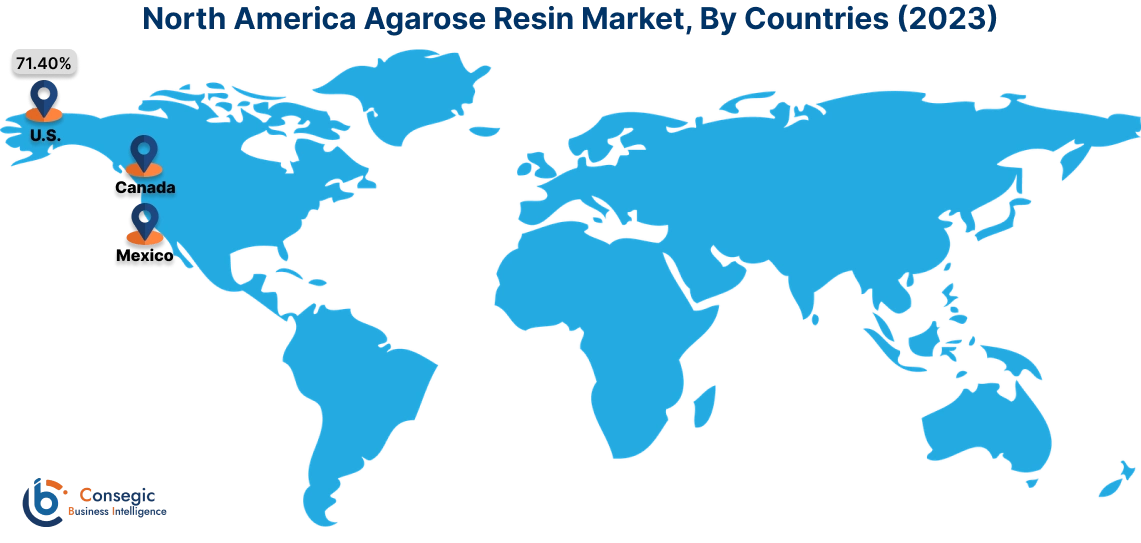
In 2023, North was valued at USD 678.15 Million and is expected to reach USD 1,315.55 Million in 2031. In North America, the U.S. accounted for the highest share of 71.40% during the base year of 2023. North America holds a significant share of the agarose resin market, supported by the robust biotechnology and pharmaceutical industries in the United States and Canada. The demand for agarose resin is increasing in applications related to molecular biology, diagnostics, and protein purification. The region's well-established research and development infrastructure, along with growing investments in biotechnology, fuel market expansion. Additionally, the rising adoption of agarose-based products for analytical and purification processes contributes to the overall market demand.
In Asia Pacific, the market is experiencing the fastest growth with a CAGR of 9.0% over the forecast period. Asia-Pacific is a rapidly expanding region in the agarose resin market. Countries like China, Japan, and India are major contributors to the demand for agarose resin due to the increasing adoption of biotechnology and pharmaceutical research. The region’s large population and expanding healthcare industry create significant opportunities for agarose resin applications, particularly in diagnostic and therapeutic research. Furthermore, cost-effective production and the availability of raw materials in Asia-Pacific support the region's competitive edge in the global market.
Europe’s agarose resin market is well-established, particularly in Germany, France, and the UK. The region benefits from a strong focus on advanced healthcare research and biotechnology. The increasing use of agarose resin in chromatography and molecular diagnostics drives market demand. Furthermore, the growing preference for bio-based and natural products aligns with the sustainability trends in the region, making agarose resin a favorable option in various applications. Stringent regulatory standards also ensure high-quality production and use of agarose resin in research and diagnostics.
The agarose resin market in the Middle East and Africa is in a developing phase. Despite limited production capabilities, there is growing interest in the use of agarose resin for pharmaceutical and diagnostic applications. Countries like the UAE and Saudi Arabia are investing in the biotechnology and healthcare sectors, which presents opportunities for agarose resin usage. However, challenges such as limited infrastructure and high import dependency affect the region's market performance. Still, ongoing investments in biotechnology research provide potential for market development.
Latin America’s agarose resin market is gradually expanding, with Brazil and Mexico leading the demand in the region. The biotechnology and pharmaceutical industries in these countries are experiencing growth, boosting the need for high-quality agarose resin for research and diagnostic purposes. However, the region faces challenges related to the availability of raw materials and the high cost of production. Despite these challenges, increasing healthcare investments and the rise of research activities in the region create opportunities for agarose resin market expansion.
Top Key Players and Market Share Insights:
The Global Agarose Resin Market is highly competitive with major players providing FWA to the national and international markets. Key players are adopting several strategies in research and development (R&D), product innovation, and end-user launches to hold a strong position in the Global Agarose Resin Market. Key players in the Agarose Resin industry include-
- GE Healthcare Life Sciences (United States)
- Lonza Group (Switzerland)
- Agilent Technologies Inc. (United States)
- Hapten Sciences (United States)
- Protiviti Inc. (United States)
- Merck KGaA (Germany)
- Bio-Rad Laboratories, Inc. (United States)
- Sigma-Aldrich (Merck) (United States)
- Cytiva (United States)
- Thermo Fisher Scientific Inc. (United States)
Agarose Resin Market Report Insights :
| Report Attributes | Report Details |
| Study Timeline | 2021-2034 |
| Market Size in 2034 | USD 5,632.16 Million |
| CAGR (2026-2034) | 8.70% |
| Base Year | 2025 |
| By Type |
|
| By Application |
|
| By Technique |
|
| By End-User |
|
| By Region |
|
| Key Players |
|
| North America | U.S. Canada Mexico |
| Europe | U.K. Germany France Spain Italy Russia Benelux Rest of Europe |
| APAC | China South Korea Japan India Australia ASEAN Rest of Asia-Pacific |
| Middle East and Africa | GCC Turkey South Africa Rest of MEA |
| LATAM | Brazil Argentina Chile Rest of LATAM |
| Report Coverage |
|
Key Questions Answered in the Report
How big is the Agarose Resin Market? −
In 2023, the Agarose Resin Market was USD 2,245.30 million.
What will be the potential market valuation for the Agarose Resin Market by 2031? +
In 2031, the market size of the Agarose Resin Market is expected to reach USD 4,385.17 million.
What are the segments covered in the Agarose Resin Market report? +
The type, application, technique, and end-user are the segments covered in this report.
Who are the major players in the Agarose Resin Market? +
GE Healthcare Life Sciences (United States), Lonza Group (Switzerland), Merck KGaA (Germany), Bio-Rad Laboratories, Inc. (United States), Sigma-Aldrich (Merck) (United States), Cytiva (United States), Thermo Fisher Scientific Inc. (United States), Agilent Technologies Inc. (United States), Hapten Sciences (United States), Protiviti Inc. (United States) are the major players in the Agarose Resin market.
Overview
Reputation & Certifications


Our Services
- Market Intelligence & Forecasting
- Custom Research Solutions
- Market Entry Strategy
- Competitive Intelligence
- Customer Insights
- Industry Innovation Analysis
- Investment Advisory