Jump to Content
Sebacic Acid Market - Size, Share, Industry Trends, and Forecasts (2025-2032)
Sebacic Acid Market Size:
The Sebacic Acid Market size is growing with a CAGR of 4.7% during the forecast period (2025-2032), and the market is projected to be valued at USD 377.24 Million by 2032 from USD 262.83 Million in 2024. Additionally, the market value for 2025 is attributed to USD 274.16 Million.
Sebacic Acid Market Scope & Overview:
Sebacic acid (SA) is a naturally derived dicarboxylic acid from castor oil. It shows applications across polymers, lubricants, and cosmetics amongst others. It plays a role in bio-nylon as a monomer and biodegradable polyester that highlights its growing significance in sustainable materials. Furthermore, its inclusion in potential conversion to pro-inflammatory 5-oxo-ODE indicates its biological factors, particularly in dermatological applications. Additionally, it is also utilized in plasticizers, corrosion inhibitors, and as a buffering agent in cosmetics. These variety of applications help sebacic acid to offer a competitive and naturally sourced solution across diverse sectors. The ongoing development of new applications, such as temperature-responsive hydrogels for drug delivery, are expected to support market revenue over the forecast period.
How is AI Impacting the Sebacic Acids Market?
AI is influencing the sebacic acid market by enhancing efficiency and sustainability in its production. While the primary driver remains the demand for bio-based and eco-friendly products, AI can contribute to optimizing the complex chemical processes involved. For instance, AI algorithms can analyze real-time data from sensors in a manufacturing plant to predict and adjust optimal reaction parameters, such as temperature and pressure, for the alkali fusion of castor oil. This can lead to higher yields and reduced energy consumption. Furthermore, AI's role in predictive maintenance helps minimize equipment downtime, ensuring a more consistent supply of sebacic acid for industries like cosmetics, lubricants, and biopolymers.

Sebacic Acid Market Dynamics - (DRO):
Key Drivers:
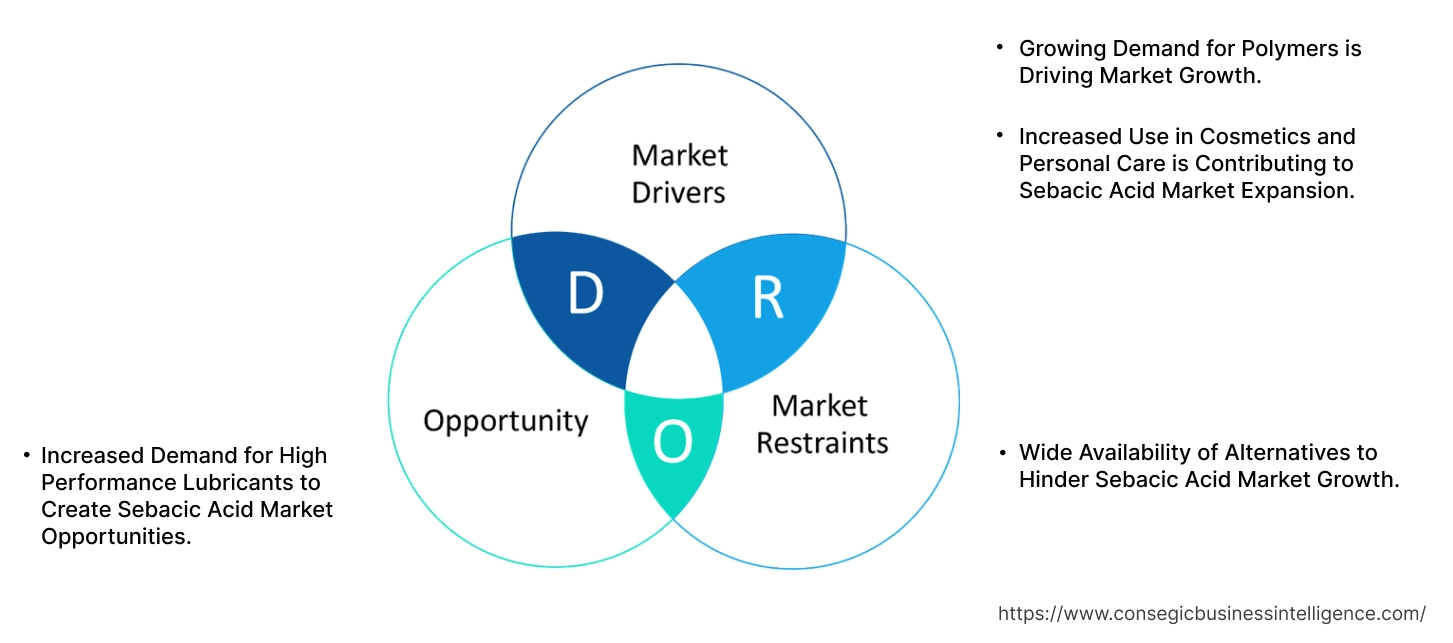
Growing Demand for Polymers is Driving Market Growth.
Sebacic acid acts as an important component in the synthesis of critical polymers. A few of these critical polymers are nylon 610. It is a material preferred due to the characteristics it offers such as tensile strength, flexibility, and resilience against environmental stressors. Hence, the growing requirement for polymers is contributing to the market revenue.
- For instance, according to Plexconnect, the polymer and plastic industry of India experienced a high increase in demand, roughly around 14% in 2024 compared to the previous year, showcasing the highest increase across the globe
Additionally, sebacic acid is also utilized in the development of biodegradable polyester. These polyesters are experiencing an increase in requirement due to the focus of key end use sectors such as packaging and agriculture, amongst others. Thus, due to the above-mentioned factors, the market for SA in polymers is growing.
Increased Use in Cosmetics and Personal Care is Contributing to Sebacic Acid Market Expansion.
Sebacic acid showcases emollient and conditioning capabilities that are utilized in a wide variety of skincare and haircare formulations. It leads to softness and improved texture of these formulations. The growing consumer preference towards natural and sustainable beauty products is contributing to the requirement for sebacic acid as it is of bio-based origin. This attracts the consumers that are focusing on environmentally friendly products.
- For instance, according to Cosmetic Europe’s Market Performance Report, the cosmetic market in France grew by 6.3% in 2023 compared to the previous year.
Thus, as per the market analysis, the increasing use of cosmetic and personal care products is in turn contributing to the sebacic acid market expansion.
Key Restraints:
Wide Availability of Alternatives to Hinder Sebacic Acid Market Growth.
The wide availability of alternative components such as adipic and azelaic acids are contributing to the hinderance in market. These alternatives offer similar functionalities in polymer and plasticizer synthesis at more or less expensive price points. Furthermore, the preference for petroleum-based chemicals and polymers, are contributing to the list of alternatives that poise as a hurdle for the widespread adoption of bio-based sebacic acid. In the plasticizers and lubricants sector, a wide range of synthetic alternatives are creating an increase in competition leading to preference of manufacturers focusing on price sensitivity components. Hence, as per analysis, the aforementioned factors are restraining sebacic acid market growth.
Future Opportunities:
Increased Demand for High Performance Lubricants to Create Sebacic Acid Market Opportunities.
Increased Demand for High Performance Lubricants to Create Sebacic Acid Market Opportunities.
The increase in need for high-performance lubricants in several end use sectors such as automotive, heavy machinery and others are in turn supporting market for sebacic acid in upcoming years. Lubricants where sebacic acid is utilized showcase capability to experience conditions that are of extreme environment. Furthermore, the increase in sales of electric vehicles in terms of units where specialized lubrication is required is further supporting market growth over the forecast period.
- For instance, according toLUBE, original equipment manufacturers (OEMs) are preferring the inclusion of high performance lubricants and fluid across a diverse range of sectors in 2024.
Thus, as per analysis, the market for sebacic acid is expecting lucrative opportunities over the forecast period.
Sebacic Acid Market Segmental Analysis :
By Form:
Based on Form, the market is categorized into flakes, powder and others.
Trends in Form:
- Powdered SA is preferred for applications such as polymer formulations, cosmetic applications amongst others.
- The inclination towards flakes is increasing due to their ease of handling, which are primarily used for lubricant formulations.
The powder segment accounted for the largest sebacic acid market share in 2024.
- Powder form holds prominence due to its utilization in several applications such as specialized polymer, cosmetics amongst others. These applications require a uniform distribution and high surface area, hence the higher preference towards the powder form.
- Additionally, the convenience in developing these formulations with the help of powder form is increasing the adoption rate of this form amongst the manufacturers operating in the market.
- For instance, according to the S. Census Bureau, United States imported more than 6 million kg of sebacic acid in 2024 when compared to 2023. The majority of the imported sebacic acid was in the powder form.
- As per the analysis, based on the above-mentioned factors, the powder segment dominates the sebacic acid market demand.
The flake segment is expected to grow at the fastest CAGR over the forecast period.
- The flakes form offers higher diminished dust generation and handling capabilities due to which they are being referred in manufacturing of lubricant, amongst others.
- The melting capabilities of flakes in polymer processing along with their ease of incorporation into lubricant blends are contributing to creation of market revenue over the forecast period.
- Furthermore, the growing focus on workplace safety and environmental regulations have led to an increase in preference for the flakes as they showcase a reduction in a variety of risks, such as respiratory hazards and environmental contamination, amongst others.
- As per analysis, owing to the aforementioned factors and trends, the flakes segment is expected to be lucrative over the forecast period in the overall sebacic acid market trend.
By Application:
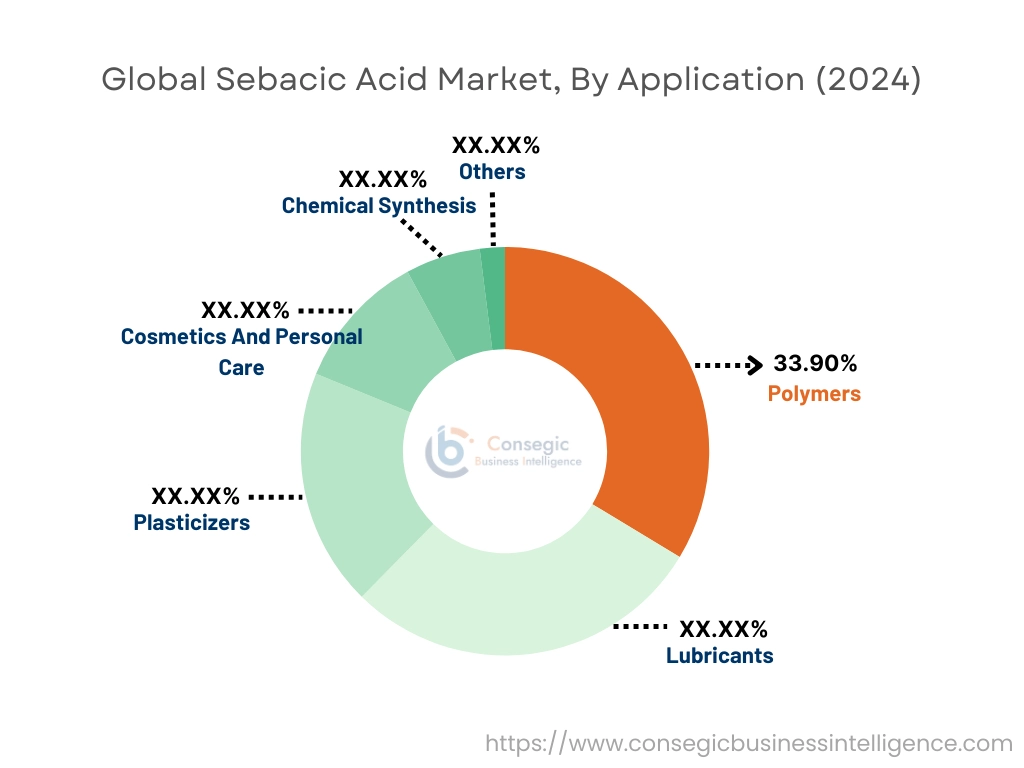
The application segment is categorized into polymers, lubricants, plasticizers, cosmetics and personal care, chemical synthesis, and others.
Trends in the Application
- The preference for bio-based nylons such as nylon 610 and biodegradable polyesters is pushing for the adoption of SA as a key monomer.
- Emphasis on bio-based lubricants is positively impacting the adoption of the compound.
The polymer segment accounted for the largest sebacic acid market share of 33.90% in 2024.
- The polymer segment is dominating as it is the primary consumer due to the increase in production of nylon 610 and the expanding field of biodegradable polyesters.
- Additionally, the importance of sebacic acid in manufacturing materials where high tensile strength, chemical resistance is mandatory is rising, in turn contributing to the segmental growth.
- Furthermore, this acid caters to diverse industrial applications ranging from automotive components to packaging solutions.
- For instance, in 2024, Department of Defense (DOD) stated that Lacamas would receive around USD 86.2 Million for the production of seven chemicals including SA for the generation of polymers, lubricants amongst others for military applications.
- Thus, as per the sebacic acid market analysis, the polymer segment is dominating the sebacic acid market trends.
The cosmetics and personal care segment is expected to grow at the fastest CAGR over the forecast period.
- The market for utilization of sebacic acid in cosmetic and personal care products is majorly driven by the growing preference of consumers towards natural, sustainable, and safe personal care products. These preferences align with the SA as it is of natural origin, making it a suitable option.
- The compound’s emollient and conditioning properties make it a versatile ingredient for its inclusion across a wide range of skincare and haircare formulations.
- Additionally, the expansion of e-commerce platforms has increased consumer access to cosmetics and personal care products in turn contributing to the segmental growth.
- As a result, owing to the aforementioned factors and trends, the cosmetic and personal care segment is expected to be lucrative over the forecast period in the overall sebacic acid market demand.
Regional Analysis:
The regional segment includes North America, Europe, Asia Pacific, the Middle East and Africa, and Latin America.
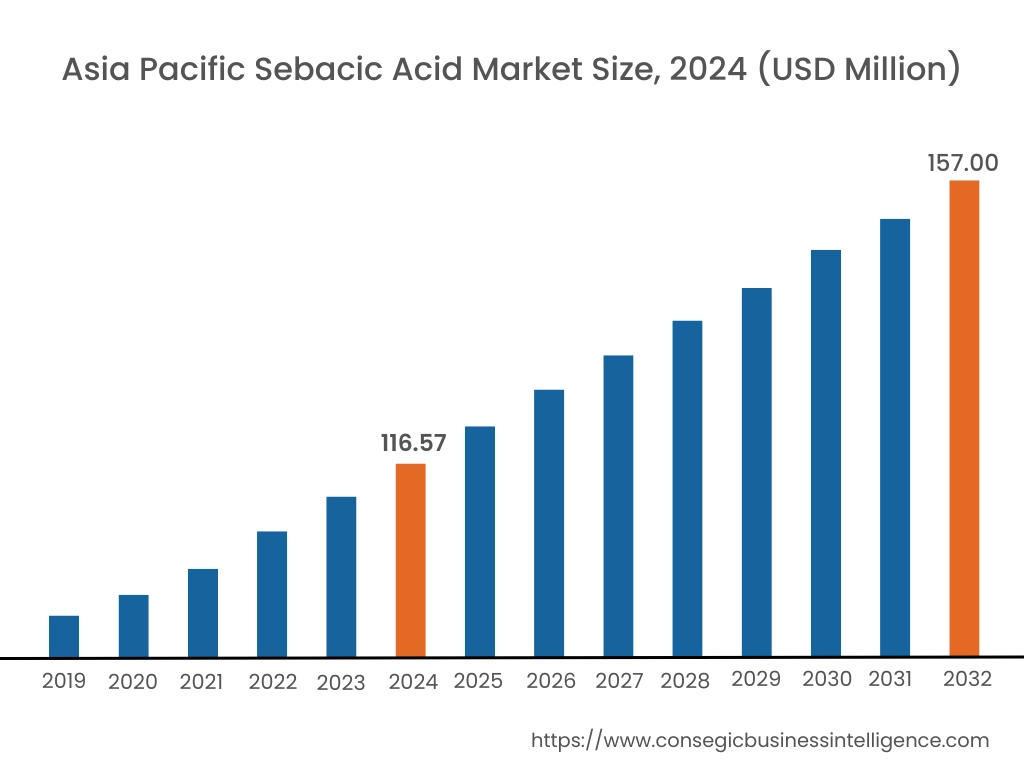
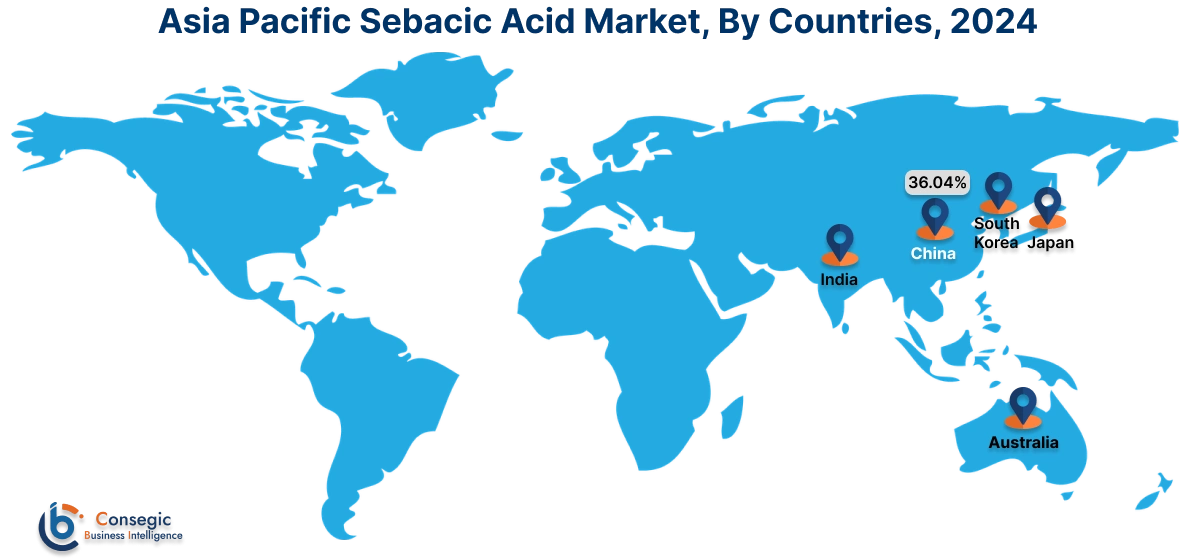
In 2024, Asia Pacific accounted for the highest market share at 44.36% and was valued at USD 116.57 Million and is expected to reach USD 157.00 Million in 2032. In Asia Pacific, China accounted for the market share of 36.04% during the base year of 2024. The Asia Pacific region is experiencing an increase in the polymer sector that is acting as a significant contributor to the market growth of sebacic acid. Additionally, the region's robust infrastructure development and rising consumer spending is further contributing to the increasing requirement in the market. Moreover, the growing focus on eco-friendly alternatives aligns perfectly with this acid's bio-based origin from castor oil, making it a preferred choice for manufacturers seeking to meet the growing need for sustainable polymers.
- For instance, according to Hengshui Jinghua Chemical Co., Ltd., the production of SA of bio-based nature was around 66,000 tons and consumption of castor oil attributed to 130,000 tons in 2023.
These factors create a strong upward trajectory for the market in Asia Pacific, positioning it as a key region for players.
In Europe, the sebacic acid industry is experiencing the fastest growth with a CAGR of 6.5% over the forecast period. There is an increase in the need for this acid in Europe due to its wide utilization in development of high-performance lubricants. These lubricants are high in demand due to their widely utilization across diverse range of industries such as automotive, aerospace, amongst others. Additionally, European end users are increasingly seeking bio-based lubricants that meet performance requirements. The acid's inherent thermal stability and lubricity along with its extraction from renewable castor oil has increased the adoption of this acid among the key players operating in the region.
The North American sebacic acid market analysis is driven by the key preference on personal care and cosmetic products that include SA. This preference is increasing due to the increase in priority for utilization of natural and sustainable ingredients in the cosmetic formulations. This increase in awareness among the consumers along with a demand for high-performance natural solutions has made this acid a preferred ingredient in the region. These trends are a few of the key factors contributing to the market share in North America.
The increase in sales of electric vehicles in Latin America is expected to support market as this acid is used for the development of specialized polymer and lubricants that are incorporated into electric vehicles for motor bearings amongst others. The adoption of EV vehicles is increasing due to the increase in consumer preference as well as supporting initiatives offered by the government. Additionally, the increasing use of polymers for lightweighting and component manufacturing in EVs is further creating sebacic acid market opportunities in the region.
In the Middle East and African (MEA) market, sebacic acid is widely used in plasticizers due to the increase in number of establishments across the construction sector. This sector requires plastics that are of a durable and flexible nature for its wide application in pipes, building materials amongst others. In addition to this, the rising awareness of health and environmental concerns associated with traditional plasticizers are creating new trends for the adoption of more environment friendly alternatives like sebacic acid-based solutions.
Top Key Players & Market Share Insights:
The Global Sebacic Acid Market is highly competitive with major players providing products to the national and international markets. Key players are adopting several strategies in research and development (R&D) and product innovation to hold a strong position in the global Sebacic Acid market. Key players in the Sebacic Acid industry include
- Akrema Group (France)
- HOKOKU KOGYO Co. Ltd (Japan)
- Shanxi Zhengang Chemical Co., Ltd. (China)
- Tianxing Biotechnology Co., Ltd. (China)
- Inolex incorporation (U.S.)
- Wilmar International (Singapore)
- Atman Kimaya (Turkiye)
- EVONIK (Germany)
- Jayant Agro-Organics Ltd. (India)
Sebacic Acid Market Report Insights:
| Report Attributes | Report Details |
| Study Timeline | 2019-2032 |
| Market Size in 2032 | USD 377.24 Million |
| CAGR (2025-2032) | 4.7% |
| By Form |
|
| By Application |
|
| By Region |
|
| Key Players |
|
| North America | U.S. Canada Mexico |
| Europe | U.K. Germany France Spain Italy Russia Benelux Rest of Europe |
| APAC | China South Korea Japan India Australia ASEAN Rest of Asia-Pacific |
| Middle East and Africa | GCC Turkey South Africa Rest of MEA |
| LATAM | Brazil Argentina Chile Rest of LATAM |
| Report Coverage |
|
Key Questions Answered in the Report
How big is the Sebacic Acid market? −
In 2024, the Sebacic Acid market is USD 262.83 Million.
Which is the fastest-growing region in the Sebacic Acid market? +
Europe is the fastest-growing region in the Sebacic Acid market.
What specific segmentation details are covered in the Sebacic Acid market? +
By Form and Application segmentation details are covered in the Sebacic Acid market.
Who are the major players in the Sebacic Acid market? +
Akrema Group (France), HOKOKU KOGYO Co. Ltd (Japan), Wilmar International (Singapore), Atman Kimaya (Turkiye), EVONIK (Germany), Jayant Agro-Organics Ltd. (India) are some of the major players in the market.
Overview
Reputation & Certifications


Our Services
- Market Intelligence & Forecasting
- Custom Research Solutions
- Market Entry Strategy
- Competitive Intelligence
- Customer Insights
- Industry Innovation Analysis
- Investment Advisory