Jump to Content
Asia Pacific Thermoplastic Vulcanizates Market - Size, Industry Share, Growth Trends and Forecasts 2025-2034
Market Scope & Overview
The Asia Pacific thermoplastic vulcanizates market is a niche and advanced segment of the elastomers and advanced materials market. It involves dynamically vulcanized alloys composed of a polypropylene thermoplastic matrix and an ethylene-propylene-diene monomer rubber phase, designed to provide rubber-like elasticity, compression set resistance, and chemical compatibility while remaining thermoplastically processable through injection molding, extrusion, and blow molding manufacturing technologies in highly demanding applications ranging from automotive sealing systems to medical devices. The product has a wide range of applications, including automotive weather sealing systems, under-hood components that require continuous operation at temperatures ranging between minus 40°C to plus 135°C, interior trim applications, wire and cable jacketing, building construction profiles, consumer electronics housings, industrial hoses, medical device seals where extreme flexibility and high compression set resistance ensure 85–92% recovery following extended compression. This makes TPVs critical in substituting conventional thermoset rubbers, enabling cost savings and providing sustainable material solutions across diverse industrial applications in the region.
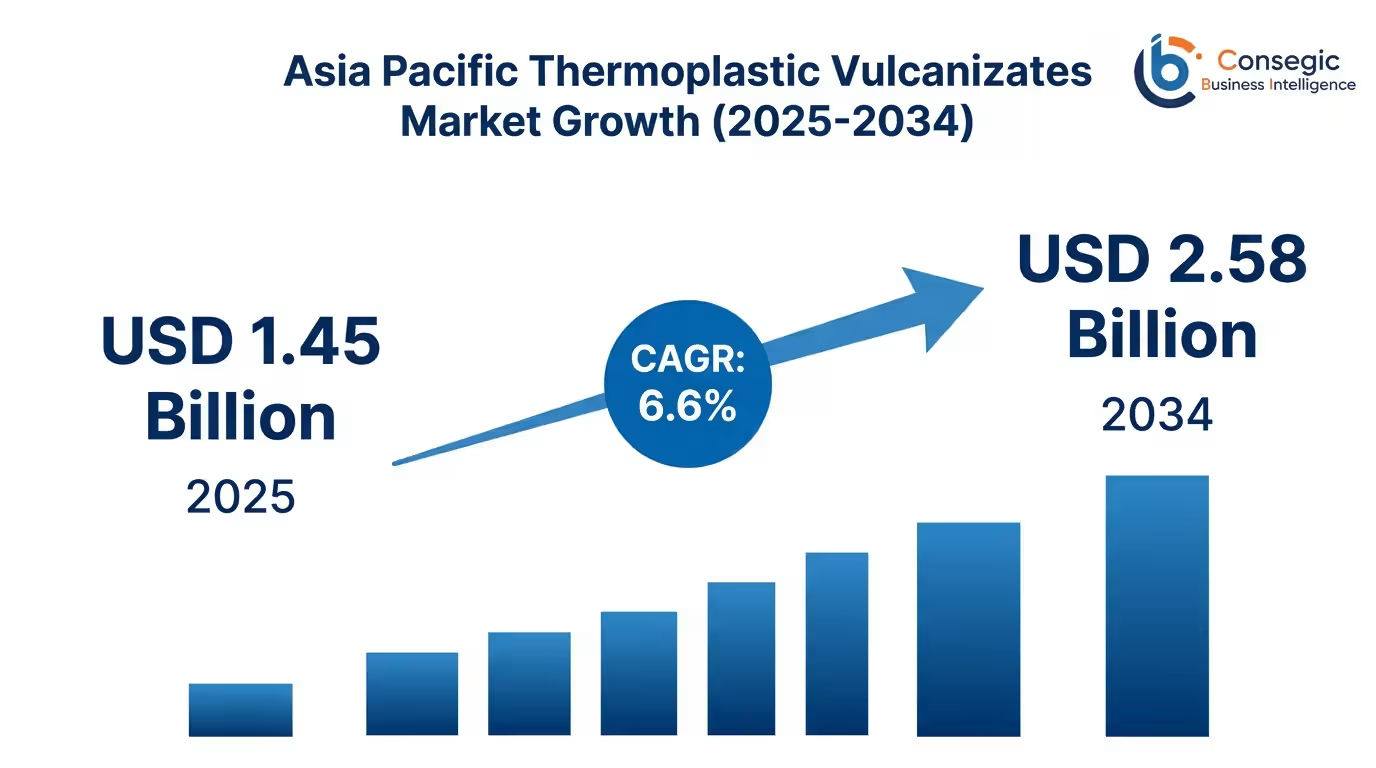
The market, valued at USD 1.45 billion in 2025 (base year), is expected to grow steadily to USD 2.58 Billion in 2034. This growth curve is as a result of a compound annual growth rate (CAGR) of 6.6 percent in the 2026-2034 forecast period owing to accelerating automotive production recovery following supply chain disruptions with a focus on lightweighting that achieves 15-25 percent weight reduction versus thermoset alternatives, full conversion to electric vehicle production necessitating complex sealant materials to service battery packs and thermal management components resistant to glycol-based coolants, strict regulations on vehicle emissions and fuel usage, and increased adoption of circular economy principles.
Key Market Insights
- Market valued at USD 1.45 billion (2025) and projected to reach USD 2.58 billion by 2034, growing at a CAGR of 6.6%
- Increasing substitution of thermoset rubber with TPVs due to lightweighting benefits (15–25% weight reduction) and recyclability
- Rising adoption in electric vehicles for battery seals and thermal management due to high chemical and temperature resistance
- Strong demand from automotive sector, especially for sealing systems, under-hood components, and EV applications
- Expanding applications across construction, medical devices, electronics, and industrial sectors due to durability and flexibility properties
Dynamic Vulcanization Technology and Processing Advantages
Newer thermoplastic vulcanizates incorporate advanced formulation technologies in the form of dynamic vulcanization processes that produce finely dispersed crosslinked rubber particles in the form of 1-5 micrometers across continuous polypropylene matrices, compatibilizer systems through the use of maleic anhydride grafted polypropylene to enhance interfacial adhesion between phases to achieve optimal morphology, mineral filler incorporation up to 10-30 percent loading to reduce material costs and plasticizer systems with paraffinic oils to enhance flexibility and processability The high-performance thermoplastic vulcanizates have Shore A hardness of between 40-95 which gives them flexibility similar to traditional rubbers, tensile strength of between 8-18 megapascals, elongation at break of between 300-600 percent, compression set of less than 25 percent after 70 hours in 100 degrees Celsius, and melt flow of 5-35 grams per 10 minutes which allows them to be easily injection molded with 40–60 percent shorter cycle times.
Fundamental changes in the Asia Pacific automotive industry, which is expected to achieve production of approximately 48.6 million vehicles in 2024 comprising 58 percent of the total world production, include electrification with battery electric vehicles projected to reach 14.8 million units annually driving demand for specialized sealing materials that withstand battery electrolytes and battery coolants, lightweighting efforts aiming to achieve 8-12 percent reduction in vehicle mass by 2030 that will require manufacturing operations to substitute metal and glass components with advanced polymers. These industry forces are both threatening and challenging, as well as offer an opportunity to the thermoplastic vulcanizates producers, who are innovating in light of evolving technical requirements, processing requirements, and sustainability requirements in a variety of applications.
Market Application Distribution Analysis
The Asia Pacific thermoplastic vulcanizates market is defined by the automotive-oriented demand configuration that indicates the material performance of high order in sealing, flexibility, and durability applications where they are tailored on the basis of technical needs of temperature resistance, compression set, and chemical compatibility. Concentration in mobility and infrastructure sectors in the market application distribution:
Application Segments (2025):
- Automotive Applications: USD 1.01 Billion (70.0 percent of market value) - Major application area which also includes weather sealing systems in door, window and trunk applications that use 35-45 percent of automotive thermoplastic vulcanizates, under hood applications such as air intake ducts, coolant hoses and turbocharger hoses that require operation at 150 degrees Celsius constant temperature, interior trim applications in which instrument panel skins, door armrests, and console parts provide soft-touch feel, exterior components.
- Building and Construction USD 203 Million (14.0 percent of market value) - Growing construction application segment such as window and door sealing profiles, roofing membranes and waterproofing systems, wire and cable jacketing used in construction, expansion joints, which need long-term weathering resistance and flexibility between temperatures of minus 40 degrees Celsius and plus 80 degrees Celsius with the presence of UV stability that ensures properties in the construction application remain intact after 2,000+ hours of accelerated weathering exposure.
- Consumer Goods and Electronics: USD 145 Million (10.0 percent of market value) - Multiple uses such as soft-touch over molding of power tools and products, consumer electronics protection and housing, sporting goods and recreational equipment, sealing components (that need food contact compliance and ability to resist repeated sterilization) of household appliances.
- Industrial and Medical Applications USD 87 Million (6.0 percent of market value) - Specialized applications such as hydraulic and pneumatic hoses, industrial seals and gaskets, conveyor belt covers, medical device components that can meet ISO 10993 biocompatibility standards, and those that protect mechanical assemblies need oil resistance, abrasion resistance and dynamic flexibility.
The thermoplastic vulcanizates technology, including the development of dynamic vulcanization process optimization, development of compatibilizer chemistry, development of filler surface treatment, formulation and development of compounds and processing parameters, and application-specific grades with better performance characteristics were attractions to the USD 185 Million of Asian Pacific investment in 2024, and the level of major producers investing between 5.5-8.8 percent of their revenues in research and development which included next-generation formulations used in electric vehicle applications, bio-based thermoplastic vulcanizates using sustainable and renewable feedstocks, thereby supporting innovation, regulatory compliance, and long-term market expansion across high-performance applications.
Key Drivers
Car Manufacturing and the EV Revolution
The strongest driver of the demand is the long-term recovery and growth in automotive production across Asia Pacific markets and the rapid increase in the transition to electric-powered vehicles that demand specific sealing materials to preserve the battery structure, thermal management devices and high-voltage cables protection products. Data published by the International Organization of Motor Vehicle Manufacturers estimates that the number of vehicles produced as of 2024 in Asia Pacific amounted to 48.6 million vehicles, 7.2 percent more than 2023, including 31.8 million passenger cars, 15.4 million light commercial vehicles and 1.4 million heavy trucks. This volume of production generates high demand of thermoplastic vulcanizing materials of average consumption of 12-18 kilograms per passenger motor vehicle in weather sealing, under-hood, interior trim, and exterior uses that translates to annual consumption of automotive thermoplastic vulcanizing materials of about 620,000 metric tons in the region.
The electric vehicle revolution is fundamentally changing demand of thermoplastic vulcanizates with battery electric vehicle production reaching 14.8 million units in Asia Pacific in 2024 which accounts for 30.4 percent of total vehicle production and showing 32.8 percent compound annual growth since 2019. Electric cars need battery pack sealing materials which are specialized thermoplastic vulcanizates formulations that offer resistance to glycol-based coolants up to concentrations of 50 percent, electrolyte solutions in the event of thermal runaway conditions, and flexibility in operating temperature ranges of minus 40 degrees Celsius cold weather operation to plus 85 degrees Celsius battery thermal management systems. Battery pack sealing applications require 4.5-7.2 kilograms of thermoplastic vulcanizates specialty to seal applications in vehicles that demand a minimum of 25-40 percentage more than the standard automotive grades with regard to stringent performance requirements such as flame retardancy to UL 94 V-0 standard and validation testing protocols.
Lightweighting Programmes and Material Replacement Trends.
The overall automotive trend of lightweighting vehicles to enhance fuel efficiency, decimate emissions and electric vehicle range necessitates tremendous substitution of conventional materials such as metals, thermoset rubbers and polyvinyl chloride with sophisticated thermoplastic vulcanizates that have similar performances at 40-55 percent weight reduction. Improvements in the regulatory pressure on fuel efficiency are aimed at having corporate average fuel economy targets of 5.2-5.8 liters per 100 kilometers in all major Asia Pacific markets by 2025-2030, with vehicle mass reductions of 8-12 percent through material replacement and design optimization. Thermoplastic vulcanizates allow lightweighting by replacing ethylene-propylene-diene monomer thermoset rubber in weather sealing applications with 15-22 percent weight reduction with no change in sealing performance, replacement of polyvinyl chloride in interior trim applications with 18-28 percent weight reduction and improved soft-touch feel and touch, and multi-material assemblies can be consolidated into single thermoplastic vulcanizates components by overmolding and two-shot injection molding.
Key Restraints
Supply chain dependencies and raw material volatility
The volatile cost of raw materials is a major issue facing the Asia Pacific thermoplastic vulcanizates market where polypropylene resin and ethylene-propylene-diene monomer rubber feedstock is impacting both cost structures and compression of margins for producers and penetration in the market by price- sensitive products. Prices of the polypropylene resin showed volatility of 22-28 percent in the 2022-2024 period as per the fluctuation of the price of crude oil, propylene monomer supply-demand and the maintenance turnarounds of the petrochemical plants that were between USD 980 per metric ton and USD 1,320 per metric ton. Specialty monomer availability, production capacity utilization and regional supply imbalances that shaped the ethylene-propylene-diene monomer rubber prices were even more volatile with prices ranging from USD 2,100 to USD 3,200 per metric ton across the same period which influenced the markets of Asia Pacific that relied on imports of North America and Europe to provide high-quality grades.
Threat of Substitute Elastomeric Materials.
Competitive pressure in the market in the form of alternative elastomeric materials such as thermoplastic polyolefin elastomers, thermoplastic polyurethanes, and new styrenic block copolymer products with similar performance characteristics at a lower cost of the material costs results in intense competition pressure in the market that restricts the thermoplastic vulcanizates penetration in applications that do not demand the ultimate performance characteristics. The thermoplastic polyolefin elastomers are made of reactor-prepared blends of polypropylene and ethylene-octene copolymers that have Shore A hardness values of 60-90, and adequate flexibility to be used in most automotive interior applications and material costs 25-35 percent less than thermoplastic vulcanizates due to simplified production processes that do not require dynamic vulcanization.
Future Opportunities
Growth of Sustainable and Bio-Based Materials.
The greatest potential lies in the development of holistic sustainable thermoplastic vulcanizates products that use bio-based polypropylene, recycled material and better end-of-life recyclability while still maintaining performance properties similar to those of petroleum-based products. The bio-based polypropylene, which is produced using renewable feedstocks such as bio-ethanol, bio-methanol and waste vegetable oils via catalytic conversion processes provide the chemically identical structure to petroleum-based polypropylene, in addition to allowing direct replacement in thermoplastic vulcanizates preparations and resulting in carbon footprint reduction by 60-75 percent through lifecycle assessment. By 2024, commercial quantities of bio-based polypropylene had reached 180,000 metric tons per year in Asia Pacific with a price of 15-25 per cent higher than petroleum-based products, with automakers looking to add more renewable content to their vehicles to achieve corporate sustainability goals of 25-30 per cent renewable content by 2030.
Advanced Applications and Electric Vehicle Battery Systems.
The potential and production of specialized thermoplastic vulcanizates formulation tailored to meet the sealing requirements of electric vehicle battery packs, thermal management components and high voltage cable protection applications with unique combinations of chemical resistance, thermal stability, flame retardancy and long term durability is an emerging opportunity. The electric vehicle battery pack sealing applications are massive market growth opportunities with battery electric vehicle manufacturers are expected to scale to 28.4 million vehicles in Asia Pacific by 2030 requiring 4.5-7.2 kilograms of specialty thermoplastic vulcanizates per car to package battery enclosures sealing, the thermal interface gaskets, coolant distribution manifolds and high-voltage connector seals fetching 25-40 percent higher than the usual automotive grades.
Market Segmentation Analysis
By Product Type: Material Chemistry and Performance Optimization
EPDM/PP Thermoplastic Vulcanizates: Market Leadership Through Versatility
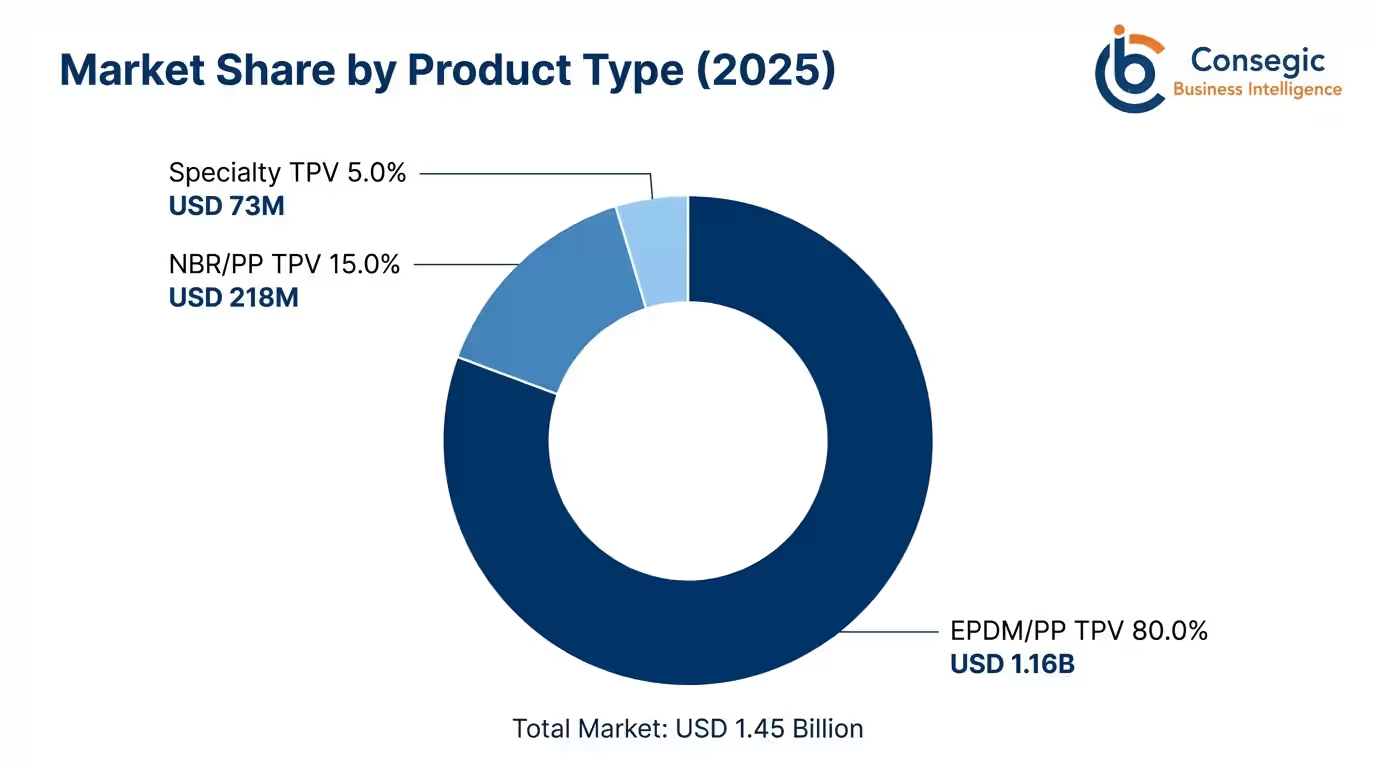
EPDM/PP thermoplastic vulcanizates will prevail in the market at USD 1.16 Billion (80.0 percent of market value) and USD 2.06 Billion that are estimated in 2025 and 2034 respectively. This bracket includes standard grades with Shore A hardness 60-80 used in application to automotive weather sealing and interior trim, soft grades with Shore A hardness 50-65 used in application to provide greater flexibility in complex seal geometry requirements and low temperature operation down to -40 degrees C to serve in electric vehicle applications and in medical applications. The EPDM/PP thermoplastic vulcanizates benefits are a high weathering performance of the material that does not change properties over 2,000 plus hours of QUV accelerated weathering exposure, high ozone performance which does not result in surface cracking in outdoor applications, good compression set performance, with 20–30 percent loss after 70 hours at 100 degrees Celsius, and low cost that enables the formulation of the material with material costs of USD 3,200-4,800 per metric ton in the typical grades of the material.
NBR/PP and Specialty Thermoplastic Vulcanizates: High-Performance Applications
NBR/PP thermoplastic vulcanizates are USD 218 Million (15.0 percent of market value) in 2025, including formulations based on nitrile rubber phase that offer greater oil resistance to engine oils, transmission fluids and hydraulic fluids than EPDM-based systems, and can be used in automotive fuel systems, in under-hood parts, and direct fluid exposure that demand hydrocarbon resistance in industrial hoses. The NBR/PP thermoplastic vulcanizates have volume swell less than 15 percent after 70 hours immersion in ASTM Oil No. 3 at 100 degrees Celsius, remain flexible down to minus 25 degrees Celsius, and have price premium in 35-55 per cent more than EPDM/PP grades at USD 5400-7200 per metric ton.
Emerging Specialty Systems: Innovation Frontiers
Specialty thermoplastic vulcanizates based on natural rubber, silicone, and other advanced rubber systems are expected to reach USD 73 Million (5.0 percent of market value) in 2025 to service niche applications that will necessitate particular performance attributes such as silicone-based thermoplastic vulcanizates that deliver extreme temperature capability between minus 60 degrees Celsius to plus 200 degrees Celsius to serve specialized automotive and medical applications, natural rubber-based systems that have high tensile strength and tear resistance and emergent bio-based form.
Regional Market Analysis
The China: Production Powerhouse and Innovation Headquarters.
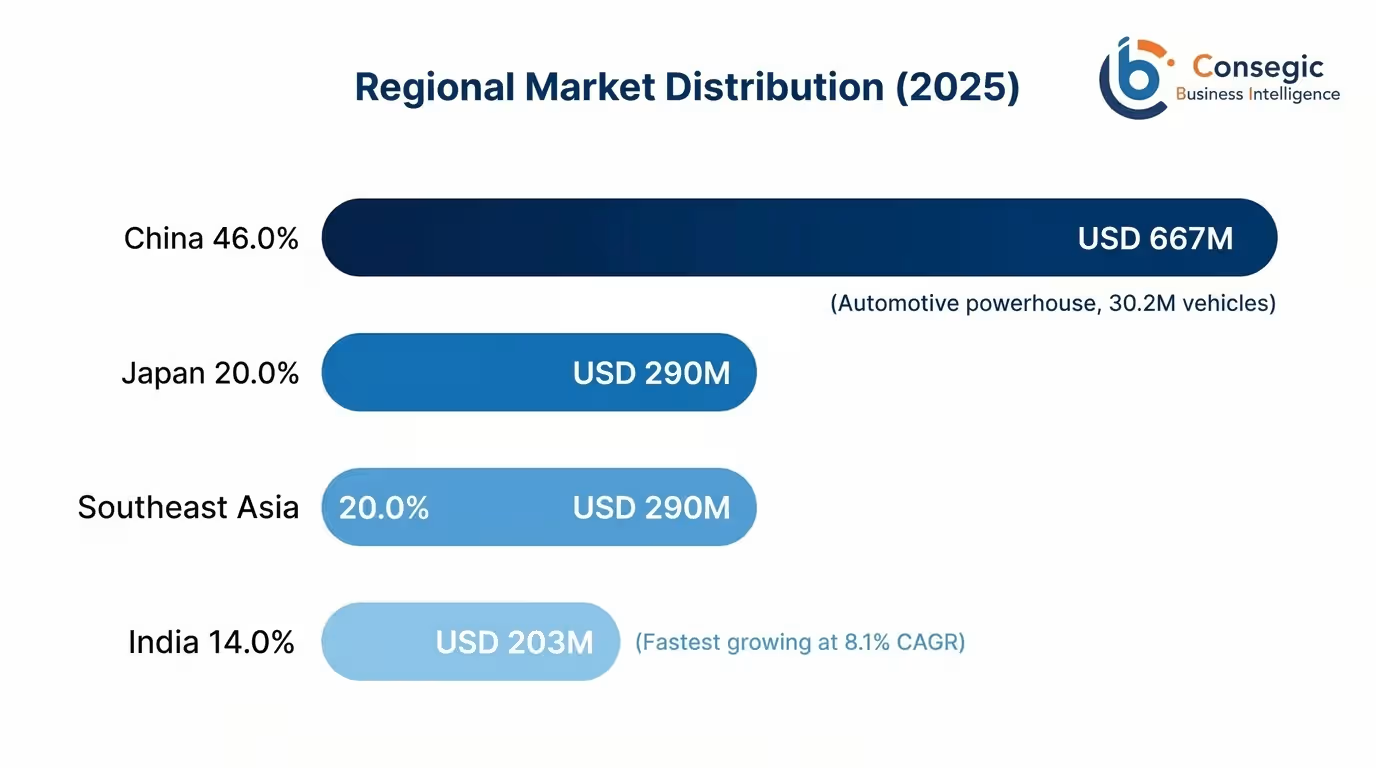
China leads the market with USD 667 million (46.0 percent market value) in 2025 that is projected to rise to USD 1.19 Billion in 2034. This leadership is driven by massive automotive production of 30.2 million vehicles in 2024 which constitutes 62 percent of the Asian Pacific production, fast-growing electric vehicles with 9.6 million battery electric vehicles produced which constitute 32 percent domestic production creating demand in specialized battery sealing material, fully developed manufacturing ecosystem with 15 major thermoplastic vulcanizates producers operating with combined capacity of 420,000 metric tons per year, and strong government support to new energy vehicles through production-linked incentive programs and carbon neutrality by 2060, thereby reinforcing domestic demand, production scalability, and long-term market dominance in thermoplastic vulcanizates across the region.
Chinese market exhibits special features such as high use of local suppliers where local manufacturers take up 72 percent market share using competitive pricing, technical support and fast responsiveness, rising demand of high grades with superior performance properties as domestic automotive brands such as BYD, NIO and XPeng raise the quality standard, and extensive recycling facilities with 165,000 metric tons of thermoplastic vulcanizates recovered in end-of-life vehicles in 2024 of 39 percent consumption allows the use of circular economy strategies.
Japan: Leadership in Technology and Premium Applications.
Japan constitutes USD 290 Million (20.0 percent of market value) in 2025 which is likely to increase to USD 516 Million in 2034. The market features are a mature automotive market of 9.2 million vehicles manufactured in 2024, technology leadership in the formulation and processing of thermoplastic vulcanizates and large emphasis on quality and performance with premium grades accounting to 64 percent of market value, and advanced usage in medical devices meeting ISO 10993 biocompatibility standards, precision industrial production and high-performance consumer electronics with high-quality standards and material certification requirements.
India: Fastest-Growing Market with Expanding Manufacturing Base
India will be USD 203 Million (14.0 percent of market value) in 2025, and USD 412 Million in 2034; compound annual growth rate is 8.1 percent, highest regional growth path. This rapid growth can be attributed to the automotive production which started to hit 5.9 million vehicles in 2024 with growth of 9.2 percent in production, government production-based incentive schemes that could attract automotive manufacturing investment worth USD 8.4 billion in 2022-2024, growing middle-class population to create domestic demand and consumer goods which created domestic demand in vehicles and consumer goods, and the development of production capacity of local thermoplastic vulcanizates with four large facilities commissioned in 2022-2024 with 78 thousand metric tons of additional annual capacity, thereby strengthening domestic supply chains, reducing import dependency, and supporting sustained market expansion in thermoplastic vulcanizates across India.
Southeast Asia and Other Markets: Development of a manufacturing hub
Southeast Asia such as Thailand, Indonesia, Malaysia, Vietnam and Philippines will be USD 290 Million (20.0 percent of market value) in 2025, which is projected to be USD 464 Million in 2034. Thailand is the regional manufacturing centre, with 1.9 million vehicles of automotive production in 2024 and defined thermoplastic vulcanizates production capacity being used in domestic consumption as well as export markets to the ASEAN region, which is growing at a rapid rate due to 1.4 million vehicles of automotive production and growing two-wheeler market utilizing thermoplastic vulcanizates to weather sealing and grip applications.
Competitive Landscape and Key Market Players
Strategic Positioning and Market Leadership
Development of a manufacturing hubCelanese Corporation (Santoprene Brand) – Global Technology Leader
With the Santoprene business acquired by Celanese Corporation as the Santoprene business of ExxonMobil, the corporation has a dominant market leadership with an estimated Asia Pacific Asian business revenue of USD 218-252 Million of the estimated 15.0-17.4 percent of the total market of both automotive, industrial and consumer applications. The production facilities of the company are located in Singapore with a capacity of 95,000 metric tons/annum and the technical center in Shanghai and Tokyo where the company offers full support in application development. It is competitive due to its proprietary dynamic vulcanization technology, which enables optimal phase morphology and mechanical properties, broad product mix spanning Shore A hardness span 40-95 with more than 200 commercial grades, its automotive approvals with the world leading original equipment manufacturers Toyota, Honda, Volkswagen and General Motors, and its global infrastructure of technical support providing formulation development, processing optimization and quality assurance.
Mitsubishi Chemical Corporation - Leadership Regional Innovation.
Mitsubishi Chemical Corporation has a strong competitive position based on Zelas and Thermoran thermoplastic vulcanizates brands with a predicted market share of USD 174-203 Million in Asia Pacific in 2024 as a result of concentration on high end automotive applications and specialty grades. The company has production plants in Japan of 52,000 metric tons per annum and Thailand of 35,000 metric tons capacity that are used in automotive, electronic and industrial markets. The competitive advantages are as follows: Leadership in innovation in specialty formulations such as ultra-soft grades with a hardness of less than 50 Shore, thermally conductive grades with thermal conductivity of 2.8 watts per meter-kelvin, and biocompatible grades that meet the ISO 10993 standard, close relations with the Japanese automotive, and full technological assistance in precision injection molding applications.
Mitsui Chemicals Inc. - Integrated Portfolio Strategy.
Mitsui Chemicals Inc. has a strong presence with Milastomer brand with a projected 2024 revenue of USD 131-160 Million of Asia Pacific market of 9.0-11.0 percent market share in diversified application profiling in automotive weather sealing, under- hood, and building construction profile. The company has both Japan and China production facilities of 68,000 metric tons/year.
Other Key Market players:
- Teknor Apex Company: USD 116-145 million Asia Pacific sales this is 8.0-10.0 percent market share, Sarlink brand catering to automotive sealing market, production plant in Thailand having capacity of 42,000 metric tons and specialization in customized formulations with shorter lead times.
- JSR Corporation: USD 87-116 Million Asia Pacific revenues, specialization of high-performance grades in automobile and industrial use, production plant located in Japan with production capacity of 32,000 metric tons, and experience on specialty rubber technologies.
- LondellBasell Industries: USD 73-102 Million Asia Pacific revenues, combined polypropylene and thermoplastic vulcanizates supply chain, concentration on low-cost formulations in high-volume consumption, and multi-shot injection moulding optimization.
Recent Industry Developments
Next-Generation Electric Vehicle Material Innovation (2024-2025)
In March 2024, Celanese Corporation introduced a new resin, Santoprene 8000 EV Series, specifically designed for battery pack sealing in electric vehicles. The material offers improved resistance to glycol-based coolants, with less than 5% volume change after 1,000 hours in an 85°C bath, compression set resistance with below 22% recovery loss after 168 hours in a 100°C environment, and flame retardancy up to UL 94 V-0 without the use of halogens. In 2024, the Santoprene 8000 EV Series achieved commercial adoption by 18 electric vehicle manufacturers in Asia Pacific, including BYD, NIO, and XPeng, along with established automakers transitioning to electric platforms.
In August 2024 Mitsubishi Chemical Corporation announced Zelas TC-Grade based on a thermally conductive formulation with aluminum oxide and boron nitride fillers with a thermal conductivity of 2.8 watts per meter-kelvin, but Shore A hardness of 70 and flexibility to minus 40 degrees Celsius, and is used in applications requiring thermal management of a battery, such as thermal interface gaskets and coolant distribution manifolds. The substance has been shown to have 45 percent higher thermal conductivity than thermoplastic vulcanizates in general and with injection moldability cycle times of 60-90 seconds on complex geometries.
Sustainable Materials and Circular Economy Programs (2024–2025)
In February 2025, Mitsui Chemicals Inc. released Milastomer Bio series with 35 percent bio-based polypropylene made of renewable ethanol and 20 percent post-consumer recycled ethylene-propylene-diene monomers rubber recovered from end-of-life vehicles achieving mechanical properties within 10 percent of the virgin material performance including tensile strength of 9.8 megapascals, elongation at break of 450 percent and compression set of 26 percent after 70 hours at 100 degrees The Milastomer Bio series is 28% smaller in carbon footprint based on lifecycle assessment than virgin thermoplastic vulcanizates, costs are reduced by 8 percent based on incentives to use renewable feedstock at USD 4,200 per metric ton, and satisfies automotive industry requirements of sustainable content while still requiring the performance needed in weather sealing and interior trim applications.
Teknor Apex Company declared full circle economy plan in June 2024 comprising of chemical recycle technology transforming end of life thermoplastic vulcanizates into virgin-like polypropylene and ethylene-propylene-diene monomer rubber by applying advanced pyrolysis at 480-540 degrees Celsius. The pilot facility in Bangkok handles 3,200 metric tons/per year of mixed thermoplastic vulcanizates waste with conversion efficiency of 82 percent and recycled monomers purity of over 99.5 percent that can be utilized in automotive applications.
Asia Pacific Thermoplastic Vulcanizates Market Report Insights
| Report Attributes | Report Details |
|---|---|
| Study Timeline | 2022–2034 |
| Base Year | 2025 |
| Forecast Period | 2026–2034 |
| Market Size in 2025 | USD 1.45 Billion |
| Market Size in 2034 | USD 2.58 Billion |
| CAGR (2026–2034) | 6.6% |
| By Product Type | EPDM/PP TPV (80.0%), NBR/PP TPV (15.0%), Specialty TPV (5.0%) |
| By Application | Automotive (70.0%), Building & Construction (14.0%), Consumer Goods (10.0%), Industrial & Medical (6.0%) |
| By End User | Sealing Systems (45.0%), Under-Hood Components (20.0%), Interior Trim (15.0%), Other Applications (20.0%) |
| By Region | China (46.0%), Japan (20.0%), India (14.0%), Southeast Asia (20.0%) |
| Key Players | Becton Dickinson, Teleflex, Coloplast, Medtronic, B. Braun, Cook Medical, ConvaTec, Hollister |
| Report Coverage |
|
Key Questions Answered in the Report
What is the size of Asia Pacific thermoplastic vulcanizates market? −
The Asia Pacific thermoplastic vulcanizates market exhibits strong growth, with a value of USD 1.45 billion in 2025, and its growth is expected to reach USD 2.58 Billion in 2034 at the growth rate of 6.6 percent per annum. The market character portrays high reliance on automotive industry with 70.0 percent of consumption usage being vehicle application of weather sealing systems consuming 35-45 percent of automotive thermoplastic vulcanizates, under-hood applications requiring continuous operation up to 150 degrees Celsius temperature, interior trim applications providing soft-touch appearance, and electric vehicle battery sealing applications. Building and construction account for 14.0 percent to sealing applications in window and door sealing profiles, 10.0 percent service in soft-touch overmolding, and 6.0 percent attributed to industrial and miscellaneous applications including wire and cable insulation, medical components, and fluid handling systems. There is consumption in the region of around 620,000 metric tons of thermoplastic vulcanizates in Asia Pacific with China 46.0 percent of volume, Japan 20.0 percent, India 14.0 percent and Southeast Asia 20.0 percent creating a significant economic activity as a result of material production, compounding, processing and recycling ecosystem to support automotive manufacturing, construction and consumer goods industries.
What are the key drivers of expansion in Asia Pacific market? +
Automobile production revival and increase with 48.6 million vehicles made in 2024 representing 7.2 percent increase and use of 12-18 kilograms thermoplastic vulcanizates per passenger vehicle that provide sustained demand, electric vehicle shift with 14.8 million battery electric vehicles made that require specialized sealing material to use in battery packs to achieve 4.5-7.2 kilograms per vehicle consumption and demand a 25-40% price premium due to additional chemical resistance and flame retardancy requirements, and lightweighting efforts targeting 8–12% vehicle weight reduction, thereby driving increased adoption of thermoplastic vulcanizates as a lightweight, high-performance alternative to conventional materials across automotive applications.
Does the Asia Pacific market have any regional differences? +
Regional variations are high with regard to automotive sector concentration, production capacity and maturity of use. China holds market share at 46.0 percent through dominance as a result of immense automotive manufacturing with a production of 30.2 million vehicles as a dominance of the Asian Pacific with 62 percent output, high rate of adoption of electric vehicles with 9.6 million battery electric vehicles representing 32 percent of domestic output, a complete manufacturing ecosystem with 15 major manufacturers with a combined capacity of 420,000 metric tons, and a high preference towards the local suppliers capturing 72 percent market share due to competitive prices and technical support. Japan shows 20.0 percent share with technology leadership in specialty formulations such as ultra-soft grades, thermally conductive grades of up to 2.8 watts per meter-kelvin as well as biocompatible grades of 45-75 percent price premiums, mature automotive industry with focus on quality and performance where premium grades represent 64 percent of the market value and innovation in medical device and precision industrial applications where stringent regulatory standards are required. India has 14.0 percent share and fastest growth of 8.1 percent with automotive production including 5.9 million vehicles with 9.2 percent annual growth rate and incentive schemes associated with government production attracting USD 8.4 billion manufacturing investments and local production capacity development reducing import reliance of 68 percent to 42 percent. Southeast Asia represents 20.0 percent share with Thailand as regional manufacturing plants to serve ASEAN markets by using automotive production of 1.9 million cars and established thermoplastic vulcanizates production capacity and Indonesia shows a high growth up with automotive and two-wheeler market expansion.
What is the competitive landscape and how are key players differentiating in the Asia Pacific thermoplastic vulcanizates market? +
The Asia Pacific market exhibits moderately competitive structure and Celanese Corporation has market share of 15.0-17.4 percent with Santoprene brand that has proprietary dynamic vulcanization technology, broad product line with more than 200 commercial grades, including Shore A hardness 40-95, secured automotive approvals of major original equipment manufacturers, and worldwide technical support infrastructure with formulation development and processing optimization. Mitsubishi Chemical Corporation is able to capture 12.0-14.0 percent share of the market using Zelas brands and Thermoran brands that specializes in high-end automotive usage and specialty grades, innovation leadership in ultra-soft, thermally conductive and bio-compatible formulations that command high price premiums, good relations with Japanese companies and companies that deal with automobiles, and experience of high precision injection molding applications. Mitsui Chemicals Inc. owns 9.0-11.0 percent of shares in Milastomer brand having diversified application portfolio in the automotive, construction and industrial segments. Technical performance is further competed on, with compression set resistance less than 25 percent after 70 hours at 100 degrees Celsius, temperature resistance between minus 40 degrees Celsius and plus 135 degrees Celsius continuous operation, processing properties obtaining injection molding cycle times less than 90 seconds, automotive approvals by major original equipment manufacturers, which require extensive validation testing, specialty formulations to be used with electric vehicles such as battery sealing materials, thermally conductive grades, and sustainability credentials such as bio-based content and recyclability to support circular economy initiatives and regulatory compliance across the Asia Pacific region.
What are the market trends in the present technology? +
Electric vehicle specifications with better performance such as increased resistance to glycol-based coolants to retain less than 5 percent volume change after 1,000 hours immersion at 85 degrees Celsius, low compression set of below 22 percent recovery loss after 168 hours at 100 degrees Celsius, flame retardancy reaching UL 94 V-0 rating without halogenated additives using mineral flame retardants and optimized processing of complex battery enclosure seals with varying wall thickness, thermally conductive thermoplastic vulcanizates enabling efficient heat dissipation and enhanced battery safety, thereby meeting stringent electric vehicle performance, safety, and regulatory requirements across advanced mobility applications.
Overview
Reputation & Certifications


Our Services
- Market Intelligence & Forecasting
- Custom Research Solutions
- Market Entry Strategy
- Competitive Intelligence
- Customer Insights
- Industry Innovation Analysis
- Investment Advisory