Jump to Content
2-Ethylhexanoic Acid Market - Size, Share, Industry Trends, and Forecasts (2025-2032)
2-Ethylhexanoic Acid Market Size:
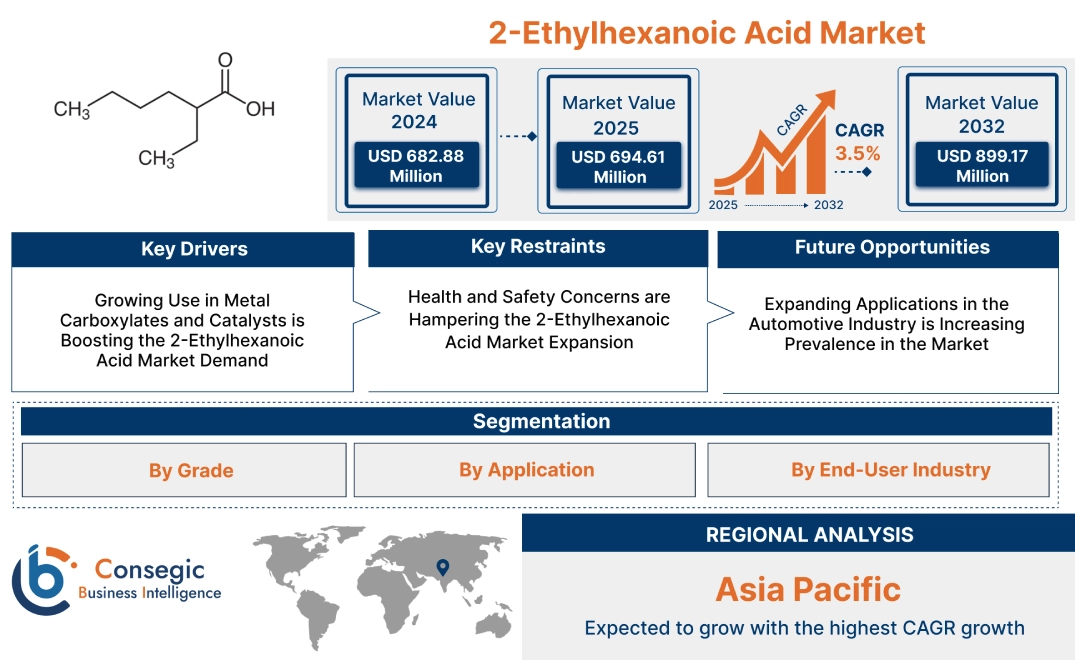
2-Ethylhexanoic Acid Market size is estimated to reach over USD 899.17 Million by 2032 from a value of USD 682.88 Million in 2024 and is projected to grow by USD 694.61 Million in 2025, growing at a CAGR of 3.5% from 2025 to 2032.
2-Ethylhexanoic Acid Market Scope & Overview:
The 2-ethylhexanoic acid is a versatile organic compound widely used in various industries due to its excellent chemical stability and compatibility. This acid is a key intermediate in the synthesis of metal salts, plasticizers, and lubricants. Key characteristics of 2-ethylhexanoic acid include its solubility in organic solvents, low volatility, and high thermal stability, making it suitable for demanding industrial processes. The benefits include improved product performance, cost-effectiveness, and versatility across multiple applications. Applications span automotive coolants, synthetic lubricants, paint driers, and plasticizers, where its unique properties enhance durability and efficiency. End-users include automotive manufacturers, chemical industries, and coatings producers, driven by rising surge for high-performance materials, advancements in manufacturing technologies, and the growing automotive and construction sectors.
2-Ethylhexanoic Acid Market Dynamics - (DRO) :
Key Drivers:
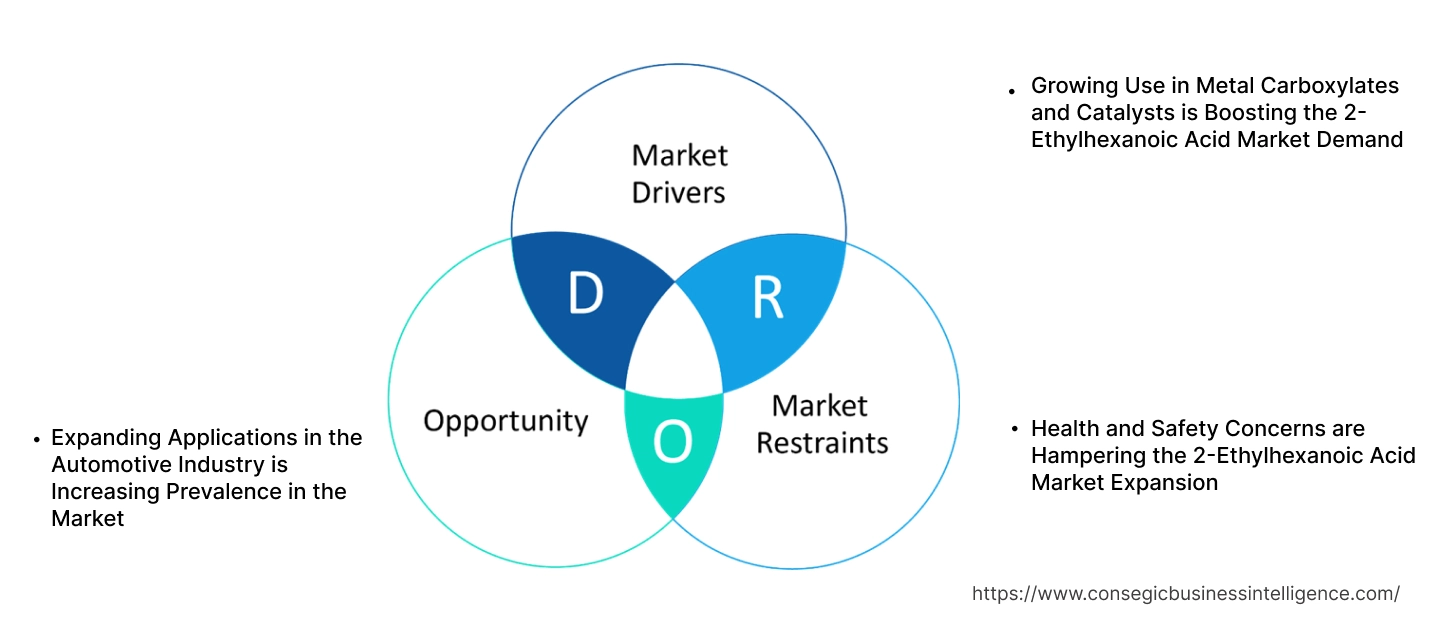
Growing Use in Metal Carboxylates and Catalysts is Boosting the 2-Ethylhexanoic Acid Market Demand
The utilization of 2-ethylhexanoic acid in the production of metal carboxylates and catalysts is significantly influencing trends across various industries. Metal carboxylates, such as driers in paints and coatings, rely on this acid compound for its excellent solubility, thermal stability, and performance-enhancing properties. These additives accelerate drying times and improve the durability and finish of coatings, aligning with industrial needs for high-performance materials.
Catalysts derived from this compound are also integral to polymerization processes, ensuring efficiency and consistency in applications such as adhesives, plastics, and sealants. The growing emphasis on energy efficiency and cost-effective manufacturing has further highlighted the importance of these catalysts. Analysis of industry trends indicates that as sectors like automotive, construction, and consumer goods continue to innovate, the role of 2-ethylhexanoic acid in enhancing product performance will remain pivotal.
Key Restraints:
Health and Safety Concerns are Hampering the 2-Ethylhexanoic Acid Market Expansion
The classification of 2-ethylhexanoic acid as a hazardous substance presents notable challenges for its handling, storage, and transportation. Direct exposure can pose health risks, including skin irritation and respiratory issues, necessitating stringent safety measures during manufacturing and application. Furthermore, the potential for environmental contamination during disposal or accidental spillage has raised concerns among regulators and environmentalists.
Compliance with health and safety regulations adds to operational complexity and costs for manufacturers. These requirements often involve investing in advanced containment systems, employee training, and monitoring protocols, which can limit adoption in cost-sensitive markets. Addressing these challenges through the development of safer formulations and improved handling practices will be critical for ensuring the sustainable use of 2-ethylhexanoic acid across industries.
Future Opportunities :
Expanding Applications in the Automotive Industry is Increasing Prevalence in the Market
The automotive sector is emerging as a significant area of application for 2-ethylhexanoic acid, particularly in the production of high-performance lubricants, coatings, and fuel additives. In lubricants, its use enhances thermal stability and reduces friction, improving engine efficiency and longevity. Similarly, coatings formulated with this acid compound provide superior protection against corrosion and wear, ensuring durability under extreme conditions.
Trends in the automotive sector, such as the transition to lightweight and fuel-efficient vehicles, are driving innovation in materials and formulations. For instance, fuel additives incorporating 2-ethylhexanoic acid optimize combustion and reduce emissions, aligning with global sustainability goals. As automotive technologies continue to evolve, analysis highlights the expanding role of 2-ethylhexanoic acid in meeting the sector's performance and environmental standards, offering manufacturers 2-ethylhexanoic acid market opportunities to cater to emerging sectors rise.
2-Ethylhexanoic Acid Market Segmental Analysis :
By Grade:
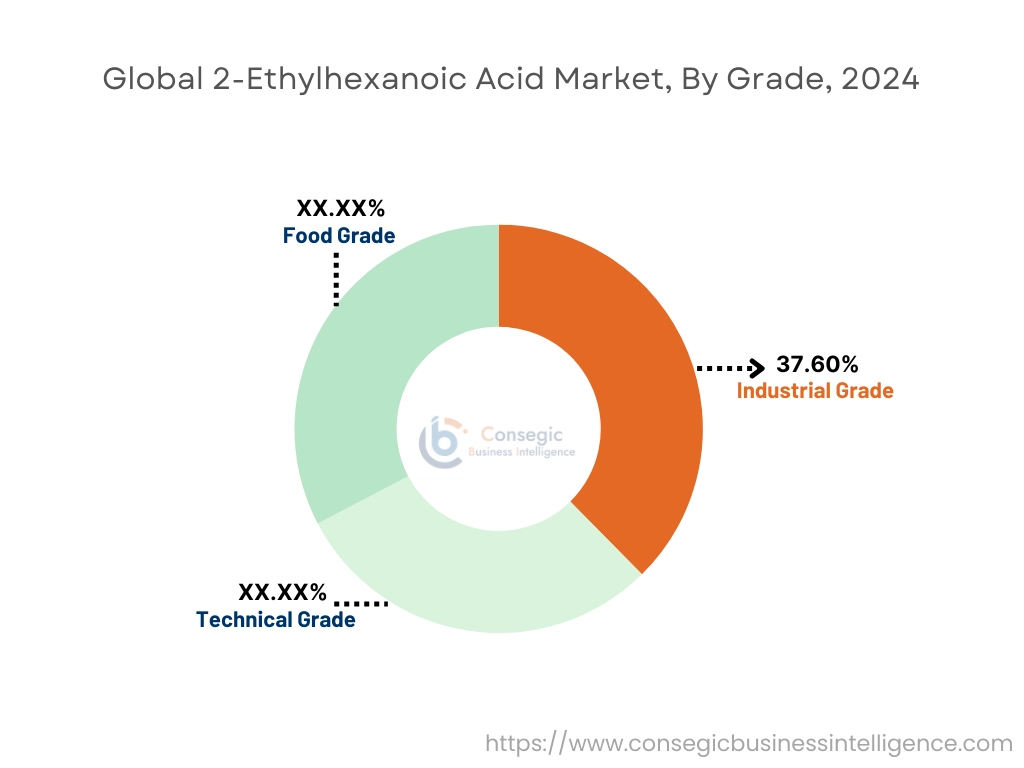
Based on grade, the 2-Ethylhexanoic Acid Market is segmented into technical grade, industrial grade, and food grade.
The industrial grade segment accounted for the largest revenue in the 2-ethylhexanoic acid market share of 37.60% in 2024.
- Industrial-grade 2-ethylhexanoic acid is widely used in manufacturing applications, including the production of metal soaps, lubricants, and plasticizers.
- This grade offers the ideal balance of cost-efficiency and performance, making it suitable for large-scale industrial applications.
- The increasing 2-ethylhexanoic acid market demand for metal soaps in the paints and coatings sectors and the use of industrial-grade lubricants in automotive and machinery sectors drive the dominance of this segment.
- Furthermore, its extensive use in producing catalysts and stabilizers in the chemicals sectors enhances its 2-ethylhexanoic acid market share.
- Industrial grade dominates the 2-ethylhexanoic acid market trends due to its broad applicability in manufacturing processes, particularly in automotive, construction, and chemicals industries.
The technical grade segment is anticipated to register the fastest CAGR during the forecast period.
- Technical-grade 2-ethylhexanoic acid is primarily used in specialized applications, such as adhesives and paints dryers, where specific performance characteristics are required.
- The increasing advancement for high-quality adhesives and coatings, driven by surge in the construction and automotive sectors, is fueling this segment's expansion.
- Additionally, technical-grade products are gaining traction due to their superior purity and tailored properties, which enhance the performance of end-use products.
- Technical grade trends is expected to grow rapidly due to increasing 2-ethylhexanoic acid market opportunities, for high-performance materials in adhesives, coatings, and other niche applications.
By Application:
Based on application, the market is segmented into paints dryers, plasticizers, lubricants, metal soaps, adhesives, and others.
The paints dryers segment accounted for the largest revenue share in 2024.
- 2-Ethylhexanoic acid is a critical component in the production of paints dryers, which are used to accelerate the drying process of alkyd-based paints and coatings.
- The 2-ethylhexanoic acid market growth of the paints and coatings industry, driven by increasing construction activities and infrastructure development, is boosting the market demand for paints dryers.
- Additionally, the rising adoption of environmentally friendly and high-performance coatings further supports this segment’s dominance, as 2-ethylhexanoic acid enhances the efficiency and durability of these products.
- Paints dryers lead the 2-ethylhexanoic acid market trends due to their essential role in enhancing drying efficiency and performance in the expanding paints and coatings industry.
The lubricants segment is anticipated to register the fastest CAGR during the forecast period.
- 2-Ethylhexanoic acid is widely used in the production of synthetic lubricants due to its excellent thermal stability and corrosion resistance properties.
- The automotive and industrial sectors are key drivers for this segment, as high-performance lubricants are essential for reducing friction and improving machinery efficiency.
- The increasing adoption of electric vehicles (EVs) and advanced machinery, which require specialized lubricants, is further propelling the requirement for this segment.
- Additionally, its use in producing biodegradable and environmentally friendly lubricants aligns with the growing focus on sustainability.
- Lubricants are expected to grow rapidly, driven by the market analysis the increasing demand for high-performance and environmentally friendly solutions in automotive and industrial applications.
By End-User Industry:
Based on end-user industry, the market is segmented into automotive, construction, paints and coatings, pharmaceuticals, chemicals, and others.
The paints and coatings segment accounted for the largest revenue share in 2024.
- The paints and coatings sectors is the largest consumer of 2-ethylhexanoic acid, primarily for its use in paints dryers and metal soaps.
- The growth of this industry, driven by increasing construction activities, infrastructure development, and automotive manufacturing, supports the dominance of this segment.
- The rising need for high-performance coatings, particularly in protective and decorative applications, further enhances the need for 2-ethylhexanoic acid.
- Innovations in coating technologies and the shift towards eco-friendly formulations are additional advancement drivers.
- Paints and coatings dominate the market expansion due to their extensive use of 2-ethylhexanoic acid in paints dryers and metal soaps, supported by robust 2-ethylhexanoic acid market growth in construction and automotive sectors.
The automotive segment is anticipated to register the fastest CAGR during the forecast period.
- The automotive sectors is a significant consumer of 2-ethylhexanoic acid, particularly for producing lubricants, plasticizers, and adhesives used in vehicle manufacturing.
- The increasing production of electric vehicles (EVs), which require advanced lubricants and lightweight materials, is driving the surege for 2-ethylhexanoic acid in this sector.
- Additionally, its role in improving the performance and durability of automotive coatings further supports growth.
- The global focus on vehicle efficiency and sustainability is expected to propel this segment’s expansion during the forecast period.
- The automotive segment is expected to grow rapidly, driven by increasing EV production, the need for advanced lubricants, and rising demand for durable and high-performance coatings.
Regional Analysis:
The regions covered are North America, Europe, Asia Pacific, the Middle East and Africa, and Latin America.
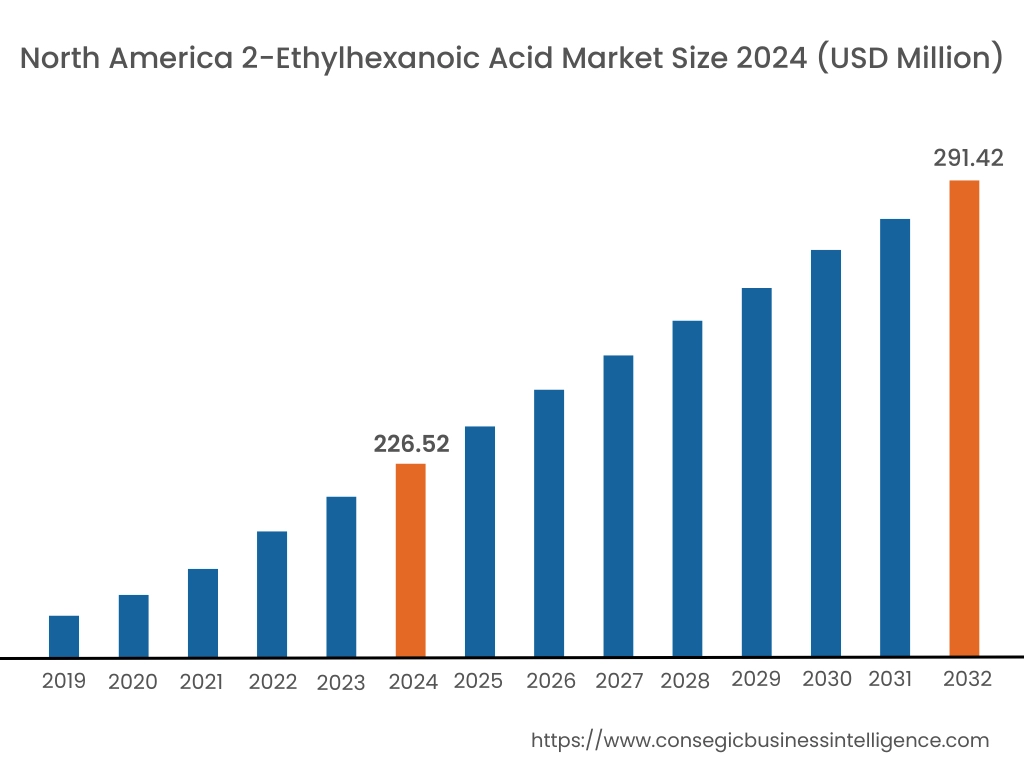
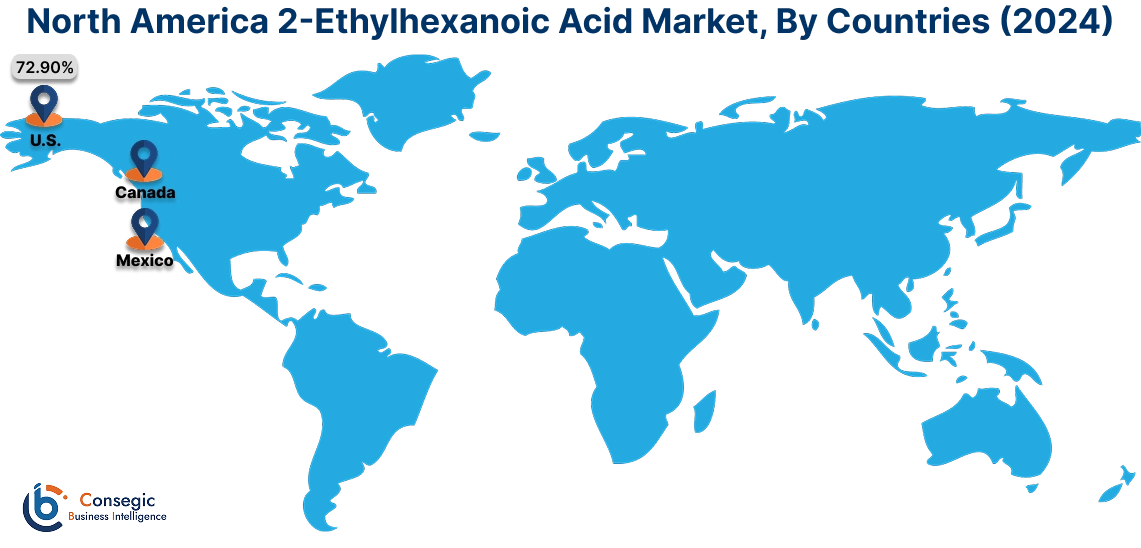
In 2024, North America was valued at USD 226.52 Million and is expected to reach USD 291.42 Million in 2032. In North America, the U.S. accounted for the highest share of 72.90% during the base year of 2024. According to the 2-ethylhexanoic acid market analysis, North America holds a significant share, driven by its extensive application in industries such as automotive, chemicals, and coatings. The U.S. leads the regional trends due to high opportunity for 2-ethylhexanoic acid as a stabilizer in PVC production, as well as its use in synthetic lubricants and metal catalysts. The region’s strong automotive manufacturing base and emphasis on high-performance coatings further enhance the market. Canada contributes through its expanding chemical and coatings industries, particularly in industrial and construction applications. However, environmental regulations surrounding volatile organic compounds (VOCs) and chemical safety may pose challenges to the 2-ethylhexanoic acid market expansion.
In Asia Pacific, the market is experiencing the fastest growth with a CAGR of 3.9% over the forecast period. Asia-Pacific is the largest and fastest-growing region in the 2-ethylhexanoic acid market analysis, fueled by rapid industrialization, urbanization, and expanding automotive and construction sectors in China, India, and Japan. China leads the region with significant use in PVC stabilizers, lubricants, and coatings, driven by its large-scale manufacturing and construction industries. India’s growing automotive and building sectors are increasing the adoption of 2-ethylhexanoic acid in coatings and adhesives. Japan focuses on high-quality applications in electronics and automotive lubricants. However, fluctuating raw material costs and environmental concerns over chemical manufacturing may impact market dynamics in the region.
Europe is a prominent market for 2-ethylhexanoic acid, supported by a well-developed chemical sectors and stringent environmental regulations. Countries like Germany, France, and the UK are major contributors. Germany’s automotive sector drives the use of 2-ethylhexanoic acid in synthetic lubricants and high-performance coatings, while France focuses on its application in the production of plasticizers and catalysts. The UK sees increasing adoption in coatings for industrial and construction purposes, particularly for corrosion resistance. However, strict EU regulations on chemical use and environmental sustainability can increase production costs and compliance challenges for manufacturers.
The Middle East & Africa region is witnessing steady growth in the 2-ethylhexanoic acid market, primarily driven by increasing industrialization and infrastructure development. Countries like Saudi Arabia and the UAE are leveraging 2-ethylhexanoic acid in construction coatings and metal catalysts for petrochemical processes. In Africa, South Africa is an emerging market with growing use in industrial lubricants and coatings to support expanding industrial operations. However, limited local manufacturing capabilities and dependency on imports for raw materials and finished products may hinder broader market development in the region.
Latin America is an emerging market for 2-ethylhexanoic acid, with Brazil and Mexico leading the region. Brazil’s strong chemical and automotive industries utilize 2-ethylhexanoic acid in coatings, lubricants, and PVC stabilizers. Mexico’s growing construction and industrial sectors support its use in high-performance coatings and adhesives. The region is also seeing increased interest in bio-based alternatives for chemical production to align with global sustainability trends. However, economic instability and inconsistent regulatory frameworks across countries may pose challenges to market growth.
Top Key Players & Market Share Insights:
The 2-ethylhexanoic acid market is highly competitive with major players providing products and services to the national and international markets. Key players are adopting several strategies in research and development (R&D), product innovation, and end-user launches to hold a strong position in the global 2-ethylhexanoic acid market. Key players in the 2-ethylhexanoic acid industry include -
- BASF SE (Germany)
- Perstorp Group (Sweden)
- Yancheng Hongtai Bioengineering Co., Ltd. (China)
- Haihang Industry Co., Ltd. (China)
- Nease Co. LLC (USA)
- KH Neochem Co., Ltd. (Japan)
- Eastman Chemical Company (USA)
- OXEA GmbH (Germany)
- Shenyang Zhangming Chemical Co., Ltd. (China)
- Elekeiroz S.A. (Brazil)
Recent Industry Developments :
Product launch:
In 2024, Perstorp launched its 2-Ethylhexanoic Acid Pro, a sustainable alternative to traditional 2-Ethylhexanoic Acid. This new product is part of the company’s Pro-Environment Solutions initiative, designed to reduce the environmental impact of chemical production. The sustainable version is produced using renewable feedstocks, aligning with global trends toward eco-friendly materials. 2-Ethylhexanoic Acid Pro maintains high performance in applications such as PVC stabilization, lubricants, and coatings while offering a reduced carbon footprint. This development reflects the industry's increasing focus on sustainability, with Perstorp leading the way in providing greener solutions for various industrial sectors.
2-Ethylhexanoic Acid Market Report Insights:
| Report Attributes | Report Details |
| Study Timeline | 2019-2032 |
| Market Size in 2032 | USD 899.17 Million |
| CAGR (2025-2032) | 3.5% |
| By Grade |
|
| By Application |
|
| By End-User Industry |
|
| By Region |
|
| Key Players |
|
| North America | U.S. Canada Mexico |
| Europe | U.K. Germany France Spain Italy Russia Benelux Rest of Europe |
| APAC | China South Korea Japan India Australia ASEAN Rest of Asia-Pacific |
| Middle East and Africa | GCC Turkey South Africa Rest of MEA |
| LATAM | Brazil Argentina Chile Rest of LATAM |
| Report Coverage |
|
Key Questions Answered in the Report
What is the projected market size of the 2-Ethylhexanoic Acid Market by 2032? −
2-Ethylhexanoic Acid Market size is estimated to reach over USD 899.17 Million by 2032 from a value of USD 682.88 Million in 2024 and is projected to grow by USD 694.61 Million in 2025, growing at a CAGR of 3.5% from 2025 to 2032.
What factors are driving the growth of the 2-Ethylhexanoic Acid Market? +
The increasing use of 2-ethylhexanoic acid in metal carboxylates, catalysts, and lubricants, coupled with its expanding applications in the automotive, construction, and chemical industries, are key drivers of the market.
What are the primary applications of 2-ethylhexanoic acid? +
The acid is widely used in paints dryers, plasticizers, lubricants, metal soaps, and adhesives, with the paints dryers segment holding the largest market share due to its critical role in enhancing drying efficiency.
Which grade of 2-ethylhexanoic acid dominates the market? +
The industrial grade segment accounts for the largest share due to its broad applicability in manufacturing processes, particularly in the automotive, construction, and chemical industries.
What challenges does the market face? +
Health and safety concerns associated with handling 2-ethylhexanoic acid, coupled with stringent environmental regulations, present significant challenges for manufacturers.
Overview
Reputation & Certifications


Our Services
- Market Intelligence & Forecasting
- Custom Research Solutions
- Market Entry Strategy
- Competitive Intelligence
- Customer Insights
- Industry Innovation Analysis
- Investment Advisory