Jump to Content
Adaptive Lighting System Market - Size, Share, Industry Trends, and Forecasts (2025-2032)
Adaptive Lighting System Market Size:
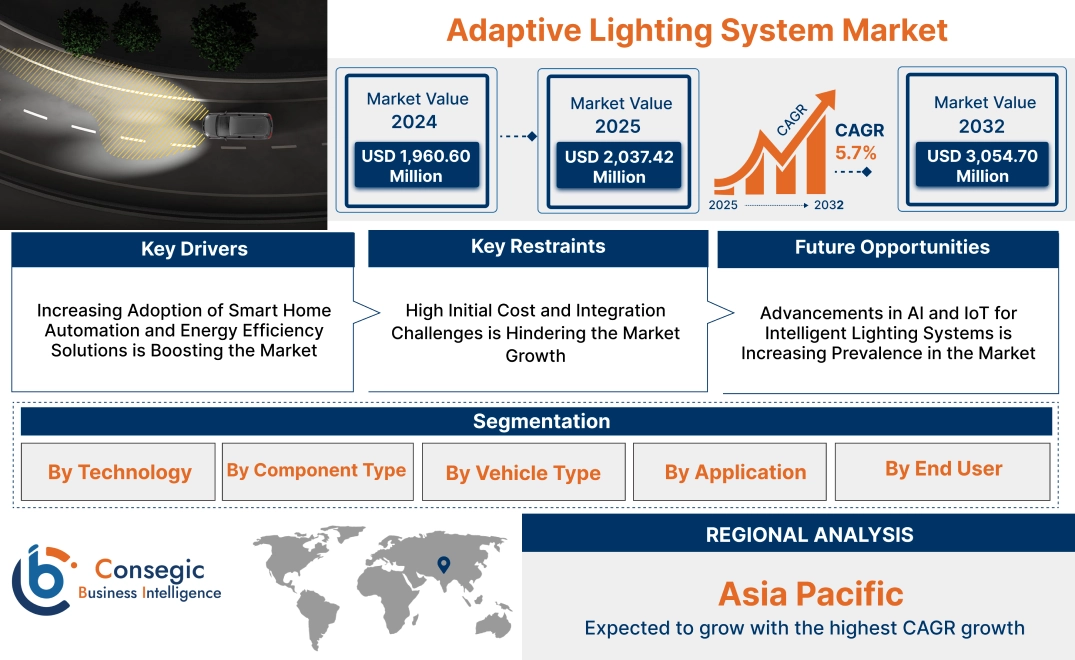
Adaptive Lighting System Market size is estimated to reach over USD 3,054.70 Million by 2032 from a value of USD 1,960.60 Million in 2024 and is projected to grow by USD 2,037.42 Million in 2025, growing at a CAGR of 5.7% from 2025 to 2032.
Adaptive Lighting System Market Scope & Overview:
Adaptive lighting systems are advanced lighting solutions designed to adjust light intensity, color, and distribution based on environmental conditions, user preferences, or pre-programmed settings. These systems leverage technologies such as sensors, IoT integration, and AI algorithms to optimize lighting for energy efficiency, comfort, and functionality. Adaptive lighting systems are widely used in residential, commercial, industrial, and automotive sectors to enhance user experience and reduce energy consumption.
Key characteristics of adaptive lighting systems include real-time lighting adjustment, energy-saving capabilities, and compatibility with smart homes and building automation platforms. The benefits include reduced energy costs, improved productivity, enhanced safety, and tailored lighting experiences for various applications.
Applications span smart homes, office spaces, industrial facilities, street lighting, and automotive interiors and exteriors. End-users include homeowners, building managers, municipalities, and automotive manufacturers, driven by rising demand for energy-efficient solutions, advancements in smart lighting technologies, and the growing adoption of sustainable and connected lighting systems.
Adaptive Lighting System Market Dynamics - (DRO) :
Key Drivers:
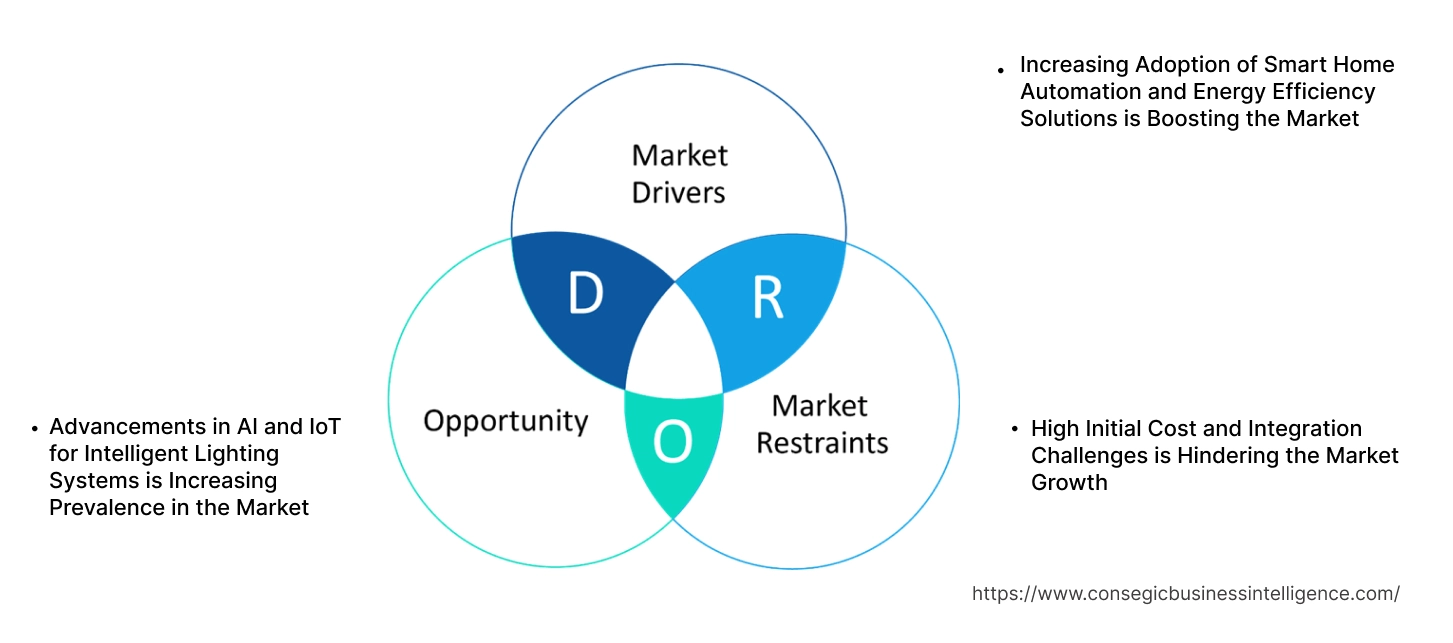
Increasing Adoption of Smart Home Automation and Energy Efficiency Solutions is Boosting the Market
The growing integration of smart home automation systems and the rising need for energy-efficient lighting solutions are significant drivers for the adaptive lighting system market. Adaptive lighting systems adjust brightness and color temperature based on real-time conditions such as natural light availability, time of day, and user preferences. These systems contribute to energy savings by reducing unnecessary electricity consumption and enhancing user comfort. The adoption of smart lighting solutions is particularly high in residential and commercial sectors, driven by advancements in IoT and AI technologies.
Additionally, government initiatives promoting energy efficiency and sustainability, such as tax incentives and rebates for smart lighting installations, are further propelling the market's growth.
Key Restraints:
High Initial Cost and Integration Challenges is Hindering the Market Growth
Despite their advantages, the adoption of adaptive lighting systems is hindered by high initial installation costs and challenges associated with integrating these systems into existing infrastructure. Advanced adaptive lighting solutions often require sophisticated sensors, controllers, and connectivity modules, which increase upfront expenses, making them less accessible to cost-sensitive markets. Furthermore, retrofitting older buildings with adaptive lighting technology can be complex and time-consuming, requiring significant modifications to electrical systems. These factors limit market penetration, particularly in regions with underdeveloped infrastructure or lower disposable incomes.
Future Opportunities :
Advancements in AI and IoT for Intelligent Lighting Systems is Increasing Prevalence in the Market
Advancements in artificial intelligence (AI) and Internet of Things (IoT) technologies present significant opportunities for the adaptive lighting system market. AI-powered adaptive lighting solutions can analyze user behavior, environmental conditions, and energy usage patterns to provide highly personalized and efficient lighting experiences. IoT integration allows seamless connectivity between lighting systems and other smart home or building devices, enabling centralized control and automation. Additionally, the adoption of wireless communication protocols like Zigbee, Z-Wave, and Bluetooth is simplifying installation processes, and making adaptive lighting solutions more accessible to a broader audience. Innovations such as voice-activated controls and real-time analytics further enhance user convenience, driving demand in residential, commercial, and industrial sectors.
These dynamics highlight the increasing importance of adaptive lighting systems in modern energy-efficient and smart building designs. While cost and integration challenges persist, advancements in AI and IoT technologies, coupled with growing awareness of sustainability, are driving significant opportunities for innovation and adaptive lighting system market expansion.
Adaptive Lighting System Market Segmental Analysis :
By Technology:
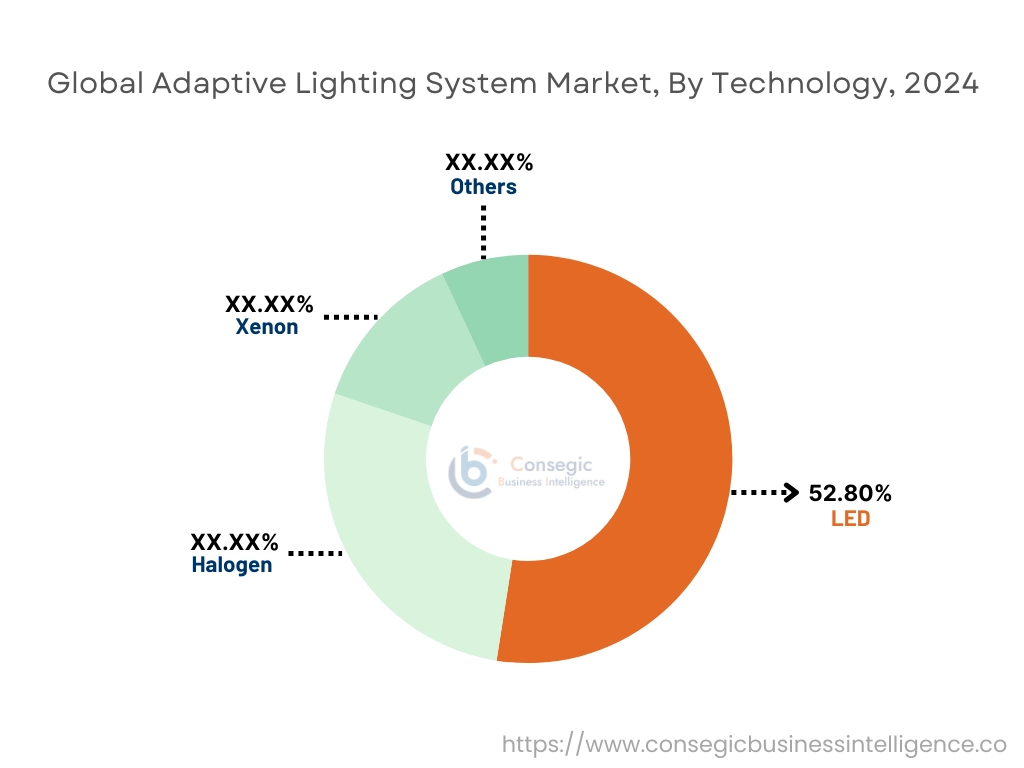
Based on technology, the market is segmented into halogen, LED, xenon, and others.
The LED segment accounted for the largest revenue in the adaptive lighting system market share of 52.80% in 2024.
- LED technology is widely adopted in adaptive lighting systems due to its energy efficiency, longer lifespan, and superior illumination.
- Increasing adaptive lighting system market opportunities for advanced and stylish automotive lighting solutions support the trends of LED technology.
- Rising adoption of LEDs in both exterior and interior lighting applications drives segment growth.
- Ongoing innovations, such as matrix LED systems and dynamic lighting features, further enhance market potential.
The xenon segment is anticipated to register the fastest CAGR during the forecast period.
- Xenon lighting offers high-intensity illumination, making it suitable for adaptive headlight systems in premium vehicles.
- The increasing prevalence of enhanced visibility and safety features in luxury vehicles propels adaptive lighting system market growth in this segmental analysis.
- Advancements in xenon technology for reduced power consumption and better performance support market extension.
- Growing automotive production in emerging markets with a focus on premium features boosts adaptive lighting system market trends for xenon lighting systems.
By Component Type:
Based on component type, the market is segmented into controllers, sensors/cameras, lamp assemblies, and others.
The sensors/camera segment accounted for the largest revenue share in 2024.
- Sensors and cameras are integral to adaptive lighting systems, enabling real-time adjustments based on driving conditions and surroundings.
- Increasing integration of advanced driver-assistance systems (ADAS) enhances the adoption of sensor-based adaptive lighting.
- Rising demand for safety-focused automotive technologies drives trends in this segment’s analysis.
- Advancements in sensor technologies, such as infrared and LiDAR, further boost market potential.
The controller segment is anticipated to register the fastest CAGR during the forecast period.
- Controllers are essential for processing input from sensors and cameras to adjust lighting patterns dynamically.
- Increasing adoption of smart and programmable controllers in adaptive lighting systems enhances functionality and efficiency.
- Growing trends for electric and autonomous vehicles, which require sophisticated control systems, support growth.
- Technological advancements in compact and integrated controller designs drive segment expansion.
By Vehicle Type:
Based on vehicle type, the market is segmented into passenger cars, commercial vehicles, and electric vehicles (EVs).
The passenger cars segment accounted for the largest revenue in the adaptive lighting system market share in 2024.
- Passenger cars dominate the market due to the high adoption of adaptive lighting systems in mid-range and luxury car segments.
- Increasing consumer preference for vehicle safety and comfort features supports this segment’s trends.
- Rising production of passenger cars globally and increasing penetration of advanced lighting technologies boost advancement.
- Government regulations mandating advanced safety features in passenger vehicles further drive adaptive lighting system market demand.
The electric vehicles (EVs) segment is anticipated to register the fastest CAGR during the forecast period.
- EV manufacturers increasingly adopt adaptive lighting systems to enhance safety and energy efficiency.
- Growing demand for innovative and sustainable automotive technologies supports growth in the EV segment.
- Rising global EV production and increasing investments in advanced lighting solutions for EVs propel market expansion.
- Collaboration between lighting system manufacturers and EV makers to integrate adaptive lighting enhances market potential.
By Application:
Based on application, the market is segmented into exterior lighting (adaptive headlights, taillights, daytime running lights [DRLs]) and interior lighting (ambient lighting, dashboard illumination).
The exterior lighting segment accounted for the largest revenue share in 2024.
- Exterior lighting, particularly adaptive headlights and taillights is essential for enhancing vehicle visibility and safety.
- Increasing adoption of advanced lighting technologies in DRLs and adaptive headlights drives trends in this segment.
- Rising awareness about road safety and the role of exterior lighting in reducing accidents supports market advancement.
- Technological advancements in dynamic and customizable exterior lighting solutions further bolster rapid trends in this segmental analysis.
The interior lighting segment is anticipated to register the fastest CAGR during the forecast period.
- Interior lighting systems, such as ambient and dashboard illumination, enhance vehicle aesthetics and user experience.
- Increasing focus on luxury and customization in automotive interiors drives appeals for advanced interior lighting solutions.
- Growing adoption of energy-efficient and mood-enhancing lighting technologies supports this segment’s analysis.
- Rising integration of interior lighting with connected car systems and voice control features fuels market advancement.
By End-User:
Based on end-users, the market is segmented into automotive OEMs and aftermarket.
The automotive OEMs segment accounted for the largest revenue share in 2024.
- Automotive OEMs lead the market due to the integration of adaptive lighting systems in vehicles during production.
- Increasing demand for factory-fitted advanced lighting solutions in new vehicles supports this segment’s dominance.
- Collaboration between OEMs and lighting system manufacturers for innovative designs and technologies drives adaptive lighting system market growth.
- Rising global automotive production, especially in emerging markets, boosts market potential for OEMs.
The aftermarket segment is anticipated to register the fastest CAGR during the forecast period.
- The aftermarket offers a wide range of adaptive lighting solutions for vehicle upgrades and replacements, driving adaptive lighting system market demand.
- Increasing consumer interest in retrofitting advanced lighting systems in older vehicles supports development in this segment.
- Expanding the availability of cost-effective aftermarket adaptive lighting solutions enhances accessibility.
- Rising demand for personalized and customizable lighting systems fuels the adaptive lighting system market trends of the aftermarket segment.
Regional Analysis:
The regions covered are North America, Europe, Asia Pacific, the Middle East and Africa, and Latin America.
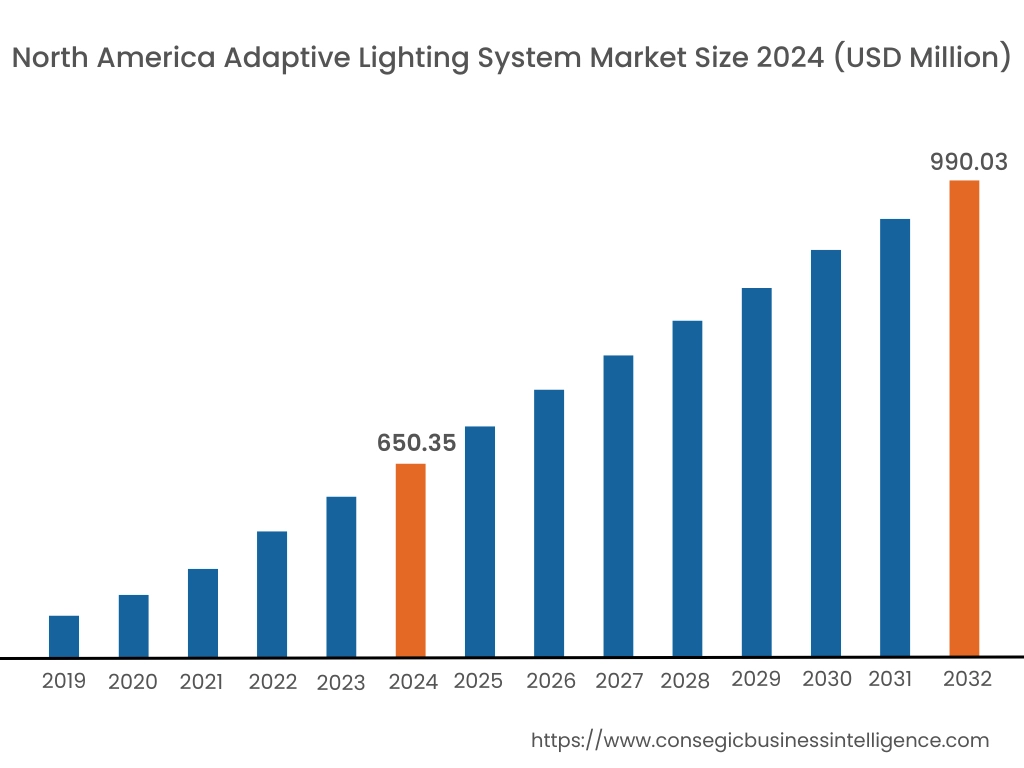
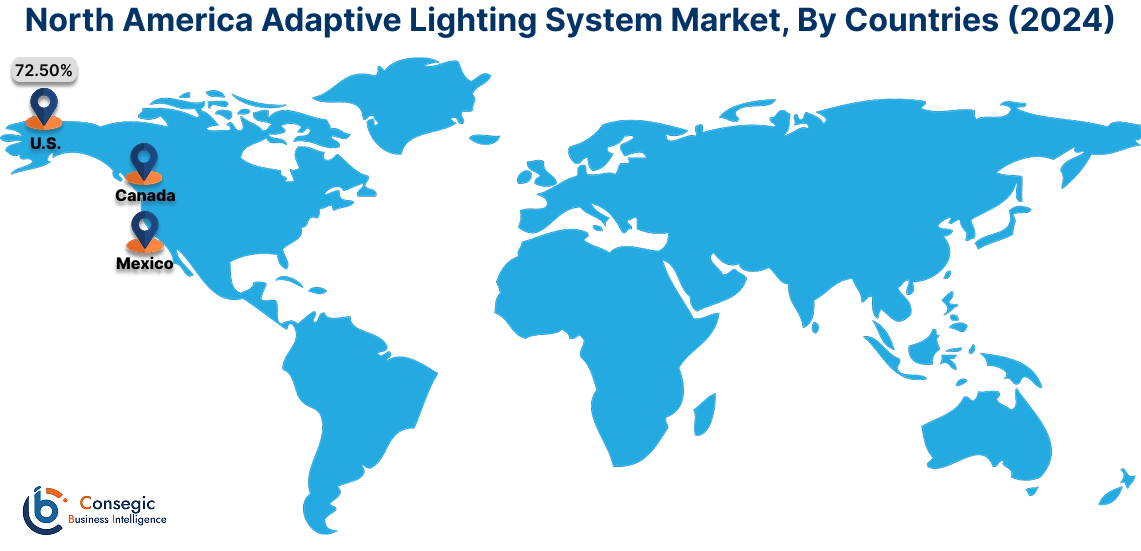
In 2024, North America was valued at USD 650.35 Million and is expected to reach USD 990.03 Million in 2032. In North America, the U.S. accounted for the highest share of 72.50% during the base year of 2024. North America holds a significant share of the global adaptive lighting system market, driven by advancements in automotive technology, rising adoption of smart city projects, and a strong surge for energy-efficient lighting solutions. The U.S. leads the region due to the widespread adoption of adaptive lighting in high-end and electric vehicles, supported by increasing automotive sales and consumer preference for safety and comfort. The rise of smart street lighting projects and government incentives for energy-efficient technologies further bolster the market. Canada contributes to the growing adoption of adaptive lighting in residential and commercial sectors, particularly in smart home setups. However, the high initial costs of implementation may limit adoption among smaller businesses and households.
In Asia Pacific, the market is experiencing the fastest growth with a CAGR of 6.1% over the forecast period. As per the adaptive lighting system market analysis, it is fueled by rapid urbanization, rising vehicle sales, and increasing adoption of smart city projects in China, India, and Japan. China dominates the region with significant appeal for adaptive lighting in both automotive and public infrastructure projects, supported by government-led smart city initiatives. India’s growing automotive industry drives the adoption of cost-effective adaptive lighting technologies, particularly in mid-range vehicles. Japan emphasizes high-quality, precision lighting technologies in advanced automotive systems, leveraging its strong R&D capabilities. However, affordability challenges and limited awareness of advanced lighting systems in rural areas may hinder enlargement in certain parts of the region.
Europe is a prominent market for adaptive lighting systems, supported by strict government regulations on energy efficiency, a growing focus on road safety, and the presence of leading automotive manufacturers. Countries like Germany, the UK, and France are key contributors. Germany drives the market with its strong automotive industry, emphasizing the integration of adaptive lighting in luxury and electric vehicles. The UK focuses on expanding adaptive lighting in public infrastructure, including highways and smart street lighting projects. France invests in energy-efficient lighting for urban spaces, supported by government-led initiatives for sustainability. However, the high cost of advanced lighting technologies may challenge adoption in smaller municipalities.
The Middle East & Africa region is witnessing a steady rise in the adaptive lighting system market, driven by increasing investments in infrastructure development and growing adoption of smart city solutions. Countries like Saudi Arabia and the UAE are adopting adaptive lighting technologies in large-scale urban projects and luxury vehicle markets, supported by government initiatives for energy efficiency. In Africa, South Africa is emerging as a key market, focusing on integrating adaptive lighting in public infrastructure to improve road safety and energy conservation. However, limited access to advanced technologies and high implementation costs may restrict broader market expansion in the region.
Latin America is an emerging market for adaptive lighting systems, with Brazil and Mexico leading the region. Brazil’s expanding automotive sector and growing applications for road safety solutions drive the adoption of adaptive lighting technologies. As per the adaptive lighting system market analysis, Mexico focuses on integrating adaptive lighting in both residential and commercial sectors as part of its efforts to promote energy efficiency and smart infrastructure development. The region also benefits from increasing awareness of sustainable lighting solutions. However, economic instability and inconsistent regulatory frameworks may pose challenges to market advancement in smaller economies.
Top Key Players & Market Share Insights:
The adaptive lighting system market is highly competitive with major players providing products and services to the national and international markets. Key players are adopting several strategies in research and development (R&D), product innovation, and end-user launches to hold a strong position in the global adaptive lighting system market. Key players in the adaptive lighting system industry include -
- Osram GmbH (Germany)
- Signify N.V. (Netherlands)
- Stanley Electric Co., Ltd. (Japan)
- Continental AG (Germany)
- Denso Corporation (Japan)
- Hella GmbH & Co. KGaA (Germany)
- Magneti Marelli S.p.A. (Italy)
- Koito Manufacturing Co., Ltd. (Japan)
- Valeo SA (France)
- Varroc Engineering Ltd. (India)
Recent Industry Developments :
Innovations:
- In July 2024, Forvia Hella and Audi unveiled a groundbreaking digital headlamp concept for the Audi Q6 e-tron. This innovative system features a digital daytime running light matrix, allowing drivers to choose from up to eight preset light signatures, thereby personalizing the vehicle's front appearance. The headlamp design is divided into two sections: the lower part utilizes Matrix LED technology with 14 LEDs to provide adaptive, glare-free high beams, while the upper section comprises 61 individually controllable segments for customizable daytime running lights. This development signifies a significant advancement in adaptive lighting systems, offering enhanced safety and personalization options for electric vehicles.
- In October 2024, Tesla's Vice President of Vehicle Engineering, Lars Moravy, announced that the company is "almost there" in bringing adaptive headlight functionality to the United States.
Adaptive Lighting System Market Report Insights:
| Report Attributes | Report Details |
| Study Timeline | 2019-2032 |
| Market Size in 2032 | USD 3,054.70 Million |
| CAGR (2025-2032) | 5.7% |
| By Technology |
|
| By Component Type |
|
| By Vehicle Type |
|
| By Application |
|
| By End-User |
|
| By Region |
|
| Key Players |
|
| North America | U.S. Canada Mexico |
| Europe | U.K. Germany France Spain Italy Russia Benelux Rest of Europe |
| APAC | China South Korea Japan India Australia ASEAN Rest of Asia-Pacific |
| Middle East and Africa | GCC Turkey South Africa Rest of MEA |
| LATAM | Brazil Argentina Chile Rest of LATAM |
| Report Coverage |
|
Key Questions Answered in the Report
What is the projected market size of the Adaptive Lighting System Market by 2032? −
Adaptive Lighting System Market size is estimated to reach over USD 3,054.70 Million by 2032 from a value of USD 1,960.60 Million in 2024 and is projected to grow by USD 2,037.42 Million in 2025, growing at a CAGR of 5.7% from 2025 to 2032.
What factors are driving the growth of the Adaptive Lighting System Market? +
Key drivers include the rising adoption of smart home automation, energy-efficient solutions, advancements in IoT and AI technologies, and increasing demand for safety-focused automotive lighting systems.
Which technology segment dominates the market? +
The LED segment holds the largest market share due to its energy efficiency, longer lifespan, and wide application in both automotive and smart lighting solutions.
Which region is expected to witness the fastest growth? +
Asia Pacific is projected to experience the fastest growth, driven by urbanization, rising vehicle sales, and significant adoption of smart city initiatives in countries like China, India, and Japan.
Overview
Reputation & Certifications


Our Services
- Market Intelligence & Forecasting
- Custom Research Solutions
- Market Entry Strategy
- Competitive Intelligence
- Customer Insights
- Industry Innovation Analysis
- Investment Advisory