Jump to Content
RFID Printer Market - Size, Share, Industry Trends, and Forecasts (2025 - 2032)
RFID Printer Market Size:
RFID Printer Market size is estimated to reach over USD 2,794.37 Million by 2032 from a value of USD 1,745.38 Million in 2024 and is projected to grow by USD 1,820.05 Million in 2025, growing at a CAGR of 6.1% from 2025 to 2032.
RFID Printer Market Scope & Overview:
An RFID printer is a specialized device used to print information on labels embedded with radio-frequency identification (RFID) tags. These printers combine printing and encoding capabilities, allowing them to create labels that store data and be scanned wirelessly. The printers are widely utilized in industries such as logistics, retail, healthcare, and manufacturing to enhance inventory management, asset tracking, and operational efficiency.
These printers are available in different configurations, including desktop and industrial-grade models, to cater to varied operational needs. They support multiple printing technologies, such as thermal transfer and direct thermal, ensuring high-quality printing on RFID-enabled labels. With advanced features like connectivity options, compatibility with management software, and user-friendly interfaces, these printers offer reliable performance in demanding environments.
End-users include warehouse operators, retail businesses, and healthcare providers, where accurate and efficient tagging and tracking are critical. These devices play a vital role in streamlining processes and improving accuracy in data collection and asset management.
How is AI Transforming the RFID Printer Market?
AI transforms the RFID printer market by enhancing operations through predictive analytics, real-time decision-making, and automation. Also, AI automates complex tasks, streamlines workflows, and reduces the need for human intervention in processes like error detection, prepress, and proofing. Additionally, AI-powered RFID systems provide instant data on asset locations, inventory levels, and supply chain status, enabling managers to make agile, informed decisions in fast-paced environments. Hence, AI integration improves tag quality control, optimizes inventory management, strengthens security by detecting fraud, and enables intelligent automation within IoT ecosystems, ultimately leading to increased efficiency, reduced costs, and greater scalability for businesses across various sectors.

RFID Printer Market Dynamics - (DRO) :
Key Drivers:
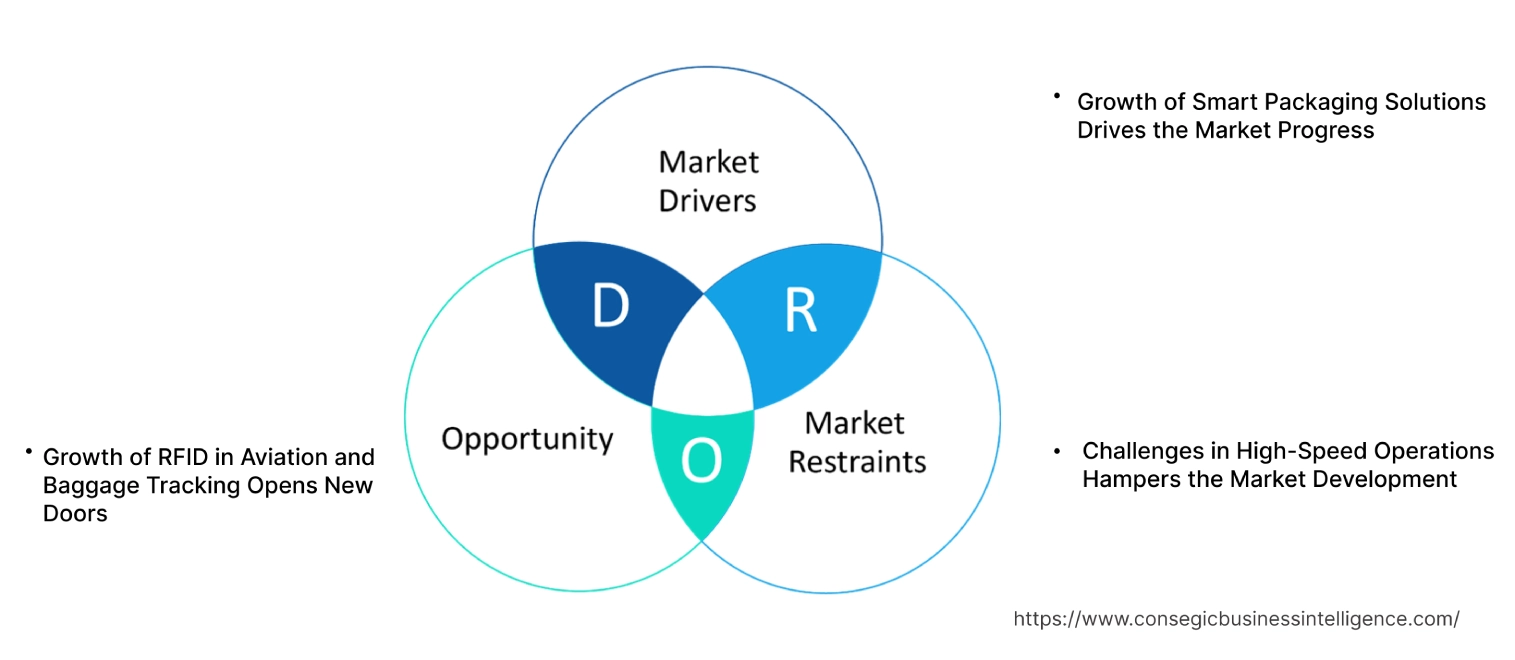
Growth of Smart Packaging Solutions Drives the Market Progress
The increasing adoption of smart packaging across industries like food and beverage and pharmaceuticals is significantly boosting the need for RFID printing solutions. Smart packaging incorporates advanced features such as real-time tracking, data storage, and supply chain transparency, ensuring enhanced product safety and compliance with regulatory standards. RFID-enabled smart packaging allows businesses to monitor inventory levels, verify product authenticity, and track shipments in real-time, improving operational efficiency and customer satisfaction. In the pharmaceutical sector, these solutions ensure compliance with stringent guidelines for drug tracking and anti-counterfeiting measures. Similarly, in the food sector, RFID tags provide critical data on product freshness and transportation conditions. The integration of RFID printing with smart packaging aligns with global trends in intelligent packaging, offering companies a competitive edge by meeting modern consumer expectations and regulatory demands. This growing trend positions RFID printing as a vital component in the evolution of supply chain technologies. Thus, the aforementioned factors are driving the RFID printer market growth.
Key Restraints:
Challenges in High-Speed Operations Hampers the Market Development
High-speed operations in RFID printers lead to several issues that impact the accuracy and reliability of the output. Encoding errors are a primary concern, where RFID tags are improperly programmed, resulting in unreadable or faulty tags that disrupt inventory and tracking processes. Additionally, misalignment in printing occurs due to the rapid movement of labels, causing smearing or incorrect placement of printed information, which compromises label legibility and usability. Synchronization issues between the encoding and printing processes further exacerbate these problems, leading to mismatched or incomplete labels. These constraints highlight the limitations of high-speed RFID printers in maintaining precision and quality, particularly in industries requiring flawless tracking and identification systems. Addressing these issues often necessitates additional quality checks, slowing operations and increasing costs. Therefore, the above mentioned factors are hindering the RFID printer market demand.
Future Opportunities :
Growth of RFID in Aviation and Baggage Tracking Opens New Doors
The aviation sector is witnessing a significant shift toward RFID technology for baggage tracking, aiming to improve operational efficiency and minimize mishandling. RFID printers are integral to this process, enabling the precise encoding and printing of RFID tags for seamless baggage monitoring. These tags allow airlines to track luggage in real time, reducing lost or delayed baggage incidents and ensuring a smoother passenger experience. The adoption of RFID-based solutions aligns with global aviation trends emphasizing digital transformation and enhanced customer service. Furthermore, regulatory bodies, such as the International Air Transport Association (IATA), are advocating the use of RFID for baggage tracking to meet efficiency and sustainability goals. By providing reliable encoding capabilities, RFID printers are critical in driving this transition, supporting the aviation sector’s push toward smarter and more passenger-centric operations. This trend is expected to bolster the need for advanced RFID printing solutions in the sector, creating significant RFID printer market opportunities.
RFID Printer Market Segmental Analysis :
By Printer Type:
Based on printer type, the market is segmented into industrial printers, desktop printers, mobile printers, and others.
The industrial printers segment held the largest revenue of the total RFID printer market share in 2024.
- Industrial printers are widely used in high-volume operations, such as manufacturing and logistics, due to their durability and efficiency in producing large batches of RFID tags.
- These printers offer advanced capabilities, including high-speed printing and encoding, making them suitable for demanding environments.
- The dominance of industrial printers is driven by their ability to operate in harsh conditions, ensuring consistent performance and minimal downtime.
- As per RFID printer market analysis, the increased adoption of industrial printers in sectors like transportation and supply chain management supports their market leadership.
The mobile printers segment is expected to grow at the fastest CAGR during the forecast period.
- Mobile printers offer portability and ease of use, enabling on-the-go RFID tag printing for field operations and small-scale logistics.
- Their application in healthcare and retail environments for inventory tracking and patient identification is driving adoption.
- These printers are increasingly integrated with wireless connectivity, enhancing their functionality and compatibility with modern systems.
- The segment's growth is fueled by the rising need for flexible and compact printing solutions across diverse industries, contributing to the RFID printer market expansion.
By Printing Technology:
Based on printing technology, the market is categorized into direct thermal, thermal transfer, inkjet, laser, and others.
The thermal transfer segment held the largest revenue of the total RFID printer market share in 2024.
- Thermal transfer printers are preferred for long-lasting, durable RFID labels that can withstand environmental challenges.
- Their application in industries such as logistics, healthcare, and automotive for asset tracking and inventory management drives their demand.
- These printers support high-resolution printing, ensuring precise and clear labeling for RFID tags.
- As per RFID printer market trends, the durability and versatility of thermal transfer technology contribute to its widespread adoption across industries.
The direct thermal segment is projected to grow at the fastest CAGR during the forecast period.
- Direct thermal printers are widely used for short-term labeling needs, such as ticketing and retail applications.
- Their cost-effectiveness and simplicity in operation make them attractive to small and medium enterprises (SMEs).
- The segment's growth is supported by advancements in direct thermal technology, ensuring compatibility with RFID encoding.
- Thus, as per the market analysis, the increasing preference for eco-friendly printing solutions further drives the adoption of direct thermal printers, fueling the RFID printer market demand.
By Frequency:
Based on frequency, the market is segmented into low frequency (LF), high frequency (HF), and ultra-high frequency (UHF).
The ultra-high frequency (UHF) segment accounted for the largest revenue share in 2024.
- UHF RFID technology is ideal for long-range applications, including asset tracking, logistics, and supply chain management.
- Its ability to read multiple tags simultaneously enhances operational efficiency in high-volume environments.
- UHF tags are widely used in retail for inventory management, contributing to the segment's dominance.
- The segment's leadership is supported by the integration of UHF printers with IoT-enabled systems for real-time tracking, which further boosts the RFID printer market growth.
The high frequency (HF) segment is expected to grow at the fastest CAGR during the forecast period.
- HF RFID technology is favored for applications requiring precise and secure data transmission, such as contactless payment and access control.
- The adoption of HF printers in healthcare and government sectors for ID cards and medical equipment tracking supports the segment's growth.
- HF tags offer higher memory capacity, making them suitable for complex data storage needs.
- Therefore, the rising adoption of HF solutions for smart ticketing and library management drives the segment's expansion, fueling the RFID printer market opportunities.
By End-User Industry:
Based on end-user industry, the market is segmented into retail, healthcare, logistics & transportation, manufacturing, government, and others.
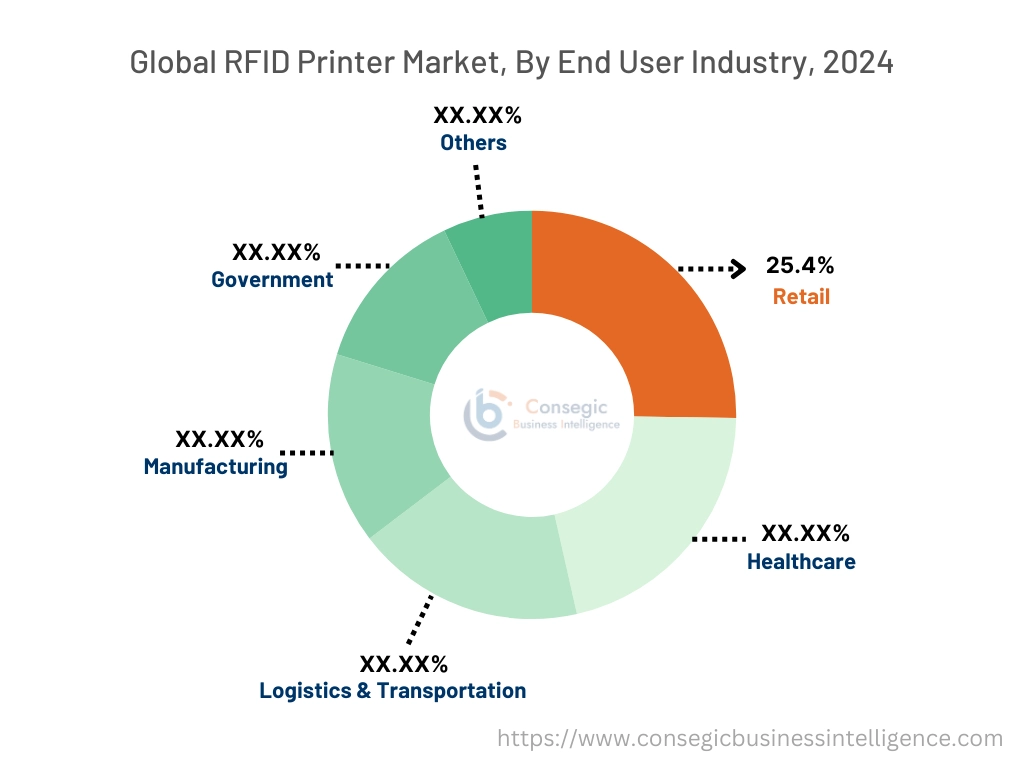
The retail segment held the largest revenue of 25.4% share in 2024.
- RFID printers are extensively used in retail for inventory management, enabling real-time visibility and reducing stockouts.
- Retailers leverage these printers for efficient item-level tagging, enhancing customer service and operational efficiency.
- The segment's dominance is driven by the widespread adoption of RFID solutions for loss prevention and supply chain optimization.
- As per RFID printer market analysis, the integration of RFID printers with point-of-sale (POS) systems further solidifies their application in retail.
The healthcare segment is projected to grow at the fastest CAGR during the forecast period.
- RFID printers are used in healthcare for patient identification, equipment tracking, and medication labeling, ensuring safety and compliance.
- The adoption of RFID technology for improving workflow efficiency in hospitals and clinics supports the segment's progression.
- Increased focus on digital healthcare and smart hospitals drives the demand for advanced RFID printing solutions.
- The healthcare segment's rapid growth is fueled by government initiatives promoting patient safety and traceability in medical operations, driving the RFID printer market expansion.
Regional Analysis:
The regions covered are North America, Europe, Asia Pacific, the Middle East and Africa, and Latin America.
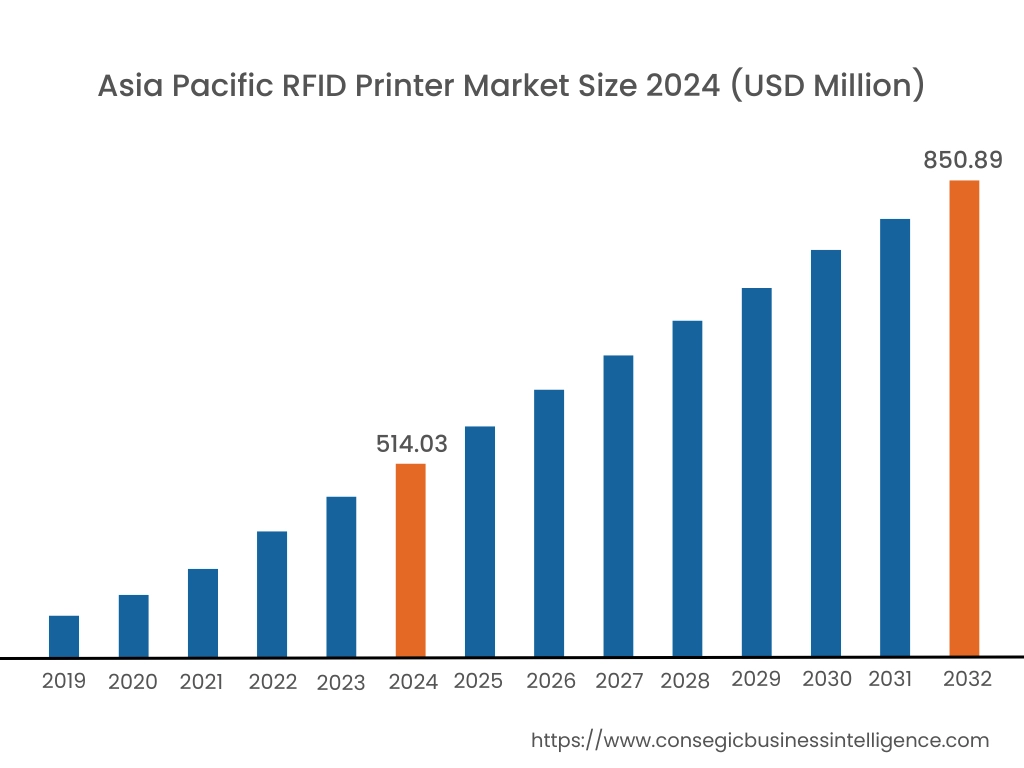
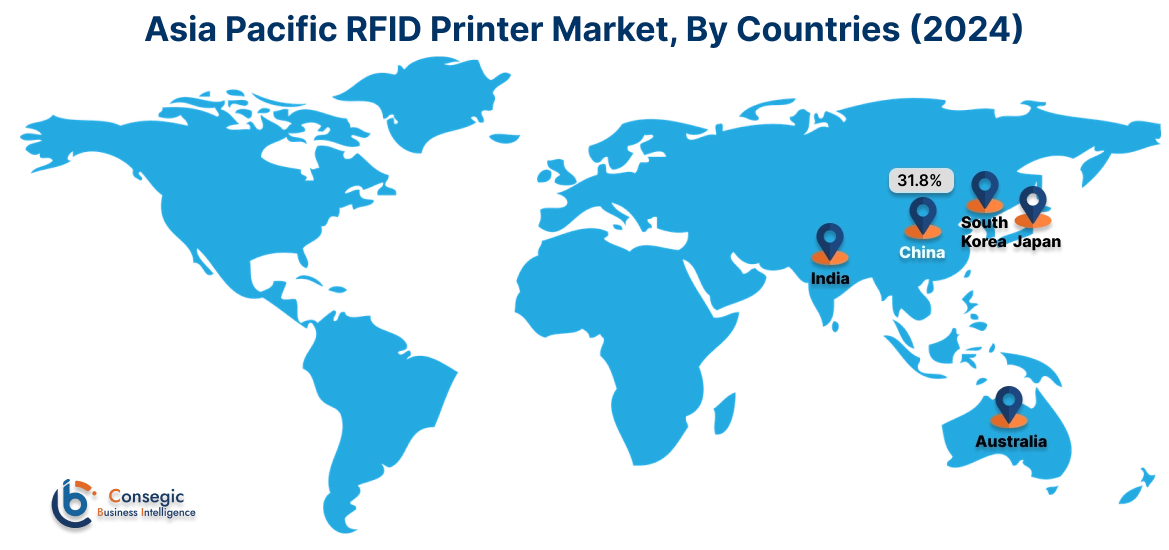
Asia Pacific region was valued at USD 514.03 Million in 2024. Moreover, it is projected to grow by USD 537.54 Million in 2025 and reach over USD 850.89 Million by 2032. Out of this, China accounted for the maximum revenue share of 31.8%. The Asia-Pacific region is experiencing rapid development in the RFID printer market, driven by industrialization and technological advancements in countries such as China, Japan, and India. The expansion of the retail and manufacturing sectors and the rising need for efficient inventory management have intensified the need for advanced RFID printing solutions. As per the RFID printer market trends, government initiatives promoting industrial efficiency further influence market progress.
North America is estimated to reach over USD 905.66 Million by 2032 from a value of USD 578.96 Million in 2024 and is projected to grow by USD 602.57 Million in 2025. This region holds a substantial share of the RFID printer market, driven by the increasing adoption of advanced inventory and supply chain management solutions. The United States, in particular, has seen a rise in the implementation of RFID technology across sectors such as retail and healthcare. A notable trend is the integration of RFID technology into label printing systems to improve efficiency and accuracy in supply chain management. Analysis indicates that the market is projected to grow significantly in the coming years, with continuous technological advancements driving innovation.
Europe represents a substantial portion of the global RFID printer market, with countries like Germany, France, and the United Kingdom leading in adoption and innovation. The region's emphasis on sustainability and energy efficiency has propelled the utilization of eco-friendly RFID printing solutions. Analysis indicates a growing trend towards the deployment of RFID printers in various applications, offering flexibility across multiple sectors.
The Middle East & Africa region shows a growing interest in advanced RFID solutions, particularly in the construction and industrial sectors. Countries like Saudi Arabia and South Africa are investing in modern technologies to enhance production efficiency. Analysis suggests an increasing trend towards adopting RFID printers to meet international quality standards.
Latin America is an emerging market for RFID printers, with Brazil and Mexico being key contributors. The region's growing focus on industrial modernization and the automotive sector has spurred the adoption of advanced RFID solutions. Government policies aimed at enhancing manufacturing capabilities influence market trends.
Top Key Players and Market Share Insights:
The RFID Printer market is highly competitive with major players providing products and services to the national and international markets. Key players are adopting several strategies in research and development (R&D), product innovation, and end-user launches to hold a strong position in the global RFID Printer market. Key players in the RFID Printer industry include -
- Zebra Technologies Corporation (USA)
- SATO Holdings Corporation (Japan)
- Honeywell International Inc. (USA)
- Toshiba Tec Corporation (Japan)
- Avery Dennison Corporation (USA)
- Printronix Auto ID (USA)
- TSC Printers (Taiwan)
- Postek Electronics Co., Ltd. (China)
- BIXOLON Co., Ltd. (South Korea)
- Godex International Co., Ltd. (Taiwan)
Recent Industry Developments :
- In September 2024, Atlas RFID Solutions Store (atlasRFIDstore) has partnered with TSC Printronix Auto ID to enhance its RFID and barcode printer offerings. The partnership introduces TSC’s mobile, desktop, industrial, and enterprise printers, including the high-performance T6000e series, which supports direct thermal and thermal transfer printing at speeds up to 14 inches per second. With 10 new printers, 16 ribbon and label options, and 8 accessories, this collaboration offers customers innovative, cost-effective printing solutions.
Product Enhancements:
- In December 2023, Chainway launched the upgraded CP30 RFID printer, featuring a self-developed RFID chip for enhanced performance and stability. Supporting thermal and thermal transfer printing, it achieves speeds up to 8ips (203dpi). A 3.5-inch LCD touchscreen and diverse connectivity options, including Bluetooth 4.0 and Ethernet, ensure user convenience. Designed for asset management, healthcare, logistics, and more, the CP30 efficiently handles small labels and RFID tags, offering robust and versatile printing capabilities.
RFID Printer Market Report Insights :
| Report Attributes | Report Details |
| Study Timeline | 2019-2032 |
| Market Size in 2032 | USD 2,794.37 Million |
| CAGR (2025-2032) | 6.1% |
| By Printer Type |
|
| By Printing Technology |
|
| By Frequency |
|
| By End-User Industry |
|
| By Region |
|
| Key Players |
|
| North America | U.S. Canada Mexico |
| Europe | U.K. Germany France Spain Italy Russia Benelux Rest of Europe |
| APAC | China South Korea Japan India Australia ASEAN Rest of Asia-Pacific |
| Middle East and Africa | GCC Turkey South Africa Rest of MEA |
| LATAM | Brazil Argentina Chile Rest of LATAM |
| Report Coverage |
|
Key Questions Answered in the Report
What is the size of the RFID Printer Market? −
RFID Printer Market size is estimated to reach over USD 2,794.37 Million by 2032 from a value of USD 1,745.38 Million in 2024 and is projected to grow by USD 1,820.05 Million in 2025, growing at a CAGR of 6.1% from 2025 to 2032.
What are the key segments in the RFID Printer Market? +
The RFID Printer market is segmented by printer type, printing technology, frequency, and end-user industry. Printer types include industrial printers, desktop printers, mobile printers, and others. Printing technologies are categorized into direct thermal, thermal transfer, inkjet, laser, and others. Frequency types include low frequency (LF), high frequency (HF), and ultra-high frequency (UHF). End-user industries include retail, healthcare, logistics & transportation, manufacturing, government, and others.
Which segment in the RFID Printer Market is expected to grow the fastest? +
The mobile printers segment is expected to grow at the fastest CAGR during the forecast period. Mobile printers are gaining traction due to their portability, ease of use, and increased adoption in healthcare and retail sectors for inventory tracking and patient identification.
Who are the key players in the RFID Printer Market? +
Key players in the RFID Printer Market include Zebra Technologies Corporation (USA), SATO Holdings Corporation (Japan), Honeywell International Inc. (USA), Toshiba Tec Corporation (Japan), Avery Dennison Corporation (USA), Printronix Auto ID (USA), TSC Printers (Taiwan), Postek Electronics Co., Ltd. (China), BIXOLON Co., Ltd. (South Korea), and Godex International Co., Ltd. (Taiwan).
Overview
Reputation & Certifications


Our Services
- Market Intelligence & Forecasting
- Custom Research Solutions
- Market Entry Strategy
- Competitive Intelligence
- Customer Insights
- Industry Innovation Analysis
- Investment Advisory