Jump to Content
Herbal Beauty Products Market - Size, Industry Share, Growth Trends and Forecasts 2025-2034
Market Scope & Overview
The world market of herbal beauty products includes skincare products, haircare solutions, cosmetics, and personal care products based on herbal and botanical extracts, essential oils, and natural compounds that promote beauty, wellness and personal care results. The products under this market segment are differentiated by a wide range of categories such as herbal skincare formulations (creams, serums, masks, cleansers), herbal haircare formulations (shampoos, conditioners, treatments), herbal cosmetics and makeup (foundations, lipsticks, mascaras), herbal personal care solutions (soaps, body care, deodorants), organic cosmeceutical Herbal beauty products are a niche within the general beauty and personal care business, characterized by botanical ingredient profiles and natural composition philosophies that separate products out of synthetic chemical-based products.
The market includes applications in various consumer groups such as affluent urbanites that like ingredient transparency and sustainability, ecologically conscious consumers that need to source eco-friendly and sustainable products, health-conscious consumers that want to integrate natural wellness using topical applications, and traditional medicine users and ayurveda enthusiasts that appreciate the time-tested botanical formulation. Geographic markets cover the developed economies such as North America, Western Europe, Japan and Australia and the emerging markets developing at a high rate such as China, India, Southeast Asia, Brazil, Mexico and Middle East regions that have increased purchasing power of the middle classes and penetration of e-commerce.
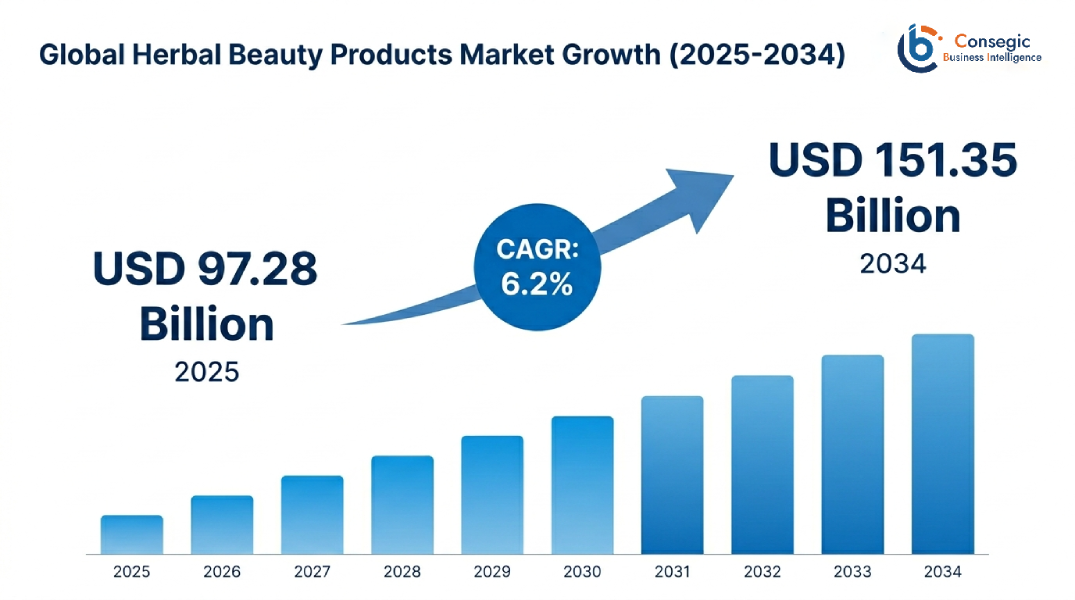
The global market in herbal beauty products is expected to grow to USD 151.35 - 308.69 billion in 2034 with the market increasing at a compound annual growth rate of 6.20 percent to 13.60 percent over the 2026-2034 forecast period. The growth of the market is driven by the increasing consumer demand in the natural and clean beauty solutions based on ingredient transparency and environmental awareness, the technological advances in the botanical extraction and formulation science to increase the efficacy of the herbal products and competitive positioning in the market, the investments of the private equity capital to support the brand consolidation and distribution growth to reach USD 1.1 billion value of the acquisition of the premium skincare.
Key Report Takeaways
- Market growing strongly, reaching USD 151.35 - 308.69 Billion by 2034
- Demand driven by clean, natural, and sustainable beauty trends
- Skincare dominates the segment
- Asia-Pacific leads growth, especially India & China
- E-commerce & D2C are key sales channels
- Tech innovation improving herbal product effectiveness
- Big players like L'Oréal Groupe and Unilever are expanding via acquisitions
- Personalization & premium products are future growth drivers
Market Supply Chain and Industry Structure
The herbal beauty supply model includes botanical sourcing, extraction and processing, ingredient suppliers, contract manufacturing, brand and distribution, and retailing. Vertical integration is moderate with established consumer brands often having proprietary formulation and manufacturing capacity but sourcing raw botanical materials via special ingredient suppliers. The dominant competitive structure in the industry is contract manufacturing relationship wherein specialized herbal beauty manufacturers offer formulation development, production and quality assurance services to brands that do not have internal infrastructure to support the brand.
The sourcing of raw materials is focused on geographical areas where the botanical infrastructure of cultivating is developed. India is the biggest herbal extraction and processing center in the world, producing USD 3.2 billion herbal beauty market worth in 2025 and projected to USD 8.5 billion by 2032 with Southeast Asia, South America, and European regions of herb cultivation coming in second, third, and fourth. Sustainability of supply chains has become an increasingly important concern, as consumers and regulators are now expecting traceability, fair-trade sourcing certification, and environmental stewardship certification of raw materials. This gives competitive advantages to businesses that develop transparent supply chains on botanical sourcing of ethical and sustainable producers.
The competitive environment in the herbal beauty industry is fragmented and has a high consolidation momentum as the major beauty conglomerates acquire specialized herbal companies. The leading seven beauty firms such as L'Oréal (revenue USD 45 billion), Procter and Gamble (revenue USD 82 billion), Unilever, Estee Lauder, Shiseido, Johnson and Johnson, and Coty have large market shares with a variety of brands under their belt. The Indian herbal beauty market displays competitive patterns which establish heritage brands like Himalaya Herbal Healthcare and Dabur Ayurved and Patanjali Ayurved as dominant market forces through their vast distribution systems and brand recognition. New direct-to-consumer herbal brands such as Rosemira Organics and PIPER LILY Skincare and Zakiella use digital marketing and social media influence to position themselves as high-end products while targeting millennial and Generation Z consumers.
Key Growth Drivers
Growing Customer Expectations of Natural and Clean Beauty Solutions.
The market is experiencing consumer preference consolidation towards natural and organic beauty products which is the driving force of market growth. U.S. organic personal care market exhibits a growing pace due to the increasing number of millennials and Generation Z customers who value health-conscious and sustainable product solutions. According to research, 68 percent of consumers proactively investigate ingredient composition and 72 percent are willing to pay high prices due to certified natural and organic formulations. The category of skincare products alone had a valuation of USD 162 billion in 2025 and is expected to grow to USD 222 billion in 2030 at a compound annual growth rate of 6.5 percent with herbal skincare securing an ever-growing market share in the growing overall total.
Innovation of technology and efficiency improvement.
The science of herbal formulation has increased the performance profiles of botanical-based products due to the technological advancement, which has the capability of positioning them across their competitors who are synthetic based products. Newer extraction techniques such as supercritical fluid extraction, nano encapsulation and controlled fermentation processes improve ingredient bioavailability and therapeutic properties. Regulatory acceptance and consumer confidence in herbal formulations has been enhanced by scientific validation by clinical trials and dermatological testing. By 2025, Premium herbal and botanical skincare will be valued at USD 5.3 billion with a future of USD 8.5 billion in 2035, the willingness of consumers to spend on natural formulations supported by science and premium prices is proven.
E-Commerce Spread and Direct-to-Consumer Distributions.
The advent of digital distribution has revolutionized the availability of herbal beauty brands, making independent and up-and-coming brands have direct contact with consumers worldwide. In 2025, e-commerce in beauty and personal care grew to 28-32 percent of the total channel value, and online channels are showing 18-22 percent growth rates, many times higher than that of traditional retail. The social media platforms such as Instagram (billion-plus users), Tik Tok, and YouTube have been the leading customer acquisition channels of herbal beauty brands through influencer marketing strategies that have proven to provide high traffic and conversion rates. Digital platforms that target customers through direct-to-consumer allow new herbal brands to circumvent the traditional retailing structure and create a premium positioning with authentic brand narratives and ingredient disclosure.
Key Restraints and Market Challenges
Costs of Regulatory Compliance and Complexity.
The herbal beauty products have to work through complicated and dynamic regulatory environments in many jurisdictions, posing significant compliance burdens and overhead costs. The variations in natural and organic certification standards in different geographies such as the United States, European Union and Asian markets necessitate different formulation optimization, testing procedures and labeling adjustments. Third party certifications such as USDA Organic (representing USD 65.1 billion organic food market with beauty crossover), COSMOS and EcoCert add additional product development time and certification expenses, which become a hindrance especially to smaller emerging brands. The rising limitations on some botanical ingredients that can be considered as potential allergens or irritants in particular jurisdictions necessitate active changes in formulations and constant control over regulations, raising research and development costs.
Vulnerability in Supply Chain and Constraint of Raw Material.
The variability in climate in the main growing areas of botanical production such as India, China and Southeast Asia instills availability of raw materials and price elasticity. The agricultural methods in botanical-sourcing areas are put under environmental stress and water scarcity factors that restrict the growth of agriculture. The supply chain delays such as transportation delays and port congestions have escalated the cost of ingredients and lengthening of production schedules. The unpredictability of prices of major botanical products such as turmeric (varying 20-35 percent every year), neem, and aloe vera cause operational uncertainties and margin pressure to manufacturers that rely on stable prices of raw materials.
Future Opportunities
Individualized Herbal Formulation.
Biotechnology and artificial intelligence allow the creation of personalized herbal beauty formulations that are specific to each type of skin, concern, and genetic predisposition. Direct-to-consumer genetic testing systems in combination with formulation software enable the development of customized herbal skincare plans, tailored to individual consumer profiles. Such companies as Function of Beauty and others have raised substantial venture capital to pursue personalization strategies. This is where much differentiation can be achieved by herbal beauty brands that develop proprietary formulation algorithms and consumer profiling capabilities and can price their products premium and gain more customer loyalty.
Functional Herbal Beauty Category Extension.
Multifunctional beauty products that contain herbal adaptogens and nootropics and wellness components experience higher market growth potential because their customer base exceeds that of standard skincare and cosmetics products. The wellness market base will grow through herbal cosmetics which use ashwagandha (USD 1.2 billion market in 2025) and rhodiola and passionflower as their foundation to create products that deliver both beauty and health benefits. The market for functional herbal haircare products with scalp-health benefits and botanical products which contain energy-boosting elements functions as an emerging growth category. The wellness market segment which drives 12-15 percent annual growth enables herbal beauty companies to sell their functional formulations at premium prices.
Market Segmentation Analysis
By Product Type: Skincare Dominance and Diversification
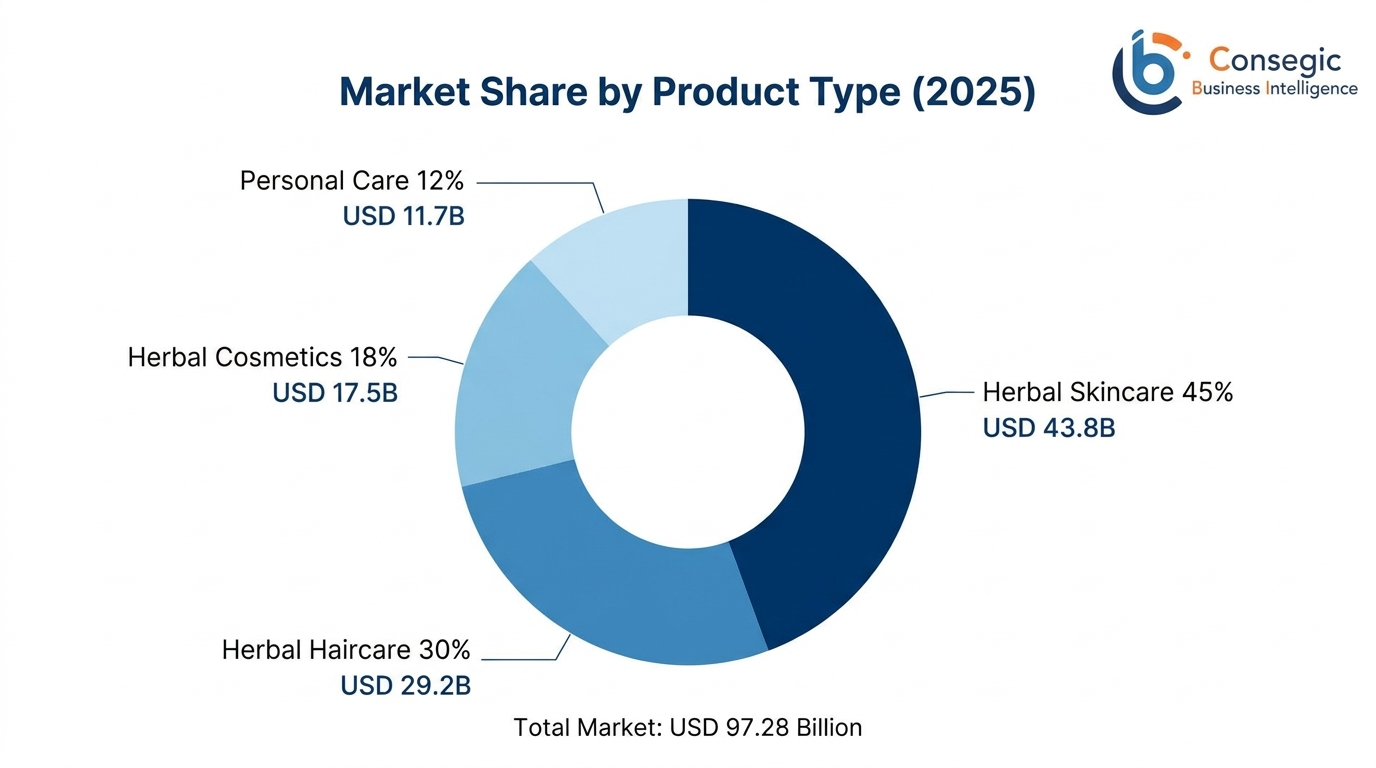
Herbal skincare products prevail market value, with their market value approximated to be 45-48 percent of the overall herbal beauty market value, owing to consumer preference of facial skincare and anti-aging products. The categories of herbal skincare are cleansers and toners (15 percent market share), serums and essences (25 percent share), moisturizers and creams (35 percent share) and masks and treatments (25 percent share). Herbal haircare comprises about 28-30 percent market value, which includes the shampoos, conditioners, scalp treatments, and hair restoration products. Included in the market value of herbal cosmetics and makeup are herbal pigments and botanical actives in foundations, lipsticks, mascaras and color cosmetics, which constitutes 15-18 percent market value. Herbal personal care products such as soaps, body care and deodorants are 10-12 percent market value with potential future growth.
By Product Form: Creams and Serums Leading
Most product form segment has the highest market value at 35-38 percent, with cream and moisturizer formulations as these types attract consumers to rich textures and visible efficacy. Serum and essence formulations have 22-25 percent market share with a growing adoption due to K-beauty trends and perceived concentrated active ingredients. The market value of masks and treatment products is 18-20 percent with high-end prices to healthy margins. Cleansers and toners depict 15-18 percent market share. New product developments such as oil-based serums, waterless products, freeze dried products are 5-8 percent market value with high growth rates indicating trends on innovation.
By Distribution Channel: E-Commerce and Traditional Retail Balance
Direct to consumer and e-commerce channels are 38-42 percent of herbal beauty market worth indicating the consumer preference of convenient online shopping and brand authenticity. Seated retail such as department stores and beauty retailers takes 32-35 percent market share. Health food stores and specialty retailers of natural beauty have a market value of 15-18 percent. Professional distribution such as salons, spas and dermatologist’s recommendations takes up 8-10 percent market value. Social commerce and influencer sales are 5-7 percent market value with outstanding growth rates.
Regional Analysis:
North America: Market leadership and Premium Positioning.
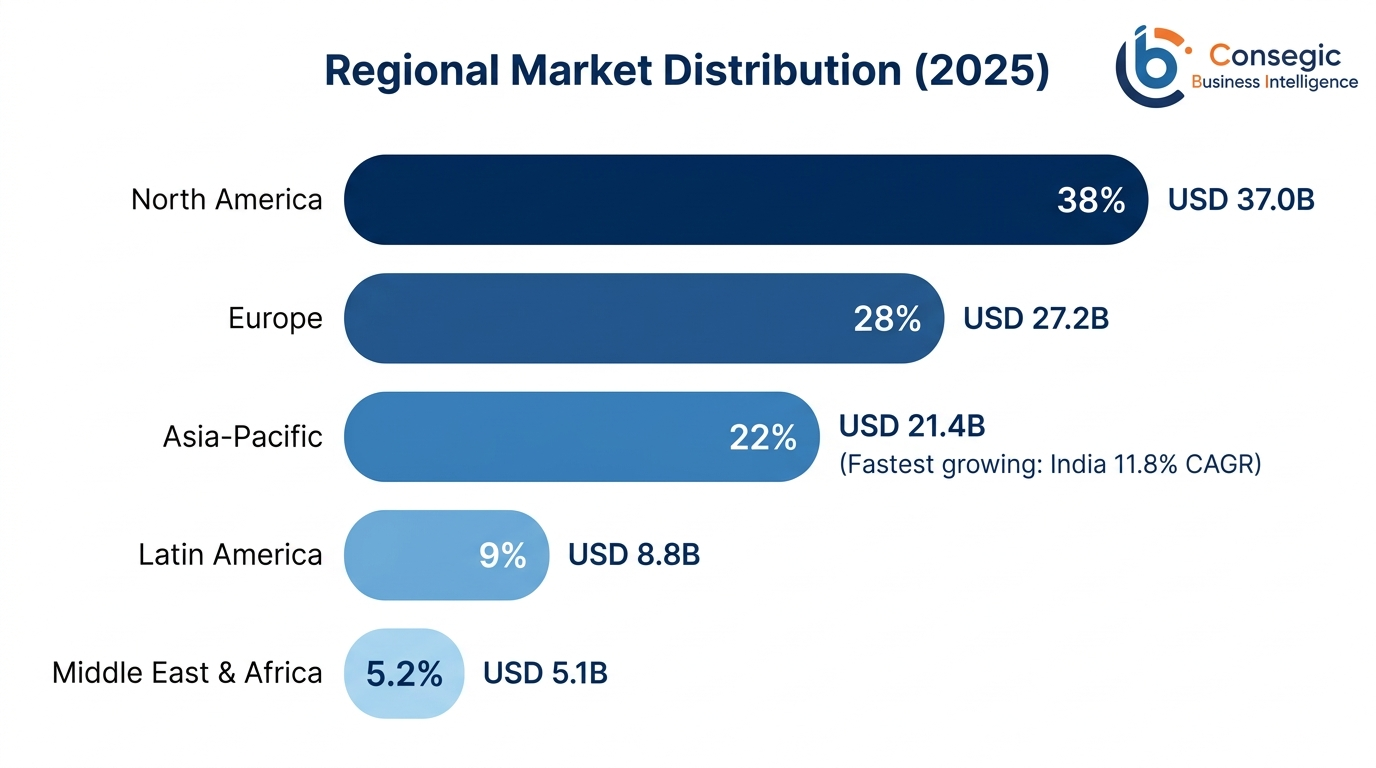
The herbal beauty products segment is dominated by North America with about 35-40 percent of the overall market value because of rich consumers, well developed distribution channels, and consumer willing-to-pay high prices of natural formulations. In this case, the United States herbal beauty market was particularly valued at USD 26.31 billion in 2025 with an estimated growth to USD 42.98 billion in 2034 at compound annual rate of growth of 6.40 percent. Consumers in North America are the most herbal beauty product adopters, with 72 percent willing to pay premiums on certified natural formulations. Big box retailers such as Sephora (annual beauty sales USD 8.3 billion), Ulta Beauty (annual revenue USD 10.2 billion) and Target have considerably diversified their herbal and natural beauty product lines based on the demand convergence. In North American beauty, e-commerce penetration hit 32 percent of total channel value in 2025, with digital-native herbal brands taking off at a rapid clip on direct-to-consumer platforms and social media marketing. Herbal beauty consumers in North America are shifting to premium sustainable products which use ethically sourced materials. The Millennial and Generation Z age groups together represent 55 percent of the total herbal beauty buyer population.
Europe: Regulatory Leadership and Sustainability Focus
Western Europe is estimated to have 25-30 percent of the global market value of herbal beauty products, which creates market size of substantial proportions due to high environmental regulations that favor the use of natural formulations and market sustainability consciousness among the consumers. The markets in Germany, France, United Kingdom and Scandinavian countries have very high demand of herbal beauty products with regards to environmental consciousness and regulatory leadership. European consumers show the highest global demands in regards to ingredient transparency and sustainability sourcing verification, generating competitive advantages to herbal brands that develop transparent supply chains. COSMOS and EcoCert had the largest adoption rates in the European markets with 68 percent of herbal beauty products containing third-party organic certifications. Luxury herbal beauty products such as Weleda (Swiss tradition), Aurelie (French luxury), and Pai Skincare (British organic) have significant market share and pricing strength across Western markets in Europe. The growth of European herbal beauty markets is moderate compared with the emerging markets since category penetration is at the maturity level in developed markets.
Asia-Pacific: Fastest Growth and Ayurvedic growth.
Asia-Pacific is identified as the fastest-growing geographic area of herbal beauty products with 20-25 percent market value in the worldwide market with significantly higher growth rates. China is the biggest Asia-Pacific market, characterized by the blistering e-commerce fulfillment center growth, the use of e-commerce in urbanization, the increasing consumer buying capacity, and the incorporation of traditional Chinese medicines in the beauty products formula. The Indian and Southeast Asian market reveal an emerging herbal beauty market growth that contributes to regional supply chain growth as well as growth of cross-border e-commerce. The herbal beauty market in India is expected to reach USD 3.2 billion by the year 2025 and USD 8.5 billion by the year 2032 with an unprecedented high 11.8 percent compound annual growth rate due to domestic brand heritage, ayurvedic formulation-based expertise and adoption of middle-class consumers. The Japan and South Korea have already established the herbal beauty market with a steady demand of high-end botanical skincare that is representative of K-beauty and J-beauty international impact. The rate of growth in Asia-Pacific market is much higher than the growth rates of North America and Europe and this has provided an incremental market opportunity to manufacturers targeting emerging markets through localized production, cost-effective solutions and regional distribution networks.
Latin America and Middle East & Africa: Potential Emerging Market.
The Latin America region contributes to about 8-10 percent of the world market value of herbal beauty, with Brazil being the leading market due to the growth of retail logistics and an increase in middle-income consumers buying high-end herbal products. The Middle East and Africa are a combined market that has a market value of 5.2 percent of the global market with the growth of herbal beauty infrastructure in the region enabling the growth of trade in the region. These areas show a low penetration of herbal beauty products now, which creates a massive green field development potential to manufacturers of cheaper solutions without adversely affecting structural integrity or safety levels. Localized formulation opportunities are presented by regional preferences to certain botanical ingredients such as Brazilian rainforest plants and African traditional herbs.
Competitive Landscape and Key Market Players
L'Oréal Groupe- Strategic Herbal Beauty Expansion Leadership.
The L'Oréal Groupe which generates annual revenue of 45 billion USD has established itself as the top market player through its strategic purchase of premium herbal and natural beauty brands. The company used scientific research to develop its herbal-based skincare products through its acquisition of British skincare brand Medik8 for 1.1 billion USD in June 2025. The company achieved 50 percent growth because of its excellent performance metrics from the year 2025.L'Oréal creates a global competitive edge through its proprietary combination of herbal beauty brands which work with its advanced research capabilities and wide distribution networks and beauty professional services. The LUXE Division of the company that includes Medik8 enhances the presence in the rapidly developing science-based skincare category.
Procter and Gamble - Natural and Organic Portfolio Development.
Procter and Gamble (annual revenue USD 82 billion) has extensive herbal beauty portfolio with several brands (Attitude, The Ordinary, and specialty natural formulations) of well-known brand families. Distribution channels via retail networks and e-commerce avenues give the company competitive advantages in penetrating the market.
Unilever - Integrated Beauty and Wellness.
Unilever has a strong herbal beauty footprint with brands such as Shea Moisture (natural haircare, USD 650 million annual revenue), Seventh Generation (plant-based personal care) and new herbal product lines that become a part of existing beauty categories.
Himalaya Herbal Healthcare Regional Market Leadership.
Himalaya Herbal Healthcare has dominated the market share in herbal beauty products in the markets in South Asia by the use of heritage brand name, skills in ayurvedic formulae, and strong distribution channels. Product lines of the company include herbal skincare (Neem Face Pack, Cucumber Peel-Off Mask) and haircare that has penetrated the regional markets.
Dabur Ayurveda Portfolio Modernization and Digital Expansion.
Dabur Ayurveda (FY2024-25 revenue USD 1.8 billion) gained a massive market share with the traditional ayurvedic formulations combined with the modern skincare science. In FY2024-2025, company introduced further Baby Care line with new immunity-enhancing herbal differentiations, which is a strategic emphasis on portfolio modernization and entering a new consumer segment. Market share is facilitated by the expansion of digital channels and direct-to-consumer abilities.
Patanjali Ayurved Ayurvedic Heritage and Market penetration.
Patanjali Ayurved has strong market share in Indian herbal cosmetics with a large network of retail outlets and brand equity. The herbal product line of the company consists of skincare, haircare, and personal care products with high penetration in the price-sensitive consumer groups.
New Direct-to-Consumer Herbal Brands.
New direct-to-consumer brands such as Rosemira Organics, PIPER LILY Skincare, Zakiella, and Integrity Botanicals are using digital marketing and the power of social media to build a premium brand image and capture millennial and Generation Z consumer markets. These brands have very high growth rates due to the use of genuine brand stories, ingredient disclosure, and customer intimacy.
Recent Industry Developments (2024–2026)
Loréal buys Medik8 at USD 1.1 Billion Strategy Skincare.
L'Oréal Groupe acquired most of the shares in British premium skin care brand Medik8 during June 2025. The company operates under private equity ownership by Inflexion, which values its assets at EUR 1 billion (USD 1.1 billion). The company achieved sales growth of 50 percent in 2024, which becomes evident through its 2025 revenue forecast of USD 115 million. Acquisition is a good example of the strategic emphasis of major beauty conglomerates on the acquisition of high-growth, science-based skincare companies that offer a combination of herbal actives and clinical efficacy validation. The hero product line offered by Medik8 with the use of botanical extracts and clean formulation principles is aligned with the emerging consumer preferences of natural ingredient profile. Transactions indicated a strong capital expenditure on building up herbal beauty categories.
M&A Activity Recalibration of Beauty and Strategic Valuations.
The beauty industry experienced 263 M&A deals in 2025 which represented an 11.5 percent decrease from 2024 but matched the total from 2023. The strategic focus had to be directed toward premium brands which achieved high growth and demonstrated stable revenue through direct sales to customers. Strategic buyers who wanted to enter the herbal and natural beauty market found acquisition opportunities during the period between 2022 to 2024 because valuation multiples returned to their normal range after reaching peak levels.
Market Growth of Ayurvedic Products and Courtesy of Mainstream.
The ayurvedic products sector, including the sub-sector of herbal beauty, which reached USD 16.51 billion in 2025 with a speeding rate of growth due to the globalization of traditional wellness systems and their adoption by mainstream consumers. The Ayurvedic herbal beauty products were enjoying a rapid market penetration among the high end, wellness-focused consumer groups in the North American and Western Europe markets. The growth was especially focused on high-end herbal skincare formulations, a combination of Indian traditional botanical knowledge with clinical confirmation.
Innovation and Launch of Clean Beauty Brand.
Direct-to-consumer brands with an opportunity to offer premium herbal formulations in the market during 2025, such as Rosemira Organics, PIPER LILY Skincare, and Zakiella, have set prices at a level that serves as an opportunity to capture the market opportunity. These new brands enjoyed high customer acquisition by collaborating with social media influencers and sharing an authentic brand story that was close to the preferences of millennial and Gen Z consumers.
Herbal Beauty Products Market Insights Table
| Report Attributes | Report Details |
|---|---|
| Study Timeline | 2022–2034 |
| Base Year | 2025 |
| Forecast Period | 2026–2034 |
| Market Size in 2025 | USD 97.28 Billion |
| Market Size in 2034 | USD 151.35 Billion |
| CAGR (2026–2034) | 6.20% |
| By Product Type | Herbal Skincare (45%), Haircare (30%), Cosmetics (18%), Personal Care (12%) |
| By Product Form | Creams & Moisturizers (35%), Serums & Essences (25%), Masks & Treatments (20%), Cleansers (15%), Other (5%) |
| By Distribution Channel | E-Commerce (40%), Traditional Retail (35%), Specialty Retailers (18%), Professional (7%) |
| By Region | Asia-Pacific, Europe, North America, Latin America, Middle East & Africa |
| Key Players | L'Oréal Groupe, Procter & Gamble, Unilever, Himalaya Herbal Healthcare, Dabur Ayurveda, Patanjali Ayurved, Rosemira Organics, PIPER LILY Skincare |
| Report Coverage |
|
Key Questions Answered in the Report
What is the size of the market in general and what is the expected growth path till 2034? −
The global market of herbal beauty products is projected to reach USD 97.28-98.7 billion in 2025 and is projected to show strong growth towards USD 151.35-308.69 billion by 2034, indicating a compound annual growth rate of 6.20-13.60 percent during the forecast period. Organic and natural cosmetics in particular reached USD 40.8 billion value in 2024 and is projected to reach USD 68.8 billion in 2034 in 5.4 percent compound annual growth rate. The ayurvedic products market, including herbal beauty formulations with traditional Indian wellness principles, was USD 16.51 billion in 2025 with phenomenal estimates of USD 77.42 billion in 2035 exhibiting 18.7 percent compound annual growth rate. The United States market with an estimated value of USD 26.31 billion in 2025 is expected to go to USD 42.98 billion by 2034 indicating market growth in North America at a rate of 6.40 percent per annum. The increase of the market is an indicator of changes in consumer preferences in favor of natural formulations and environmentally friendly buying habits.
Which are the main market growth drivers and structural demand catalysts? +
The most crucial growth drive is the consumer demand consolidation towards natural and organic beauty solutions where 68 percent of customers are conducting active research on ingredient composition and 72 percent of consumers are ready to pay more premiums on certified natural solutions. Gen Z and millennial generations exhibit more environmental awareness and clean beauty tastes, with 27 percent of Generation Z and 26 percent of millennials categorizing beauty products as needs as opposed to 18 percent of Generation X generations. The efficacy of herbal products has been improved through technological innovation in botanical extraction and formulation science which has made it able to compete with synthetic products. The proliferation of e-commerce channels has democratized brand access, giving independent and emerging herbal beauty companies access to direct consumer relationships and high-level scaling. The 263-beauty industry M&A transactions which private equity capital brought about in 2025 show that investors consider the herbal and natural beauty sector to have growth potential and sustainable development.
What are the competitive maturity and growth potential of geographic markets? +
North America has the dominant market share of about 35-40 percent of the worldwide market value of herbal beauty, due to the wealthy consumer base, well-established distribution systems with retailers such as Sephora and Ulta Beauty, and the premium pricing of natural formulations that consumers are willing to pay. The herbal beauty market in the United States in particular was estimated to attain USD 26.31 billion in 2025 and estimated growth of USD 42.98 billion by 2034. The European markets, which reflect about 25-30 percent of the global market value, exhibit specific competence in high-quality herbal skin care products and sustainable formulation leadership through high environmental standards and sustainability awareness among consumers. Asia-Pacific areas, which constitute merely 20-25 percent of present market value, exhibit the most promising growth rates due to the globalization of traditional wellness systems, the rapid urbanization and the rise in the number of middle-income consumers. The herbal beauty market of India alone had been valued at USD 3.2 billion in 2025 with an estimated valuation of USD 8.5 billion by 2032 with a growth rate of 11.8 percent per annum.
What are the competitive dynamics and consolidation trends within industry landscape? +
Competitive environment is characterized by the presence of fragmentation and high consolidation rates among the large beauty conglomerates who buy specialty herbal brands. The example of L’Oréal purchasing Medik8 in June 2025 in USD 1.1 billion as part of strategic consolidation of premium high-growth skincare brands with a combination of herbal actives and scientific validation can serve as a prime example. Medik8 also showed 50 percent increase in sales in 2024 with an expected 2025 income of USD 115 million. Beauty M&A activity recorded 263 completed transactions in 2025, a slight reduction compared to 2024 but still at 2023 levels, which suggests market stabilization and shift towards higher-quality acquisition targets. The Indian herbal beauty market exhibits certain specific competitive characteristics, with the traditional heritage brands, such as Himalaya Herbal Healthcare, Dabur Ayurved (FY2024-25 revenue USD 1.8 billion), and Patanjali Ayurved, playing a significant role in the region due to brand recognition and wide distribution channels.
Overview
Reputation & Certifications


Our Services
- Market Intelligence & Forecasting
- Custom Research Solutions
- Market Entry Strategy
- Competitive Intelligence
- Customer Insights
- Industry Innovation Analysis
- Investment Advisory