Jump to Content
Analog Semiconductor Market - Size, Share, Industry Trends, and Forecasts (2025 - 2032)
Analog Semiconductor Market Size:
Analog Semiconductor Market size is estimated to reach over USD 136.62 Billion by 2032 from a value of USD 96.37 Billion in 2024 and is projected to grow by USD 98.95 Billion in 2025, growing at a CAGR of 4.5% from 2025 to 2032.
Analog Semiconductor Market Scope & Overview:
Analog semiconductors are essential electronic components used to process real-world signals such as sound, light, temperature, and pressure. They operate by converting these signals into usable data for various applications in industries such as telecommunications, automotive, healthcare, and consumer electronics. These components play a critical role in functions like signal amplification, power management, and data conversion.
They are available in various types, including amplifiers, linear regulators, data converters, and sensors, catering to diverse operational needs. They are designed to ensure precise performance, reliability, and efficiency in electronic systems. These components are integral to enabling seamless operation in devices and systems requiring accurate signal interpretation and processing.
End-users include manufacturers of industrial equipment, automotive systems, and medical devices, where reliable signal processing and power management are crucial. These components support the functionality and efficiency of modern electronics across multiple sectors.
How is AI Impacting the Analog Semiconductor Market?
AI is significantly impacting the analog semiconductor market by driving demand for specialized analog components, enabling AI-driven design and manufacturing processes, and influencing the development of new AI-specific hardware. This impact is seen in areas like increased precision and efficiency in analog front-end systems, optimized semiconductor supply chains, and faster chip design cycles. Also, AI helps to customized microvertical solutions addressing pain points in storage, memory, and specialized computing is creating new opportunities for smaller semiconductor companies.

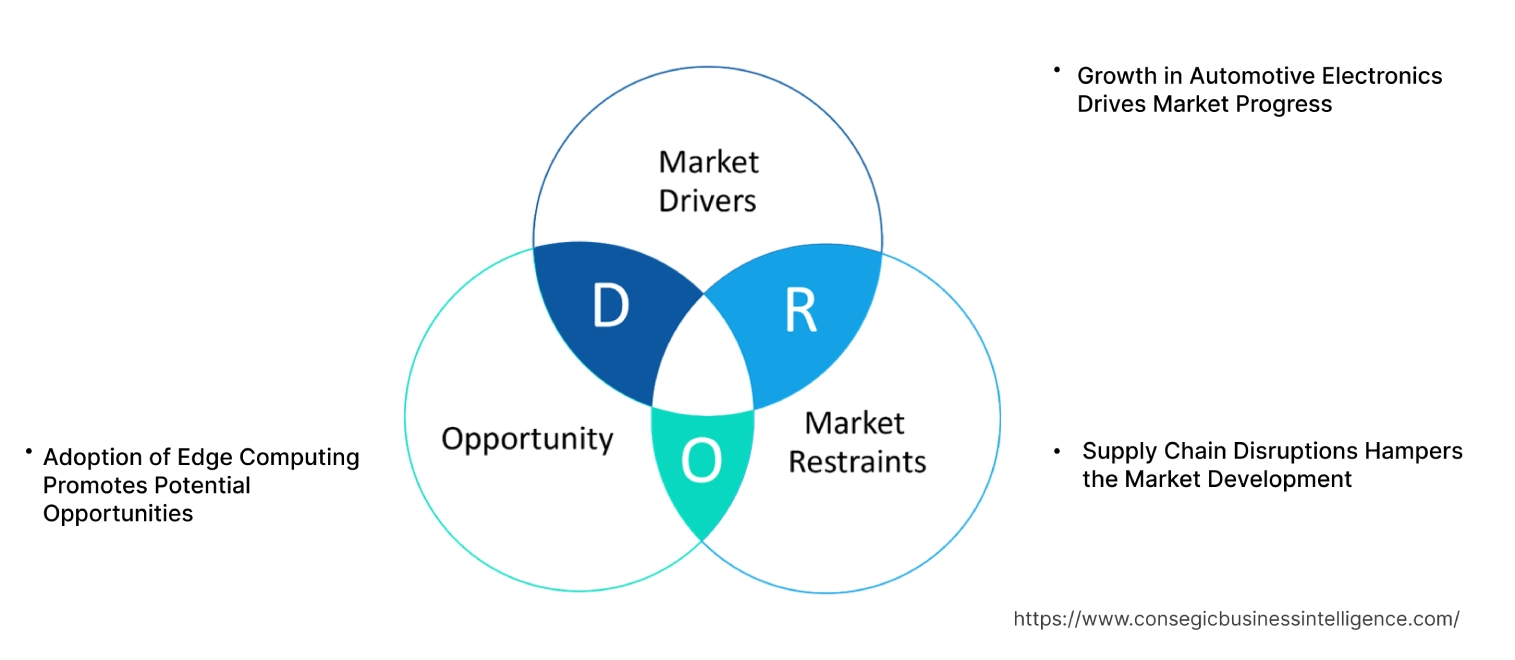
Analog Semiconductor Market Dynamics - (DRO) :
Key Drivers:
Growth in Automotive Electronics Drives Market Progress
The automotive sector is increasingly adopting advanced electronics for modern applications such as advanced driver-assistance systems (ADAS), electric vehicle (EV) powertrains, and in-vehicle infotainment systems. These systems require analog semiconductors to ensure efficient power distribution, precise signal processing, and seamless connectivity.
Analog components like power management ICs and signal amplifiers are crucial in maintaining the performance and reliability of these applications. The growing penetration of EVs, driven by sustainability goals and regulatory incentives, is further amplifying demand for high-performance semiconductors to optimize energy efficiency and battery management. Additionally, the rising integration of safety features in vehicles, including collision avoidance and autonomous driving, relies heavily on robust analog solutions. As automotive electronics continue to evolve, the requirement for efficient and reliable semiconductor technologies is fueling the analog semiconductor market growth, aligning with trends in connected and electric mobility.
Key Restraints:
Supply Chain Disruptions Hampers the Market Development
The global semiconductor supply chain is grappling with disruptions caused by factors such as raw material shortages, geopolitical tensions, and logistical issues. Analog semiconductor production heavily relies on critical materials, including silicon and rare earth elements, which are subject to supply constraints and price volatility.
Additionally, geopolitical uncertainties and trade restrictions further exacerbate delays in procurement and manufacturing processes. These disruptions impact the timely production and delivery of analog components, causing supply-demand imbalances across industries like automotive, consumer electronics, and industrial automation. Manufacturers are also facing increased costs due to these constraints, which are often passed on to end-users, limiting affordability and adoption. The complexity of the semiconductor value chain, combined with the high precision required in analog production, magnifies the effects of these supply chain issues, creating barriers to analog semiconductor market expansion.
Future Opportunities :
Adoption of Edge Computing Promotes Potential Opportunities
The increasing adoption of edge computing across industries such as healthcare, retail, and manufacturing is driving demand for reliable and efficient analog solutions. Edge systems require robust analog semiconductors to enable real-time data processing, signal conversion, and communication between devices and cloud infrastructure. These components play a critical role in ensuring low-latency operations and energy efficiency, which are essential for edge applications like remote patient monitoring, automated retail checkout, and industrial IoT.
Analog solutions support precise control and seamless data flow, enhancing the performance of distributed computing networks. As industries continue to embrace edge computing to optimize processes and reduce latency, the need for advanced analog technologies is expected to grow, creating significant analog semiconductor market opportunities for innovation and market expansion. This trend aligns with global shifts toward decentralized computing and intelligent infrastructure.
Analog Semiconductor Market Segmental Analysis :
By Type:
Based on type, the market is segmented into general-purpose analog ICs and application-specific analog ICs.
The general-purpose analog ICs segment accounted for the largest revenue of the total analog semiconductor market share in 2024.
- General-purpose analog ICs are widely used across various industries, including consumer electronics, automotive, and telecommunications, for their versatility and adaptability.
- These ICs are essential for signal amplification, power management, and data conversion, which are critical functions in diverse electronic systems.
- The requirement for general-purpose analog ICs is fueled by their compatibility with a wide range of devices, making them indispensable in both traditional and modern electronic designs.
- The analysis of segmental trends portrays that the dominance of this segment is attributed to its broad application scope and ability to support advancements in connectivity and IoT devices, contributing to the analog semiconductor market demand.
The application-specific analog IC segment is expected to register the fastest CAGR during the forecast period.
- These ICs are designed for specific applications, such as automotive ADAS, industrial automation, and medical imaging, offering optimized performance for targeted use cases.
- Application-specific analog ICs are becoming increasingly popular in the automotive and healthcare industries, where precision and efficiency are paramount.
- The rapid growth of this segment is driven by increasing investments in smart devices and autonomous technologies.
- As per the analog semiconductor market analysis, continuous innovation in application-specific designs to cater to niche markets supports the segment’s robust progression during the forecast period.
By Component:
Based on components, the market is segmented into analog amplifiers, linear ICs, power management ICs, data converters, RF ICs, and others.
The power management ICs segment accounted for the largest revenue of the total analog semiconductor market share in 2024.
- Power management ICs are critical for ensuring energy efficiency in electronic devices, reducing power consumption while maintaining optimal performance.
- The rising adoption of energy-efficient devices in consumer electronics and industrial applications supports the need for power management ICs.
- These ICs are integral in renewable energy systems and electric vehicles, further contributing to their prominence in the market.
- As per the analog semiconductor market trends, the segment’s role in enabling battery management and extending device lifecycle underpins the dominance of power management ICs across multiple industries.
The RF ICs segment is projected to grow at the fastest CAGR during the forecast period.
- RF ICs play a vital role in wireless communication systems, including 5G networks, IoT devices, and satellite communications.
- The expansion of 5G infrastructure and the growing adoption of connected devices globally are key drivers of the RF IC segment’s rapid growth.
- These components enable high-frequency signal transmission, ensuring seamless communication and data exchange in advanced electronic systems.
- Thus, continuous advancements in RF technology for higher bandwidth and reduced latency bolster the segment’s growth trajectory, driving the analog semiconductor market growth.
By End User Industry:
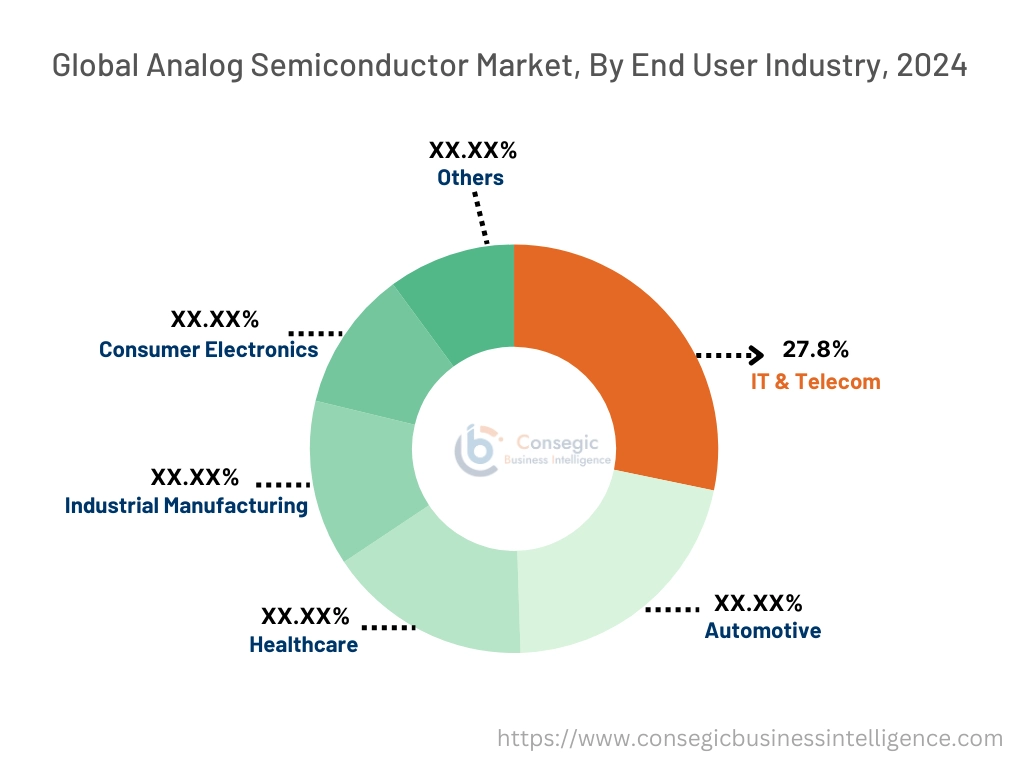
Based on end-user industry, the market is segmented into IT & telecom, automotive, healthcare, industrial manufacturing, consumer electronics, and others.
The IT & telecom segment held the largest revenue of 27.8% share in 2024.
- The deployment of analog semiconductors in networking equipment and communication devices supports the growing demand for reliable connectivity solutions.
- With the increasing rollout of 5G networks, IT & telecom applications require high-performance analog ICs for efficient signal processing and power management.
- They are crucial for maintaining the performance of base stations, data centers, and telecommunication infrastructure.
- As per the analog semiconductor market trends, the dominance of this segment reflects the critical role of these semiconductors in enabling seamless global communication networks.
The automotive segment is expected to register the fastest CAGR during the forecast period.
- Analog semiconductors are widely used in advanced driver-assistance systems (ADAS), battery management systems, and infotainment solutions in modern vehicles.
- The growing adoption of electric vehicles (EVs) and autonomous driving technologies is driving the demand for these semiconductors in the automotive industry.
- These components ensure precision and reliability in mission-critical automotive applications, supporting the transition to smarter and safer vehicles.
- The analog semiconductor market analysis shows that the segment’s rapid growth is fueled by increasing investments in automotive innovation and the integration of IoT-enabled technologies in vehicles.
Regional Analysis:
The regions covered are North America, Europe, Asia Pacific, the Middle East and Africa, and Latin America.
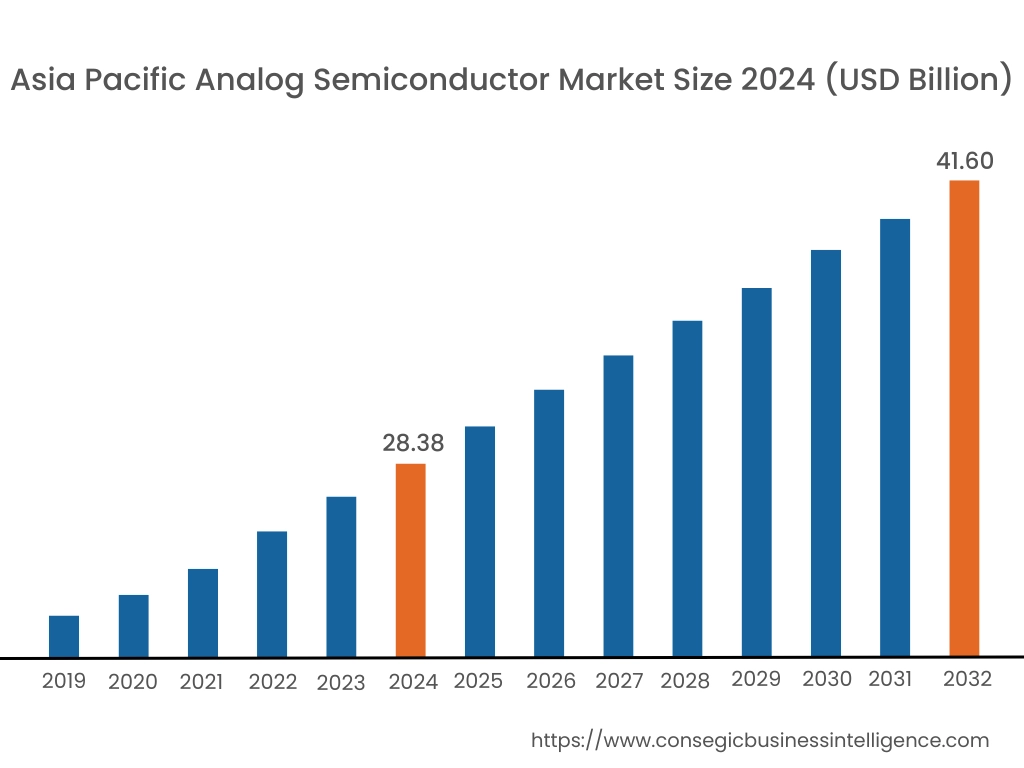
Asia Pacific region was valued at USD 28.38 Billion in 2024. Moreover, it is projected to grow by USD 29.22 Billion in 2025 and reach over USD 41.60 Billion by 2032. Out of this, China accounted for the maximum revenue share of 37.2%. The Asia-Pacific region is experiencing rapid development in the analog semiconductor market, driven by industrialization and technological advancements in countries such as China, Japan, and South Korea. The enlargement of the consumer electronics sector and the rising requirement for high-performance semiconductors have intensified the need for advanced materials like semiconductors. Government initiatives promoting industrial efficiency further influence analog semiconductor market expansion.

North America is estimated to reach over USD 44.28 Billion by 2032 from a value of USD 31.97 Billion in 2024 and is projected to grow by USD 32.76 Billion in 2025. This region holds a significant share of the analog semiconductor market, driven by the increasing adoption of advanced electronic devices and the miniaturization of components. The United States, in particular, has seen a rise in the implementation of these semiconductors in sectors such as automotive, consumer electronics, and telecommunications. A notable trend is the integration of semiconductors in high-frequency applications due to their superior thermal and mechanical properties. Analysis indicates that the presence of key market players and continuous technological advancements contribute to the analog semiconductor market opportunities.
Europe represents a substantial portion of the global analog semiconductor market, with countries like Germany, France, and the United Kingdom leading in adoption and innovation. The region's emphasis on sustainability and energy efficiency has propelled the utilization of eco-friendly materials in semiconductor manufacturing. Analysis indicates a growing trend towards the deployment of analog semiconductors in automotive and industrial machinery applications, offering flexibility across multiple sectors.
The Middle East & Africa region shows a growing interest in advanced semiconductor solutions, particularly in the telecommunications and industrial sectors. Countries like the United Arab Emirates and South Africa are investing in modern technologies to enhance data transmission capabilities and comply with international standards. Analysis suggests an increasing trend towards adopting analog semiconductors to meet the needs of modern communication networks.
Latin America is an emerging market with Brazil and Mexico being key contributors. The region's growing focus on technological modernization and the automotive sector has spurred the adoption of advanced semiconductor solutions. Government policies aimed at enhancing technological capabilities influence analog semiconductor market demand.
Top Key Players and Market Share Insights:
The Analog Semiconductor market is highly competitive with major players providing products and services to the national and international markets. Key players are adopting several strategies in research and development (R&D), product innovation, and end-user launches to hold a strong position in the global Analog Semiconductor market. Key players in the Analog Semiconductor industry include -
- Texas Instruments (USA)
- Analog Devices (USA)
- ON Semiconductor (USA)
- Microchip Technology (USA)
- Renesas Electronics (Japan)
- Skyworks Solutions (USA)
- Infineon Technologies (Germany)
- STMicroelectronics (Switzerland)
- NXP Semiconductors (Netherlands)
Recent Industry Developments :
Product Launches:
- In November 2024, Orca Semiconductor announced the OS2000 IO-Link communications transceiver, designed to enhance Industry 4.0 intelligence in industrial applications. It is expected to come out in late 2025. The OS2000 enables seamless, bi-directional communication between sensors, actuators, and control systems, improving productivity, and efficiency, and reducing downtime. It offers features like I2C and GPIO control options, integrated surge protection, linear voltage regulators, and compatibility with Analog Devices' MAX22515.
Analog Semiconductor Market Report Insights :
| Report Attributes | Report Details |
| Study Timeline | 2019-2032 |
| Market Size in 2032 | USD 136.62 Billion |
| CAGR (2025-2032) | 4.5% |
| By Type |
|
| By Component |
|
| By End User Industry |
|
| By Region |
|
| Key Players |
|
| North America | U.S. Canada Mexico |
| Europe | U.K. Germany France Spain Italy Russia Benelux Rest of Europe |
| APAC | China South Korea Japan India Australia ASEAN Rest of Asia-Pacific |
| Middle East and Africa | GCC Turkey South Africa Rest of MEA |
| LATAM | Brazil Argentina Chile Rest of LATAM |
| Report Coverage |
|
Key Questions Answered in the Report
What is the size of the Analog Semiconductor Market? −
The Analog Semiconductor Market size is estimated to reach over USD 136.62 Billion by 2032 from a value of USD 96.37 Billion in 2024 and is projected to grow by USD 98.95 Billion in 2025, growing at a CAGR of 4.5% from 2025 to 2032.
What are the key segments in the Analog Semiconductor Market? +
The Analog Semiconductor Market is segmented by type (general purpose analog ICs, application-specific analog ICs), component (analog amplifiers, linear ICs, power management ICs, data converters, RF ICs, others), end-user industry (IT & telecom, automotive, healthcare, industrial manufacturing, consumer electronics, others), and region (Asia-Pacific, Europe, North America, Latin America, Middle East & Africa).
Which segment is expected to grow the fastest in the Analog Semiconductor Market? +
The application-specific analog IC segment is expected to register the fastest CAGR during the forecast period. This is driven by increasing demand for specialized applications in industries such as automotive, healthcare, and industrial automation.
Who are the major players in the Analog Semiconductor Market? +
Key players in the Analog Semiconductor Market include Texas Instruments (USA), Analog Devices (USA), Skyworks Solutions (USA), Infineon Technologies (Germany), STMicroelectronics (Switzerland), NXP Semiconductors (Netherlands), ON Semiconductor (USA), Microchip Technology (USA), and Renesas Electronics (Japan).
Overview
Reputation & Certifications


Our Services
- Market Intelligence & Forecasting
- Custom Research Solutions
- Market Entry Strategy
- Competitive Intelligence
- Customer Insights
- Industry Innovation Analysis
- Investment Advisory