Jump to Content
Europe Point of Sale (POS) Terminals Market - Size, Industry Share, Growth Trends and Forecasts (2025-2034)
Executive Summary
The European Point of Sale (POS) terminals market is a critical infrastructure element of the highly digitizing payment economy of the region that includes hardware terminals, software platforms, payment processing services, and integrated business management solutions. This broad market comprises traditional countertop terminals, mobile POS (mPOS), smart Android-based terminals, SoftPOS, and self-service payment kiosks deployed retail, hospitality, healthcare, and service markets.
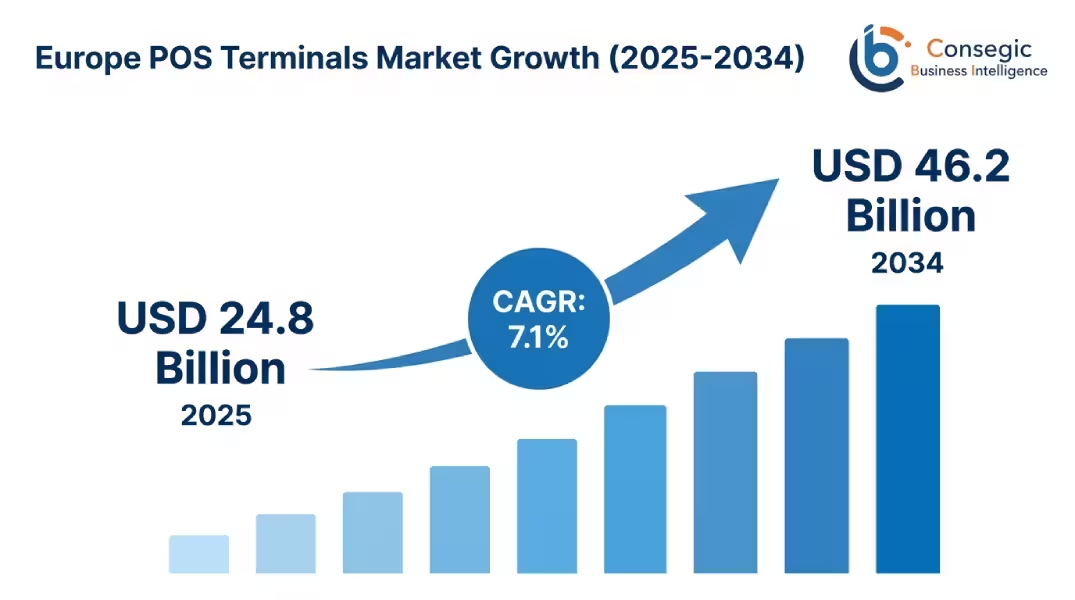
The European POS terminals market, with 2025 as the base year, is projected to reach USD 24.8 billion and grow at a Compound Annual Growth Rate (CAGR) of 7.1 % during the period 2026–2034. Supported by regulatory requirements under the Payment Services Directive 2 (PSD2), particularly Strong Customer Authentication, the spread of contactless payments to 73 % of all European card-based transactions, and the move towards strategic integrated omnichannel commerce platforms.
Key Market Insights
- The European POS terminals market is projected to reach USD 24.8 billion in 2025 and grow at a CAGR of 7.1% from 2026 to 2034
- The market includes countertop POS, mobile POS (mPOS), Android-based smart terminals, SoftPOS, and self-service kiosks used in retail, hospitality, healthcare, and services
- Growth is driven by strong adoption of contactless payments, accounting for about 73% of card transactions in Europe
- Regulatory support such as PSD2 and Strong Customer Authentication is accelerating secure digital payment adoption
- Increasing shift toward integrated omnichannel commerce platforms is further boosting demand for advanced POS solutions
Key Market Characteristics:
The market is characterized by high technological development where outdated payment-only systems have been replaced by smart Android-based systems that have built-in business applications. SoftPOS technology, which converts NFC-enabled smartphones into certified payment terminals, is becoming a major disruptor, especially among micro-merchants and workers in the gig economy. In 2024, the European payment infrastructure facilitated nearly EUR 5.8 trillion in card-based transactions, of which contactless transactions were EUR 2.1 trillion, highlighting the scale of payment processing needs driving terminal demand.
Western Europe holds the highest market share at 55% of total revenue, while Eastern Europe is the fastest-growing region with a projected CAGR of over 8.5 % as a result of the government digitization efforts and the growth of card acceptance networks.
Market Dynamics
Key Driver: Regulatory Framework and Digital Payment Mandates
The primary growth driver of the European POS terminals market is the comprehensive regulatory measures encouraging electronic payments and fiscal transparency. The introduction of PSD2 across EU member states has created a need to upgrade terminals to meet the requirements of Strong Customer Authentication (SCA). According to the European Banking Authority, the implementation of SCA by 94 % of payment service providers by December 2024 required hardware and software modifications across an estimated 18.5 million merchant locations.
In addition to PSD2, governments across Europe have established stringent fiscalization requirements to fight tax avoidance and reduce the shadow economy. The sanctions imposed on merchants who refuse card payments in Italy, the use of tamper-proof security modules required in Germany under KassenSichV, along with the Cashless Poland program with subsidies on terminals in Poland all create sustained replacement cycles. These regulatory conditions function as mandatory drivers, ensuring baseline demand for terminal infrastructure that meets the requirements.
Additional requirements are increased terminal capability to facilitate new payment rails and better security measures due to the Digital Euro project by the European Central Bank and harmonization of instant payments. This regulatory trend introduces a multi-year churn cycle in millions of merchant locations in various industry sectors.
Key Restraint: Security Concerns and Compliance Cost Pressures
The market is experiencing significant friction due to growing security demand and compliance expense notwithstanding the strong growth drivers. POS terminals are now attractive targets for sophisticated cyberattacks as they become more interconnected and increasingly software-defined, with point-of-sale malware programs available to scrape payment card details from device memory.
The cost of compliance with the Payment Card Industry Data Security Standard (PCI DSS) may be very high, especially for small and medium-sized businesses that have limited profit margins. The ongoing changes in EMV standards, encryption protocols, and security certifications cause upgrade fatigue among business people who have to make the same investment in compliance.
Additionally, the fragmentation of European payment systems, such as national schemes, such as Germany’s Girocard and France’s Cartes Bancaria’s, and the emergence of instant payment networks complicate and increase certification expenses to POS vendors. This fragmentation has the potential to slow the rollout of pan-European solutions, and escalate the overall cost of ownership to merchants that operate in more than one market.
Key Opportunity: Integration of Artificial Intelligence and Value-Added Services
The most important market opportunity is the transformation of POS terminals into intelligent business platforms. State-of-the-art AI-based terminals have the capability to analyze transaction patterns in real-time, with accuracy rates 99.7% and a false positive rate of less than 0.8%, which is a big improvement over the old rule-based systems.
Contemporary Android smart terminals allow merchants to install business management applications directly on payment devices to create integrated platforms for inventory management, customer relationship management, employee scheduling, and business analytics. This model of app store changes the POS systems into revenue generators especially in the hospitality industry where efficiency and customer contact are key determinants of profitability.
The predictive analytics incorporation allows predicting the demand with a high level of accuracy, 85-92 %, and automatic re-inventory replenishment systems and customized customer engagement plans. Retailers using AI-based customer analytics report 18-27 % marketing campaign performance improvement and 12-19 % customer retention rate improvement and develop an attractive value proposition that would justify high-priced advanced terminal solutions.
Market Segmentation Analysis
By Component: Technology Platform Evolution
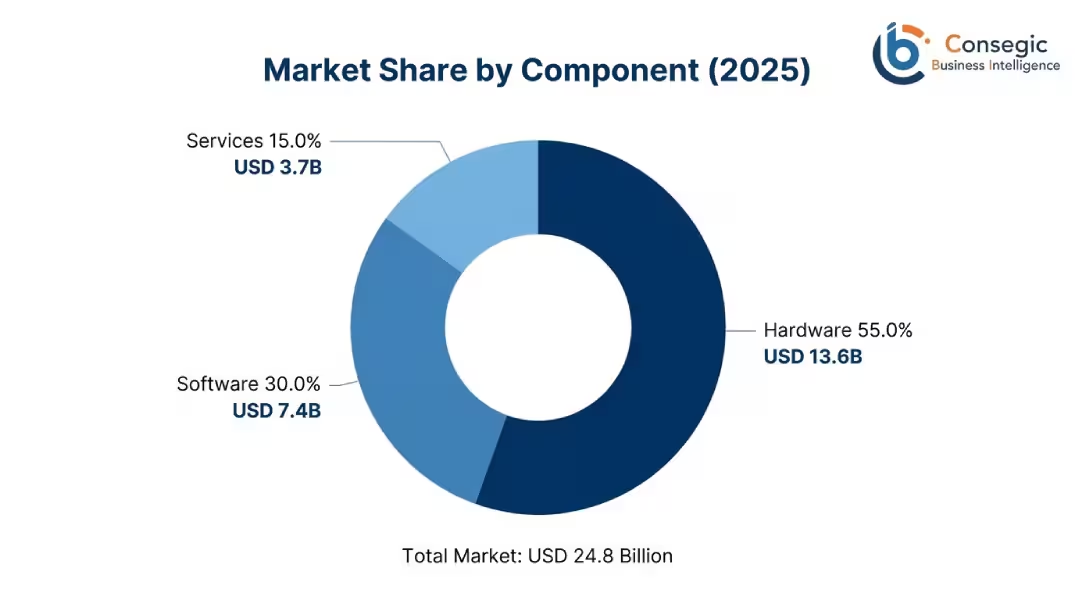
Hardware Segment=55.0%×USD 24.8 billion=USD 13.6 billion (2025
Hardware
The biggest revenue segment is hardware (55.0% of market value) including fixed countertop terminals, mobile wireless devices, smart Android-based systems and self-service kiosks. As hardware remains the main driver of revenues with the cost of devices, market maturity has led to slower growth as hardware vendors are more likely to see growth on replacement cycles, and feature upgrades as opposed to new deployments.
Software and Platforms
Software and Platforms (30.0% of market value) is the most rapidly growing segment that is powered by subscription-based Software-as-a-Service (SaaS) systems, cloud-based terminal management, and integrated business applications. This division comprises POS operating systems, payment processing middleware, device management platforms, and retail, hospitality and healthcare-specific applications.
The services segment accounts for 15.0% of USD 24.8 billion, equivalent to USD 3.7 billion in 2025
Services (15.0% market value) includes installation, maintenance, technical support and managed payment services. Expansion here is aided by the fact that merchants prefer outfitting their systems with OPEX-based models in which hardware, software and payment processing are rolled together into monthly service charges.
By Terminal Type: Mobility and Intelligence Focus
Smart POS terminals (45.0% of market value) dominate new deployments, with Android operating systems, touchscreen interfaces, and non-payment processing application ecosystems. These additions combine inventory control, loyalty systems, and customer analytics and turn the traditional checkout systems into multi-faceted business management systems.
Mobile POS Solutions (35.0% of market value) are handheld wireless terminals and Smartphone-based SoftPOS applications, enabling use at the table in restaurants, busting queues in retail outlets, and accepting payments by mobile businesses and gig economy workers.
Traditional Fixed Terminals (20.0% of market value) are still relevant in high-volume settings in need of special payment processing, peripheral connectivity to scanners and scales, and reliability required for mission-critical operations.
By End-User Vertical: Industry-Specific Requirements
Retail Sector
The largest vertical is Retail Sector (40.0% of market value) including supermarkets, specialty stores, fashion retailers, and convenience shops that demand an omnichannel integration and synchronized inventory and analytics capabilities to be used in customer management.
Hospitality and Food Service
The Hospitality and Food Service (30.0% of market value) requires specific functionalities such as order co-ordination with kitchen displays, table management, menu customization, and split payment processing.
Healthcare and Professional Services
Healthcare and Professional Services (15.0% market value) require enhanced security measures, compliance with healthcare privacy, integration of appointment schedules, and insurance payment systems.
Other Sectors
Other Sectors (15.0% of market value) such as transportation and entertainment have varied requirements that include; ticket validation, access control integration, and high-speed transaction processing.
Regional Market Analysis
Largest Market: Western Europe - Premium Technology Leadership
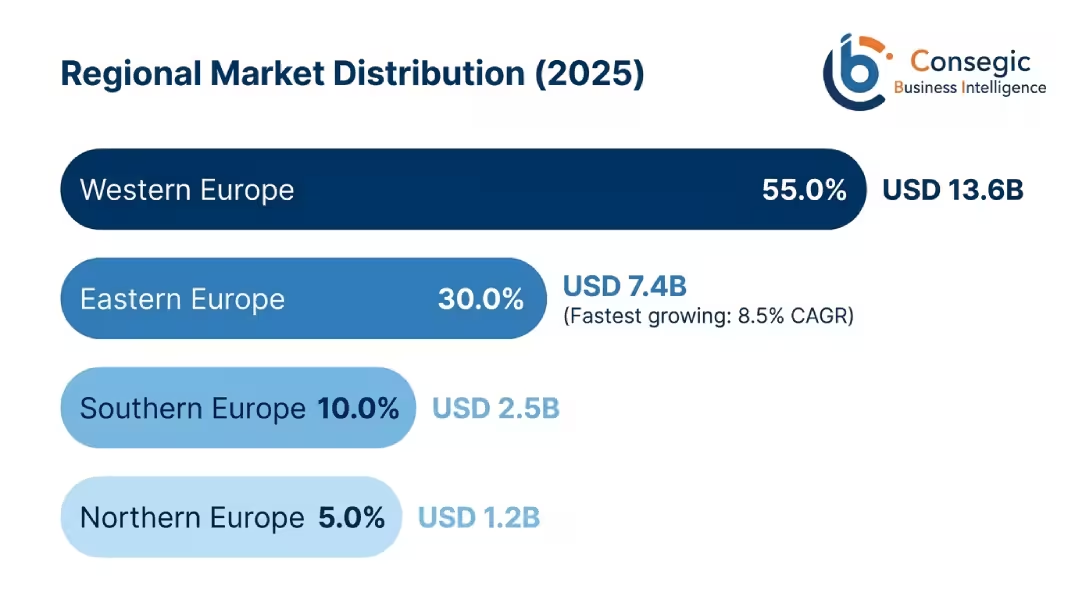
Western Europe accounts for USD 13.6 billion (55.0% of market value) in 2025, which will be USD 25.4 Billion in 2034. Germany, the United Kingdom, and France are the top three contributors to Western European revenue (68 %) spurred by the well-developed infrastructure of retailers, the greater penetration of card payment (more than 70 %), and the advanced merchant ecosystem requiring advanced functionality.
Germany leads with 32% of Western European value upon the backing of 2.4 million merchant locations and contactless adoption of 68 % of card transactions. German market focuses on hybrid terminals that serve the international schemes and the local Girocar system, and has high demand for fiscalization compliance based on the regulation of KassenSichV.
The United Kingdom has 26% regional value, and contactless adoption rates are 87 % and has a large fintech ecosystem of more than 1,600 payment technology companies. The UK market is at the forefront of SoftPOS adoption and mobile wallet integration, where there is great focus on integrated commerce platforms between online and offline platforms.
France accounts for 24% of Western European revenue, with 79 % contactless uptake and well-established integration of the domestic Cartes Bancaires scheme. Digitization programs of government involve EUR 450 million budget on adoption of technology by small businesses which will directly contribute towards deployment of POS terminals.
Rapidly Growing Market: Eastern Europe - Digital Transformation Acceleration.
Eastern Europe accounts for USD 7.4 billion (30.0% of market value) in 2025, with the highest regional CAGR of 8.7%, projected to reach of USD 16.2 Billion in 2034. Poland, Czech Republic, Romania, and Hungary are the regional growth drivers as governments are digitizing, card acceptance infrastructure is growing, and advanced terminal technology is being leapfrogging traditional technologies.
Poland controls 35 % of the Eastern European value with 850,000 merchant locations and government support through the Cashless Poland initiative which offers terminal subsidies and tax incentives in accepting electronic payment. By 2024, the volume of card payments had reached PLN 892 billion, and it was increasing at 14.2 % every year.
The Czech Republic has the highest regional contactless adoption at 83%, with 2.8 billion transactions per year in card transactions. There are also favorable regulatory frameworks that encourage the use of cashless payments and the market is highly digital literate.
Romania demonstrates a fast growth potential due to the rising card penetration (42 % in 2020 to 61 % in 2024), governmental regulations which require businesses with yearly revenues over EUR 50,000 to accept electronic payments and EU structural funds which promote the modernization of retail technologies.
Competitive Landscape and Key Market Players
Market Leadership: Worldline (Ingenico) – Integrated Solutions Dominance
After acquiring Ingenico, Worldline is a leader in most of the European market, with estimated future revenues of EUR 920-980 million, representing approximately 28–30% market share across terminal categories. The competitive positioning of the company focuses on product portfolio covering all the traditional terminals to smart Android devices, the networks of extensive services in 37 countries across Europe, and payment processing services which combine hardware with merchant acquiring solutions.
The strategy focuses on the unified commerce model where terminals serve as gateways to full business management platforms, such as inventory management, customer analytics, and integrating the omnichannel. The AXIUM smart terminal series, offered by Worldline, has 5-inch touchscreen resolutions, quad-core processors and supports more than 150 payment methods, making it one of the first companies to be technologically advanced.
Technology Innovation: Verifone - Security and Vertical Specialization.
Verifone is highly European with forecasted 2024 revenues of EUR 540-590 million that equates to about 16-18 % market share with specific dominance in the retail and hospitality sectors. The competitive differentiation strategy focuses on innovative security measures such as point-to-point encryption, full support for payment methods such as traditional cards and new digital currencies as well as industry-specific solutions are designed to meet the needs of different industries.
The Carbon series terminals of the company combine two cameras to scan QR codes, biometric authentication, and cloud platforms to manage the operation of the company remotely and implement software deployment on distributed networks of merchants.
Upcoming Competition: Fintech and Regional Competitors.
Adyen has expanded from online payments into physical POS with unified commerce propositions addressing the needs of enterprise clients that need to manage customer data online and offline. Its feature-rich, developer-friendly terminals, and broad APIs attract technology-aware merchants who want to have custom implementations.
SumUp dominates the micro-merchant category by offering transparent pricing, cheap hardware, and streamlined onboarding services. The company is upselling through POS Lite and POS Pro to cafes and small outlets other than the traditional nano-merchant segment.
Recent Industry Developments
Technology Integration and Strategic Consolidation (2024-2025)
Traditional hardware vendors are becoming software-first companies, leading to significant market consolidation in the European POS market. The reorganization of NCR into NCR Voyix reflects with a narrower product focus on digital commerce and POS software is one such move by the industry towards an integrated platform, but is no longer a supplier of standalone hardware.
Several payment service providers have introduced end-to-end SoftPOS applications that meet PCI Contactless Payments certification on Commercial Off-The-Shelf (CPoC) and allow merchants to receive payments on standard NFC-enabled smartphones with no special hardware needed. In Spain, Germany and France, major European banks have implemented SoftPOS as a standard banking service, the technology has transitioned from fintech innovation into mainstream payment infrastructure.
Improvement of Artificial Intelligence and Fraud Prevention (2024-2025).
Major producers have deployed cutting-edge AI algorithms to the actual-time recognition of fraud, combining transaction patterns, signifiers of customer conduct and fingerprinting details of devices to identify potential fraudulent transactions. In August 2024, PAX Technology released the A920 Pro smart terminal which is based on machine learning models trained on 2.8 billion transaction records to produce risk scores improving fraud detection accuracy by 43% and reducing fraudulent approvals and a 38 % reduction in false positive rates.
Circular Economy Initiatives/Sustainability (2024-2025).
The large manufacturers have adopted holistic sustainability programs in reaction to the EU requirements under the Circular Economy Action Plan. The Carbon 8 terminal series by Verifone has housings made from 75% recycled plastic and a modular design that allows replacing components instead of disposing of the entire device. Worldline terminal take-back program in 15 European countries registered 180,000 old gadgets in the first four months preventing 420 metric tons of electronic waste from entering landfills and recovering 92 % of material.
Europe POS terminals Market Report Insights
| Report Attributes | Report Details |
|---|---|
| Study Timeline | 2022–2034 |
| Base Year | 2025 |
| Forecast Period | 2026–2034 |
| Market Size in 2025 | USD 24.8 Billion |
| Market Size in 2034 | USD 46.2 Billion |
| CAGR (2026–2034) | 7.1% |
| By Component | Hardware (55.0%), Software (30.0%), Services (15.0%) |
| By Terminal Type | Smart POS (45.0%), Mobile POS (35.0%), Traditional (20.0%) |
| By End-User | Retail (40.0%), Hospitality (30.0%), Healthcare (15.0%), Others (15.0%) |
| By Distribution Channel | PSPs & Acquirers (40.0%), Direct Sales (30.0%), ISOs (20.0%), Online (10.0%) |
| By Region | Western Europe (55.0%), Eastern Europe (30.0%), Southern Europe (10.0%), Northern Europe (5.0%) |
| Key Players | Worldline, Verifone, Adyen, SumUp, PAX Technology, NCR Voyix, Castles Technology |
| Report Coverage |
|
Key Questions Answered in the Report
How large is the Europe POS terminals market? −
In 2025, Europe POS terminals market is estimated at USD 24.8 billion, which will cover hardware terminals, software platforms, and related services in the retail, hospitality, healthcare, and service segments.
How fast does the European POS terminals market grow? +
It is estimated that the market would grow at 7.1 % CAGR between 2026 and 2034 reaching USD 46.2 billion by 2034, as a result of compliance regulations, adoption of contactless payments, and modernization of technology.
Which component segment is the most profitable? +
In 2025, hardware is valued at 55.0 % of the market value and this includes smart terminals, mobile devices and traditional countertop systems. Software and services, however, are increasing more rapidly since subscription is the new model and all-in-one business platforms.
What are the major market development factors? +
The PSD2 regulatory compliance entailing Strong Customer Authentication, the adoption of contactless payments (73 % of European transactions), government digitization efforts in Eastern Europe, and the need to have integrated platforms in omnichannel commerce are some of the main drivers.
What part of Europe is the fastest-growing? +
The Eastern Europe has the best growth potential with expected CAGR of over 8.5 % due to government digitization initiatives, a growing card acceptance system and leapfrog uptake of superior terminal solutions.
Overview
Reputation & Certifications


Our Services
- Market Intelligence & Forecasting
- Custom Research Solutions
- Market Entry Strategy
- Competitive Intelligence
- Customer Insights
- Industry Innovation Analysis
- Investment Advisory