Jump to Content
Aortic Aneurysm Market - Size, Share, Industry Trends, and Forecasts (2025-2032)
Aortic Aneurysm Market Size:
Aortic Aneurysm Market size is growing with a CAGR of 9.3% during the forecast period (2025-2032), and the market is projected to be valued at USD 10,852.55 Million by 2032 from USD 5,361.08 Million in 2024. Additionally, the market value for 2025 attributed to USD 5,838.53 Million.
Aortic Aneurysm Market Scope & Overview:
An aortic aneurysm is a bulging in the wall of the aorta. Aorta is the body's largest artery. The aneurysm ruptures if it is not treated. This leads to life-threatening bleeding. There are three main types, thoracic aortic aneurysm, abdominal aortic aneurysm, and thoracoabdominal aortic aneurysm. Medical professionals are using ultrasound, CT scans, MRI, and angiography for the diagnosis of this condition. The treatment of this condition varies. The small dimensions of aneurysms are frequently monitored by doctors. Moreover, larger aneurysms are treated with surgery. There are two treatment options. This includes open surgical repair (OSR) and endovascular aneurysm repair (EVAR). Hospitals, clinics, and ambulatory surgery centers (ASCs) are the healthcare facilities which are providing treatments.

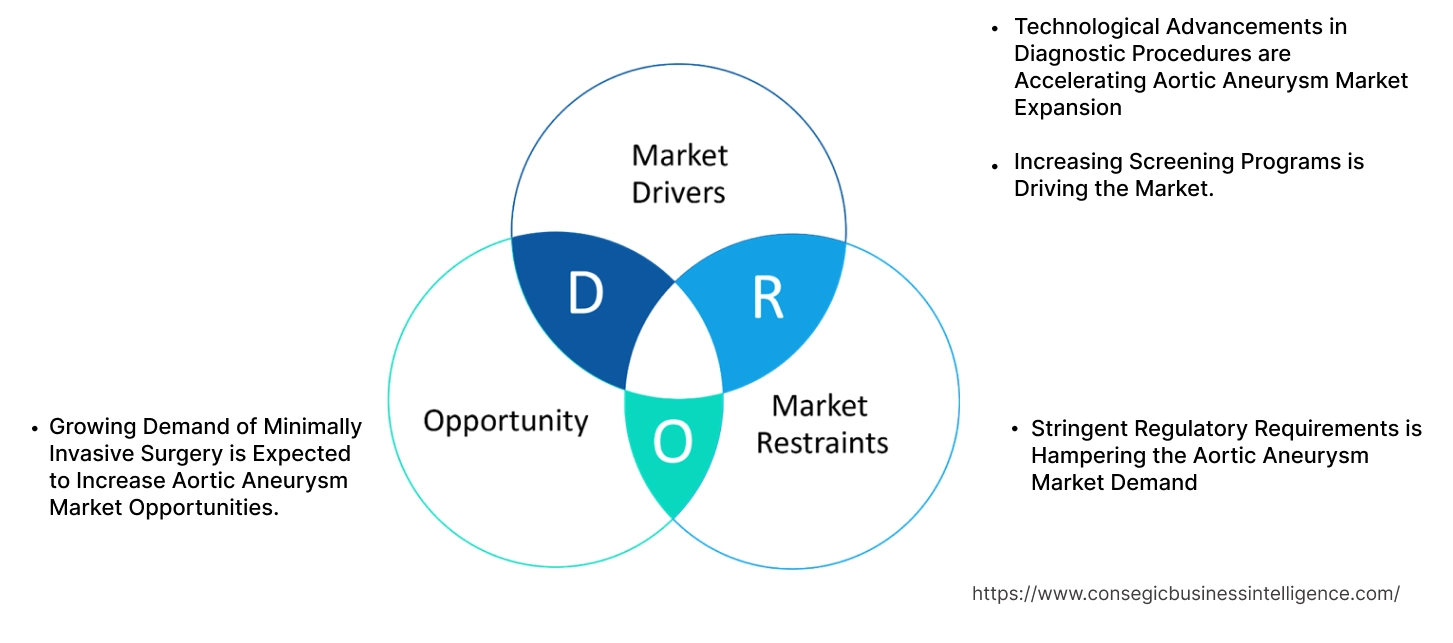
Aortic Aneurysm Market Dynamics - (DRO) :
Key Drivers:
Technological Advancements in Diagnostic Procedures are Accelerating Aortic Aneurysm Market Expansion
New medical imaging technologies are improving detection rates of aneurysms in aorta. Advanced ultrasound and 4D flow MRI machines provide real-time 3D visualization. It gives better insights into blood flow and aneurysm structure. These improvements are leading to early and safer diagnosis. Also, they are proving to be more accurate. This reduces the risk of sudden ruptures. Moreover, companies are integrating machines with advanced software as well.
For instance,
- In 2021, Philips integrated 3D ultrasound with software for the surveillance of abdominal aneurysms. This is helping clinicians in providing accurate diagnostics without radiation. It is avoiding the usage of contrast agents also. This has increased the adoption rate of diagnosis, thus driving market share.
Overall, the technological advancements in diagnostic procedures are significantly boosting the aortic aneurysm market expansion.
Increasing Screening Programs is Driving the Market.
There is an increasing aging population. Aneurysms are more common among older adults. Also, worldwide poor lifestyle factors are observed. Due to this, governments are promoting ultrasound screenings for people at higher risk. This includes men over 65, and smokers. Individuals with high blood pressure are also encouraged. Regular screening detects aneurysms early. Moreover, hospitals and healthcare organizations are also launching surveillance programs to save lives.
For instance,
- In 2022, UC Davis Health and Illuminate company launched a surveillance program for aortic aneurysm. Through this program, more aneurysms are detected and treated by medical professionals, before they cause serious problems, this driving the market growth.
Thus, increasing screening programs are accelerating the global aortic aneurysm market growth.
Key Restraints:
Stringent Regulatory Requirements is Hampering the Aortic Aneurysm Market Demand
The market faces hurdles due to strict regulatory approvals required for medical devices and medications. Regulatory bodies such as U.S. Food and Drug Administration (FDA) and European Medicines Agency (EMA) closely monitor stent grafts, surgical tools, and new medicines. Before they get approved, companies must go through long clinical trials. This is important to prove they are safe and work well.
Even after approval, companies must provide ongoing data about patient safety. These regulations help protect patients, but they slow down innovation. It also increases treatment costs. Moreover, the regulatory process varies by country and region. This creates barriers for companies who aim for international commercialization. Hence, the stringent regulatory requirements are hampering the aortic aneurysm market demand.
Future Opportunities :
Growing Demand of Minimally Invasive Surgery is Expected to Increase Aortic Aneurysm Market Opportunities.
Minimally invasive surgery (MIS) is a procedure that uses small incisions. Endovascular aneurysm repair (EVAR) is a popular choice among medical professionals. The main benefits include shorter recovery times and reduced risk of infection. It also causes less pain when compared to traditional. There is a growing focus on patient-centric treatments. This is leading manufacturers to focus on products that align with minimally invasive approaches.
For instance,
- In 2024, L. Gore & Associates launched their Gore Tag Thoracic Branch Endoprosthesis stent graft in Europe. It is for patients with complicated aortic problems. It is implanted through minimally invasive techniques. This is increasing the adoption of treatments, thus creating potential for the market.
Overall, growing demand for minimally invasive surgery is expected to increase aortic aneurysm market opportunities.
Aortic Aneurysm Market Segmental Analysis :
By Type:
Based on type, the market is categorized into diagnosis and treatment.
Trends in Type:
- CT scans with contrast (CT angiography) are increasingly used in hospitals. It is due to their speed and detailed visualization of the aorta.
- Companies are developing advanced endografts. The new products have improved durability and ease of deployment for EVAR procedures.
The treatment segment accounted for the largest market share in 2024 and is expected to grow at the fastest CAGR over the forecast period.
- Treatment segment dominated the aortic aneurysm market trends. It is further categorized into open aneurysm repair, endovascular aneurysm repair, and others. It is the only way to avoid rupture, which is fatal.
- Open aneurysm repair is a traditional surgery. In this surgery, the damaged part of the aorta is removed and replaced with a graft.
- Endovascular aneurysm repair is a minimally invasive procedure. In this procedure, a stent graft is placed inside the artery to support the weakened wall.
- Medical companies are developing better stent grafts and surgical tools to make treatment safer and more effective.
- For instance, Medtronic announced launched Steerant aortic guidewire. It is designed to facilitate accurate catheter placement
- Overall, as per the market analysis, the new product innovations are driving a segment in aortic aneurysm market growth.
By Aneurysm Type:
Based on aneurysm type, the market is categorized into thoracic aortic aneurysm (TAA), abdominal aortic aneurysm (AAA), and thoracoabdominal aortic aneurysm (TAAA).
Trends in Aneurysm Type:
- Efforts are increasing to detect abdominal aneurysm aneurysms early. This is through screening programs and risk factor management.
- The anatomy of thoracic aneurysm is very complex. This is leading to a growing focus on developing endovascular techniques specifically tailored for it.
The abdominal aortic aneurysm (AAA) segment accounted for the largest market share in 2024
- Abdominal aortic aneurysm (AAA) segment dominated the market trends. It is a bulge in the lower part of the aorta.
- AAA develops due to weakening of the artery walls. It is caused by smoking and atherosclerosis (plaque buildup).
- Social media and healthcare websites are sharing information on online platforms. This is guiding patients to manage their condition early.
- For instance, Chapter, a Medicare platform published an article in 2024 stating what is abdominal aneurysms, how screenings are done, and the treatment options available. This awareness has increased the visits, driving the segment.
- According to market analysis, the growing awareness amongst patients is driving the segment.
The thoracic aortic aneurysm (TAA) segment is expected to grow at the fastest CAGR over the forecast period.
- The thoracic aortic aneurysm (TAA) segment is emerging in market trends. It is a bulge in the upper part of the aorta, near the heart.
- The rupturing of this aorta causes severe internal bleeding and death. It is caused by high blood pressure and genetic disorders.
- It also develops due to aging and infections. CT and MRI scans are used to monitor small TAAs.
- A surgery is required for large TAAs. Better imaging technology is detecting more TAA cases.
- Increased awareness of genetic diseases is leading to earlier diagnosis and treatment. Moreover, advancements in minimally invasive procedures such as TEVAR will drive segmental growth for the upcoming years.
By End-Use:
Based on end-use, the market is categorized into hospitals, clinics, and ambulatory surgical centers.
Trends in the End-Use:
- Telemedicine is increasingly used by hospitals. It is to monitor patients remotely. This is especially helpful in rural areas where access to specialists is limited.
- There is the development of dedicated vascular clinics. They offer comprehensive diagnostic and treatment services for aneurysms.
The hospitals segment accounted for the largest market share of 69.48% in 2024.
- Hospitals segment dominated the aortic aneurysm market trends. They have the best facilities and experienced surgeons.
- Also, they have advanced technologies for both diagnosis and treatment procedures.
- Moreover, they handle high-risk and emergency cases 24/7. They have high influx of patients due to referral systems and insurance coverage. To provide increased access hospitals are incorporating new technologies.
- For instance, in 2024, North Shore University Hospital became first in Long Island City of New York to adopt GORE TMBE for treating complex thoracoabdominal aneurysms. This is increasing the access to patients.
- Overall, as per the market analysis, hospitals incorporating newer technologies is driving segmental growth in the aortic aneurysm industry.
The ambulatory surgical centers segment is expected to grow at the fastest CAGR over the forecast period.
- Ambulatory surgical centers (ASCs) are emerging in market trends. They offer faster, cost-effective, and specialized care.
- Many minimally invasive procedures, such as EVAR and TEVAR, are now done in ASCs instead of hospitals.
- These centers provide shorter waiting times and quicker recovery. They also offer treatment at lower costs. This makes them attractive to patients.
- ASCs also reduce hospital overcrowding by treating low-risk aneurysm cases in an outpatient setting. This will make treatment more accessible.
- As per the market analysis, governments investing in the ASCs industry will drive segmental growth for the forecasted years.

Regional Analysis:
The regional segment includes North America, Europe, Asia Pacific, the Middle East and Africa, and Latin America.

In 2024, North America accounted for the highest aortic aneurysm market share at 46.25% and was valued at USD 2,479.44 Million and is expected to reach USD 4,802.00 Million in 2032. In North America, the U.S. accounted for the aortic aneurysm market share of 70.87% during the base year of 2024. Governments are encouraging individuals for early detection through routine screenings. This is for high-risk populations such as older adults and smokers. This leads to early detection and timely treatment. Moreover, healthcare facilities are incorporating new innovative products. This is to make treatments safer and more effective.
For instance,
- In 2024, UC Davis Health received FDA approval to use new device in minimally invasive procedures to repair aortas. This is leading to increased access to treatment for patients.
Overall, increasing screenings programs and healthcare facilities adopting innovative products are driving the market in region.

In Asia Pacific, the aortic aneurysm market is experiencing the fastest growth with a CAGR of 10.6% over the forecast period. The risk of aneurysms also increased with aging population because aging weakens the blood vessels. This has led to a higher demand for diagnostic tests and treatments for aneurysms. Moreover, there is growing awareness about aneurysms in APAC. More people are learning about the symptoms and risks of aneurysms. This has led to the need in diagnosis and preventive treatments. Additionally, governments and medical organizations are working to educate the public, encouraging regular health checkups and screenings.
Europe's aortic aneurysm market analysis states that several factors are responsible for the progress of the market in the region. Manufacturers are introducing innovative stent grafts, minimally invasive devices, and robotic surgery tools in the region. These innovations are making treatments more effective and less invasive. These products are improving patient outcomes. Moreover, growing demand for minimally invasive surgery is another key driver in Europe. Procedures such as EVAR and TEVAR are gaining popularity. It is because they reduce recovery times and minimize pain. Additionally, governments in the region are introducing favorable initiatives to support the treatment of aneurysms.
The Middle East and Africa (MEA) aortic aneurysm market analysis states that the region is also witnessing several trends for notable surge. Advances in imaging technologies, such as CT scans, MRIs, and AI-based diagnostics are making it easier to detect aneurysms at an early stage. Early detection allows for timely treatment. Moreover, the growing prevalence of hypertension, smoking, and high blood pressure is driving the market in region. These factors damage the arteries, making individuals more vulnerable to developing aortic aneurysms. This is leading to increased demand for treatments.
Latin America's aortic aneurysm market size is also emerging. The expansion of ambulatory centers is driving the growth of the market in region. Ambulatory Surgical Centers (ASCs) offer minimally invasive procedures. These procedures are safer and less costly compared to traditional surgeries. These centers provide faster treatments, and shorter recovery times. Moreover, collaborations between healthcare providers, medical device companies, and governments are also boosting the market in the region. These partnerships are focused on improving access to treatments. They are also increasing awareness and enhancing medical research.
Top Key Players & Market Share Insights:
The Aortic Aneurysm market is highly competitive with major players providing products to the national and international markets. Key players are adopting several strategies in research and development (R&D) and product innovation to hold a strong position in the global Aortic Aneurysm market. Key players in The Aortic Aneurysm industry include-
- Medtronic Plc (Ireland)
- Cook Medical (U.S.)
- LeMaitre Vascular (U.S.)
- GE HealthCare (U.S.)
- L. Gore & Associates (U.S.)
- Koninklijke Philips NV (Netherlands)
- Abbott Laboratories (U.S.)
- Terumo Corporation (Japan)
- Boston Scientific (U.S.)
- Getinge (Sweden)
- Cardinal Health (U.S.)
- Siemens Healthineers (Germany)
Recent Industry Developments :
Product Launch:
- In June 2024, Medtronic plc launched the Steerant Aortic Guidewire. It is used to facilitate catheter placement during diagnostic or interventional procedures in the aorta. The Steerant Aortic Guidewire is designed to provide a balance of stiffness and trackability. It is designed to protect fragile aortic anatomy.
- In January 2021, Philips launched 3D ultrasound with integrated aneurysms software, also known as the Philips AAA Model. This imaging accurately detects abdominal aortic aneurysms and quantify the mass more precisely.
Aortic Aneurysm Market Report Insights :
| Report Attributes | Report Details |
| Study Timeline | 2019-2032 |
| Market Size in 2032 | USD 10,852.55 Million |
| CAGR (2025-2032) | 9.3% |
| By Type |
|
| By Aneurysm Type |
|
| By End-Use |
|
| By Region |
|
| Key Players |
|
| North America | U.S. Canada Mexico |
| Europe | U.K. Germany France Spain Italy Russia Benelux Rest of Europe |
| APAC | China South Korea Japan India Australia ASEAN Rest of Asia-Pacific |
| Middle East and Africa | GCC Turkey South Africa Rest of MEA |
| LATAM | Brazil Argentina Chile Rest of LATAM |
| Report Coverage |
|
Key Questions Answered in the Report
How big is the Aortic Aneurysm market? −
In 2024, the Aortic Aneurysm market is USD 5,361.08 Million.
Which is the fastest-growing region in the Aortic Aneurysm market? +
Asia-Pacific is the fastest-growing region in the Aortic Aneurysm market.
What specific segmentation details are covered in the Aortic Aneurysm market? +
Type, Aneurysm Type, and End-Use segmentation details are covered in the Aortic Aneurysm market
Who are the major players in the Aortic Aneurysm market? +
Medtronic Plc (Ireland), Cook Medical (U.S.), Abbott Laboratories (U.S.), Terumo Corporation (Japan), Boston Scientific (U.S.), Getinge (Sweden), and Cardinal Health (U.S.) are some major players in the market.
Overview
Reputation & Certifications


Our Services
- Market Intelligence & Forecasting
- Custom Research Solutions
- Market Entry Strategy
- Competitive Intelligence
- Customer Insights
- Industry Innovation Analysis
- Investment Advisory