Jump to Content
Mastitis Market Size & Industry Share - Growth Trends & Forecasts (2026 - 2034)
Mastitis Market Size:
The Mastitis Market is expected to expand from 2.07 (US$B) in 2025 to 2.2 (US$B) in 2026, and is forecast to surpass 3.56 (US$B) by 2034, growing at a CAGR of 6.2% between 2026 and 2034, according to a recent report from Consegic Business Intelligence.
Mastitis Market Scope & Overview:
Mastitis is an inflammatory condition of the mammary gland and udder tissue, typically caused by bacterial infections that enter through the teat canal. It is the most significant disease in the dairy industry, leading to physical and chemical changes in milk composition and substantial economic losses due to reduced yield and treatment costs. Further, key trends driving the market include rapid adoption of precision livestock farming technologies, such as automated milking systems and AI-powered health sensors, which enable real-time detection and personalized herd management. Moreover, the sector is witnessing a significant shift toward antimicrobial stewardship, fostering a growing demand for non-antibiotic alternatives, including vaccines, teat sealants, and immunostimulants to combat rising resistance and meet consumer preferences for residue-free dairy.
How is AI Impacting the Mastitis Market?
AI is revolutionizing the market by transitioning dairy management from reactive treatment to predictive, precision-based care. By leveraging machine learning and deep learning algorithms, AI-powered systems analyze real-time data from IoT sensors, automated milking robots, and infrared thermography to detect subtle physiological changes such as udder temperature spikes or altered milk conductivity. These advanced models, including artificial neural networks, integrate multi-omics and somatic cell count data to provide highly accurate, cow-side diagnoses. This proactive approach significantly reduces reliance on broad-spectrum antibiotics, minimizes milk waste, and enhances animal welfare by enabling early, targeted interventions that preserve herd productivity and farm profitability.

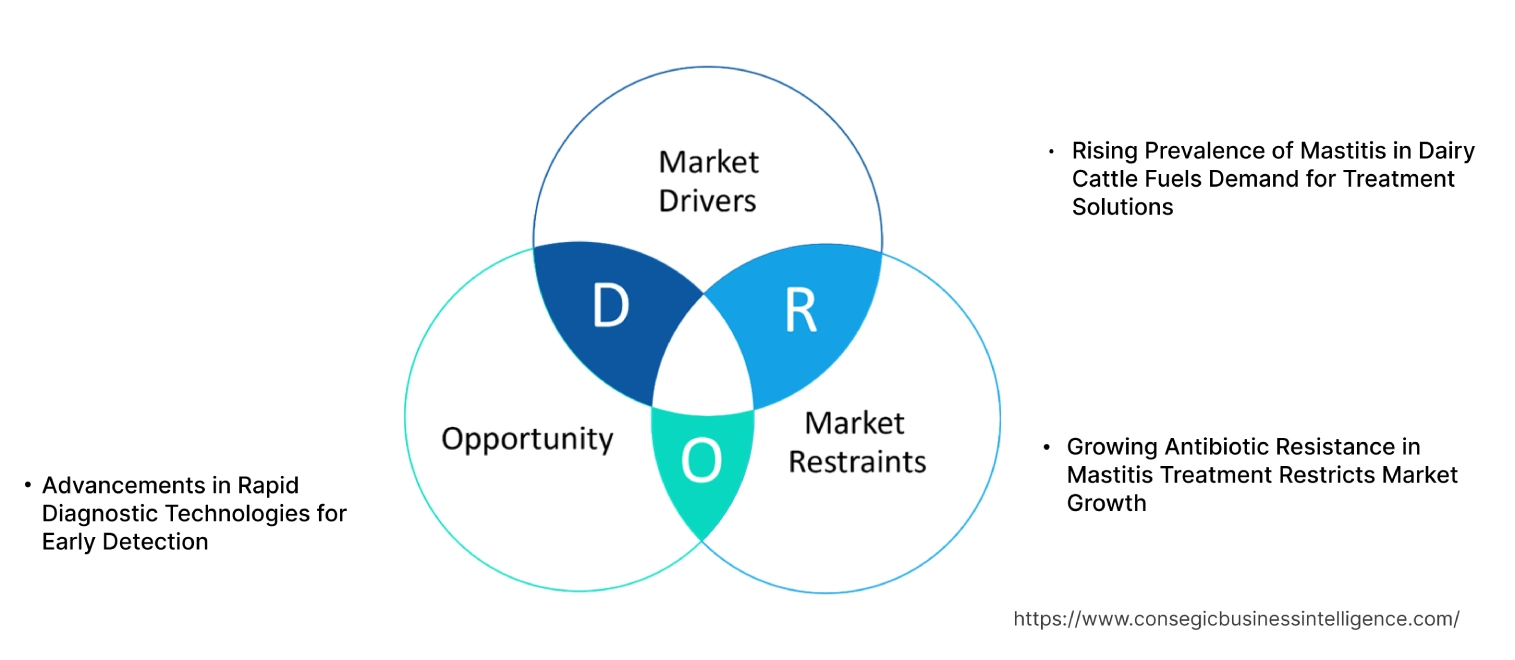
Mastitis MarketDynamics - (DRO) :
Key Drivers:
Rising Global Milk Demand and Increasing Integration of Technology Drives the Market
Rising global demand for dairy products, particularly in emerging economies, is intensifying pressure on producers to maximize yield while maintaining stringent milk quality standards, directly fueling the mastitis market. Further, to stay competitive, dairy operations are rapidly integrating precision livestock technologies, such as AI-driven sensors and automated milking systems, which facilitate the continuous monitoring of individual cow health. These technological advancements enable the early detection of sub-clinical infection before visual symptoms appear, allowing for targeted interventions that minimize milk waste and antibiotic use.
- For instance, according to OECD, India will lead the global dairy market with a robust annual milk production growth rate of 3.6% from 2025 through 2034. This expansion is expected to outpace all other nations, fueled primarily by a strategic combination of larger livestock populations, enhanced animal genetics, and more efficient farming practices.
Thus, the growing need for milk and milk-based products, along with the integration of AI and automation technologies, contributes significantly to the mastitis market size.
Key Restraints :
Strict Regulatory Hurdles and Low Adherence in Emerging Markets are Limiting the Market Growth
The market faces significant barriers due to stringent regulatory frameworks and poor treatment adherence in developing regions. In highly regulated markets like the EU and North America, strict mandates on antibiotic residues and maximum residue limits force frequent milk disposal, imposing heavy financial burdens on producers and deterring intensive treatment. Simultaneously, in emerging economies, limited awareness and rural isolation lead to low adherence to standardized veterinary protocols, such as improper withdrawal periods or uncompleted drug courses. These factors collectively foster antimicrobial resistance and increase disease recurrence, ultimately stifling overall market revenue and slowing the adoption of advanced therapeutic solutions.
Future Opportunities :
Increasing focus on Non-Antibiotic Alternatives Drives Mastitis Market Opportunities
The increasing focus on non-antibiotic alternatives is creating significant market opportunities as the dairy industry faces mounting pressure from antimicrobial resistance and stringent residue regulations. This shift is accelerating the research and commercialization of diverse solutions, including vaccines to enhance herd immunity, bacteriophage therapies that specifically target infection pathogens, and herbal-based anti-inflammatories. These alternatives are particularly attractive to producers because they eliminate milk withdrawal periods, thereby preventing the economic loss associated with discarded milk. Furthermore, the rising consumer preference for organic and residue-free dairy products is driving a premium market for manufacturers that prioritize sustainable, antibiotic-free therapeutic portfolios.
- For instance,Merck & Co., Inc. offers BOVILIS J-5, which is a specialized Gram-negative core-antigen vaccine designed to combat infection caused by pathogens such as Escherichia coli, which frequently results in decreased milk yields, the need for culling, or livestock fatalities.
Thus, availability of alternatives such as vaccines & bacteriophage therapies and preference for organic and residue-free dairy drive the mastitis market opportunities.
Mastitis Market Segmental Analysis :
By Disease Type:
Based on the disease type, the market is segmented into clinical mastitis and sub-clinical mastitis.
Trends in the Disease Type:
- Dairy processors are tightening Somatic Cell Count (SCC) limits, forcing farmers to treat sub-clinical cases aggressively to avoid significant financial penalties, which is driving the mastitis market trends.
- There is a significant trend toward using internal teat sealants during the dry period to prevent sub-clinical infections from developing during gestation, which in turn drives the mastitis market size.
Clinical mastitis accounted for the largest revenue portion in the year 2024 and is anticipated to register a significant CAGR during the forecast period.
- Increasing consumer pressure is driving the use of pain management as a standard part of clinical care rather than an optional add-on, driving the mastitis market share.
- Further, there is a growing trend toward using fast-acting, intramammary antibiotic infusionsto minimize the time milk must be discarded.
- Furthermore, farmers are using digital health alerts to track recurring clinical cases, leading to more data-driven culling decisions to maintain herd health, which in turn drives the mastitis market trends.
- Thus, as per the mastitis market analysis, rapid treatment protocols, rising severity tracking, and emphasis on animal welfare are driving the market.
By Treatment:
Based on the treatment, the market is segmented into antibiotics, vaccines, painkillers/NSAIDs, and teat sealants & disinfectants.
Trends in the Treatment:
- Rising consumer and retail pressure for humane dairy production is mandating the use of pain relief for all clinical mastitis cases, driving the mastitis market demand.
- The adoption of antibiotic-free internal pastes is surging as a physical barrier to prevent new infections during the dry period, driving the mastitis market share.
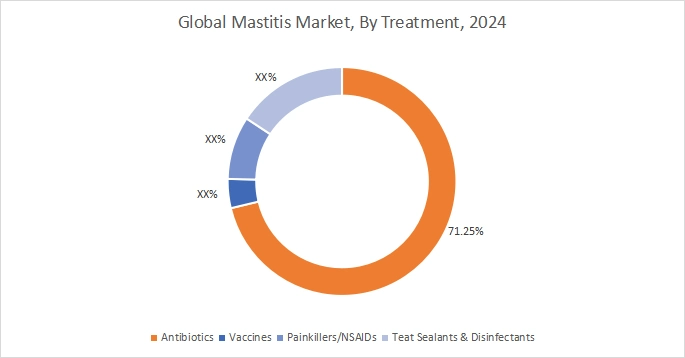
Antibiotics accounted for the largest revenue share of 71.25% in the year 2024.
- Farmers are shifting from treating all cows at the end of lactation to only treating those with confirmed infections to reduce antibiotic use.
- Further, new intramammary drugs are being designed with shorter milk-withholding periods to minimize the economic loss of discarded milk, in turn driving the mastitis industry.
- Furthermore, diagnostic-led treatment is replacing broad-spectrum use, ensuring that the specific bacteria are targeted accurately, which in turn drives mastitis market growth.
- Thus, as per the mastitis market analysis, selective dry cow therapy, short-withdrawal formulations, and pathogen-targeted prescribing are driving the market.
Vaccines is anticipated to register the fastest CAGR during the forecast period.
- New generation vaccines are specifically targeting difficult-to-cure contagious pathogens like Staphylococcus aureus to reduce chronic herd infections.
- Further, commercial vaccines for environmental infections are becoming standard on large-scale farms to reduce the severity of clinical outbreaks, which subsequently propels the mastitis market expansion.
- Furthermore, large dairy operations are increasingly using custom-made vaccines derived from their own herd's specific bacterial strains for higher efficacy.
- Therefore, based on analysis, the aforementioned factors are anticipated to boost the growth of the market during the forecast period.
By Diagnostics:
Based on the diagnostics, the market is segmented into on-farm culture kits, PCR tests, automated milk analyzers, handheld detectors, and others.
Trends in the Diagnostics:
- New PCR kits can now detect up to 15–20 different pathogens simultaneously from a single milk sample, which in turn drives the mastitis market expansion.
- Advanced handheld devices now feature Bluetooth connectivity to sync diagnostic data directly with a farmer's smartphone or tablet, which propels the mastitis market demand.
On-Farm Culture Kits accounted for the largest revenue share in the year 2024 and is anticipated to register the fastest CAGR during the forecast period.
- On-farm culture kits are increasingly used to determine if an infection is Gram-positive or Gram-negative before administering antibiotics, which drives the market growth.
- Further, manufacturers are redesigning culture media to provide clearer color-coded results that require minimal training for farm staff.
- Furthermore, new incubation technologies have shortened the wait time for culture results from 48 hours down to 18–24 hours, which in turn drives mastitis market growth.
- Thus, based on analysis, rise of selective treatment, simplified user interfaces, and reduced turnaround times are driving the market.
By End User:
Based on the end user, the market is segmented into dairy farms & cooperatives, veterinary hospitals & clinics, and research & diagnostic laboratories.
Trends in the End User:
- Large cooperatives are investing heavily in staff education to ensure consistent milking hygiene and early symptom recognition at the farm level, which in turn drives the market.
- Researchers are heavily focusing on identifying milk-based microRNAs and proteins that can cause infection days before current tests, propelling the mastitis market.
Veterinary Hospitals & Clinics accounted for the largest revenue share in the year 2024.
- Veterinarians are transitioning from emergency care to strategic herd-health consultants who design long-term prevention programs.
- Further, clinics are facing increased regulatory pressure to justify antibiotic use, leading to a surge in the prescription of vaccines and NSAIDs.
- Furthermore, many clinics now use remote monitoring platforms to track a farm’s real-time milk data and intervene before an outbreak becomes clinical.
- Thus, based on analysis, shifts to advisory roles, digital health monitoring, and others are driving the market.
Dairy Farms & Cooperatives is anticipated to register the fastest CAGR during the forecast period.
- Large-scale farms are increasingly integrating AI-powered milking robots that monitor udder health 24/7 without manual intervention.
- Further, producers are shifting away from waiting for external results by investing in cow-side PCR and culture kits for immediate treatment decisions.
- Furthermore, farmers are moving toward selective dry-cow therapy to reduce antibiotic costs and comply with rising sustainability standards.
- Therefore, based on analysis, the aforementioned factors are anticipated to boost the market during the forecast period.
Regional Analysis:
The regions covered are North America, Europe, Asia Pacific, Middle East and Africa, and Latin America.
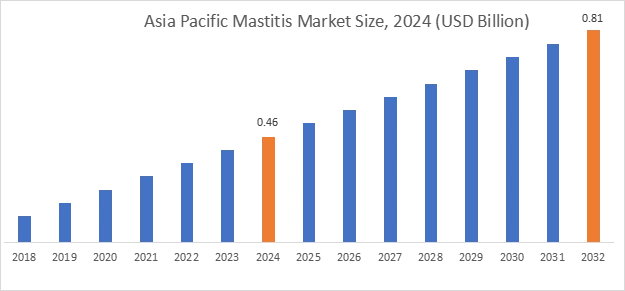
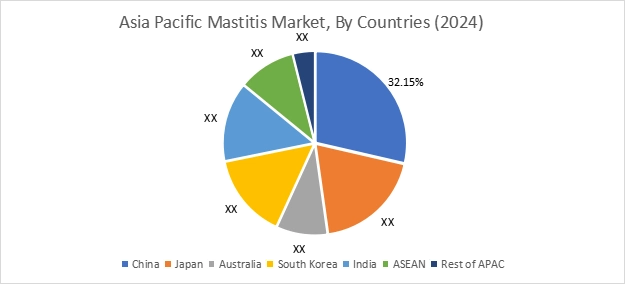
Asia Pacific region was valued at USD 0.46 Billion in 2024. Moreover, it is projected to grow by USD 0.49 Billion in 2025 and reach over USD 0.81 Billion by 2032. Out of this, China accounted for the maximum revenue share of 32.15%. The market growth is mainly driven by the massive and expanding cattle population and the rising demand for high-quality dairy products, which necessitates more rigorous herd health management. The market development is further accelerated by the rapid modernization of dairy farms, increasing government initiatives for milk safety, and a surge in awareness regarding the economic impact of sub-clinical mastitis.
- For instance, in June 2024, IIT Kanpur licensed its pioneering "Lateral Flow Immunoassay Strip" technology to Prompt Equipments Pvt. Ltd. to transform how mastitis is detected in dairy cattle across India. By partnering with a company that maintains a presence in over 70,000 villages, the institute ensures that this advanced chemical engineering breakthrough moves from the lab to the front lines of rural dairy farming.
North America is estimated to reach over USD 1.15 Billion by 2032 from a value of USD 0.67 Billion in 2024 and is projected to grow by USD 0.71 Billion in 2025. The North American market is primarily driven by highly industrialized dairy infrastructure, stringent government regulations on milk quality, and the rapid adoption of advanced precision technologies like automated milking sensors and rapid diagnostic kits.
- For instance, in August 2023, Zoetis Inc. introduced the Vetscan Mastigram+, an innovative on-farm diagnostic tool designed to identify Gram-positive mastitis infections in approximately eight hours. This rapid turnaround allows for more precise medical intervention, ensuring that antimicrobial treatments are reserved strictly for cases that will benefit from them.
The regional trends analysis depicts that stringent regulation and accelerating shift toward selective dry cow therapy, non-antibiotic treatments, and advanced diagnostic technologies in Europe are driving the market. Additionally, the factors driving the market in the Middle East and African region are the steady rise of the commercial dairy sector and increasing government and private investments in improving veterinary infrastructure and herd hygiene. Further, increasing transition toward large-scale, commercialized dairy farming and a rising emphasis on improving milk quality in the Latin America region are driving the market.
Top Key Players & Market Share Insights:
The global mastitis market is highly competitive with major players providing solutions to the national and international markets. Key players are adopting several strategies in research and development (R&D), product innovation, and end-user launches to hold a strong position in the mastitis industry. Key players in the global mastitis market include-
- Zoetis Inc. (U.S.)
- Merck Animal Health (U.S.)
- Boehringer Ingelheim (Germany)
- Elanco Animal Health (U.S.)
- Ceva Santé Animale (France)
- Dramiński S.A. (Poland)
- DeLaval (Sweden)
- GEA Group (Germany)
- Lely (Netherlands)
- Virbac (France)
Recent Industry Developments :
Collaboration and Partnership
- In August 2025, Asahi Kasei Corp. officially licensed its proprietary detection technology to the biotechnology trading specialist AR BROWN Co., Ltd. This agreement covers key markets across Japan, Asia, and the Middle East, aiming to provide dairy farmers with faster identification of bacterial infections.
Mastitis Market Report Insights :
| Report Attributes | Report Details |
| Study Timeline | 2021-2034 |
| Market Size in 2034 | USD 3.56 Billion |
| CAGR (2026-2034) | 6.20% |
| Base Year | 2025 |
| By Disease Type |
|
| By Treatment |
|
| By Diagnostics |
|
| By End User |
|
| By Region |
|
| Key Players |
|
| North America | U.S. Canada Mexico |
| Europe | U.K. Germany France Spain Italy Russia Benelux Rest of Europe |
| APAC | China South Korea Japan India Australia ASEAN Rest of Asia-Pacific |
| Middle East and Africa | GCC Turkey South Africa Rest of MEA |
| LATAM | Brazil Argentina Chile Rest of LATAM |
| Report Coverage |
|
Key Questions Answered in the Report
How big is the mastitis market? −
Themastitis market is estimated to reach over USD 3.16 Billion by 2032 from a value of USD 1.85 Billion in 2024 and is projected to grow by USD 1.96 Billion in 2025, growing at a CAGR of 6.2% from 2025 to 2032.
What specific segmentation details are covered in the mastitis report? +
The mastitis report includes specific segmentation details for disease type, treatment, diagnostics, end user, and regions.
Which is the fastest segment anticipated to impact the market growth? +
In the mastitis market, vaccines is the fastest-growing segment during the forecast period.
What are the key trends in the mastitis market? +
The mastitis marketis being shaped by several key trends including integration of AI and IoT-driven sensors for real-time milk analysis and global shift toward selective dry cow therapy and non-antibiotic alternatives like vaccines and bacteriophages. Further, this transformation is fueled by the transition toward precision livestock farming, where rapid molecular diagnostics and data-driven monitoring allow for early intervention at the sub-clinical stage to preserve both milk quality and farm profitability.
Who are the major players in the mastitis market? +
The key participants in the mastitis marketare Zoetis Inc. (U.S.), Merck Animal Health (U.S.), Boehringer Ingelheim (Germany), Elanco Animal Health (U.S.), Ceva Santé Animale (France), Dramiński S.A. (Poland), DeLaval (Sweden), GEA Group (Germany), Lely (Netherlands), Virbac (France), and others.
Overview
Reputation & Certifications


Our Services
- Market Intelligence & Forecasting
- Custom Research Solutions
- Market Entry Strategy
- Competitive Intelligence
- Customer Insights
- Industry Innovation Analysis
- Investment Advisory