Jump to Content
Biaxially Oriented Polyamide Films Market - Size, Industry Share, Growth Trends and Forecasts (2023 - 2030)
Biaxially Oriented Polyamide Films Market :
Consegic Business Intelligence analyzes that the Biaxially Oriented Polyamide Films market size is growing with a CAGR of 5.3% during the forecast period (2023-2030), and the market is projected to be valued at USD 3,763.31 Million by 2030 from USD 2,496.32 Million in 2022.
Biaxially Oriented Polyamide Films Market Scope & Overview:
Biaxially oriented polyamide (BOPA) films is a type of high-performance specialty film. These films are produced through a process called biaxial stretching, which involves stretching the polyamide film in both the machine direction (MD) and transverse direction (TD). Based on the analysis, these films possess exceptional mechanical properties, including high tensile strength, puncture resistance, and flexibility.
These films provide excellent barrier properties which are crucial for preserving the quality and shelf life of various packaged products. Further, such films are commercialized as versatile packaging materials widely used in various industries such as food & beverage, household products, pharmaceuticals, and electronics, among others due to properties such as lightweight nature, durability, and superior printability.
Market Size & Forecast
- 2022 Market Size : USD 2,496.32 Million
- 2030 projected Market Size : USD 3,763.31 Million
- CAGR (2023-2030) : 5.3%
- Base Year : 2025
Biaxially Oriented Polyamide Films Market Insights :

Biaxially Oriented Polyamide Films Market Dynamics - (DRO) :
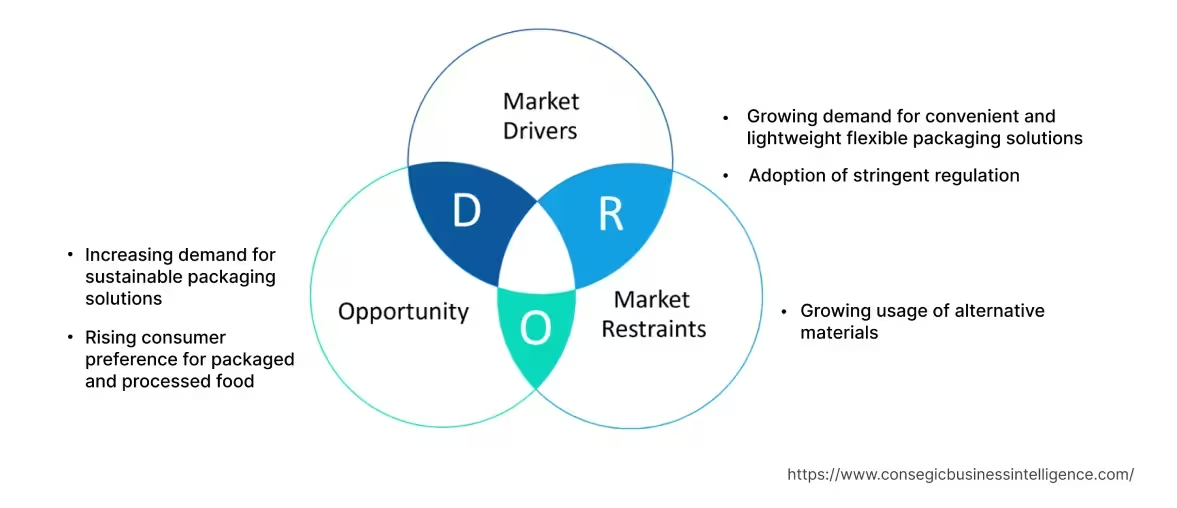
Key Drivers :
Growing demand for convenient and lightweight flexible packaging solutions
The flexible packaging sector is experiencing robust trends due to its numerous advantages such as convenience, lightweight nature, and cost-effectiveness. The films are extensively used in flexible packaging applications due to their excellent barrier properties against moisture, oxygen, aroma, and durability. Based on the analysis, the requirement for these films has surged due to the increased adoption of flexible packaging from various end-use industries including pharmaceuticals, personal care & cosmetics, and consumer goods, among others. For instance, according to the British Retail Consortium, the global flexible plastic packaging market was valued at USD 143.8 billion in 2020 and is expected to reach approximately USD 200 billion by 2026. Hence, the growing adoption of flexible packaging solutions is boosting the revenue trends of the biaxially oriented polyamide market.
Adoption of stringent regulation
Regulatory initiatives and standards related to packaging materials and food safety is increasing the requirement for these films. The films meet the stringent requirements for food contact applications, ensuring product safety and durability. For instance, FDA regulations, such as 21 CFR (Code of Federal Regulations) Part 177, approve the use of polymeric materials such as biaxially oriented polyamide films in contact with food.
Hence, as per the analysis, compliance with these regulatory standards by various industries has made these films a preferred choice for packaging various food and pharmaceutical products is driving the market trends.
Key Restraints :
Growing usage of alternative materials
The growing usage of availability of alternative packaging materials, such as polyethylene terephthalate (PET), polyethylene (PE), and polypropylene (PP) films is hampering the biaxially oriented polyamide films market growth.
PET, PE, and PP films are more cost-effective options compared to these films. These alternative materials are widely available and offer superior properties. The excellent mechanical properties, including high tensile strength, impact resistance, and toughness, make them suitable for various packaging applications including bottles, containers, films, and bags. Further, as per the analysis, such types of materials can withstand high temperatures, making them suitable for applications involving heat sealing or heat resistance. Hence, the availability and versatility of alternative materials are the key factors limiting the biaxially oriented polyamide films market demand.
Future Opportunities :
Increasing demand for sustainable packaging solutions
The growing awareness regarding environmental concerns has shifted towards eco-friendly packaging solutions. Hence, the increasing emphasis on sustainable practices is providing lucrative opportunities to the market players for the development of these films with a focus on recyclability by using bio-based materials.
For instance, Domo Film Solutions introduced the launch of a new Nyleen nylon film. This family of nylon films has a low carbon footprint compared to standard nylon films. Further, the Nyleen nylon film is a sustainable BOPA film that can be widely used for flexible packaging and other technical applications. Hence, based on the analysis, such efforts to reduce the environmental impact of packaging materials are expected to fuel the trends and o biaxially oriented polyamide films market opportunities.
Rising consumer preference for packaged and processed food
With changing lifestyles and hectic schedules, consumers are seeking convenient food options that require minimal preparation. Processed foods, such as ready-to-eat meals, pre-packaged snacks, and canned goods, provide quick and easy solutions. These films are considered an ideal material for the packaging of processed food. It provides an effective packaging solution that protects the food from moisture, oxidation, microbial attack, and other contaminants, which helps to extend the shelf life of the packaged material.
The films are known for providing exceptional oxygen barrier properties and can limit oxygen permeation, thereby, ensuring food safety and durability. Thus, the increasing demand for packaged and processed food is expected to boost the demand for biaxially oriented polyamide films.
Biaxially Oriented Polyamide Films Market Report Insights :
| Report Attributes | Report Details |
| Study Timeline | 2017-2030 |
| Market Size in 2030 | USD 3,763.31 Million |
| CAGR (2023-2030) | 5.3% |
| By Type | Specialty Films and Plain Films |
| By Technology | Sequential Films, Simultaneous Films, Blown Films, and Others |
| Application | Packaging (Food, Confectionary, Pharmaceutical, Personal Care Products, Tobacco, and Others), Labelling, Tapes, Laminations, and Others |
| By Region | North America, Europe, Asia-Pacific, Latin America, and Middle East & Africa |
| Key Players | Unitika Ltd., TPL Transparent Paper Ltd., Mitsubishi Chemical Corporation, Felizplastic, TOYOBO Co., Ltd., DOMO Chemicals, Biaxis Oy Ltd., Sojitz Plastics America Inc., AdvanSix, and JK Materials Co., Ltd. |
Biaxially Oriented Polyamide Films Market Segmental Analysis :
By Type :
The type segment is categorized into specialty films and plain films. In 2022, the plain films segment accounted for the highest market share in the overall biaxially oriented polyamide films market. Plain films provide resistance to harmful chemicals, pollution, oils, and grease. Such types of films also offer good puncture and flex crack resistance over a wide range of temperatures which is a key factor boosting the biaxially oriented polyamide films market growth.
However, the specialty films segment is expected to be the fastest-growing segment in the market during the forecast period. Specialty films are made with multiple polymer layers, such multi-polymer layered films offer convenient and flexible packaging solutions due to their superior properties such as excellent barrier properties, transparency, and printability. As per the analysis, specialty films have enhanced tensile strength, tear resistance, and dimensional stability making them suitable for a wide range of packaging applications. Such types of films offer lightweight packaging solution which reduces packaging material usage and transportation costs which are the key drivers expected to increase the biaxially oriented polyamide films market trends.
By Technology :
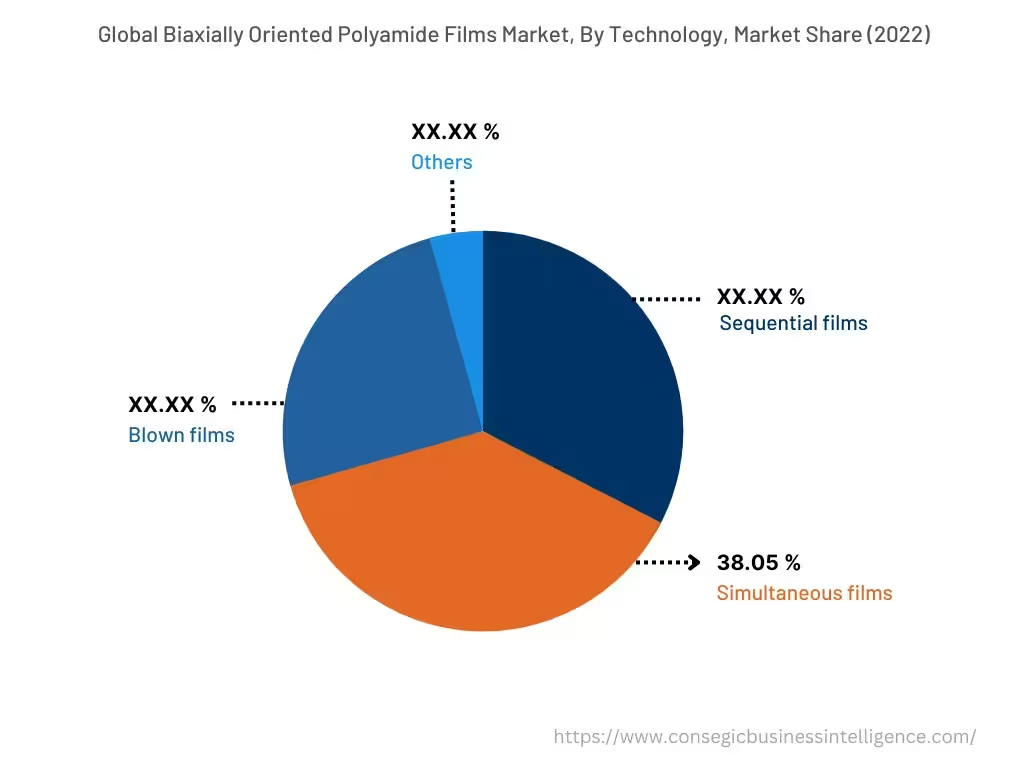
The technology segment is categorized into sequential films, simultaneous films, blown films, and others. In 2022, simultaneous films segment accounted for the highest biaxially oriented polyamide films market share of 38.05% in the overall biaxially oriented polyamide films market. Simultaneous film process allows for the production of higher quality films with excellent mechanical and barrier properties while reducing production cost and lead times. Based on the analysis, this makes it an attractive option for manufacturers looking to improve the quality and efficiency of film production processes which are the key factors driving the segment trends.
However, blown films are expected to be the fastest-growing segment over the forecast period in the biaxially oriented polyamide films market. Blown film is the most common process for the production of various monolayer and multilayered films such as biaxially oriented polyamide films. Further, the blown film offers a better balance of mechanical properties because it is drawn in both the machine and transverse directions. Mechanical properties of the manufactured film include tensile and flexural strength, and toughness to drive the segment trends.
By Application :
The application segment is classified into packaging labeling, tapes, laminations, and others. In 2022, the packaging segment accounted for the highest market share and is expected to grow at the fastest CAGR over the forecast period. Biaxially oriented polyamide films are extensively used in pharmaceutical packaging, such as blister packs, pouches, sachets, and medicine strips, due to their excellent barrier properties and compatibility with drug formulations.
Moreover, biaxially oriented polyamide films are also used in the food and beverage sector for packaging perishable and non-perishable food products, including snacks, confectionery, dairy products, meat, fish, and other food products.
For instance, according to The Agricultural and Processed Food Products Export Development Authority (APEDA), the food processing sector will grow at a compounded annual growth rate of 3% between 2022 and 2030. Thus, the rising food processing sector is expected to boost the segment trends in the coming years.
By Region :
The regional segment includes North America, Europe, Asia Pacific, the Middle East and Africa, and Latin America.
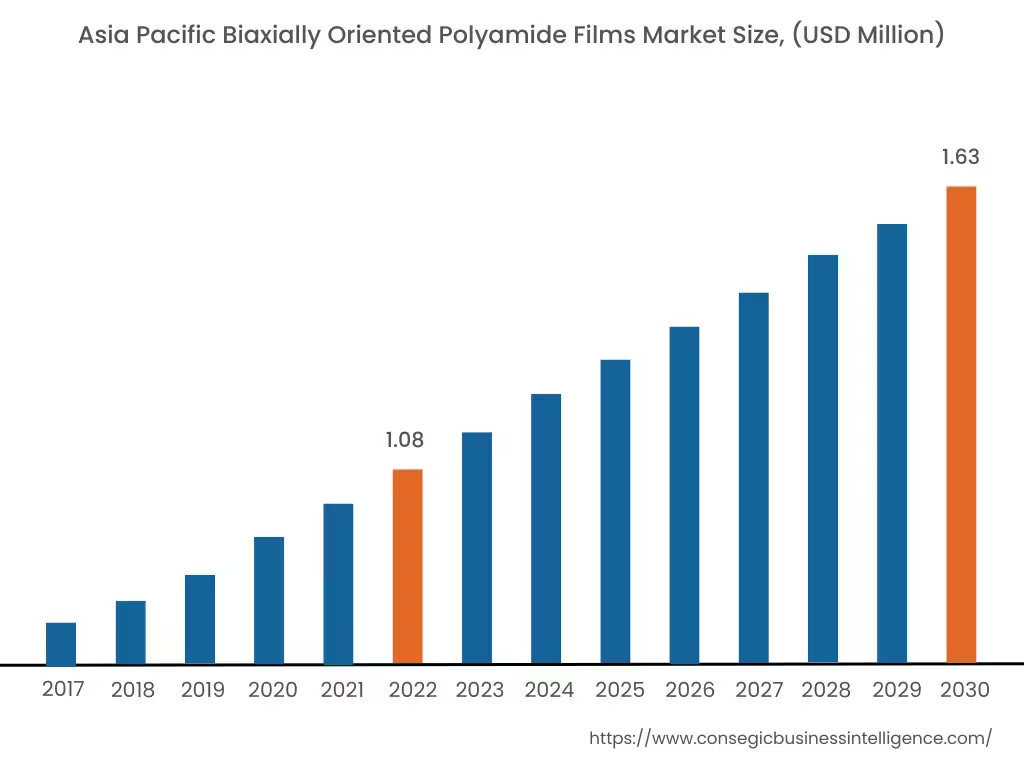
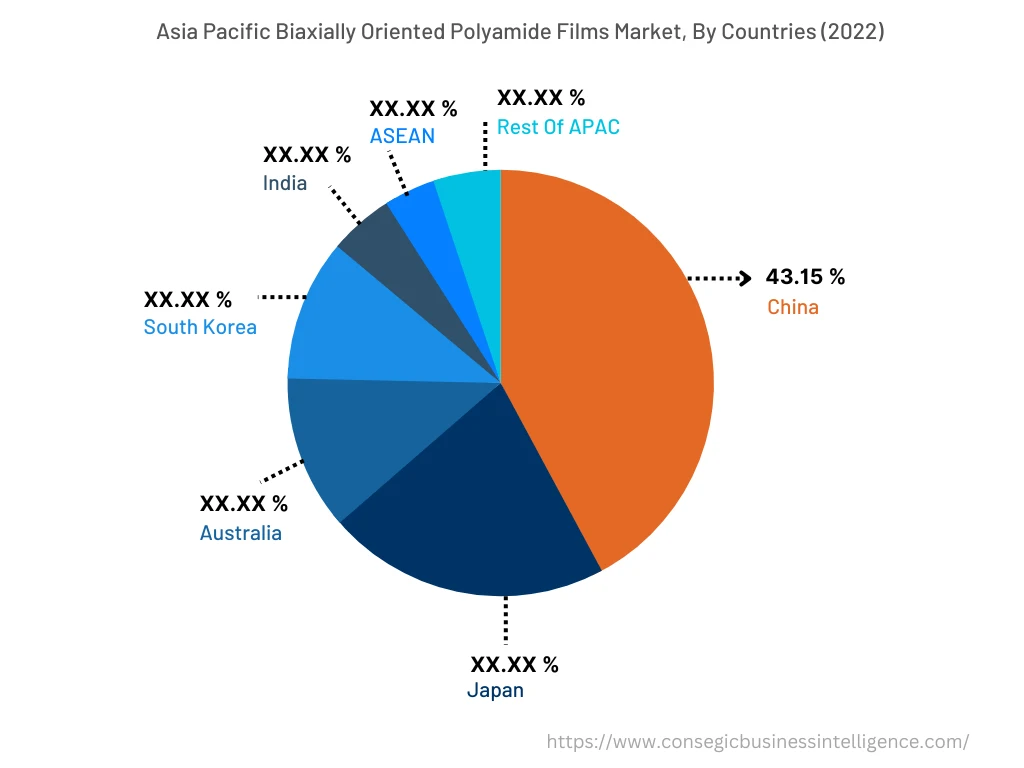
In 2022, Asia Pacific accounted for the highest market share at 43.15 and was valued at USD 1,077.16 million, and is expected to reach USD 1,634.41 million in 2030. In Asia Pacific, China accounted for the highest market share of 45.85% during the base year 2022 owing to the increasing growth of the food and beverage industries. Based on the biaxially oriented polyamide films market analysis, in the food and beverage industry, the films are highly used for the packaging of various food products due to their excellent barrier and moisture resistance properties. Moreover, the key manufacturing companies in the region are involved in research and development activities for expanding their product portfolios and distribution networks increasing the market growth.
Moreover, North America is expected to grow at the fastest CAGR of 6.3% during the forecast period owing to the increased growth of the pharmaceutical sector particularly in the U.S. Biaxially oriented polyamide films are heat sealable and have chemical resistance properties which are the critical factors required to ensure secure and efficient packaging of pharmaceutical products.
For instance, according to the IQVIA, in 2021, the U.S. held the largest national pharmaceutical market accounting for 41% of total pharmaceutical spending worldwide. Hence, this rising growth of pharmaceutical industries is increasing the demand for efficient packaging and labeling solution which is expected to contribute to the growth of the biaxially oriented polyamide films market.
Top Key Players & Market Share Insights:
The global biaxially oriented polyamide films market is highly competitive, with several large players and numerous small and medium-sized enterprises. These companies have strong research and development capabilities and a strong presence in the market through their extensive product portfolios and distribution networks. The biaxially oriented polyamide films industry is characterized by intense competition, with companies focusing on expanding their product offerings and increasing their market share through mergers, acquisitions, and partnerships. The key players in the market include-
- Unitika Ltd
- TPL Transparent Paper Ltd
- Mitsubishi Chemical Corporation
- Felizplastic
- TOYOBO Co., Ltd.
- DOMO Chemicals
- Biaxis Oy Ltd.
- Sojitz Plastics America Inc.
- AdvanSix
- JK Materials Co., Ltd
Recent Industry Developments :
- In September 2021, Uflex, Hoffer Plastics & Mespack announced a partnership to launch 100% recyclable mono-polymer hot-fill pouches. The partnership was aimed at bringing many ecologically responsible brands closer to reaching their sustainability goals.
- In May 2021, Mitsubishi Chemical Corporation acquired all the shares of Nakai Industrial Co., Ltd., a film coating manufacturer. The acquisition was aimed to cater to the demands of a wide range of customers through technology, human resources, and processing facilities possessed by Nakai Industrial.
Key Questions Answered in the Report
What was the market size of the biaxially oriented polyamide films market in 2022? −
In 2022, the market size of biaxially oriented polyamide films was USD 2,496.32 million
What will be the potential market valuation for the biaxially oriented polyamide films market by 2030? +
In 2030, the market size of biaxially oriented polyamide films will be expected to reach USD 3,763.31 million.
What are the key factors driving the growth of the biaxially oriented polyamide films market? +
Growing demand for convenient and lightweight flexible packaging solutions and the adoption of stringent regulation are the key factors driving the growth of the biaxially oriented polyamide films market.
What is the dominating segment in the biaxially oriented polyamide films market by type? +
In 2022, sequential films segment accounted for the highest market share of 38.05% in the overall biaxially oriented polyamide films market.
Based on current market trends and future predictions, which geographical region will have the fastest impact on the biaxially oriented polyamide films market's growth in the coming years? +
North America is expected to be the fastest-growing region in the market during the forecast period.
Overview
Reputation & Certifications


Our Services
- Market Intelligence & Forecasting
- Custom Research Solutions
- Market Entry Strategy
- Competitive Intelligence
- Customer Insights
- Industry Innovation Analysis
- Investment Advisory