Jump to Content
Bio Oil Market - Size, Industry Share, Growth Trends and Forecasts (2025 - 2032)
Bio Oil Market Size:
Bio Oil Market size is growing with a CAGR of 5.8% during the forecast period (2025-2032), and the market is projected to be valued at USD 2.03 Billion by 2032 from USD 1.29 Billion in 2024. Additionally, the market value for the 2025 attributes to USD 1.37 Billion.
Bio Oil Market Scope & Overview:
Bio oil, which is also called as pyrolysis oil is a dark, viscous liquid that consists of various oxygenated organic compounds, and water. The compound is easy to handle, store, and transport, has low nitrogen and sulfur contents, and possesses high energy density. It usually contains a composite blend of deoxygenated compounds such as alcohol, ketones, carboxylic acids, esters, benzoids, and aldehydes. This oil is a form of liquid biofuel that is mainly derived from feed stock such as agricultural residues, algae, waste plastic, waste tire/rubber, and others. These oils find their application in transportation fuel, industrial fuel, power generation, agricultural products, and others.
How is AI Impacting the Bio Oil Market?
Artificial Intelligence is transforming the bio oil market by improving production efficiency, process optimization, and market forecasting. In manufacturing, AI-powered systems analyze pyrolysis and refining conditions in real time, optimizing temperature, feedstock composition, and reaction time to maximize yield and quality. Machine learning models predict equipment performance and enable predictive maintenance, reducing downtime and operational costs. AI also supports the development of advanced bio oil formulations by simulating chemical reactions and evaluating potential catalysts. In addition, AI-driven analytics help forecast demand trends, optimize supply chains, and enhance sustainability reporting. As the global focus on renewable energy intensifies, AI is accelerating innovation, reliability, and scalability within the bio oil industry.

Bio Oil Market Dynamics - (DRO) :
Key Drivers:
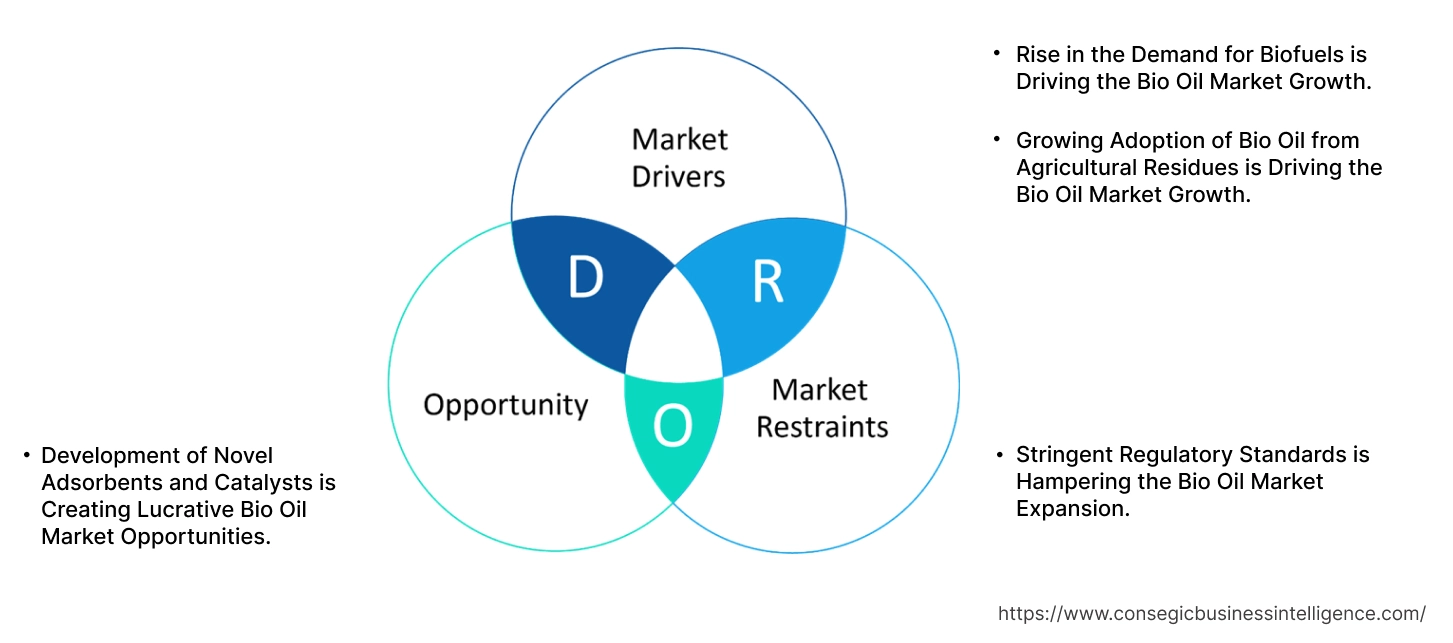
Rise in the Demand for Biofuels is Driving the Bio Oil Market Growth.
Bio oil is a type of biofuel that is mainly produced by pyrolysis of biomass. The pyrolysis method is a well-known optimizing method to maximize the production of biofuels. As the world shifts towards more sustainable energy sources, the role of this oil is a crucial intermediate in biofuel production. The increasing requirement for biofuels, driven by environmental regulations, and energy security concerns is influencing the use of these oils.
For instance,
- The data by IEA states that the demand for biofuels in 2022 reached 170,000 million litres, surpassing levels seen in 2019.
Thus, the rise in the requirement for biofuels in various applications is influencing the bio oil market expansion.
Growing Adoption of Bio Oil from Agricultural Residues is Driving the Bio Oil Market Growth.
Agricultural residue, also known as crop residue, are the materials that remain in the field or are generated after the crop has been harvested or processed. Agricultural residues suitable for bio oil production include items like rice straw, wheat straw, rice husk, corn stover, and other crop-related waste materials. The rise in the requirement for more bioenergy value feedstock is influencing the use of feed stock materials such as plant seeds.
For instance,
- The data published in the Waste Management Bulletin Journal states that an average 47.85% bio oil is received from plant seeds with more bioenergy value than that from other tree parts' biomass resources.
Thus, the rise in the requirement of these oils for essential feed stock is influencing the bio oil market demand.
Key Restraints :
Stringent Regulatory Standards is Hampering the Bio Oil Market Expansion.
The Bio Oil industry faces significant hurdles due to stringent regulatory standards imposed by various regulatory bodies worldwide. These standards are mainly designed for its production use and transportation. Regulations are necessary to ensure the quality and safety of these oils, their compatibility with existing infrastructure, and to verify claims of carbon reduction. Compliance with these standards is time-consuming and costly, particularly for smaller companies or those developing novel ingredients.
Additionally, changes in regulatory guidelines or the introduction of stricter regulations disrupt established processes and require significant investments in research, development, and manufacturing to meet the new standards. These factors contribute to increased costs, delayed product launches, and limited market access, ultimately hindering the growth of the market.
Future Opportunities :
Development of Novel Adsorbents and Catalysts is Creating Lucrative Bio Oil Market Opportunities.
Adsorbents and catalysts play a crucial role in the purification of bio oil, that generally consists of water, acids, aldehydes, ketones, phenols, and other oxygenated compounds. Raw oil mainly consists of high viscosity, acidity, instability, and low heating value, hindering its direct use as fuel or chemical feedstock. Novel adsorbents and catalysts are designed to be employed in various stages of oil processing to remove impurities, reduce oxygen content, improve stability, and increase its overall quality.
For instance,
- In 2025, Evonik introduced Purocel products and catalysts technologies that improve the quality of pyrolysis oil. The products help reduce chlorides, silicon, TAN and other contaminants in pyrolysis oil.
Thus, the development of adsorbents and catalysts for enhanced purification is creating lucrative bio oil market opportunities.
Bio Oil Market Segmental Analysis :
By Feed Stock:
Based on the feed stock, the market is categorized into agricultural residues, algae, waste plastic, waste tire/rubber, and others
Trends in the Feed Stock:
- There is a growing trend for blending different residues to optimize feed stock quality and reduce variability.
- Growing trend for advanced bio oil is influencing the use of waste plastic as a feed stock.
The agricultural residue segment accounted for the largest market share in 2024.
- Agricultural residues, such as rice straw or corn stover, are converted into bio oil through thermochemical processes like pyrolysis.
- This process generally decomposes organic matter at high temperatures, yielding a liquid fuel known as bio oil.
- This oil is used as a biofuel or as a feedstock for further processing into other fuels or chemicals.
- Thus, as per the market analysis, the rise in the use of agricultural residue as feed stock for production if these oils is driving the segment share.
The waste plastic segment is expected to grow at the fastest CAGR over the forecast period.
- Waste plastic is effectively converted into bio oil through pyrolysis, a process that breaks down long-chain polymers into shorter, fuel-like molecules.
- This process offers a way to manage plastic waste while producing a potentially renewable fuel source.
- This oil, produced from plastic pyrolysis is used as a fuel, feedstock for other products, or even as a rejuvenator for asphalt.
- Additionally, the rising application of these oils for various applications is influencing various manufacturers in developing pyrolysis oil through various feed stocks such as waste plastic.
- For instance, in 2024, Corsair introduced operations in Finland, primarily to produce advanced bio oil from plastic waste.
- Thus, as per the market analysis, the growing production of these oils from waste plastic is driving the bio oil market demand and trends in the coming years.
By Application:
Based on the application, the market is categorized into transportation fuel, industrial fuel, power generation, agricultural products, and others.
Trends in Application:
- There is a rise in trends for efficient boilers and industrial furnaces, which are influencing the use of bio oil.
- Development of novel biofuel for transportation applications is influencing the use of bio oil.
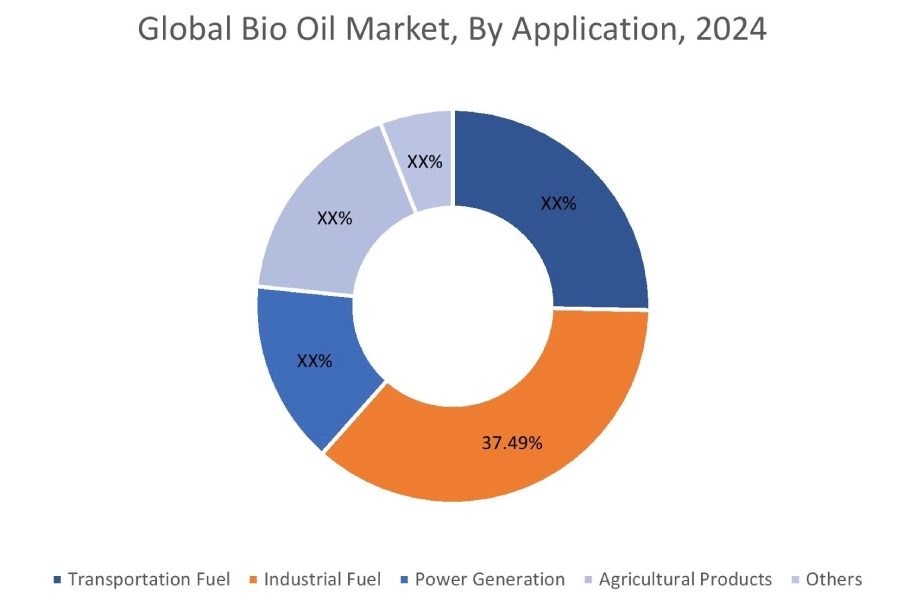
The industrial fuel segment accounted for the largest Bio Oil market share of 37.49% in the year 2024.
- Bio oil serves as a direct substitute for fossil fuels mainly in various industrial heating applications.
- These applications generally consist of boilers and furnaces, with some modifications to the existing equipment.
- The easy handling, storage, and combustion property make it a significant renewable alternative for heat and power generation in industrial settings.
- Additionally, this oil is also co-fired with traditional fuels to reduce reliance on purely fossil-based energy sources.
- Thus, as per the bio oil market analysis, the rise in the adoption of industrial fuel is influencing the utilization of this oil.
The transportation fuel segment is expected to grow at the fastest CAGR over the forecast period.
- Bio oil presents a prominent application as transportation fuel.
- The utilization of this oil generally requires significant upgradation through numerous processes such as hydrodeoxygenation, catalytic cracking, amongst others.
- This improves the quality and energy density, and compatibility with conventional fuels that include gasoline and diesel.
- This oil is transformed into various alternatives that include automotive biofuels, and others.
- The lower carbon dioxide content emitted by this oil makes it a cleaner fuel compared to fossil fuels.
- Ongoing research and technological advancements upgraded oil holds potential as a renewable component in the transportation fuel mix.
- These factors influence the rise in the adoption of biofuels.
- For instance, the data by IEA states that, biofuel demand is set to expand 38 billion litres over 2023-2028, a near 30% increase from the last five-year period.
- Thus, as per the market analysis, these aforementioned factors are influencing the growth of the segment.
Regional Analysis:
The regional segment includes North America, Europe, Asia Pacific, the Middle East and Africa, and Latin America.

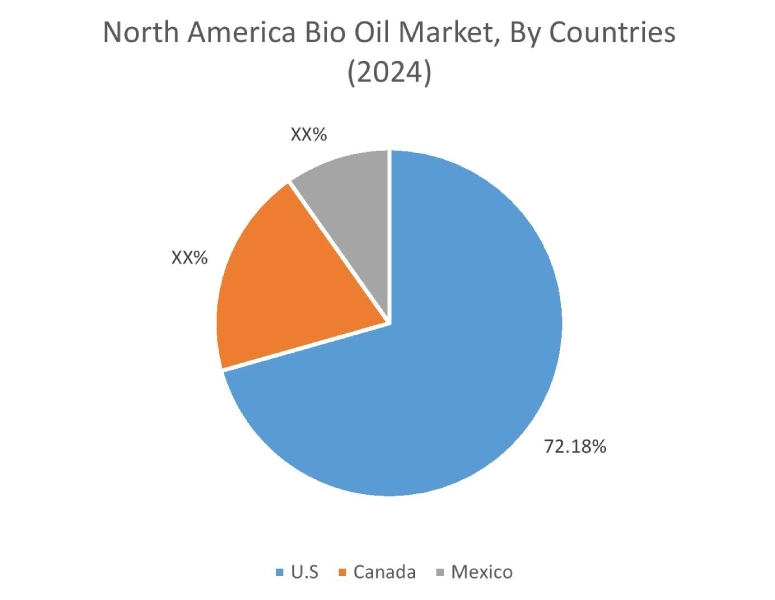
In 2024, North America accounted for the highest Bio Oil market share at 38.46% and was valued at USD 0.50 Billion and is expected to reach USD 0.72 Billion in 2032. In North America, the U.S. accounted for the highest market share of 72.18% during the base year of 2024. Biofuels in the U.S. are primarily utilized as transportation fuel. Biofuels, including the potential contributions from upgraded bio oil, play a significant role in the transportation fuel industry, mainly influenced by the Renewable Fuel Standard (RFS) program. This federal policy mainly mandates a minimum volume of renewable fuels to be combined into the nation's transportation fuel supply. This aims to reduce greenhouse gas emissions and enhance energy security. These factors lead to the rise in the production of biofuel in the U.S. region.
For instance,
- The data by IEA Bioenergy states that the production capacity of biofuel in the U.S. rose by 23.8 billion gallons per year (BGPY) in 2023, a growth of over 1.7 billion gallons compared to 2022.
Thus, as per the market analysis, the rise in the utilization of biofuels is influencing growth and bio oil market trends in this region.
Asia Pacific is experiencing the fastest growth with a CAGR of 7.6% over the forecast period. The purification of bio oil generally uses adsorbents and catalysts, driven by the need for sustainable energy sources and the use of abundant agricultural and forestry residues. Various research efforts and some industrial applications focus on using cost-effective and locally sourced materials as adsorbents to remove impurities such as alkali metals, water, and particulate matter. This improves the stability of oil and reduces the catalyst deactivation in subsequent upgrading processes. Thus, as per the market analysis, the rise in the use of enhanced material for purification is influencing the use of bio oil.
Bio oil production from agricultural residues in Europe is a field of increasing interest mainly because of the European Union's commitment to renewable energy targets, waste reduction, and the development of a circular bioeconomy. Various projects and research initiatives across Europe are exploring different agricultural residues, such as straw, corn stover, and other crop wastes, as feedstocks for bio oil production through technologies like fast pyrolysis and hydrothermal liquefaction. Thus, these aforementioned factors are influencing the bio oil market trends in this region.
There is a growing opportunity for the adoption of bio oil from feed stock such as waste plastic. The significant plastic waste management issues in various MEA countries, along with increasing energy requirement and a desire for sustainable solutions, are driving the interest for this type of oil. Several projects and research initiatives are exploring pyrolysis and other thermochemical conversion technologies to transform plastic waste into valuable oil and other products. Thus, as per the bio oil market analysis, the rise in the research for waste plastic derived oil is influencing the market growth in this region.
Latin American countries, face significant challenges with the disposal of end-of-life tires. Pyrolysis, a thermochemical process that converts tires into tire pyrolysis oil, is being explored as a significant solution for waste management and resource recovery. The concept of a circular economy that aims to minimize waste and maximize resource utilization, is gaining in Lati significant potential in America. Thus, as per the market analysis, tire pyrolysis aligns with this principle by transforming a waste product into potentially valuable materials.
Top Key Players & Market Share Insights:
The global Bio Oil market is highly competitive with major players providing precise products to the national and international markets. Key players are adopting several strategies in research and development (R&D) and product innovation to hold a strong position in the global Bio Oil market. Key players in the Bio Oil industry include-
- Stanley Black & Decker, Inc. (United States)
- Evonik (Germany)
- Hebei Jingu Co.Ltd (China)
- Bio-Green Pvt. Ltd (India)
- Valmet (Finland)
- BTG Bioliquids (Netherlands)
- Neste (Finland)
Bio Oil Market Report Insights :
| Report Attributes | Report Details |
| Study Timeline | 2019-2032 |
| Market Size in 2032 | USD 2.03 Billion |
| CAGR (2025-2032) | 5.8% |
| By Feed Stock |
|
| By Application |
|
| By Region |
|
| Key Players |
|
| North America | U.S. Canada Mexico |
| Europe | U.K. Germany France Spain Italy Russia Benelux Rest of Europe |
| APAC | China South Korea Japan India Australia ASEAN Rest of Asia-Pacific |
| Middle East and Africa | GCC Turkey South Africa Rest of MEA |
| LATAM | Brazil Argentina Chile Rest of LATAM |
| Report Coverage |
|
Key Questions Answered in the Report
Which is the fastest-growing region in the Bio Oil market? −
Asia Pacific is the fastest-growing region in the Bio Oil market.
How big is the Bio Oil market? +
In 2024, the Bio Oil market is USD 1.29 Billion.
What specific segmentation details are covered in the Bio Oil market? +
Feed Stock and Application segmentation details are covered in the Bio Oil market.
Who are the major players in the Bio Oil market? +
Stanley Black & Decker, Inc. (United States), Valmet (Finland), BTG Bioliquids (Netherlands) are some of the major players in the market.
Overview
Reputation & Certifications


Our Services
- Market Intelligence & Forecasting
- Custom Research Solutions
- Market Entry Strategy
- Competitive Intelligence
- Customer Insights
- Industry Innovation Analysis
- Investment Advisory