Inside the AI Boom: Is the World Entering Another Tech Bubble?
Artificial intelligence has been at the center of global economic and technological growth in recent years. In 2025 and early 2026, markets around the world saw massive investment in AI technologies, from chips and data centers to software and services. Major tech companies continued to report strong earnings and rising valuations linked to AI innovation, while investors poured money into AI‐focused startups. However, this rapid expansion has led to an important question: is the world entering another tech bubble similar to the dot-com craze of the late 1990s or does the AI boom represent sustainable growth?
Understanding the AI Boom
The AI boom can be traced back to breakthroughs in machine learning and generative AI, which sparked widespread interest across industries. Companies such as Nvidia became some of the most valuable in the world as demand for AI hardware and software soared. Large tech firms also invested heavily in AI infrastructure to support future innovation. This massive flow of capital helped drive technology stock markets to record highs and contributed to overall market growth, with AI-related companies accounting for a large share of stock market gains.
The boom is not limited to a few markets either. Around the world, countries like the United Kingdom and the United States have seen rapid growth in AI spending, with entire sectors focusing on advancing AI research and deployment. Governments and private sectors alike have backed ambitious AI projects, showing the level of confidence that exists in next-generation technologies.
Signs of Possible Overheating
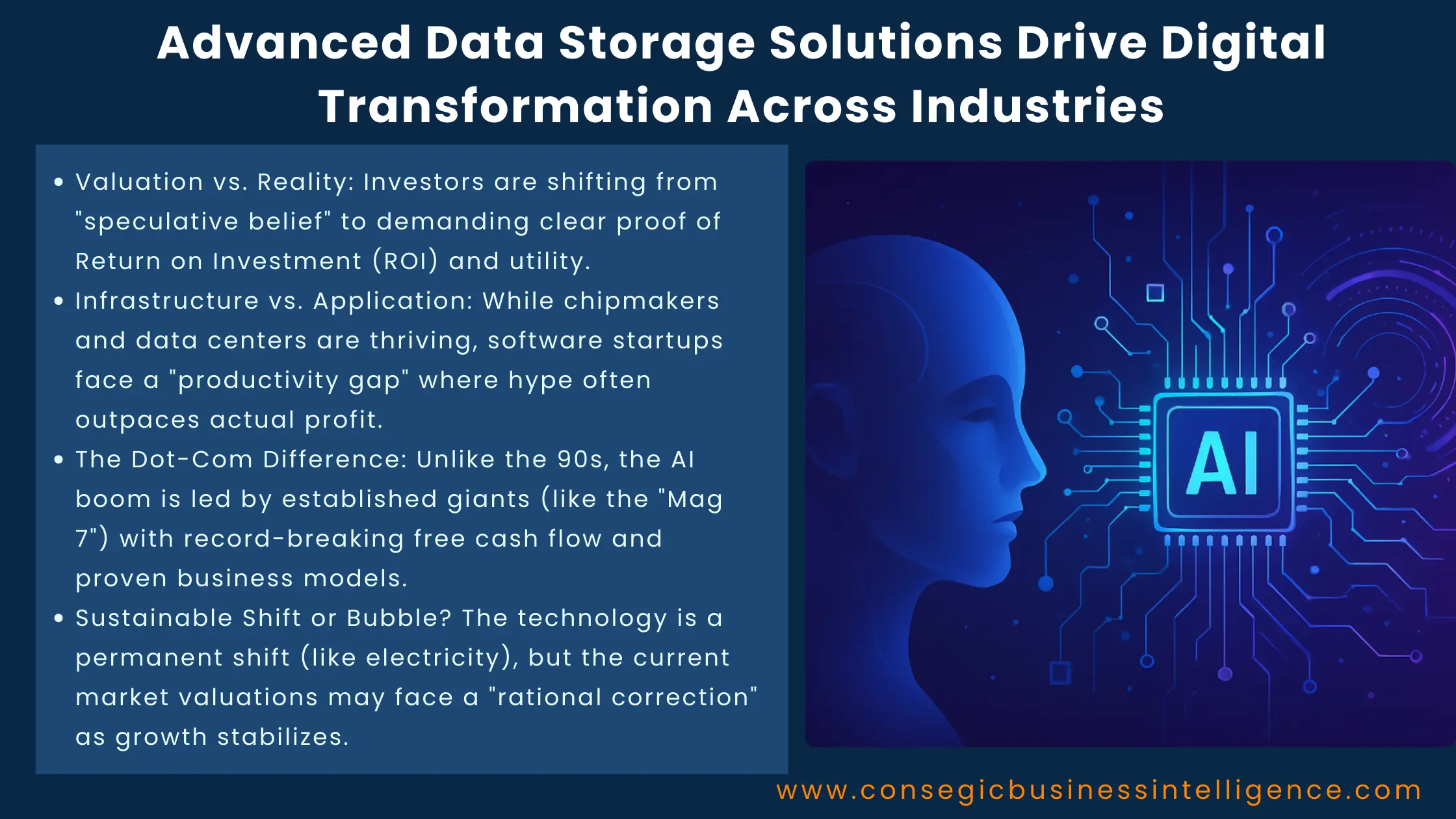
Despite the impressive growth, some signs suggest that the pace of investment may be outstripping the actual economic value being created. For example, valuations of AI companies have soared to extreme levels, in some cases giving rise to fears that stock prices are detached from business fundamentals. Analysts have pointed out that many AI startups and projects receive large funding rounds based on potential future gains rather than proven profits or revenue streams.
This pattern echoes past episodes in tech history, such as the dot-com bubble, where investor enthusiasm led to inflated valuations and eventually sharp declines. Some industry leaders and fund managers have openly warned that the current environment resembles a bubble, where capital is chasing opportunities that may not yield expected returns.
Debate Among Experts
There is no consensus among experts about whether the AI boom is definitively a bubble. Some believe that the surge in funding is justified by transformative potential in fields such as healthcare, cloud computing, autonomous vehicles, and enterprise automation. They argue that AI will fundamentally change how businesses operate and drive long-term productivity gains.
Others caution that valuations could be too optimistic and that many companies may struggle to deliver sustainable profits. A notable portion of investors managing large pools of capital has expressed concern that too much money is being deployed too quickly into speculative AI ventures. This sentiment is fueled by examples of AI projects failing to generate clear returns, despite heavy investment.
How Markets Are Responding
Financial markets have reflected these mixed signals. While AI stocks contributed significantly to stock market gains over the past few years, there have also been periods of volatility and pullbacks. Investors have shown caution in some quarters, rotating money into safer assets or diversifying into areas less tied to AI hype. Some global market forecasts suggest continued overall stock market growth in 2026, with AI remaining a key driver, but also note potential turbulence and correction phases.
Supporters of the AI boom highlight that major corporations are still investing large amounts in AI infrastructure because they view it as essential to competitiveness and future innovation. Even so, rising costs in data center operations and energy usage are adding pressure on margins, prompting debate about how quickly economics can turn in favor of sustained profitability.
Comparisons to Past Tech Bubbles
Comparisons to previous technology bubbles are common in discussions about AI. In the dot-com era, companies with little revenue went public at high valuations simply because they were linked to the internet. In the current cycle, some startups and projects receive valuations driven more by investor enthusiasm than by performance metrics.
However, there is an important difference. Many AI innovations today have real commercial applications and are being integrated into business operations. Unlike some dot-com companies that lacked clear revenue models, AI technologies are often embedded in products and services that generate real income for established firms and startups alike. This makes the situation more complex and less clear-cut than past bubbles where speculative investment had little grounding in actual business value.
What It Could Mean for Investors and Businesses
For investors, the possibility of a bubble means balancing optimism with caution. Diversification and careful analysis of fundamentals can help mitigate risk in a market where valuations may be overstretched. Investors may choose to focus on companies with strong revenue growth and clear paths to profitability rather than chasing speculative ventures based solely on hype.
For businesses, the key takeaway is that AI remains a powerful tool for innovation, productivity, and competitive advantage. Companies that adopt AI thoughtfully and align it with strategic goals are more likely to see positive outcomes than those pursuing technology for its own sake. Responsible investment and a focus on real business impact may help organizations thrive even if markets undergo correction.
Conclusion
The question of whether the world is entering another tech bubble because of the AI boom does not have a simple yes or no answer. There are aspects of the current environment that resemble past bubbles, particularly in terms of rapid valuation growth and enthusiasm. However, there are also substantial signs that AI is delivering real value across industries and driving meaningful change.
The future will likely involve both challenges and opportunities. A careful balance between innovation and financial discipline, guided by solid fundamentals, will help determine if AI’s rise is a sustainable transformation or part of a speculative cycle. Regardless, understanding these dynamics helps investors, businesses, and everyday consumers navigate an evolving economic landscape shaped by artificial intelligence.