In the rapidly evolving digital landscape, data has become the foundation of innovation and decision-making. Every click, transaction, and interaction across digital platforms generates massive amounts of information, creating an unprecedented need for efficient, scalable, and secure data storage solutions. Traditional storage systems, once sufficient for limited datasets, are now being replaced by next-generation data storage technologies designed to handle the explosive growth of information in real time.
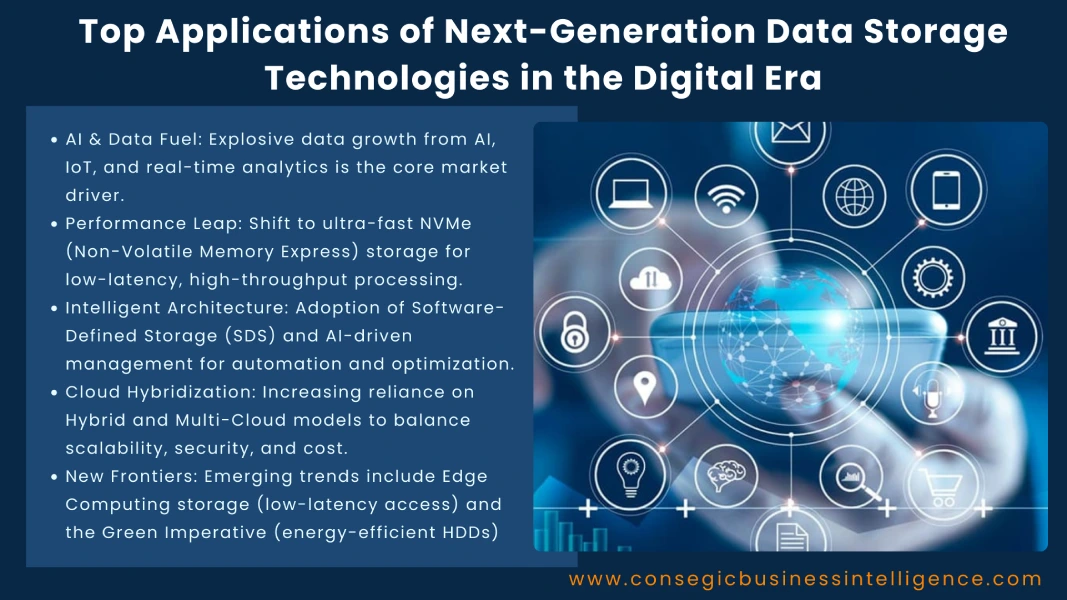
From enterprises managing cloud infrastructures to governments processing continuity and digital transformation. New technologies like NVMe (Non-Volatile Memory Express), AI-driven storage, software-defined architectures, and cloud-based storage models are redefining how organizations store, manage, and retrieve critical data assets.
This blog explores the top applications of next-generation data storage technologies across industries, highlighting how they are driving agility, efficiency, and innovation in the digital era.
- Cloud Computing and Enterprise Data Management
One of the most prominent applications of next-generation storage lies in cloud computing, where vast volumes of data are stored, processed, and accessed remotely. Cloud storage has evolved into a backbone for enterprise IT infrastructure, enabling organizations to scale resources dynamically and eliminate dependence on physical hardware.
Modern cloud storage leverages object-based storage systems and NVMe-enabled architectures to deliver high-speed access and greater reliability. These systems support hybrid and multi-cloud environments, allowing businesses to distribute workloads across public and private clouds seamlessly.
Enterprises now use next-gen storage solutions to manage structured and unstructured data more effectively, supporting real-time analytics, customer insights, and collaborative work environments. The ability to automatically replicate and back up data across regions also ensures business continuity and disaster recovery, making cloud-based storage a critical enabler of global digital operations.
- Artificial Intelligence and Machine Learning Workloads
Artificial Intelligence (AI) and Machine Learning (ML) rely heavily on large datasets to train complex models and algorithms. These workloads require high-speed data retrieval, low latency, and scalable storage systems capable of managing diverse data formats from text and images to sensor data and video.
Next-generation storage technologies such as NVMe drives, all-flash arrays, and distributed storage systems are optimized for these data-intensive workloads. They enable high input/output operations per second (IOPS), reducing training times and improving model accuracy.
In industries such as healthcare, finance, and autonomous vehicles, AI-driven insights depend on rapid data processing and reliable storage infrastructure. For example, AI-based diagnostic tools rely on massive medical image databases that must be accessed in milliseconds. Similarly, financial institutions use AI models for fraud detection and risk assessment, requiring real-time access to historical and transactional data.
As organizations continue to deploy advanced AI and ML applications, next-gen storage is ensuring that data pipelines remain fast, scalable, and secure.
- Big Data Analytics and Real-Time Processing
In today’s data-driven world, big data analytics has become an essential tool for understanding trends, improving decision-making, and predicting future outcomes. Next-generation data storage plays a pivotal role in enabling real-time analytics by ensuring quick access to massive datasets.
Traditional hard drive-based systems often struggled to handle the speed and volume of big data. Modern solutions like storage-class memory (SCM), hyper-converged infrastructure (HCI), and software-defined storage (SDS) now provide the flexibility and performance needed to process large volumes of information across distributed systems.
Businesses in retail, telecommunications, and e-commerce are leveraging these technologies to analyze consumer behavior, monitor transactions, and personalize experiences instantly. Real-time analytics powered by advanced storage systems also support industrial IoT and smart city applications, where decisions must be made within seconds based on continuous data streams.
By combining speed, scalability, and automation, next-generation storage is making real-time data analysis both practical and cost-effective.
- Edge Computing and IoT Ecosystems
The proliferation of Internet of Things (IoT) devices has led to massive data generation at the network edge from smart homes and connected cars to industrial sensors and medical devices. Managing this distributed data efficiently requires advanced storage architectures capable of supporting edge computing environments.
Next-generation storage systems are designed to bring data processing closer to the source, reducing latency and improving responsiveness. Edge storage nodes equipped with solid-state drives (SSDs) and AI-driven caching capabilities allow real-time decision-making without relying solely on centralized data centers.
In industries like manufacturing, healthcare, and energy, this localized approach enhances reliability and ensures uninterrupted operations. For instance, an autonomous vehicle can process sensor data instantly to make driving decisions, while an industrial IoT network can monitor equipment health and predict failures in real time.
As IoT adoption grows, edge-optimized storage solutions are becoming critical for supporting decentralized data ecosystems in a secure and efficient manner.
- Data Security, Governance, and Compliance
With the rising frequency of cyberattacks and data breaches, ensuring data security has become a top priority across industries. Next-generation data storage technologies now incorporate built-in encryption, zero-trust architectures, and AI-based threat detection to protect sensitive information.
These systems support advanced data governance models that comply with global privacy regulations such as GDPR, HIPAA, and CCPA. Automated access controls, multi-factor authentication, and immutable storage (WORM - Write Once, Read Many) help prevent unauthorized access and data tampering.
Financial institutions, government agencies, and healthcare providers rely on such technologies to safeguard customer data, ensure audit readiness, and maintain regulatory compliance. Moreover, the integration of blockchain-based storage systems offers additional layers of transparency and integrity by creating tamper-proof records of data transactions.
As data continues to grow in both value and vulnerability, next-generation storage solutions are redefining what secure, compliant, and trustworthy data management looks like in the digital age.
- Media, Entertainment, and High-Performance Computing
In the media and entertainment industry, data volumes are growing rapidly due to the shift toward high-resolution content, 3D graphics, and immersive experiences. Video production, animation rendering, and game development demand storage systems with ultra-fast performance and low latency.
Next-gen storage technologies such as NVMe over Fabrics (NVMe-oF) and cloud-based object storage deliver the high throughput needed for collaborative workflows and real-time editing. These systems enable teams to work simultaneously on large files stored in shared repositories, enhancing productivity and creativity.
Similarly, high-performance computing (HPC) applications used in fields like weather forecasting, genomics, and scientific research require rapid access to petabytes of data. By combining flash-based architectures with parallel processing, modern storage solutions significantly accelerate computational workloads and reduce time-to-insight.
The ability to handle unstructured and large-scale datasets efficiently is transforming how creative and scientific organizations manage digital content.
- Disaster Recovery and Business Continuity
In an era where data drives every aspect of business, system downtime or data loss can result in major disruptions. Next-generation storage technologies provide automated disaster recovery (DR) and continuous data protection (CDP) functionalities to ensure business resilience.
These systems maintain real-time replication across multiple sites or cloud environments, allowing instant restoration in case of hardware failure or cyber incidents. Snapshot-based backups and versioning ensure that even corrupted files can be quickly recovered to previous states.
For industries such as banking, logistics, and e-commerce, where uptime is critical, these capabilities minimize financial and reputational risks. Cloud-based DR solutions further simplify the process, eliminating the need for expensive on-premise infrastructure while ensuring scalability and rapid failover recovery.
By integrating backup automation and real-time synchronization, organizations can operate with confidence, knowing their data is always protected and available.
Conclusion
The rise of next-generation data storage technologies marks a transformative phase in the way organizations handle information. From powering cloud computing and AI to enabling IoT and real-time analytics, these innovations are forming the backbone of digital transformation.
By offering speed, scalability, security, and intelligence, next-gen storage systems are not just repositories for data but they are active enablers of business agility and innovation. As industries continue to evolve in the digital era, the demand for efficient and adaptive data storage will only intensify, driving further advancements in automation, sustainability, and performance.
In essence, the future of digital infrastructure depends on how effectively we store, protect, and harness the world’s most valuable asset, which is data.
FAQs about Next-Generation Data Storage Technologies Market:
- What is the market size of next-generation data storage technologies market?
Next Generation Data Storage Technologies Market size is estimated to reach over USD 140.29 Billion by 2031 from a value of USD 83.65 Billion in 2023 and is projected to grow by USD 87.75 Billion in 2024, growing at a CAGR of 6.7% from 2024 to 2031. - What are next-generation data storage technologies?
Next-generation data storage technologies refer to advanced systems such as NVMe, software-defined storage, cloud-based architectures and AI-driven storage solutions designed to handle massive data volumes with greater speed, scalability, and reliability than traditional storage models. - How do these technologies support cloud computing and enterprise operations?
These technologies support cloud computing and enterprise operations by enabling seamless scalability, faster data access, and automated replication across hybrid and multi-cloud environments, ensuring business continuity, disaster recovery and efficient enterprise data management. - How do these technologies enhance data security and compliance?
Modern storage systems incorporate encryption, zero-trust architectures, and AI-powered threat detection while supporting global compliance standards such as GDPR and HIPAA to ensure secure, tamper-proof data management. - What role do next-generation storage systems play in disaster recovery and business continuity?
They offer automated backup, real-time data replication, and instant recovery capabilities across multiple sites or clouds, ensuring uninterrupted operations even during hardware failures or cyber incidents.