The arbitrary waveform generator (AWG) market is expanding rapidly as industries embrace precision electronic testing and signal simulation. An AWG is an advanced signal generator capable of producing custom electrical waveforms, enabling engineers and researchers to simulate real-world signals for testing and development purposes. Unlike traditional function generators, arbitrary waveform generators offer high resolution, flexible modulation, and digital accuracy, which make them vital tools in telecommunications, defense, healthcare, and semiconductor applications.
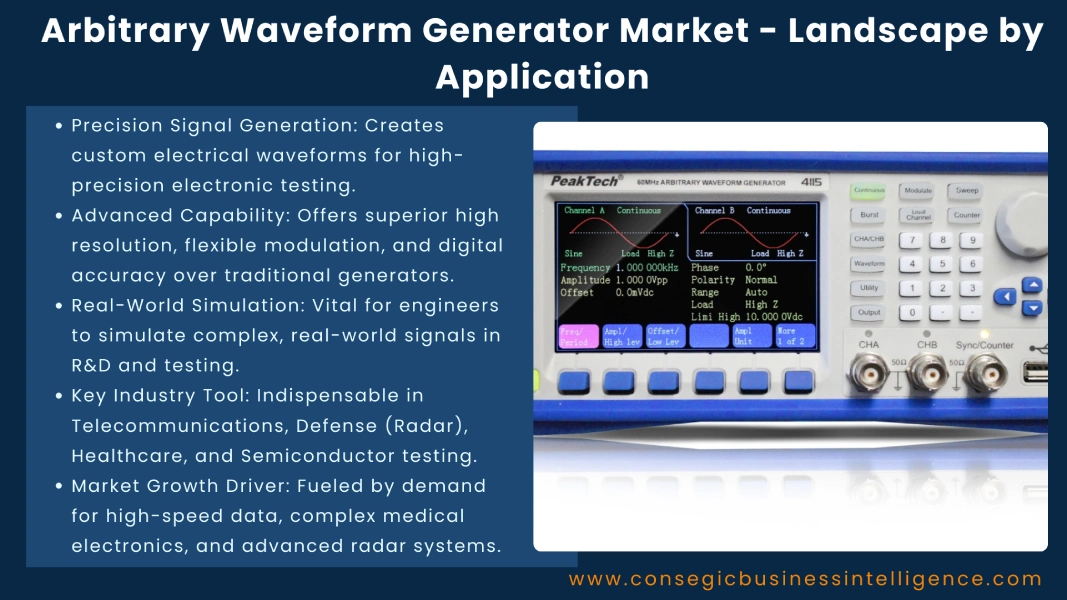
As demand for high-speed data transmission, advanced radar systems, and complex medical electronics grows, the need for precise and programmable waveform generation is driving innovation. Below, we will explore the key application areas shaping the global AWG market landscape and how these sectors are contributing to its sustained growth.
- Telecommunications and Wireless Communication
The telecommunications sector represents one of the most significant application areas for arbitrary waveform generators. With the rollout of 5G and upcoming 6G technologies, network equipment manufacturers rely on AWGs to develop, test, and validate communication components and transmission systems.
AWGs simulate diverse signal conditions such as interference, noise, and distortion to ensure devices maintain performance and reliability under varying environments. They are crucial in testing modulators, baseband units, and transceivers, particularly for wideband and multi-carrier systems.
As the industry transitions toward ultra-high-frequency communication and massive MIMO systems, the use of multi-channel AWGs with GHz-level sampling rates is becoming standard practice. This application segment is expected to remain a core driver of AWG market growth, fueled by global connectivity advancements.
- Aerospace and Defense
The aerospace and defense sector heavily depends on arbitrary waveform generators for radar, sonar, and electronic warfare (EW) system development. These devices allow engineers to replicate highly complex and time-varying signal environments that mimic real battlefield conditions.
AWGs help simulate Doppler shifts, pulse compression, and jamming waveforms for performance evaluation and system calibration. Defense agencies and contractors use them for satellite communication testing, radar target simulation, and missile guidance verification, where signal accuracy and reliability are critical.
The growing investment in advanced defense systems and increasing emphasis on software-defined radar and EW platforms continue to expand this application segment. Manufacturers are also integrating AI-assisted waveform generation for faster, adaptive testing, making defense one of the most technologically progressive users of AWGs.
- Semiconductor and Electronics Testing
Semiconductor testing is another vital application area where arbitrary waveform generators play a central role. In chip design and validation, engineers use AWGs to create precise analog and digital waveforms that test integrated circuits (ICs), sensors, and microcontrollers under controlled conditions.
With the growing complexity of system-on-chip (SoC) architectures, AWGs are essential for verifying signal integrity, clock synchronization, and power efficiency. High-speed AWGs with multiple channels support automated test equipment (ATE) setups used for production-line testing.
Furthermore, the rising demand for IoT devices, automotive electronics, and AI chips has increased the need for advanced waveform simulation tools. Semiconductor companies are investing in modular AWG platforms that can scale with testing requirements, improving productivity while reducing costs.
- Medical and Healthcare Equipment Testing
In the healthcare sector, AWGs are used to design and test a wide range of medical imaging, diagnostic, and monitoring devices. Equipment such as MRI scanners, ultrasound systems, and ECG monitors rely on precisely controlled electrical signals for accurate readings and imaging quality.
AWGs allow medical device engineers to replicate bioelectrical waveforms and physiological signals, enabling realistic testing conditions without human subjects. This ensures safety, performance, and compliance with global regulatory standards.
As digital health technologies evolve, AWGs are increasingly being used in the development of wearable biosensors, neurostimulation systems, and telemedicine devices. Their ability to simulate complex biological signals makes them indispensable for innovation in next-generation medical electronics.
- Automotive and Electric Vehicle (EV) Testing
The automotive industry, particularly in the electric vehicle (EV) segment, is a growing application area for arbitrary waveform generators. As EVs incorporate more advanced power electronics, sensors, and autonomous driving systems, precise signal testing becomes essential.
AWGs help test components such as battery management systems (BMS), motor control units (MCUs), and lidar/radar sensors by simulating real-world driving and electrical conditions. They also enable engineers to evaluate the electromagnetic compatibility (EMC) of in-vehicle systems, ensuring safety and performance under complex signal environments.
With the rapid rise of vehicle electrification and connected car technologies, the automotive sector is set to be one of the fastest-growing application markets for AWGs over the next decade.
- Research, Education, and Academic Institutions
Universities, laboratories, and research institutes form another important end-use segment for the AWG market. Researchers use these devices to conduct signal processing experiments, physics studies, and electronic system design.
In educational settings, AWGs provide students with hands-on experience in waveform generation, circuit testing, and instrumentation. They also play a key role in research on quantum computing, nanotechnology, and photonics, where precise signal manipulation is critical for experimentation.
The increasing integration of virtual laboratories and remote testing environments is expanding AWG adoption in academia, making them an essential component of modern scientific education.
Conclusion
The arbitrary waveform generator market is evolving rapidly, driven by technological advancements and expanding cross-industry applications. From telecommunications and defense to semiconductor testing, healthcare, and automotive innovation, AWGs are becoming indispensable tools for precision testing and signal analysis.
As industries transition toward AI-driven design, 5G connectivity, and electric mobility, the need for high-performance waveform generation will only increase. Manufacturers are responding with compact, multi-channel, and software-defined AWG systems that offer greater flexibility, speed, and accuracy.
Ultimately, the growing reliance on digital testing and real-world signal simulation ensures that the AWG market will continue to be a cornerstone of progress across multiple technology-driven sectors.