The global polyurethane industry is undergoing a wave of innovation, driven by the demand for materials that combine durability, flexibility, and sustainability. Among the critical components shaping this transformation are aromatic polyester polyols, which have become indispensable in modern polyurethane formulations. These polyols, derived from aromatic acids and glycols, form the structural backbone for polyurethane foams, coatings, adhesives, and elastomers used across diverse industrial sectors.
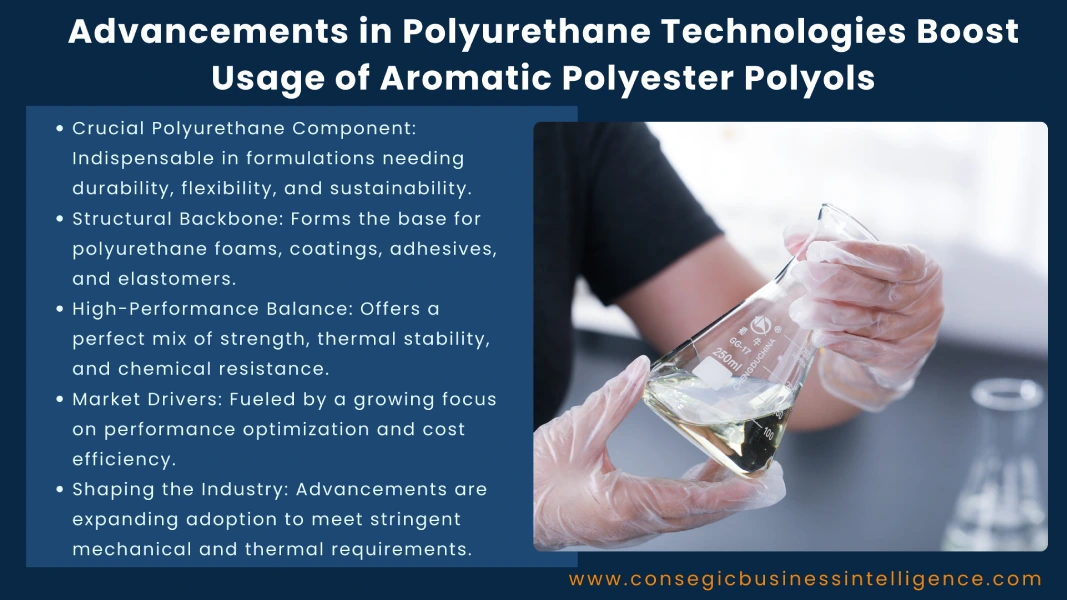
With growing emphasis on performance optimization, cost efficiency, and environmental compliance, advancements in polyurethane chemistry and production technologies are significantly expanding the adoption of aromatic polyester polyols. As industries seek materials that can meet stringent mechanical and thermal requirements, these polyols are emerging as a preferred choice, offering a perfect balance of strength, thermal stability, and chemical resistance.
This blog explores how technological progress in polyurethane manufacturing is enhancing the functionality, versatility, and the demand for aromatic polyester polyols across global applications.
- Evolving Role of Aromatic Polyester Polyols in Polyurethane Chemistry
Aromatic polyester polyols serve as a fundamental building block in the synthesis of polyurethane materials. Produced by the polycondensation of aromatic acids (such as phthalic or terephthalic acid) with glycols, they provide rigidity, toughness, and thermal resistance to the final product.
Their superior hydrolytic and solvent resistance makes them ideal for applications where mechanical performance and environmental exposure are critical factors such as construction insulation, automotive interiors, and industrial coatings. Unlike polyether polyols, which offer higher flexibility, aromatic polyester polyols deliver enhanced strength and temperature resistance, allowing manufacturers to fine-tune polyurethane formulations for specialized uses. As industries transition toward performance-driven materials, the unique chemical attributes of these polyols are making them increasingly valuable across both rigid and flexible foam applications.
- Technological Innovations in Polyurethane Formulations
Recent advancements in polyurethane chemistry have revolutionized the way aromatic polyester polyols are utilized. New formulation technologies and catalyst systems are improving compatibility, processing efficiency, and recyclability.
Manufacturers are leveraging high-reactivity aromatic polyols that enable faster curing, better adhesion, and improved foam morphology. In rigid foam applications such as thermal insulation boards and refrigeration systems these innovations result in superior dimensional stability and reduced energy loss.
Moreover, progress in polymer blending techniques allows formulators to combine aromatic polyester polyols with polyether variants to achieve balanced properties, optimizing both flexibility and structural strength. This synergy is expanding their use across industrial coatings, adhesives, and high-density foams.
The integration of nanotechnology in polyurethane systems has also introduced improved dispersion and surface properties, creating materials that exhibit greater mechanical integrity and longer lifespan, key factors driving widespread adoption in construction and automotive industries.
- Growth in Rigid Foam Applications for Construction and Insulation
One of the strongest demand drivers for aromatic polyester polyols comes from the construction and building materials sector, particularly in the production of rigid polyurethane foams. These foams are prized for their exceptional insulation properties, making them essential in energy-efficient buildings, refrigeration units, and pipelines.
Aromatic polyester polyols provide the dimensional stability and fire resistance required for these applications. The foams exhibit excellent compressive strength and maintain structural integrity under thermal stress, contributing to improved safety and energy conservation.
Global initiatives promoting green building standards and sustainable insulation materials such as LEED and BREEAM certifications are accelerating the adoption of polyurethane-based insulation solutions. As construction industries in Asia-Pacific and North America continue to grow, demand for aromatic polyester polyols in rigid foam production is set to rise significantly.
- Rising Use in Coatings, Adhesives, Sealants, and Elastomers (CASE)
Beyond foams, aromatic polyester polyols are increasingly used in coatings, adhesives, sealants, and elastomers (CASE) applications due to their superior abrasion resistance, adhesion strength, and durability.
In coatings, these polyols enhance gloss retention, chemical stability, and weather resistance, making them ideal for industrial floors, automotive finishes, and protective surfaces. Adhesive and sealant formulations benefit from their excellent adhesion to metals, plastics, and composites, ensuring performance in demanding environments.
In elastomeric applications, aromatic polyester polyols impart mechanical resilience and load-bearing capacity, supporting industries such as mining, footwear, and heavy equipment manufacturing. The continuous development of solvent-free and low-VOC polyurethane systems has further expanded their use in eco-friendly CASE products, aligning with environmental regulations and green manufacturing standards.
- Sustainable Polyol Production and Circular Economy Initiatives
Sustainability has become a defining theme in polyurethane manufacturing, prompting innovation in recycled and bio-based aromatic polyester polyols. New production techniques utilize post-consumer PET waste and recycled plastics as feedstock for polyol synthesis, reducing reliance on virgin raw materials.
This approach not only supports circular economy principles but also significantly reduces carbon emissions associated with conventional production. Several leading manufacturers have commercialized recycled aromatic polyols that maintain equivalent performance standards, enabling environmentally conscious product lines without compromising quality.
Additionally, efforts are underway to develop low-emission catalysts and greener solvent systems that minimize environmental impact. These initiatives align with the industry’s broader goal of achieving sustainable polyurethane value chains, reinforcing the role of aromatic polyester polyols in future-ready material systems.
- Automotive and Transportation Industry Integration
The automotive and transportation industries are emerging as major consumers of aromatic polyester polyols, primarily for lightweighting and noise reduction applications. Polyurethane components ranging from interior panels and seating foams to underbody coatings are being reformulated using advanced aromatic polyols for improved mechanical properties and environmental resistance.
In electric and hybrid vehicles, polyurethane materials derived from these polyols contribute to thermal insulation, vibration control, and acoustic performance, enhancing both safety and comfort. Their chemical resistance also makes them suitable for fuel tank coatings, gaskets, and adhesives exposed to harsh environments.
As automakers prioritize lightweight, energy-efficient materials to meet emission standards, the adoption of aromatic polyester polyols in polyurethane systems continues to expand, supporting sustainable mobility trends worldwide.
Conclusion
The advancements in polyurethane technologies are ushering in a new era of performance-driven and sustainable materials, with aromatic polyester polyols at the core of this transformation. Their superior mechanical strength, chemical resistance, and compatibility with evolving green chemistry practices make them indispensable to industries ranging from construction and automotive to coatings and adhesives.
Furthermore, with the ongoing research and sustainability-driven innovation, these versatile polyols are not only enhancing polyurethane performance but also paving the way for a smarter, greener, and more resilient materials future.
FAQs about Aromatic Polyester Polyols Market:
- What is the market size of Aromatic Polyester Polyols Market?
Aromatic Polyester Polyols Market is growing with a CAGR of 5.3% during the forecast period (2023-2031). The market accounted for USD 1,204.15 million in 2022 and USD 1,262.22 million in 2023, and the market is projected to be valued at USD 1,909.46 Million by 2031. - What are aromatic polyester polyols used for?
Aromatic polyester polyols are key ingredients in polyurethane formulations used for foams, coatings, adhesives, sealants, and elastomers across industries like construction and automotive. - How do aromatic polyester polyols differ from polyether polyols?
While polyether polyols offer flexibility, aromatic polyester polyols provide greater strength, chemical resistance, and thermal stability for high-performance applications. - Why are aromatic polyester polyols important in rigid foam production?
They are used due to their enhanced insulation, fire resistance, and structural integrity, which makes them essential for energy-efficient buildings and refrigeration systems. - What role do aromatic polyester polyols play in the automotive industry?
They are used in lightweight polyurethane components for better durability, thermal insulation, and noise reduction in modern vehicles.