The automotive emission test equipment market plays a vital role in ensuring that vehicles meet global environmental and regulatory standards. As climate change concerns intensify and governments impose stricter emission norms, the demand for advanced emission testing solutions has grown substantially. These systems are essential for measuring and analyzing pollutants such as carbon monoxide (CO), nitrogen oxides (NOx), hydrocarbons (HC), and particulate matter (PM) emitted by vehicles.
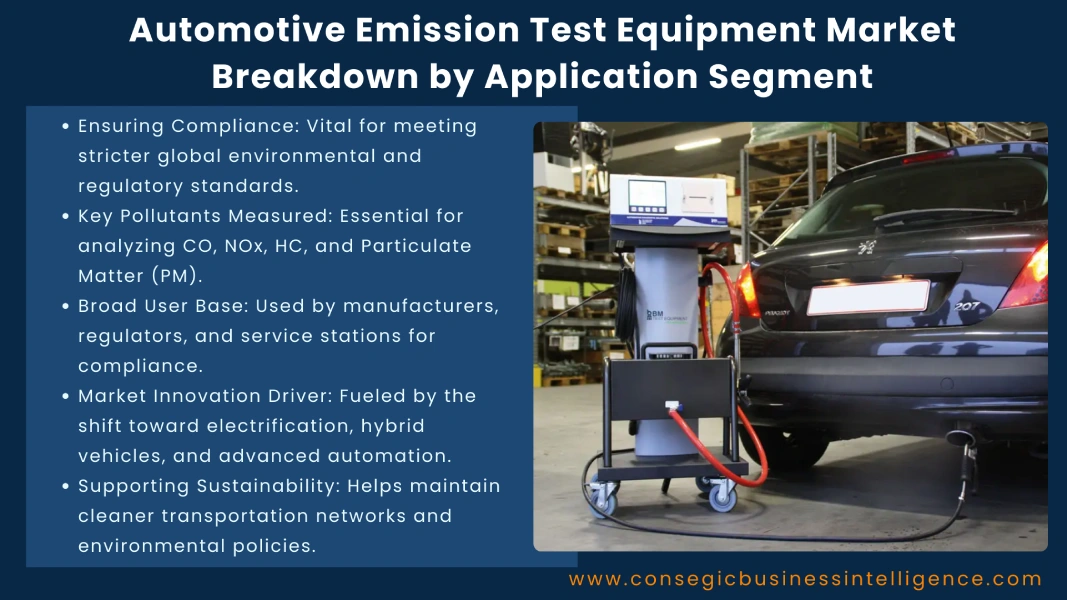
From vehicle manufacturers to regulatory bodies and service stations, emission test equipment helps maintain cleaner transportation networks while supporting compliance with environmental policies. The market’s evolution is being driven by the rapid transition toward electrification, hybrid technologies, and advanced testing automation, reshaping the way automotive testing facilities operate.
This blog provides an in-depth breakdown of the automotive emission test equipment market by application segment, highlighting the key areas where these technologies are driving innovation and sustainability.
- Vehicle Manufacturing and Production Testing
One of the largest application segments in the automotive emission test equipment market is vehicle manufacturing and production testing. Automakers use emission analyzers, chassis dynamometers, and onboard diagnostic (OBD) systems to evaluate the environmental performance of new vehicles before mass production.
During development, manufacturers conduct pre-compliance and durability tests to ensure engines meet Euro 6, EPA, and BS VI emission standards. These tests assess how vehicles perform under different load and driving conditions, including cold starts, acceleration, and idling.
Modern facilities now employ real-time data acquisition systems and automation technologies that streamline testing and improve accuracy. Additionally, as hybrid and electric vehicle (EV) technologies evolve, emission test equipment manufacturers are adapting systems to evaluate both internal combustion engines (ICEs) and hybrid powertrains.
The trend toward virtual testing and simulation-based validation is also emerging, allowing OEMs to accelerate development cycles while maintaining compliance. This segment continues to dominate market demand as global automakers strive to balance performance, efficiency, and environmental impact.
- Vehicle Inspection and Maintenance Centers
Vehicle inspection and maintenance (I/M) centers represent another key application segment, focusing on emission testing for in-use vehicles. These facilities ensure that vehicles on the road remain compliant with emission regulations throughout their operational lifespan.
Governments in regions such as North America, Europe, and Asia-Pacific have established mandatory inspection programs to control vehicular pollution. Testing centers employ gas analyzers, smoke meters, and OBD scanners to identify non-compliant vehicles and recommend necessary maintenance or repairs.
The introduction of remote sensing technology (RSD) is revolutionizing the inspection landscape. This innovation allows authorities to measure emissions from vehicles in real-time without requiring them to enter a testing bay. Additionally, AI-based data analysis tools are improving accuracy and enabling predictive maintenance, helping to detect potential emission issues before they worsen.
With growing regulatory stringency and environmental awareness, the vehicle inspection and maintenance segment is expected to witness sustained expansion, particularly in urban centers with high vehicle density.
- Engine and Component Testing
The engine and component testing segment forms the backbone of emission evaluation, ensuring that individual vehicle components meet performance and regulatory benchmarks before integration into complete systems.
This segment focuses on evaluating engines, catalytic converters, fuel injectors, exhaust systems, and particulate filters. Specialized testing equipment simulates various driving environments and thermal conditions to assess emissions behavior under real-world scenarios.
Technological advancements such as high-precision gas chromatography analyzers and portable emission measurement systems (PEMS) have made testing more efficient and accurate. PEMS devices, in particular, have gained traction for their ability to perform Real Driving Emissions (RDE) tests, providing insights into how vehicles behave outside of laboratory conditions.
Furthermore, growing interest in alternative fuels including compressed natural gas (CNG), hydrogen, and biofuels has expanded testing requirements. Manufacturers now use emission test systems to evaluate the performance and emissions of engines running on multiple fuel types, promoting innovation in cleaner propulsion technologies.
- Research and Development (R&D) Facilities
Research and development facilities represent a crucial application area within the emission test equipment market, driving innovation in sustainable vehicle technologies. Automakers, universities, and independent research labs rely on advanced testing systems to develop cleaner engines, improve aftertreatment systems, and optimize fuel efficiency.
These facilities use chassis dynamometers, dilution tunnels, and emission benches to measure pollutant concentrations across various operating conditions. Data from these tests informs the development of next-generation combustion technologies, hybrid architectures, and emission control systems.
The growing emphasis on simulation-integrated testing and digital twins allows R&D teams to model engine behaviour virtually, reducing testing time and cost. Additionally, the rise of hydrogen fuel cell and electric vehicle research has prompted testing companies to diversify their portfolios, offering equipment designed to assess not only emissions but also energy consumption, battery performance, and thermal management.
As global automakers increase investments in low-emission vehicles, R&D testing will remain one of the most dynamic and innovation-driven market segments.
- Certification and Regulatory Compliance Testing
Certification and compliance testing are fundamental applications ensuring that vehicles meet national and international emission standards before entering the market. These tests are typically conducted by regulatory bodies and accredited laboratories under standardized conditions defined by organizations such as the Environmental Protection Agency (EPA), European Commission, and Japan’s Ministry of Land, Infrastructure, Transport and Tourism (MLIT).
Testing focuses on verifying pollutant levels through homologation procedures, which include type approval, conformity of production, and in-service compliance checks. Certification laboratories employ highly calibrated emission benches, dilution systems, and gas analyzers to ensure accuracy and repeatability.
Emerging trends in this segment include real-world emission monitoring and lifecycle emission assessments, aimed at measuring the environmental footprint of vehicles across their entire operational lifespan. As regulations evolve toward stricter carbon neutrality goals, compliance testing will remain an essential component of the automotive ecosystem.
Conclusion
The automotive emission test equipment market is at the center of the global push toward cleaner and more sustainable mobility. From vehicle manufacturing and inspection centers to R&D facilities and certification labs, each application segment plays a critical role in minimizing the environmental footprint of modern transportation.
Technological advancements in portable testing systems, AI-driven analytics, and real-time monitoring are revolutionizing how emissions are measured and managed. As hybrid, electric, and alternative fuel vehicles continue to rise, the demand for adaptable and intelligent emission testing equipment will remain robust.
Ultimately, the market’s growth reflects a broader industry transformation, one where regulatory compliance, environmental stewardship, and technological innovation converge to create a cleaner, greener future for global mobility.