The digital integrated circuit (IC) market is experiencing a transformative era, driven by rapid technological advancements, rising semiconductor demand, and the global shift toward connected, intelligent devices. Digital ICs comprising of logic, memory, microprocessors, and digital signal processing units are fundamental to modern electronics, powering everything from smartphones and data centers to autonomous vehicles and industrial automation systems.
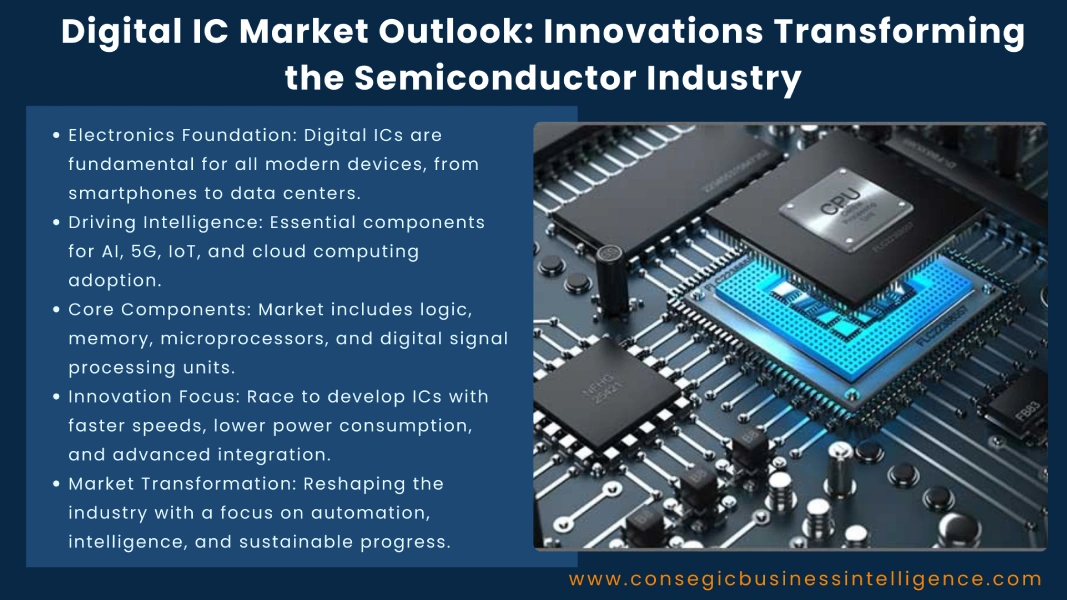
As industries embrace artificial intelligence (AI), 5G, cloud computing, and the Internet of Things (IoT), the need for high-performance, energy-efficient, and scalable digital ICs has never been greater. Manufacturers are racing to develop next-generation semiconductor designs that deliver faster processing speeds, lower power consumption, and advanced integration capabilities.
Below, we will explore the key innovations shaping the digital IC market and how they are transforming the semiconductor industry into a hub of intelligence, automation, and sustainable progress.
- Rising Demand for AI and Machine Learning Applications
One of the most significant trends shaping the digital IC market is the increasing integration of artificial intelligence (AI) and machine learning (ML) into devices and systems. AI accelerators and neural processing units (NPUs) embedded within digital ICs enable faster data analysis and real-time decision-making across applications like autonomous driving, smart cameras, and robotics.
Semiconductor companies such as NVIDIA, Intel, and AMD are leading this transformation by developing advanced digital ICs optimized for deep learning workloads. These chips leverage parallel computing architectures to deliver superior performance while minimizing latency.
The expansion of edge AI, where computation occurs closer to data sources is also fueling demand for low-power, high-efficiency digital ICs. As industries prioritize AI-driven automation, this segment continues to drive growth and innovation across the global semiconductor landscape.
- Expansion of 5G and High-Speed Connectivity
The rollout of 5G networks is creating new opportunities for digital IC manufacturers, enabling faster communication, lower latency, and higher data throughput. Digital ICs serve as the foundation for 5G infrastructure, powering base stations, modems, and network equipment that support next-generation wireless communication.
Advanced ICs designed for millimeter-wave (mmWave) and massive MIMO (multiple-input, multiple-output) technologies are essential for handling the increased data traffic generated by billions of connected devices.
Moreover, the demand for system-on-chip (SoC) solutions that integrate multiple digital components such as processors, memory units, and communication interfaces into compact architectures is rising sharply. As the world becomes more interconnected, 5G-driven digital IC innovations will continue to accelerate global digital transformation.
- Miniaturization and Advanced Node Manufacturing
The push for smaller, faster, and more efficient chips is transforming semiconductor manufacturing processes. With transistor sizes shrinking to 3-nanometer and even 2-nanometer nodes, digital ICs are achieving unprecedented levels of performance and power efficiency.
Leading foundries such as TSMC, Samsung Electronics, and Intel are investing heavily in extreme ultraviolet (EUV) lithography to enhance transistor density and optimize power management. These advances are enabling the production of ICs that are not only compact but also capable of handling complex computations for AI, data analytics, and quantum simulation.
Miniaturization also supports the rise of wearable electronics, smart sensors, and portable medical devices, where space and energy efficiency are critical. This ongoing evolution in semiconductor manufacturing represents one of the strongest growth pillars for the digital IC market.
- Integration of Heterogeneous Computing Architectures
As data processing requirements become more complex, the semiconductor industry is shifting toward heterogeneous computing architectures, where multiple processing units like CPUs, GPUs, FPGAs, and AI accelerators work together on a single chip.
This integration allows devices to execute specialized tasks efficiently, such as real-time graphics rendering or machine learning inference. Digital ICs designed with heterogeneous structures enhance flexibility, performance, and workload optimization, making them ideal for applications in autonomous vehicles, data centers, and aerospace systems.
The combination of custom chip design (ASICs) and reconfigurable computing is gaining popularity, enabling manufacturers to deliver application-specific performance improvements. This trend is redefining chip design philosophy, emphasizing agility and adaptability across diverse use cases.
- Surge in Data Center and Cloud Computing Investments
The exponential growth of data centers and cloud computing has become a major catalyst for digital IC demand. As cloud providers and enterprises manage vast amounts of data, high-performance digital ICs are essential for supporting efficient processing, storage, and transmission.
Chips used in servers, switches, and networking hardware are being designed to handle intensive workloads with optimized power consumption. The rise of hyperscale data centers operated by companies like Amazon, Google, and Microsoft has accelerated the adoption of advanced logic and memory ICs.
In parallel, custom silicon development for cloud infrastructure, such as Google’s Tensor Processing Units (TPUs) and AWS Graviton processors, demonstrates how semiconductor innovation is shaping the backbone of the digital economy. This trend continues to position digital ICs at the center of global computing advancements.
- Growth of Automotive Electronics and Autonomous Systems
The automotive industry’s transition toward electrification and automation is significantly influencing the digital IC market. Modern vehicles are increasingly equipped with advanced driver-assistance systems (ADAS), infotainment platforms, and battery management systems, all powered by sophisticated digital ICs.
With the development of autonomous vehicles, demand for high-speed computing, real-time data analysis, and sensor fusion has skyrocketed. Digital ICs enable communication between LiDAR, radar, and vision systems, ensuring accurate environmental perception and safety.
Automakers are also adopting functional safety standards (ISO 26262) and automotive-grade ICs that ensure reliability under extreme conditions. As vehicles evolve into intelligent, connected systems, digital ICs will remain at the heart of next-generation automotive innovation.
- Increasing Focus on Energy Efficiency and Sustainable Chip Design
Sustainability has emerged as a defining factor in semiconductor innovation. With growing concerns over energy consumption and carbon emissions, manufacturers are prioritizing low-power digital IC architectures and eco-friendly production processes.
Techniques such as dynamic voltage and frequency scaling (DVFS) and power gating are widely adopted to reduce energy use in portable electronics and servers. Additionally, manufacturers are exploring 3D chip stacking and advanced packaging to enhance performance while minimizing material waste.
The trend toward green chip design aligns with global energy-efficiency goals and supports broader initiatives such as net-zero manufacturing and circular semiconductor supply chains.
- Advances in Quantum and Neuromorphic Computing
The next frontier in digital IC development lies in quantum and neuromorphic computing, which promise to revolutionize data processing and computational intelligence.
Neuromorphic chips, modeled after the human brain, are designed to perform complex pattern recognition tasks with minimal energy consumption, making them ideal for AI, robotics, and sensor-driven applications. Quantum-ready ICs, meanwhile, are being developed to support early-stage quantum processors by managing control systems and error correction.
Companies such as IBM, Intel, and BrainChip Holdings are investing heavily in these futuristic architectures, signaling a shift toward computing paradigms that will redefine the semiconductor industry over the next decade.
Conclusion
The digital IC market is at the core of the semiconductor industry’s transformation, driving innovation across every sector from smart devices and industrial automation to AI, cloud computing, and automotive systems.
Emerging technologies such as AI-driven chips, heterogeneous architectures, and energy-efficient IC designs are shaping the next wave of semiconductor advancements. With continuous progress in nanometer fabrication, quantum integration, and sustainable chip engineering, digital ICs are evolving beyond traditional processing units into the foundation of intelligent systems.
As industries worldwide embrace digitalization and automation, the digital IC market will continue to expand, ushering in a new era of connectivity, computational power, and innovation that defines the future of modern electronics.