The Growing Demand for Energy-Efficient Wearable Technology
The evolution of wearable technology is from simple fitness trackers to devices that can monitor health, communicate, entertain, navigate and deliver personalized digital experiences. The rise of smartwatches, fitness bands, AR glasses, smart earbuds and other types of connected wearables requires them to have functionalities such as display, audio processing, camera, video playback and wireless connectivity. But the issue with all these features is that they consume a lot of power, posing challenges for manufacturers to develop wearables with high battery life.
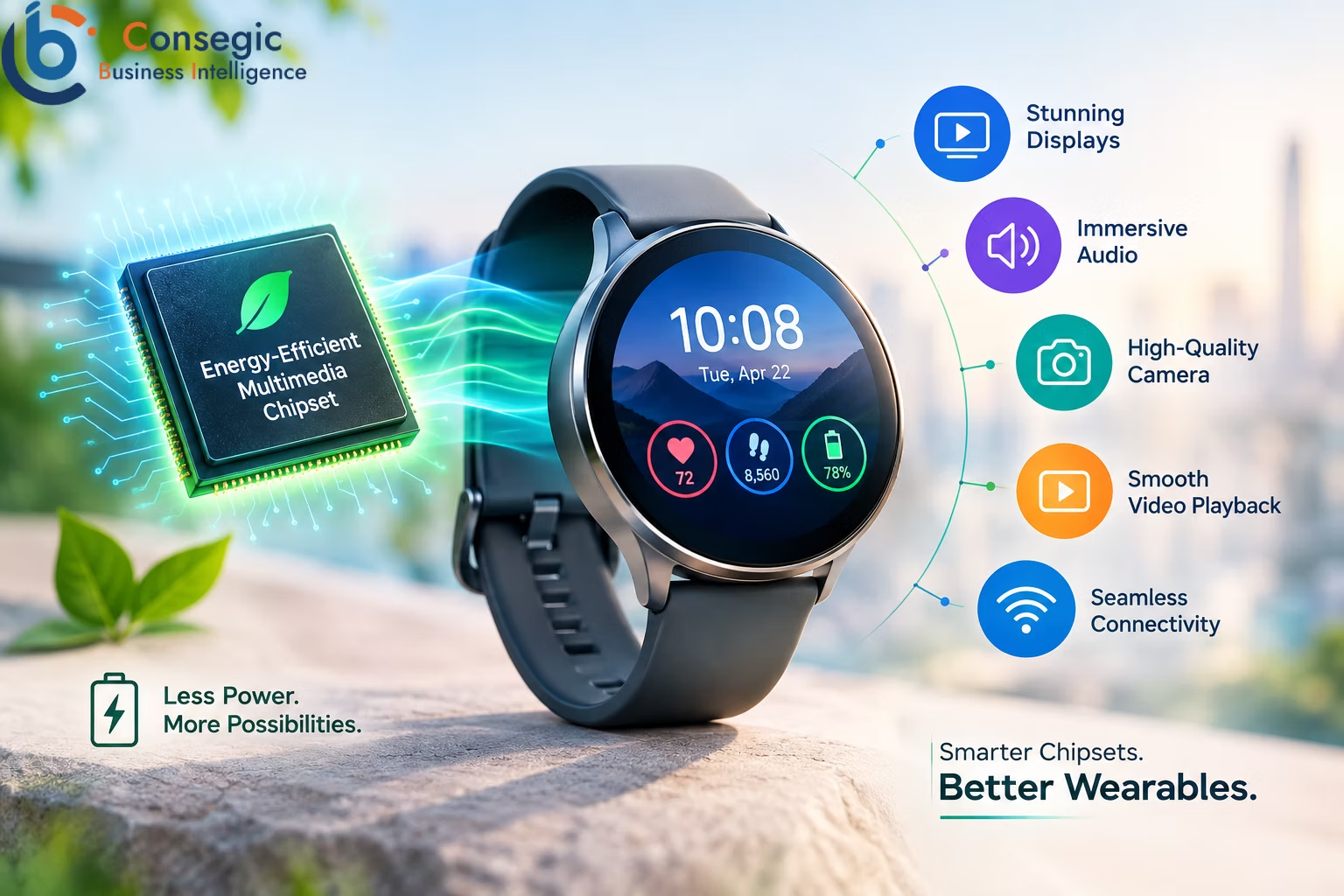
This problem is being solved by energy efficient multimedia chipsets because they provide high performance and reduced power consumption. Multimedia chipsets include a processor, graphics unit, AI accelerator, image and audio processing unit, and a connectivity unit that are put together in one optimized platform. Their capacity to efficiently handle high workloads enables wearables to perform more complex tasks without affecting battery power much.
As customers are now expecting thin, lightweight and advanced wearable devices, energy efficiency has now become a key consideration in design. That is why multimedia chipsets have started gaining importance because of their capabilities to increase performance, enhance battery life, reduce heat generation and help to build next generation wearables.
How Energy-Efficient Multimedia Chipsets Improve Wearable Device Performance
Energy-efficient multimedia chipsets ensure superior performance of wearables through combining strong computing capabilities with intelligent power management. In contrast to traditional chip architecture, which might constantly work in high-performance mode, new chipsets are able to adapt their computing power depending on workload. Thus, the wearables will spend additional energy only when performing demanding tasks and save energy during routine activities.
For instance, when a smartwatch processes graphic images, receives and processes voice commands or runs navigation software, it will need lots of computing power. However, during idle times, chipset will be able to switch to low-power mode to save its energy.
Integrated graphics and multimedia processing unit ensures smooth animation, improved display quality, better video playback, and improved image processing. On the other hand, there will be special AI accelerators that will perform such tasks as voice recognition, movement recognition, and processing of information coming from various health sensors more efficiently than regular processors.
Moreover, new chipsets dissipate less heat because of their energy efficiency. It is critical for wearable devices as they are in constant touch with users' skin. Thus, thanks to the improved heat dissipation, the manufactures will be able to design compact wearables that provide superior performance.
Key Technologies Driving Low-Power Multimedia Chipsets for Wearables
Several technological advancements are contributing towards the development of more energy-efficient multimedia chipsets for wearable technology. Advanced fabrication processes make it possible for manufacturers to put many transistors in smaller chipsets while at the same time conserving power. The smaller process nodes provide more computational efficiency and better performance for the limited power budget of wearable devices.
In addition, heterogeneous computing is a significant field. These days, chipsets are designed with multiple processing cores, each of which is dedicated to a specific task. High-performance cores take care of complex application execution, whereas low-efficiency cores manage simple operations with a very low level of power usage. Thus, wearable devices become able to adjust their performance and battery efficiency depending on current needs.
Special multimedia engines can also help improve power efficiency. For example, an Image Signal Processor can process data coming from cameras, while a Digital Signal Processor will take care of all audio workloads. Machine learning operations can be done efficiently through AI accelerators.
Dynamic voltage and frequency scaling increases power efficiency by adjusting automatically the voltage and frequency of the chipset. The advanced power gating technology is capable of completely turning off any components of the chipset when not being used.
The Role of Energy-Efficient Chipsets in Next-Generation Wearable Applications
Efficient multimedia chipsets have increased the possibilities of wearable devices for use in healthcare, fitness, entertainment, communications, and augmented reality. Smartwatches now can perform activities such as activity tracking, heart rate monitoring, notifications, navigation, voice assistants, and multimedia applications without consuming the battery power too quickly.
The importance of energy-efficient processing in chipsets is even greater in smart glasses and AR wearables since these devices will likely need to process graphical images, camera feed, spatial data, and sensor inputs simultaneously. With the low-power processing and graphics engine, users can enjoy the augmented reality experience while minimizing the heat generation and consumption of battery power.
Smart earbuds also benefit from energy-efficient multimedia processing. Advanced chipsets make it possible to include advanced functionalities like active noise cancellation, voice recognition, spatial audio, and wireless connectivity even when the batteries in such devices are very tiny. Similarly, fitness-oriented wearables could benefit from artificial intelligence-enabled processing.
With the growing importance of edge computing, wearables can now process information locally rather than offloading all tasks to remote servers hosted in the cloud. The reason behind this trend is the use of energy-efficient chipsets that facilitate this process.
Future Outlook: How Advanced Multimedia Chipsets Will Shape Wearable Technology
The future of wearables is likely going to be greatly affected by further improvements in energy-efficient multimedia chipsets. As chip designs get more advanced, as well as better at processing information and working with AI, wearable devices can be expected to become more effective without having any proportional increase in size or energy requirements. This can allow for manufacturers to incorporate new functionality into smaller devices.
The future chipsets can be expected to feature improved AI functionality that will let wearables learn user's habits, recognize surroundings, process speech and produce useful insights without relying too much on cloud-based services. Enhanced graphic processing can also make possible enhanced AR and mixed reality experience in lightweight glasses and head-mounted devices.
Moreover, the energy-efficient architecture can help extend battery life and make less frequent recharging necessary. All of this can be made even more useful with further advances in battery technology, energy harvesting and low power display screens.
With the rise of need for health monitoring, digital immersion, and connectivity, the design philosophy of chipset manufacturers will revolve around performance, power efficiency, and thermal efficiency. In essence, multimedia chipsets that are energy efficient will be the core technology required to develop wearable devices.
Final Thoughts
Energy-efficient multimedia chipsets are turning into an essential technology that will help in the evolution of future wearables. With their advanced features of processing, graphics, AI, and multimedia along with the efficient use of energy, they allow devices to perform with increased functions without reducing the battery life or compromising user comfort. The need for such chipsets becomes more evident with the development of wearables capable of offering health monitoring, smart communication, augmented reality, and intelligent apps on the device itself. Future improvements in the technologies of semiconductor design, heterogeneous computing, and power management will further enhance the efficiency of such chipsets. Therefore, such chipsets will help manufacturers build compact, smart, fast, and long-lasting wearables.