The energy measurement ICs market is rapidly gaining momentum as global industries and utilities transition toward smarter, more efficient energy management systems. Energy measurement integrated circuits (ICs) are semiconductor devices designed to monitor and analyze electrical parameters such as voltage, current, power, and energy consumption with high accuracy. These ICs form the backbone of smart meters, industrial automation systems, and IoT-based energy networks, enabling real-time monitoring and data-driven energy optimization.
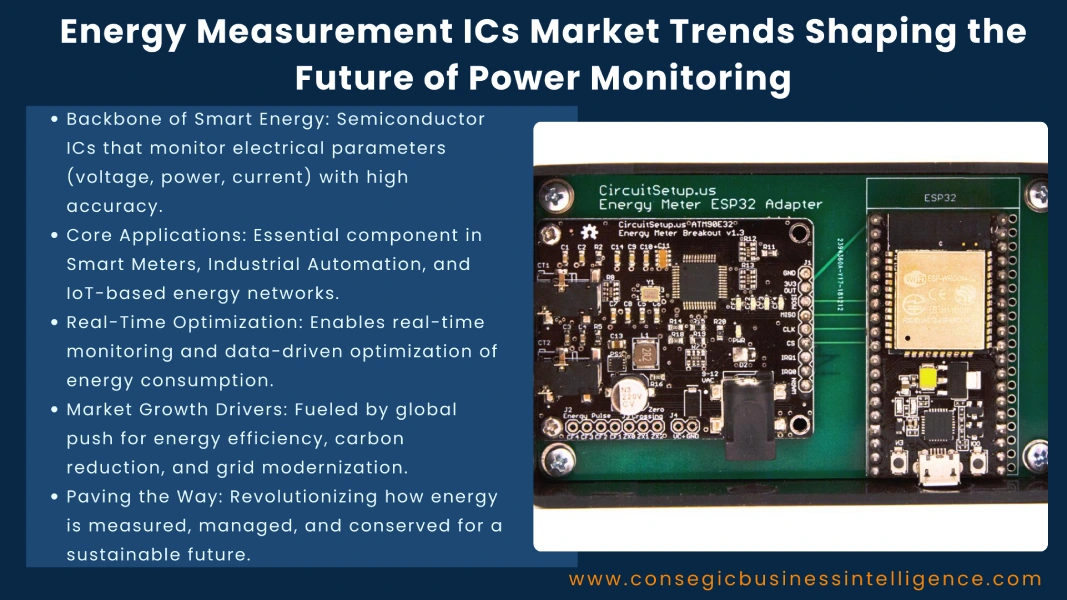
With the rising emphasis on energy efficiency, carbon reduction, and grid modernization, the demand for intelligent power monitoring solutions is accelerating. The integration of advanced ICs into both residential and industrial applications is revolutionizing how energy is measured, managed, and conserved.
In this blog, we will explore the key trends shaping the global energy measurement ICs market and how these technologies are paving the way for a more connected and sustainable energy future.
- Growing Adoption of Smart Grids and Smart Meters
One of the most influential trends driving the energy measurement ICs market is the rapid adoption of smart grids and smart meters. As governments worldwide modernize electrical infrastructure, the deployment of advanced metering systems has become a priority.
Energy measurement ICs enable precise monitoring of real-time energy usage, helping utilities detect losses, improve billing accuracy, and enhance load management. Smart meters equipped with these ICs provide two-way communication between consumers and utility providers, enabling dynamic energy pricing and demand response programs.
Regions like North America, Europe, and Asia-Pacific are leading large-scale smart grid rollouts, with national mandates supporting the replacement of traditional meters with digital systems. This transformation is driving sustained demand for multi-channel, high-accuracy energy measurement ICs capable of handling diverse load profiles and communication protocols.
- Integration of IoT and Cloud-Based Energy Monitoring
The convergence of Internet of Things (IoT) and cloud computing is reshaping how energy is monitored and analyzed. Energy measurement ICs now serve as intelligent data collection nodes that transmit real-time information to cloud-based platforms for centralized monitoring.
This integration enables predictive maintenance, anomaly detection, and energy optimization across industrial, commercial, and residential facilities. Businesses can remotely access energy data through dashboards and analytics tools, leading to smarter decision-making and cost control.
The trend toward wireless energy measurement modules, using communication standards like Wi-Fi, Zigbee, and LoRa, is also gaining traction. These solutions simplify installation, reduce wiring costs, and enable scalable energy monitoring networks. As IoT adoption accelerates, energy measurement ICs will remain critical to powering this digital transformation.
- Rising Demand for Energy Efficiency in Industrial Automation
Industries across manufacturing, oil and gas, and utilities are increasingly focused on energy efficiency and process optimization. Energy measurement ICs are integral to industrial automation systems that track real-time power usage of motors, drives, and production equipment.
By integrating energy ICs with programmable logic controllers (PLCs) and energy management software, manufacturers can identify inefficiencies, reduce downtime, and enhance operational sustainability. This capability supports compliance with ISO 50001 energy management standards, which promote continuous improvement in industrial energy performance.
As Industry 4.0 initiatives expand globally, demand for high-speed, precision measurement ICs is rising to support smart factories and connected production lines. The trend toward AI-driven predictive maintenance also relies on accurate power monitoring to forecast equipment performance and prevent energy wastage.
- Transition to Renewable Energy and Decentralized Power Systems
The global energy transition toward renewables such as solar, wind, and hydro is another key trend propelling the energy measurement ICs market. In decentralized power systems, energy measurement ICs play a vital role in monitoring distributed generation sources, energy storage systems, and microgrids.
These ICs ensure balanced power distribution by accurately measuring generation, consumption, and grid feed-in data. Solar inverters and energy storage units increasingly integrate multi-phase energy measurement ICs to provide real-time insights into system efficiency and grid interaction.
Additionally, the rise of prosumers, consumers who both generate and consume electricity has intensified the need for advanced energy monitoring solutions that can handle bi-directional power flows. As renewable installations expand, energy ICs will be essential in maintaining grid stability and optimizing power quality.
- Emergence of High-Precision and Low-Power IC Designs
As electronic devices become smaller and more energy-efficient, manufacturers are focusing on developing high-precision, low-power energy measurement ICs. These innovations ensure reliable performance in battery-operated systems such as smart plugs, home automation devices, and portable meters.
Modern IC designs now feature integrated analog-to-digital converters (ADCs), digital signal processors (DSPs), and temperature compensation circuits to enhance accuracy across varying load conditions. Semiconductor companies are also embedding energy computation algorithms directly onto ICs, reducing the need for external processors and simplifying product design.
The trend toward miniaturization and system-on-chip (SoC) integration is expected to dominate future developments, making energy measurement technology more accessible across diverse applications from household appliances to renewable energy inverters.
- Expansion in Electric Vehicle (EV) Charging Infrastructure
The rapid growth of the electric vehicle (EV) industry is creating new opportunities for the energy measurement ICs market. EV charging stations require precise power monitoring to ensure billing accuracy, grid load management, and user transparency.
Energy ICs are used to measure current, voltage, and power factor in both AC and DC charging systems, supporting fast-charging technologies and grid interaction. Moreover, advanced energy measurement solutions enable dynamic load balancing in multi-station charging networks, optimizing energy usage and minimizing costs.
As governments invest heavily in EV infrastructure and smart charging networks, the need for high-efficiency, tamper-proof, and real-time energy monitoring ICs continues to expand. This trend aligns with the global push toward electrified mobility and sustainable transportation.
- Enhanced Security and Data Accuracy in Energy Monitoring
With the rise of digital energy systems, data security and measurement integrity have become critical priorities. Utilities and businesses are implementing secure energy IC architectures to prevent tampering and ensure accurate billing.
Manufacturers are incorporating hardware-based encryption and authentication features within energy measurement ICs to protect transmitted data from cyber threats. The focus on metrological accuracy, governed by international standards such as IEC 62053 and ANSI C12, ensures transparency in energy billing and compliance with regulatory mandates.
This trend is particularly strong in regions deploying advanced metering infrastructure (AMI), where secure, tamper-resistant ICs form the foundation of reliable energy monitoring systems.
- Growing Penetration in Consumer and Smart Home Devices
The increasing popularity of smart home technologies is expanding the role of energy measurement ICs in consumer electronics. From smart plugs and energy monitors to HVAC systems and appliances, these ICs enable real-time energy tracking and automation.
Homeowners can now monitor energy usage per device, receive alerts for abnormal consumption, and make data-informed decisions to reduce costs. The integration of AI and voice assistant compatibility in smart devices further enhances the consumer experience by enabling intelligent energy management.
As energy awareness rises among consumers, the demand for compact, cost-effective ICs for home automation applications continues to grow, creating new opportunities for semiconductor manufacturers.
Conclusion
The energy measurement ICs market is at the forefront of the global movement toward smarter, cleaner, and more efficient power management. From smart grids and industrial automation to renewable energy and electric mobility, these ICs enable accurate monitoring, intelligent control, and sustainable energy use across industries.
Key trends such as IoT integration, renewable energy expansion, and high-precision design innovations are reshaping the market landscape. As regulatory frameworks tighten and digitalization accelerates, energy measurement ICs will continue to serve as the foundation for next-generation power monitoring systems.
In a world increasingly driven by data and sustainability, these advanced ICs are not just components but they are the enablers of a connected, energy-efficient future.