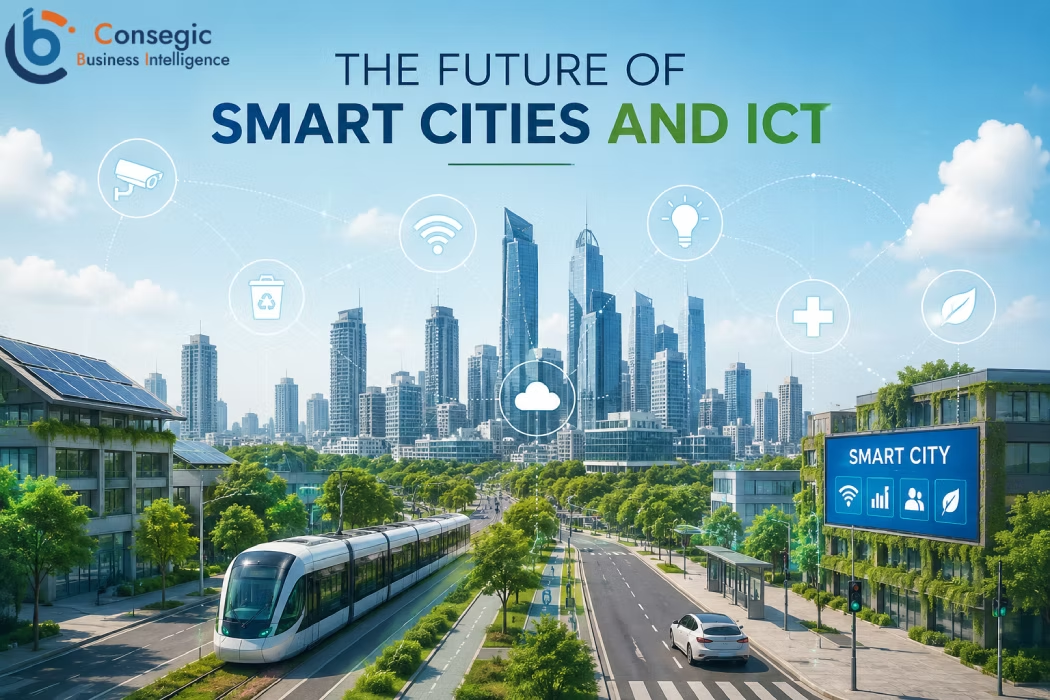
Smart cities can be described as the future of urbanization. Smart cities are based on the integration of ICT in order to make urban life more efficient, sustainable, secure and convenient. Urbanization is associated with increasing pressure on transportation, energy supply, health care, waste management, housing and other areas of public life. It is clear that ICT can provide the necessary infrastructure for solving urban problems. ICT makes possible communication between people, devices, organizations and governments. The technologies used for these purposes include fast communication channels, Internet of Things (IoT), artificial intelligence (AI), cloud computing, big data and others. With the help of all these technologies, cities get an ability to gather and analyze information in real-time mode. For instance, smart traffic systems can monitor traffic jams and adjust traffic lights, and smart energy networks can improve distribution of electricity and reduce its wastage. ICT allows citizens to use various government services through the network. With growing cities, it will be necessary to integrate ICT into urban planning.
Role of ICT in Developing Smart Cities
Information and Communication Technologies (ICTs) form the foundation of smart cities development in the contemporary world since it allows for efficient communication between various urban systems. Using sensors, communication networks, clouds and data analysis tools, municipalities will be able to monitor their infrastructure and act promptly on any changes that may arise. Transportation sector would benefit from the use of intelligent traffic management systems, GPS-enabled public transport, ticketing systems and smart parking systems. In addition, ICT can assist in implementing digital health solutions and connected medical devices which would allow for better access to services and communication between citizens and their healthcare providers. ICT also can be used in energy management sector in the form of smart grids, electricity monitoring and use of renewable energy. Besides, sensors can be employed to monitor waste disposal, water consumption, air quality and lighting systems. Digital government portals would provide residents with an opportunity to access certificates, payments, complaints and other services. Consequently, ICT would allow cities to make better decisions using up-to-date information.
Emerging Technologies Shaping Smart Cities
There are several technologies that will play a significant role in the development of smart cities over the next few years. One of the most essential technologies in this respect is the Internet of Things (IoT). It is a system where sensors, vehicles, buildings, household appliances and other physical devices are linked to digital networks and capable of gathering real-time information about urban environments. Another useful technology that is able to handle large amounts of data and detect any patterns within it is artificial intelligence (AI). As a result, it will be possible to make forecasts of potential problems including traffic jams, energy consumption, equipment malfunctions, etc. 5G wireless networks can provide fast communication and lower latency thus making connected cars and other real-time applications possible. Cloud computing will allow using scalable platforms for storage and processing of huge amounts of data related to cities. Digital twins will be helpful in creating virtual models of buildings, roads and even entire urban areas to conduct experiments without implementing changes physically. Blockchain can possibly provide secure transaction of digital data in some applications.
Benefits and Challenges of Smart City Development
The emergence of smart cities can lead to many economic, social and environmental opportunities. The first benefit is increased efficiency of public services. In real time, one can manage traffic, energy, water, waste and transportation more efficiently. Besides, with the help of smart technologies, it will be possible to save energy and use renewables. Transportation can reduce the traffic jam and the travel time. Moreover, digital government services will increase the efficiency of public administration. Additionally, there can be such positive outcomes for smart cities as improvement of public safety through development of smart healthcare and emergency response systems. Nevertheless, the development of smart cities also raises many problems. First of all, smart projects need financial investment, technical skills and long-term plans. Another problem is that smart cities gather much data from people and infrastructure which means that it is very important to keep data private and secure. Furthermore, there is also a possibility of the digital divide in case low-income and technologically deprived citizens do not have access to digital services. Different systems may also meet the problems of compatibility.
Future Outlook: Towards Smarter and Sustainable Cities
Future developments in the field of smart cities should ensure not just the technological advancements in the urban environment but sustainability, inclusiveness, and citizen-centered approach. ICT should connect different city systems in order to allow government to make decisions based on real-time data and predictions provided by analytics. Transportation systems in future smart cities may include electric and self-driving vehicles as well as intelligent public transport and mobility platforms. Smart buildings would control their own electricity, lighting, and heat and air conditioning in order to minimize their impact on environment. Water and waste management would be optimized by means of sensor technology and AI which would detect leaks and reduce wastage. Citizens would communicate with government by means of digital platforms which would offer personalized services to them. Future developments should take into account such issues as cybersecurity, data protection, accessibility, and digital equality. Innovations should solve real-life urban problems and all stakeholders including government, technology firms, researchers, and citizens should cooperate in the process. ICT developments could help smart cities to become more resilient and sustainable and improve lives of citizens.
Conclusion
Smart cities are one of the most promising trends for the future of urban areas, as ICT forms the core of the construction of more efficient, sustainable, secure, and connected communities. Smart cities technologies include IoT, AI, 5G, cloud computing, big data, and digital twins and are helpful in improving the functioning of transport, health care, energy systems, waste management, security, and government services. At the same time, the development of ICT raises issues associated with investments, cybersecurity, privacy, digital divide, and integration of systems. Consequently, the development of a smart city is not only related to the implementation of innovative technologies but also to making sure that these technologies are accessible, secure, and useful for all residents of the city. Cooperation among government, businesses, technology vendors, scientists, and communities would be necessary.