The global pentane market is witnessing steady growth, driven by its extensive use as a blowing agent, solvent, and chemical intermediate across diverse industries. Pentane, a hydrocarbon belonging to the alkane group, is available in three isomeric forms n-pentane, isopentane, and neopentane, each with unique chemical and physical properties. Due to its volatility, high purity, and eco-friendly characteristics compared to traditional chlorofluorocarbon (CFC) agents, pentane has become a preferred alternative in industrial applications.
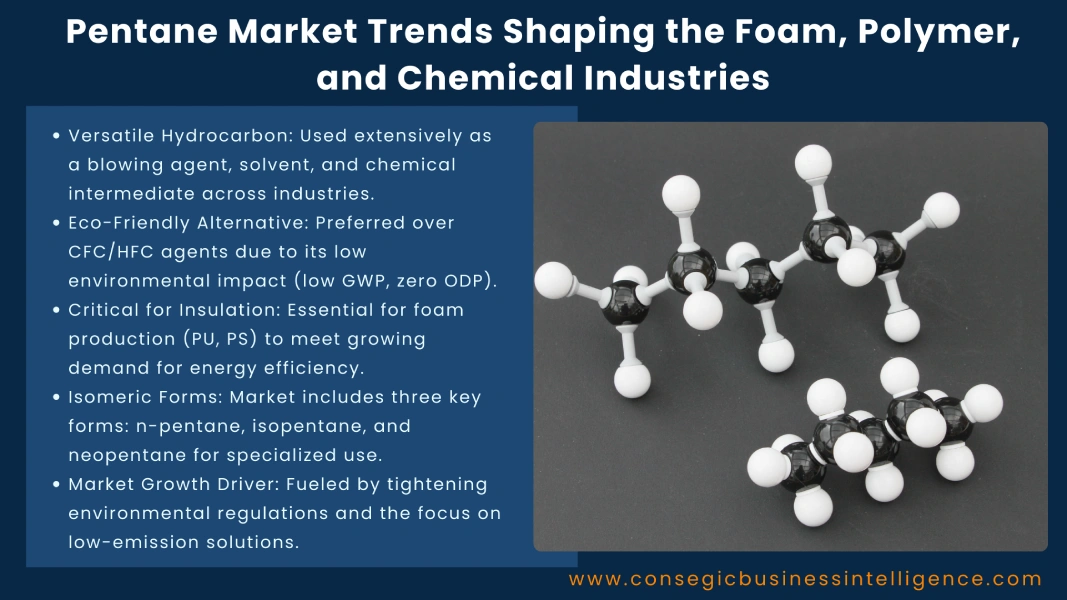
As environmental regulations tighten and industries prioritize energy efficiency and low-emission solutions, the demand for pentane is expanding rapidly across foam production, polymer processing, and specialty chemical manufacturing. In this article, we explore the key trends shaping the pentane market and how its applications are driving innovation in global manufacturing ecosystems.
- Rising Demand in Foam Manufacturing
One of the primary growth drivers in the pentane market is its extensive use as a blowing agent in foam production, particularly in polyurethane (PU) and polystyrene foams. These foams are widely used in insulation, packaging, and refrigeration due to their lightweight, durable, and thermally efficient properties.
Pentane has increasingly replaced ozone-depleting substances like HCFCs and CFCs as a sustainable alternative for foam expansion. Manufacturers prefer n-pentane and isopentane blends for producing rigid and flexible foams used in construction insulation panels, cold storage units, and appliances.
The growing focus on green building initiatives and energy-efficient housing has further boosted pentane consumption in foam insulation. With global construction activities surging, particularly in Asia-Pacific and the Middle East, the demand for pentane-based foams is expected to grow substantially.
- Expanding Applications in Polymer Processing
Pentane is playing a vital role in the polymer industry, particularly in the production and processing of expanded polystyrene (EPS) and polyethylene (PE). As a polymerization solvent and expansion agent, pentane helps achieve uniform cell structure and improved mechanical strength in final polymer products.
EPS, used extensively in packaging, thermal insulation, and lightweight construction materials, relies heavily on pentane as a foaming agent. The material’s growing demand in packaging for electronics, food, and medical supplies is strengthening pentane’s position in the global polymer sector.
Additionally, pentane’s role in polyolefin processing, especially in catalyst preparation for polyethylene and polypropylene has expanded as manufacturers seek solvents with better solubility and low toxicity. As industries transition toward sustainable and high-performance polymers, pentane continues to serve as a critical enabler of production efficiency and quality enhancement.
- Growing Use as a Solvent and Extraction Agent
Beyond foam and polymer applications, pentane serves as an effective solvent and extraction agent in the chemical and pharmaceutical industries. Its non-polar nature and volatility make it ideal for dissolving hydrocarbons, waxes, and oils, as well as for purifying natural extracts.
The cannabis and essential oil industries are notable emerging markets for pentane, where it is used in the extraction of cannabinoids, terpenes, and aromatic compounds. The increasing legalization of medical cannabis and the growing demand for natural fragrances and flavors have fueled pentane’s adoption as a clean and efficient extraction medium.
In laboratories and chemical synthesis facilities, pentane is used for chromatography and compound purification, underscoring its versatility and relevance in modern industrial chemistry. As industries seek safer and more efficient solvents, pentane’s low toxicity and excellent volatility make it a preferred choice.
- Environmental and Regulatory Shifts Favoring Hydrocarbon Blowing Agents
Stringent environmental regulations have been a major catalyst in reshaping the blowing agent’s market. As chlorinated and fluorinated compounds have been phased out under the Montreal Protocol and subsequent amendments, hydrocarbon-based agents like pentane have gained traction as eco-friendly substitutes.
Pentane has a zero-ozone depletion potential (ODP) and relatively low global warming potential (GWP) compared to traditional agents. Manufacturers are increasingly formulating pentane blends optimized for safety, energy efficiency, and performance in insulation and packaging materials.
Moreover, advancements in closed-cell foam technologies and safe handling systems have minimized the risks associated with pentane’s flammability, making it viable for large-scale industrial adoption. The alignment of regulatory policies with sustainability goals continues to propel the market toward hydrocarbon-based solutions like pentane.
- Integration into Energy and Refrigeration Systems
Pentane is emerging as a valuable working fluid in geothermal power plants and organic Rankine cycle (ORC) systems, used for waste heat recovery and renewable energy generation. Its thermodynamic properties make it suitable for converting low-temperature heat into usable electricity, especially in industrial and renewable applications.
In addition, pentane’s role as a refrigerant component in eco-friendly cooling systems is gaining attention. With the global refrigeration industry transitioning to low-GWP alternatives, pentane blends are increasingly incorporated into formulations that meet both performance and environmental criteria.
As energy efficiency and sustainability remain top priorities, the integration of pentane into alternative cooling and power generation systems is expected to expand significantly over the next decade.
- Technological Advancements in Storage and Handling
One of the historical challenges associated with pentane use has been its high flammability. However, ongoing technological advancements in storage, blending, and transportation have mitigated these risks. Modern closed-loop systems, explosion-proof storage tanks, and vapor recovery technologies have improved safety and operational efficiency.
Chemical manufacturers are also adopting automated blending technologies to create customized pentane formulations tailored to specific industrial needs. These innovations not only enhance process control but also ensure compliance with safety and environmental regulations.
With continuous R&D investments, the industry is successfully overcoming operational barriers, paving the way for broader pentane adoption across industrial applications.
- Expansion in Emerging Economies and Industrialization Growth
Emerging economies, particularly in Asia-Pacific, Latin America, and the Middle East, are becoming major growth hubs for the pentane market. Rapid industrialization, expanding infrastructure development, and the growth of the construction and packaging industries are boosting pentane demand.
Countries such as China, India, and Indonesia are investing heavily in housing, refrigeration, and automotive manufacturing, all key sectors utilizing pentane-based materials. Meanwhile, growing domestic chemical industries in these regions are fostering partnerships with global suppliers to secure reliable pentane availability.
The cost-effectiveness and versatility of pentane make it an attractive solution for developing economies seeking sustainable industrial growth without compromising efficiency or safety.
- Innovations in Blending and Product Development
Manufacturers are continuously developing optimized pentane blends to improve performance and meet specific industry requirements. For instance, n-pentane and isopentane mixtures offer enhanced insulation properties in foam production, while neopentane-based formulations provide superior stability for specialized chemical applications.
Additionally, innovation in bio-based pentane production from renewable feedstocks is gaining momentum as part of the chemical industry’s decarbonization efforts. Research into green synthesis routes aims to reduce the carbon footprint associated with conventional hydrocarbon production while maintaining cost and performance advantages.
Such advancements are positioning pentane not only as a traditional industrial solvent but as a key component of the sustainable materials ecosystem.
Conclusion
The pentane market is undergoing dynamic transformation, propelled by its expanding role across the foam, polymer, and chemical industries. As sustainability, efficiency, and performance take center stage, pentane’s versatility and eco-friendly properties make it indispensable in modern industrial processes.
From insulation materials and polymer foams to solvent extraction and clean energy systems, pentane continues to shape the evolution of manufacturing and environmental innovation. With growing regulatory support, technological progress, and industrial diversification, the global pentane market is poised for strong and sustained growth, cementing its position as a cornerstone of the next generation of sustainable industrial materials.