In 2025, central banks around the world have made a notable shift in monetary policy by cutting interest rates more aggressively than they have in years. This trend, which marked the largest global easing cycle in over a decade, wasn’t limited to one country or region but it spanned major economies, including the U.S., Europe, and several emerging markets.
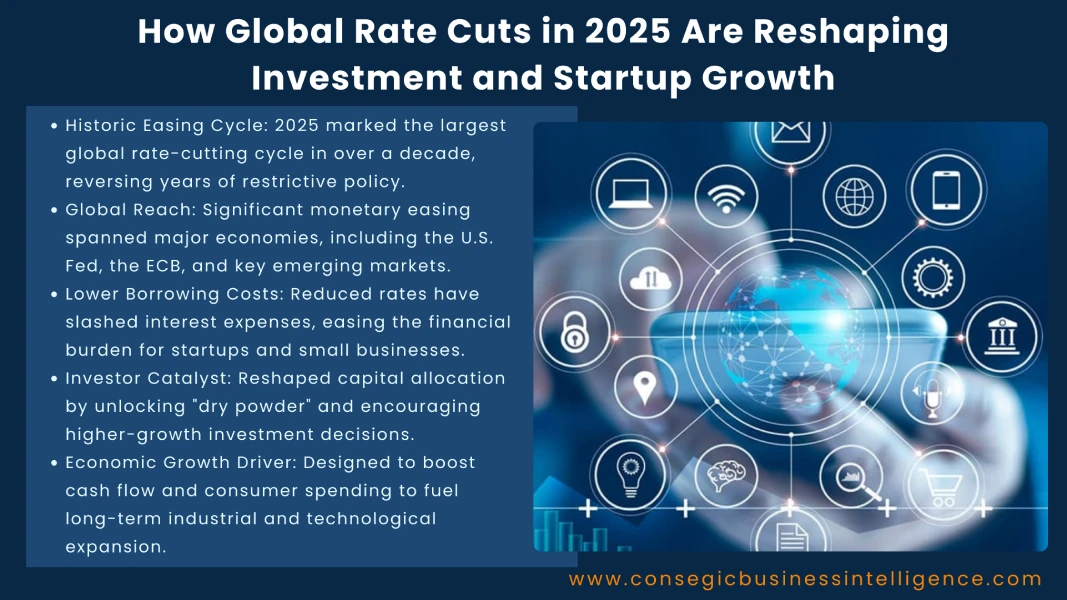
These rate cuts are significant because interest rates influence how money flows through the economy. For investors, startups, and businesses of all sizes, lower interest rates can lift borrowing activity, reduce costs, and reshape how capital is allocated. In this blog, we break down what these rate cuts mean in simple terms and how they are reshaping investment decisions and startup activity around the world.
What Are Rate Cuts and Why Do They Matter?
Interest rates, set by central banks like the U.S. Federal Reserve or the Bank of England, represent the cost of borrowing money. When central banks cut these rates, borrowing becomes cheaper for individuals, businesses, and investors.
Globally in 2025, many central banks implemented rate cuts to support economic growth after periods of high inflation and tighter monetary policy. For example, the Federal Reserve reduced its benchmark rate to around 3.50%–3.75% by late 2025, reflecting a broader trend of easing monetary conditions.
Lower rates matter because they can influence investment, access to capital, and overall business confidence. Let’s look at how these changes are affecting markets and startups.
- Cheaper Borrowing Encourages Investment Activity
When borrowing costs fall, companies and investors are more willing to take on debt to finance growth initiatives. For startups and early-stage businesses, this can be a game changer because access to affordable capital makes expansion, hiring, and product development more feasible.
Lower rates typically mean banks and lenders offer loans at lower interest charges, which encourages businesses to invest in new projects they might have postponed otherwise. This liquidity boost increases the amount of money flowing through the economy and can fuel a positive feedback loop of activity and confidence.
For startup founders, this translates into better terms for lines of credit, equipment financing, and even bridging loans that help sustain operations during growth phases.
- Venture Capital and Startup Funding Trends
Startup ecosystems are highly sensitive to the direction of interest rates. Historically, lower interest rates tend to support stronger venture capital (VC) activity. That’s because investors seeking higher returns may shift money away from low-yield bonds and savings instruments into riskier, potentially higher-return startup investments.
In 2025, data showed a rise in seed and early-stage valuations, with the median valuation for primary seed rounds increasing significantly compared to previous periods. This suggests that investors were more willing to back innovative ideas in a softer rate environment, despite broader market volatility.
For startups, this shift means access to more capital at earlier stages, potentially at higher valuations. It also encourages more founder activity and idea generation as funding becomes more accessible.
- Effects on Consumer Demand and Market Growth
Rate cuts don’t just affect borrowing but they also influence consumer behaviour. Lower interest rates generally reduce monthly payments on loans and mortgages, putting more money into consumer’s hands. This further increases spending on goods and services, which is good for businesses across sectors.
Furthermore, higher spending can, in turn, boost startup revenue models, especially for consumer-focused companies whose growth depends on steady customer demand. It also encourages established companies to invest in digital solutions, partnerships, and new ventures that further stimulate innovation ecosystems.
- Risk of Asset Price Inflation and Market Volatility
While rate cuts can power investment and growth, they are not without trade-offs. One common effect is asset price inflation, where stocks, real estate, and other financial assets rise in value, sometimes beyond what fundamentals justify.
In 2025, markets experienced notable volatility and record highs in certain indices, suggesting a potential mix of enthusiasm and caution among investors.
This dynamic can create a feedback loop, where investors chase higher returns in tech and growth stocks, while startup valuations rise even if corporate earnings or economic growth don’t align perfectly. While this can benefit startups in the short term, it also raises questions about long-term sustainability and risk.
- Impact on Bank Lending and Liquidity for Startups
Commercial banks often follow the direction of central bank policy when setting lending rates for business loans. As rates fall, lines of credit and other financing tools become more affordable.
For many startups, especially in early stages where cash flow can be tight, benefiting from lower business loan rates helps unlock growth that might otherwise be stifled. Even when lending conditions are cautious, the general sentiment of easier monetary policy can encourage banks to relax credit standards slightly, boosting access to capital.
- Encouraging Strategic Investment in Technology and Innovation
Across industries, businesses are also using rate easing as an opportunity to invest in technology, digital transformation, and future capabilities. With cheaper borrowing, companies can fund projects like automation, cloud migration, and data analytics areas that support long-term competitive advantage.
For startups in deep tech, AI, and green innovation sectors, this environment offers a supportive backdrop for experimentation and commercialization. Even though broad economic uncertainty may linger, access to capital and strategic investment become more achievable.
Conclusion
The global rate cuts of 2025 have done more than adjust interest rates, they have helped shape how capital flows through markets, how investors behave, and how startups plan for growth. By lowering the cost of borrowing, central banks have supported investment activity, venture capital interest, consumer demand, and strategic business spending.
While challenges like market volatility and asset inflation remain, the overall landscape is more favourable for growth and innovation than it might have been in a higher-rate environment. For startups and investors alike, navigating this landscape with thoughtful strategies, sound financial planning, and a clear understanding of risk will be key to success in the new rate-cut era.