The colorectal cancer (CRC) solutions are witnessing robust growth, driven by advancements in diagnostic technologies, precision medicine, and targeted therapies. Colorectal cancer is one of the most common malignancies worldwide, which continues to pose significant public health challenges. However, recent innovations in screening, early detection, and personalized treatment approaches are revolutionizing patient outcomes and reshaping the global healthcare landscape.
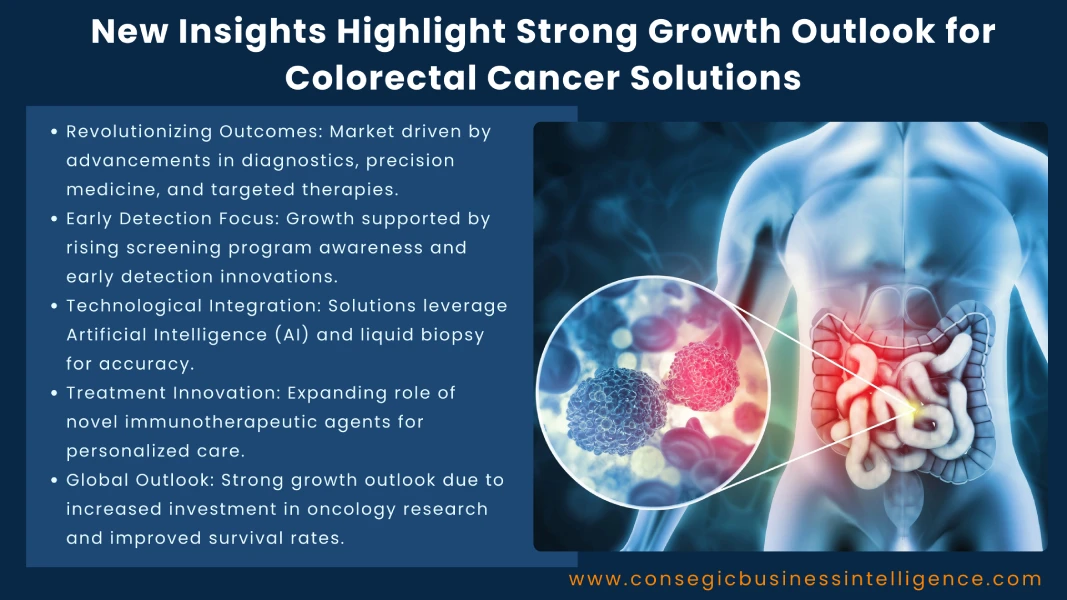
This expansion is further supported by rising awareness, government screening programs, and increasing investment in oncology research. With the integration of artificial intelligence (AI), liquid biopsy, and novel immunotherapeutic agents, colorectal cancer solutions are becoming more accurate, effective, and accessible.
This blog explores the latest insights and developments that highlight a strong growth outlook for the global colorectal cancer solutions covering diagnostics, treatment innovations, and evolving healthcare strategies that are improving survival rates and quality of life.
- Rising Prevalence and Growing Global Awareness
The increasing incidence of colorectal cancer, particularly in developed and transitioning economies, has heightened the need for comprehensive prevention and treatment solutions. According to the World Health Organization, CRC ranks among the top three most frequently diagnosed cancers globally.
Changing lifestyles characterized by sedentary habits, dietary imbalances, and obesity have been key contributors to the disease’s rising prevalence. However, greater awareness of early symptoms, such as bowel irregularities and rectal bleeding, has encouraged more individuals to seek screening and medical consultation.
Furthermore, governments and healthcare organizations are implementing nationwide colorectal screening programs aimed at early detection. These initiatives, coupled with public education campaigns, are driving higher adoption of diagnostic and preventive healthcare solutions, creating a positive ripple effect across the globe.
- Technological Advancements in Screening and Diagnostics
Early detection remains the cornerstone of effective colorectal cancer management, and new technologies are transforming the diagnostic landscape. Traditional colonoscopy, though still the gold standard, is increasingly complemented by non-invasive and AI-driven diagnostic tools that improve accessibility and accuracy.
One major breakthrough is the use of liquid biopsy, which allows detection of circulating tumor DNA (ctDNA) in blood samples, enabling early-stage diagnosis and treatment monitoring without invasive procedures. Similarly, fecal immunochemical tests (FIT) and multi-target stool DNA tests have gained popularity for population-level screening.
Artificial intelligence is enhancing endoscopic imaging by identifying polyps and lesions with greater precision, reducing human error and improving diagnostic outcomes. These innovations are making colorectal screening more efficient, patient-friendly, and cost-effective, key factors that support broader adoption.
- Precision Medicine Driving Personalized Treatment
The rise of precision medicine is reshaping the treatment landscape for colorectal cancer. Genetic and molecular profiling now enable oncologists to tailor therapies based on specific tumor characteristics, improving efficacy and minimizing side effects.
Advances in next-generation sequencing (NGS) have identified key genetic mutations such as KRAS, NRAS, and BRAF that influence treatment response. This allows clinicians to design personalized regimens using targeted therapies like cetuximab and bevacizumab, which inhibit cancer cell growth and angiogenesis.
Furthermore, the integration of companion diagnostics is enhancing treatment selection, ensuring that patients receive the most appropriate drugs for their tumor profile. The synergy between genomic research and clinical practice is driving the shift from generalized treatment toward precision-based oncology care.
- Immunotherapy Revolutionizing Colorectal Cancer Care
Immunotherapy has emerged as a game-changing approach in colorectal cancer treatment, particularly for patients with microsatellite instability-high (MSI-H) and mismatch repair-deficient (dMMR) tumors. Drugs such as pembrolizumab (Keytruda) and nivolumab (Opdivo) have shown remarkable success in activating the immune system to target cancer cells.
Recent clinical trials have demonstrated improved survival outcomes for patients treated with immune checkpoint inhibitors, establishing immunotherapy as a standard care option for advanced-stage disease. Ongoing research aims to expand immunotherapy’s effectiveness to microsatellite-stable (MSS) colorectal cancers, which currently represent the majority of cases.
The development of combination regimens, pairing immunotherapy with chemotherapy, targeted therapy, or radiation is showing promise in overcoming resistance and improving treatment durability. As clinical data continues to accumulate, immunotherapy is expected to play an increasingly central role in the global CRC treatment paradigm.
- Growth in Minimally Invasive and Robotic Surgery
Surgical advancements are another critical factor shaping the future of colorectal cancer management. Minimally invasive techniques, including laparoscopic and robotic-assisted surgeries, are now widely used to improve precision, reduce recovery time, and minimize postoperative complications.
Robotic systems enable surgeons to operate with enhanced accuracy and visualization, leading to better patient outcomes. The adoption of image-guided surgery and intraoperative navigation technologies is also improving tumor resection success rates.
With hospitals worldwide investing in advanced surgical infrastructure, these technologies are making complex colorectal surgeries safer and more efficient. As minimally invasive procedures become the global standard, their integration with preoperative imaging and post-surgical monitoring will further strengthen the treatment ecosystem.
- Integration of Artificial Intelligence and Digital Health Solutions
The role of artificial intelligence (AI) and digital health technologies in colorectal cancer care continues to expand. AI-powered tools are being used to assist pathologists in identifying cancerous tissues, analyze genetic data, and predict patient prognosis.
Digital health platforms enable remote patient monitoring, ensuring that treatment adherence and symptom management are maintained even outside clinical settings. Telemedicine has become particularly vital for ongoing follow-ups, providing patients with continuous support and reducing healthcare costs.
Moreover, the integration of big data analytics is improving population health management by identifying at-risk groups and optimizing resource allocation for screening programs. The digital transformation of colorectal cancer care is streamlining workflows and enhancing collaboration across multidisciplinary teams.
Conclusion
The colorectal cancer solutions stand at the forefront of medical innovation, offering a dynamic mix of advanced diagnostics, precision treatments, and patient-centered care. From AI-powered screening and liquid biopsy technologies to immunotherapy and robotic surgery, the landscape is rapidly evolving toward more effective and personalized solutions.
Backed by strong research investments, expanding healthcare access, and growing public awareness, the growth trajectory of these solutions is set to accelerate over the next decade. As innovation continues to redefine prevention, detection, and treatment paradigms, colorectal cancer care is transitioning into a new era, one marked by precision, accessibility, and hope for improved survival outcomes worldwide.
FAQs about Colorectal Cancer Market:
- What is the market size of Colorectal Cancer Market?
The Colorectal Cancer Market size is growing with a CAGR of 3.7% during the forecast period (2023-2031), and the market is projected to be valued at USD 26,111.69 Million by 2031 and USD 19,530.85 Million in 2023 from USD 18,944.00 Million in 2022.
- What factors are driving the growth of colorectal cancer solutions?
Advancements in diagnostics, precision medicine, immunotherapy, and AI integration are major factors propelling the growth of colorectal cancer solutions globally. - How is artificial intelligence improving colorectal cancer diagnosis?
AI enhances endoscopic imaging accuracy, identifies polyps with precision, and reduces diagnostic errors, making screening faster and more reliable. - What role does precision medicine play in colorectal cancer treatment?
Precision medicine tailors therapies based on a patient’s genetic and molecular tumor profile, improving treatment effectiveness and minimizing side effects. - How is immunotherapy transforming colorectal cancer care?
Immunotherapy drugs like pembrolizumab and nivolumab activate the immune system to target cancer cells, significantly improving outcomes for advanced-stage patients.