Understanding the Role of Industrial Chemicals
Industrial chemicals are chemicals which have been manufactured or processed for the purpose of use in industries, commerce, and manufacturing. Industrial chemicals are extremely important in the manufacture of various products, improvement of processes involved in production and for large scale production of goods. The types of industrial chemicals include solvents, acids, alkalis, polymers, gases, catalysts, dyes, adhesives and specialty chemicals among others.
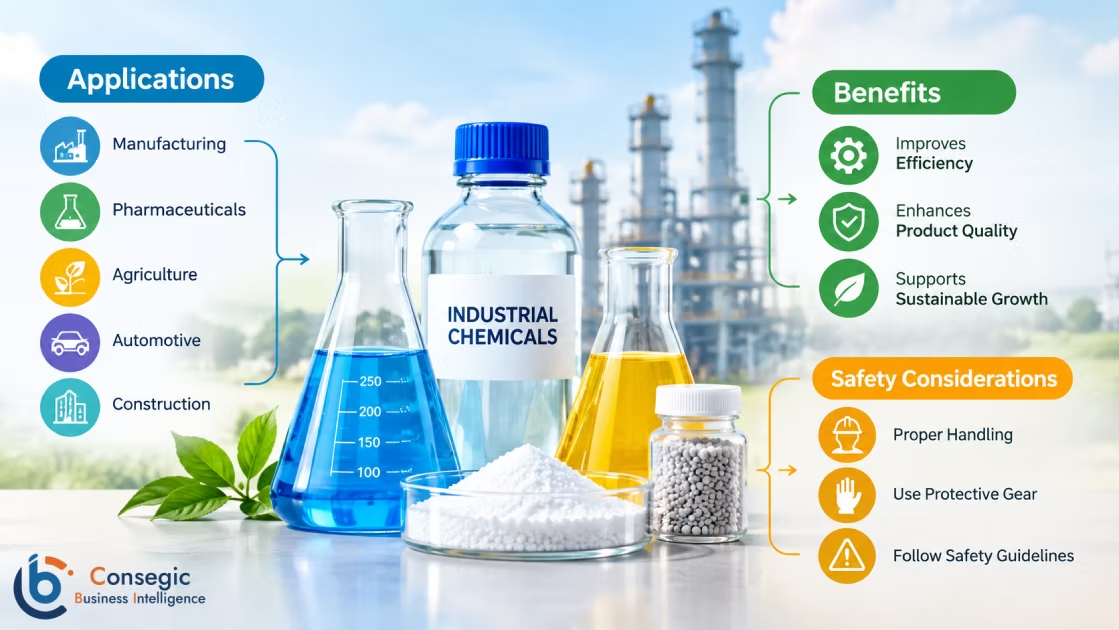
Pharmaceuticals, agricultural, construction, automotive, food processing, textile, electronic and energy industries, among other, use industrial chemicals in different stages of production of goods. Chemicals may be used for cleaning, reaction control, preservation of raw materials, improving performance of products and creation of new chemicals. Uses of industrial chemicals vary from simple processing to sophisticated processing with complex chemical reactions.
The increased demand of industrial chemicals is associated with the process of industrialization and technology improvement as well as effective means of production. Nevertheless, their uses should be coupled with proper handling and storage. The chemicals may be potentially hazardous to health and environment or even be a source of fire hazard. Thus, one should know their applications, advantages and special characteristics.
Major Applications of Industrial Chemicals Across Industries
Industrial chemicals find use in many different industries owing to their various chemical and physical properties that suit the needs of manufacture and processing. In the pharmaceutical industry, chemicals help in creating active substances, drugs, coatings, and cleaning agents. Agriculture involves the use of fertilizers, pesticides, herbicides, and other chemicals required to support crop growth and fight off plant pests and diseases.
Construction uses industrial chemicals in cement additives, paints, coatings, adhesives, sealants, insulation, and concrete treatments. Chemicals are used in the automotive industry as lubricants, coolants, paints, plastics, rubber parts, batteries, and surface treatments. Textile manufacturing involves the use of chemicals for processes like dyeing, bleaching, finishing, and treatment of fabrics.
Electronics manufacturing is one of the most advanced applications of industrial chemicals, requiring very specialized chemicals in semiconductor manufacturing, circuit board manufacturing, cleaning, etching, and surface treatments. Food processing uses selected chemicals in sanitation, water treatment, processing, and preservation, provided that the laws permit.
Because each industry requires different technical specifications, the choice of chemical will be based on purity, concentration, compatibility, performance, and intended use.
Key Benefits of Industrial Chemicals in Modern Manufacturing
Industrial chemicals offer a number of benefits which make it possible for the producers to optimize the performance, increase efficiency, and improve the quality of the goods. Firstly, chemicals enable precise manufacturing processes by accelerating reactions, temperature control, removal of impurities, and altering the properties of the material.
Additionally, chemicals are able to increase durability and the functionality of the finished product. Thus, various chemicals may protect the material from corrosion, humidity, high temperatures, and harmful substances. Moreover, industrial chemicals make the manufacturing materials more flexible, strong, resistant to thermal conditions and wear-and-tear. Besides, special cleaning chemicals may clean machines and components which are exposed to manufacturing processes.
Furthermore, industrial chemicals enable process optimization through catalyzing the chemical reactions and making certain manufacturing processes controllable through the help of solvents and other processing chemicals. Industrial chemicals can be used for producing advanced materials which are used in electronics, renewable energy sector, health care, transportation, and other industries.
Nevertheless, these benefits can be gained only with proper selection and control of the chemicals use. Proper storage, management, dosing, and disposal of the chemicals are required.
Types of Industrial Chemicals and Their Functional Uses
There are many categories of industrial chemicals that are defined by various features of these compounds. There are acids and alkalis that are applied in different processes such as cleaning, pH adjusting, metal working, and chemical processing. Another group of industrial chemicals is solvents that are applied for dissolving, extracting, cleaning, and processing of substances.
Polymers and resins are used in production of plastics, coatings, adhesives, insulating materials, packaging, composites, etc. There are also some industrial gases like oxygen, nitrogen, hydrogen, carbon dioxide, and others that are used in welding, food processing, chemical production, metal forming, energy systems, and other processes. Catalysts are used in order to speed up the chemical reaction but are not involved in reaction themselves.
Specialty chemicals are another category of chemicals. These products have special properties and functions and are developed for some specific purposes. Specialty chemicals may include surfactants, corrosion inhibitors, flame retardants, dyes, pigments, and other performance additives. They can be used in water treatment, manufacturing of personal care products, electronics and other processes.
The selection of the correct chemical depends on the performance needs, its compatibility with other substances, operating conditions, and other factors.
Safety Considerations for Handling and Using Industrial Chemicals
Safety is another critical component of chemical management in industries since some chemicals are potentially risky if there is exposure to them, inadequate storage, chemical reactions, fire or environmental contamination. When a chemical is being used, the user needs to know all the characteristics, hazards, safety precautions, and procedures of the substance. The SDS give valuable information on the potential hazards, protective gear, first aid instructions, storage, transportation, and response measures.
Proper labeling and storage are also very vital. Chemicals need to be stored in proper containers with storage conditions appropriate for the particular chemical. In addition, incompatible chemicals must be stored away from each other so as not to react with each other in case of leakage. Appropriate ventilation facilities must also be put in place in order to be able to deal with any leakages.
The use of personal protective equipment like gloves, proper clothing, safety goggles and masks where necessary also reduces occupational exposure to such chemicals. The personnel must also be trained on how to handle the chemicals before they can actually do it.
Disposal of such chemicals is equally very important since improper discharge of chemicals into the environment has effects on the soil, water, air, and the ecosystem around that area.
Conclusion
The application of industrial chemicals is crucial for today’s manufacturing process and many other sectors including but not limited to pharmaceuticals, agriculture, electronics, construction, and vehicle manufacturing. The fact that they can help to increase the quality of a product, improve its performance and processes, and allow advanced manufacturing make them highly valuable industrial resources. At the same time, all these advantages should be balanced with proper chemical management which includes such aspects as selection, labeling, storage, handling, protection equipment, worker training, and disposal. With further adoption of advanced technologies and processes in industries, knowledge of both advantages and safety aspects of industrial chemicals becomes crucial.