A new era of technological transformation is at our doorstep, with many of these new changes expected in the coming decade, including breakthroughs in fields such as artificial intelligence, cloud computing, the internet of things, which are all contributing to the new way we are living and working. The next evolution, however, is expected to be even more remarkable than previous years, with three emerging technologies: Quantum Computing, Robotics, and 6G connectivity, all working towards defining new industries, economies, and our very everyday existence. While on their own these technologies are massive advancements in themselves, together these will have the potential to create entirely new digital systems where machines operate faster, communicate faster and operate in a way that none could have previously predicted. While many of these advancements are in the very early stages, many experts believe these changes will be evident by the mid-21st Century.
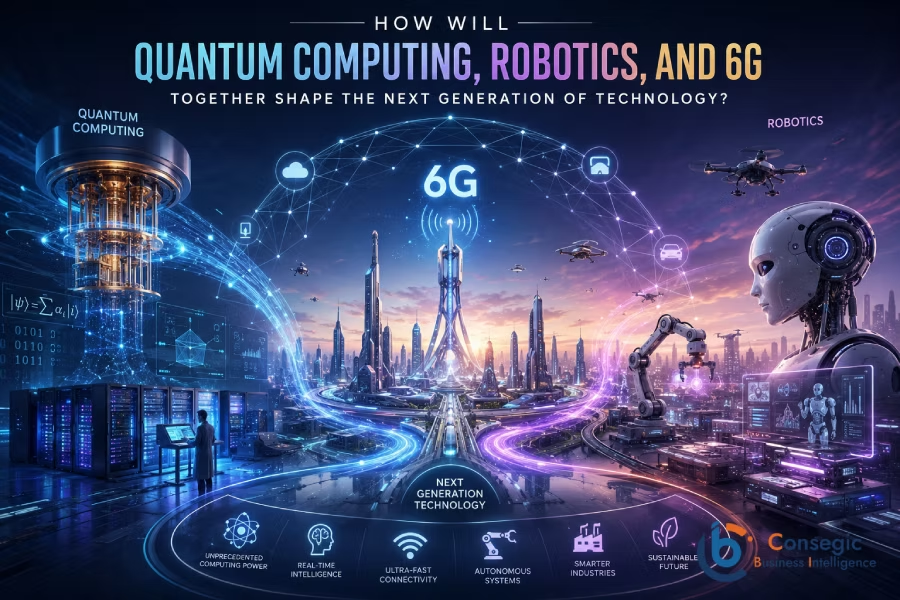
Understanding the Three Technologies
Each technology has a specific function and it is important that we understand the core function of each in relation to one another. The three key technologies in this technological revolution are the following: -
Quantum Computing: Quantum Computing is a system of computing that allows complicated algorithms to be processed at tremendous speeds through the use of quantum mechanics. Whereas normal, classical, computers process information in bits, where a bit is either a 0 or a 1, a Quantum Computer uses a Qubit. A Qubit can be simultaneously set to any one of a number of different states at a single time, thus making it incredibly powerful and able to process large amounts of information at high speeds.
Robotics: Robotics is the development of sophisticated machines that can perform actions either autonomously, or with the assistance of minimal human intervention. Modern robots are being implemented across the manufacturing industry, medical sectors, logistics, agriculture, and many more.
6G: This represents the newest generation of wireless communication beyond 5G. Although currently under development, 6G networks will achieve faster speeds, extreme low-level delays and a wider array of connectivity devices. All three these technologies can create an intelligent network unlike any seen today.
Why could 6G become a Foundation?
Ultimately, all technology requires a method to successfully transfer and process information, which 6G seems to do effectively. Previous advancements such as 5G networks were able to dramatically improve speed and connectivity of many technologies, but future technologies such as 6G and robotics will require an even higher level of speed. Future networks are predicted to allow for large volumes of data to be transmitted instantly between all machines, vehicles and devices. Imagine a future society with driverless cars, delivery robots, AI's and more, all communicating and collaborating with one another without lag. This could allow for a safer future as a direct consequence of reducing the likelihood of errors and accidents. The capabilities of 6G will be what gives quantum computers and robots the connectivity they need to operate at their optimum level.
The Role of Quantum Computing in Problem Solving
The primary limitation of the computers available today is the ability to execute extremely complex calculations instantly, with problems such as the identification of drugs, analyzing climate change and financial prediction requiring large quantities of computational power. Quantum Computing technology has the potential to remove the limitations currently presented.
Pharmaceutical research could be dramatically sped up as a result, whilst it can also provide optimization solutions in logistics. Climate modeling could be enhanced with highly accurate models in the future to explain environmental changes, and this can only improve as they are paired with robotic technology, allowing for real-time calculation on how to improve efficiency.
The Evolution of intelligent robots
Robots have already entered our workplaces and homes and while the robots of today are helpful, the robots of the future will have advanced sensors and AI to aid in more complex tasks and calculations. The advanced machinery will have an increased level of autonomy and will continue to develop how they learn from environments and interact with humans more efficiently. Industries will become more flexible as robotic automation adapts to new production challenges, medicine will see increased patient recovery time through robotic aid and farming can be enhanced with intelligent machinery making agriculture more precise and less wasteful.
The Power of integrating all three technologies
The most radical changes will undoubtedly come from the merging of the three. Envision a smart factory where the robotic workers have the data fed to them from complex algorithms derived from quantum computers to help optimize each of their tasks in real time to maximize the efficiency of the operation whilst minimizing waste, with all the data being transmitted to and from machines via high-speed, low-delay 6G connections.
The potential in medicine is similar: surgical robots can achieve more complex and delicate procedures with the real-time assistance from sophisticated quantum computing analysis and hospitals can further improve the speed of disease diagnosis by rapidly processing medical data using quantum computers and distributing it quickly and securely across hospital networks.
Transforming Industries Across the Economy
The effects of these technological advancements are predicted to be far-reaching and include:
Increased productivity and decreased costs in manufacturing sectors through smart, collaborative robots.
Drug discovery and personalised medicine will be transformed through the application of quantum computing, and the use of intelligent surgical robots.
Enhanced risk assessment capabilities in the financial sectors through quantum computing and rapid communication via 6G.
More accurate methods of farming with automation using smart robots, quantum-based analysis and 6G connectivity.
More immersive educational programs for individuals through smart learning environments and robotic tutors operating on 6G networks.
It is undeniable that there is huge potential but challenges such as stability and cost will have to be overcome before large-scale implementation can occur, but it is undeniable that this future could bring a wealth of new possibilities to our world. <.p>
The Future ahead
By 2030, the integration of all three systems will see machines becoming incredibly intelligent in integrated and connected networks allowing them to adapt to various environments at unprecedented speeds. Services such as healthcare will become far more precise and personalized as a direct result of these advancements; transportation will become far safer, and industries can expect significant improvements in efficiency. These new discoveries and advancements mean the pace of progress will continue to accelerate at an exponential rate.