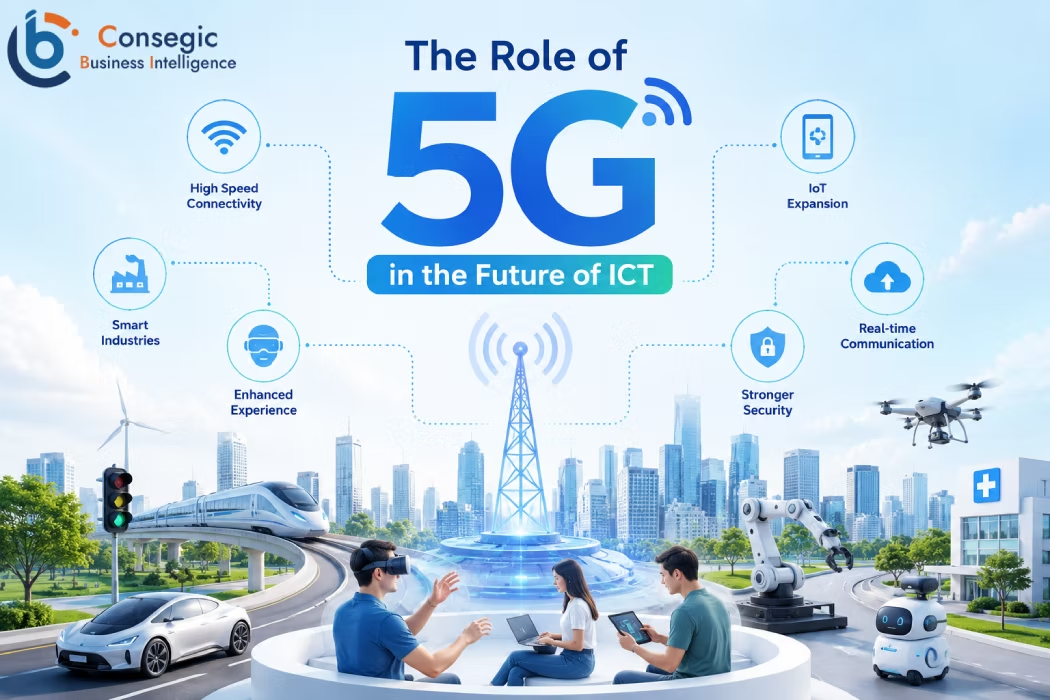
The fifth generation of the wireless communication technology, referred to as 5G, changes the Information and Communication Technology (ICT) industry by delivering faster speeds, lower latencies, higher capacity, and enhanced connectivity. In contrast to previous generations of mobile networks, 5G is capable of not only working with smartphones, but also with other kinds of connected devices, machines, vehicles, and even factories. The high capacity of 5G to process large amounts of data in real-time creates the basis for the digital economy. As businesses and states turn to such innovations as cloud computing, artificial intelligence, the Internet of Things (IoT), automation, and other advanced technologies, the need for a reliable, high-speed connectivity has emerged. With 5G technology, this requirement is met by creating the possibility of communication between systems and devices. Besides the above advantages, 5G is believed to enhance the remote work, smart cities, digital healthcare, connected transport, and industrial automation. Thus, through speed, reliability, and scalability, 5G becomes one of the key technologies of the future of ICT.
Evolution and Key Features of 5G Technology
Mobile communications have evolved through several generations, and each new generation brought major improvements. 1G provided analog voice service, while 2G provided digital communication services and SMS. 3G offered improved mobile internet and 4G – fast broadband communication that supports video streaming, social media, and applications. 5G will be the next generation of mobile communications focused on high-performance, intelligent connectivity, and massive connectivity of many devices. The first feature of 5G is increased speed of data transfer. Thanks to 5G, large files and multimedia can be transferred very fast. The second major advantage of 5G is low latency, which will be crucial for applications that require real-time reaction, such as autonomous cars, remote operation, and industrial robotics. Massive device connectivity is another major characteristic of 5G that will allow the network to support thousands of IoT devices at the same time. Network slicing will let the operator customize a network for specific needs. There are other features of 5G such as improved reliability, capacity, and energy efficiency of the network.
Impact of 5G on ICT Infrastructure and Connectivity
5G will transform ICT infrastructure through enhancing communication between various devices, networks, data centers, and cloud platforms. Due to high bandwidth and lower latency levels, information will flow much faster among inter-connected systems. This will be of benefit to firms operating on cloud computing, edge computing, virtual collaboration, and intensive data processing. 5G will also enhance Internet of Things (IoT) as well as making it easier for sensors, machines, appliances, and other devices to communicate. For example, in a smart city environment, 5G will enable inter-communication within the infrastructure to create smart traffic management, public transport, environmental monitoring, and smart utilities. In industries, 5G technology will enhance connection between machines and production processes in order to facilitate monitoring and automation process. 5G will further enhance edge computing through enabling data processing close to where the data is generated, hence ensuring reduced time lag and enhanced performance. Besides, 5G will enhance connectivity in regions where wired infrastructure cannot easily be set up due to financial and logistical constraints. Therefore, as firms continue migrating towards digitalization and connectivity, it is expected that 5G technology will become an important part of ICT infrastructure and network architecture.
Applications of 5G in Emerging Technologies
The importance of 5G in the facilitation of new technological innovations is due to the fact that 5G offers high-speed internet, low latency, greater network capacity, and communication reliability. This makes advanced technologies work effectively and in real time. The major applications of 5G technology in the emerging technologies are:
Internet of Things (IoT): 5G can connect many IoT devices, sensors and machines simultaneously. This supports smart homes and connected industries, smart cities and real-time monitoring systems.
Artificial Intelligence (AI) - 5G enables the fast transfer of the large amount of data to the systems that use AI. This will help in improving the decision making capabilities, intelligent automation and AI-driven services.
Augmented Reality (AR)/Virtual Reality (VR): To achieve a full experience of augmented reality and virtual reality in gaming, learning, training, entertainment and collaboration applications, low latency and high bandwidth of 5G is required.
Smart Healthcare: 5G can help in remote patient monitoring, medical device connectivity, telemedicine and better doctor patient communication.
Autonomous vehicles: In future, cars would be connected and would communicate with each other and also with the infrastructure that helps in controlling the traffic in order to facilitate efficient transportation.
Smart manufacturing: 5G technology would provide means to connect the industrial robots, sensors and machinery, thus giving the opportunity for automation, predictive maintenance and factory automation.
Edge computing: The combination of 5G with edge computing would facilitate the process of data processing at the source itself.
Smart cities: 5G can help with smart traffic management, connected public services, smart energy solutions, surveillance and environment monitoring applications
Future Opportunities and Challenges of 5G in ICT
The future outlook of 5G in ICT is associated with various opportunities but also includes certain challenges. With the growth of network coverage, companies may use connected devices, automation, AI, edge computing, and real-time data analysis to create new digital services. Thus, industries, like manufacturing, healthcare, transport, agriculture, logistics, and retail, will be able to use 5G technologies to boost their efficiency, decrease delays and offer better experiences to customers. Besides, 5G can help create the concept of smart city. Nevertheless, there are several challenges that arise from the future of 5G in ICT. The implementation and maintenance of 5G networks require great investments in infrastructure, namely the construction of base stations, fiber connections, spectrum and appropriate equipment. Moreover, cybersecurity and privacy are crucial issues due to the fact that the greater number of connected devices creates additional vulnerabilities to cyberattacks. It is essential to enhance security and protect sensitive data. Another challenge is that coverage can differ from urban to rural area, and this fact may result in digital inequality. Finally, such factors as device compatibility, energy consumption, regulation and availability of spectrum should be taken into account.
Conclusion
The 5G technology is anticipated to contribute immensely to the evolution of Information and Communication Technology with fast, dependable, and responsive connectivity. The technology’s abilities are capable of facilitating the increasing applications of IoT, artificial intelligence, edge computing, smart healthcare, self-driving cars, and smart manufacturing. By facilitating more efficient communication among devices and machines, the 5G can assist businesses in improving efficiency, innovation, and creation of digital products and services. Nevertheless, there are issues that must be overcome for the success of the implementation of the 5G technology such as cost, security concerns, privacy issues, rural connectivity, energy, and regulations. On the whole, the 5G technology is much more than an improvement in mobile communication but a key component for the digital ecosystem.